Environment Model 1. To evaluate a combination: evaluate - - PDF document

environment model 1 to evaluate a combination evaluate
SMART_READER_LITE
LIVE PREVIEW

Environment Model 1. To evaluate a combination: evaluate - - PDF document

Environment Model 1. To evaluate a combination: evaluate subexpressions then apply value of operator subexpression to values of operand subexpressions. 2. Value of a variable w.r.t. an environment is the value given by the binding of the


slide-1
SLIDE 1

1

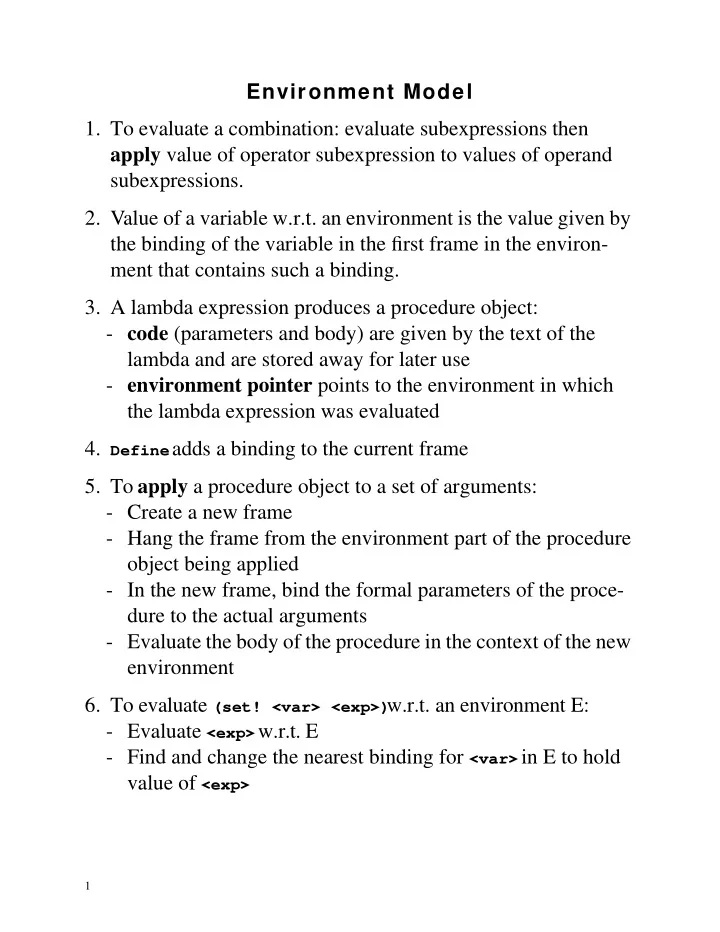
Environment Model

  • 1. To evaluate a combination: evaluate subexpressions then

apply value of operator subexpression to values of operand subexpressions.

  • 2. Value of a variable w.r.t. an environment is the value given by

the binding of the variable in the first frame in the environ- ment that contains such a binding.

  • 3. A lambda expression produces a procedure object:
  • code (parameters and body) are given by the text of the

lambda and are stored away for later use

  • environment pointer points to the environment in which

the lambda expression was evaluated

  • 4. Define adds a binding to the current frame
  • 5. To apply a procedure object to a set of arguments:
  • Create a new frame
  • Hang the frame from the environment part of the procedure
  • bject being applied
  • In the new frame, bind the formal parameters of the proce-

dure to the actual arguments

  • Evaluate the body of the procedure in the context of the new

environment

  • 6. To evaluate (set! <var> <exp>)

w.r.t. an environment E:

  • Evaluate <exp> w.r.t. E
  • Find and change the nearest binding for <var> in E to hold

value of <exp>

slide-2
SLIDE 2

2

Use and Mis-Use of Set!

;; Functional programming style (define (factorial n) (define (iter product counter) (if (> counter n) product (iter (* counter product) (+ counter 1)))) (iter 1 1)) ;; Imperative programming style -- DEPRECATED (define (factorial n) (let ((product 1) (counter 1)) (define (iter) (if (> counter n) product (begin (set! product (* counter product)) (set! counter (+ counter 1)) (iter)))) (iter)))

slide-3
SLIDE 3

3

;; Imperative programming style -- BUGGY! (define (factorial n) (let ((product 1) (counter 1)) (define (iter) (if (> counter n) product (begin (set! counter (+ counter 1)) (set! product (* counter product)) (iter)))) (iter)))

slide-4
SLIDE 4

4

Implications of Mutation

  • Must worry about time and change: order of evaluation mat-

ters!

  • Variables no longer stand for values
  • Become places whose contents may change
  • Must worry about identity: lose referential transparency
  • Natural for modeling objects/systems with state
slide-5
SLIDE 5

5

Message-Passing Ship Implementation

(define (make-ship x-pos y-pos time-left) (define (move dx dy) (set! x-pos (+ x-pos dx)) (set! y-pos (+ y-pos dy)) (list x-pos y-pos)) (define (count-down) (set! time-left (- time-left 1)) (if (<= time-left 0) ’blast-off time-left)) (define (dispatch message) (cond ((eq? message ’move) move) ((eq? message ’count-down) count-down) (else (error "No method" message)))) dispatch) (define enterprise (make-spaceship 0 0 10)) ((enterprise ’move) 1 2) ==> (1 2)

slide-6
SLIDE 6

6

Data-Directed Ship Implementation

(define (install-ship-package) ;; Internal representation (define (make-ship x y time) (list x y time)) ; Accessors (define (ship-x ship) (car ship)) (define (ship-y ship) (cadr ship)) ; Mutators (define (set-ship-x! ship new-x) (set-car! ship new-x)) (define (set-ship-y! ship new-y) (set-car! (cdr ship) new-y)) ; Operations (define (move ship dx dy) (set-ship-x! (+ (ship-x ship) dx)) (set-ship-y! (+ (ship-y ship) dy)) (list (ship-x ship) (ship-y ship))) ;; External representation - tagged object (define (tag x) (attach-tag ’spaceship x)) (put ’make ’spaceship (lambda (x y t) (tag (make-ship x y t)))) (put ’move ’spaceship (lambda (s dx dy) (tag (move s dx dy)))) ’done ) (define (move obj dx dy) (apply-generic ’move obj dx dy)