entrepreneurship and sustainable development in Aotearoa New - - PowerPoint PPT Presentation

entrepreneurship and
SMART_READER_LITE
LIVE PREVIEW

entrepreneurship and sustainable development in Aotearoa New - - PowerPoint PPT Presentation

Indigenous entrepreneurship and sustainable development in Aotearoa New Zealand Dr Jason Paul Mika e: j.p.mika@massey.ac.nz m: 650 630 7510 Fulbright Visiting Scholar, Native Nations Institute, guest talk at Professor Katherine Snyders


slide-1
SLIDE 1

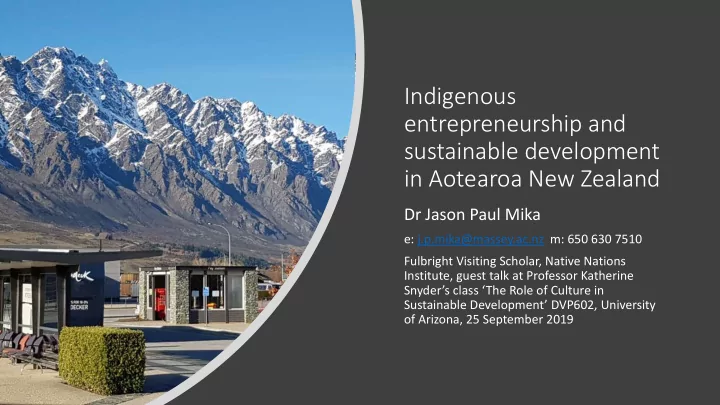
Indigenous entrepreneurship and sustainable development in Aotearoa New Zealand

Dr Jason Paul Mika

e: j.p.mika@massey.ac.nz m: 650 630 7510 Fulbright Visiting Scholar, Native Nations Institute, guest talk at Professor Katherine Snyder’s class ‘The Role of Culture in Sustainable Development’ DVP602, University

  • f Arizona, 25 September 2019
slide-2
SLIDE 2

Introductions

Thinking about where you were born and raised (your “home town”), tell us:

  • The name of your most significant mountain
  • The name of your most important river, lake or

coastal waters

  • The name of an important ancestor in your

family

  • The name of the village or town where these

places and people (and you) come from

Identify one major (iconic) contribution to ‘culture’ that your “home town” is known for or you remember most.

slide-3
SLIDE 3

Ōhinemataroa is my river Waikirkiri is my marae Maungapōhatu is my mountain Mika Te Tawhao is my ancestor

20-Aug-20 3

Tūhoe is my tribe

slide-4
SLIDE 4

Inspiration for my research

  • The wisdom of my elders
  • Māori entrepreneurs
  • Māori small businesses
  • Indigenous entrepreneurs
  • A passion for research,

policy and practice

20-Aug-20 4

slide-5
SLIDE 5

Agenda

  • Indigenous world view
  • Indigenous entrepreneurship
  • Sustainable development
  • Role of government
  • Case studies
  • Māori marine economy
  • Māori agribusiness
  • Māori tourism
  • Implications for research, policy and practice
  • Question and answer
slide-6
SLIDE 6

Māori economic development

Māori entrepreneur

Identity, indigenous entrepreneurial capabilities

Māori enterprise

Identity, definition and enterprise development

Māori economy

Identity, nature, measurement, development and growth

Māori development

Identity, self- determination, wellbeing, potential, freedom

slide-7
SLIDE 7

Identity

slide-8
SLIDE 8

Indigenous world view

  • Metaphysical explanations of the

world and our place within it

  • Interconnectedness of all things

creates sense of responsibility

  • Key concepts:
  • Whakapapa (genealogy)
  • Wairuatanga (spirituality)
  • Tapū, noa (sacred and profane)
  • Mauri (life force)
  • Indigenous culture, language and

institutions accord with this paradigm

slide-9
SLIDE 9

Te Kupenga: Survey

  • f Māori wellbeing
  • Culture: 373,000 (70 percent) Māori

adults said Māori culture somewhat important.

  • Marae: 71% of Māori know their marae.
  • Iwi: 89 percent of Māori adults said they

knew their iwi.

  • Reo: 257,500 (55 percent) Māori adults

had some ability to speak, 50,000 (11 percent) speak well

  • Most Māori defined their whānau by

whakapapa.

slide-10
SLIDE 10

Mult ulti-dimensional Model of Māori Identity and Cultural Engagement

slide-11
SLIDE 11

Unfolding tensions among post- settled iwi

How do tribes create culturally grounded global citizens? How do tribes rebalance wealth creation (shared capital) and wealth distribution (shared well-being)? How do tribes recalibrate tribal institutions so they are fit for purpose? How can tribes embed entrepreneurship, innovation and enterprise within the tribe?

slide-12
SLIDE 12

Entrepreneur

slide-13
SLIDE 13

Entrepreneurship

  • Non-indigenous entrepreneurs
  • Creating new combinations
  • Bearers of risk and

uncertainty

  • Seize price differentials
  • Individualised value and

impact

  • Non-indigenous entrepreneurship
  • Perceiving opportunity
  • Emphasis on newness &

growth

  • Venture formation and

growth

slide-14
SLIDE 14

Māori entrepreneurship

A Māori entrepreneur is a person who identifies as Māori and engages in entrepreneurial activity according to a Māori world view, but integrates within this, elements of a Western world view.

20-Aug-20 14

slide-15
SLIDE 15

A Māori way of doing business

  • Culture, identity and

socialisation as Māori

  • Self-determination,

potentiality and freedom

  • Māori enterprise ownership

and values

  • Duality, collectivism,

permanence and intergenerationality

  • Integrate Māori and Western

world views

20-Aug-20 15

slide-16
SLIDE 16

Indigenous entrepreneurship

  • “A means of fulfilling aspirations for

self-determination, sustainable economic development, preservation

  • f traditional knowledge, improving

socioeconomic and structural disadvantage and validating alternative conceptualisations of economy.”

  • Theoretical and practical challenges:
  • Developing indigenous theories of

value and economy

  • Balancing cultural and

commercial imperatives

  • Indigenous entrepreneurship as

self-development.

Mika, Smith, Gillies and Wiremu,(2019, p. 3).

slide-17
SLIDE 17

Enterprise

slide-18
SLIDE 18

What is a Māori enterprise?

What participants say...

Māori values Ownership by Māori Self-identification Self-determination Profit distribution Māori in business

(Mika, 2015)