ENTER.HUB Rostock - Local Action Plan 1. City context Definition of - - PowerPoint PPT Presentation

enter hub rostock local action plan 1 city context
SMART_READER_LITE
LIVE PREVIEW

ENTER.HUB Rostock - Local Action Plan 1. City context Definition of - - PowerPoint PPT Presentation

ENTER.HUB Rostock - Local Action Plan 1. City context Definition of the initial problem/ policy challenge Spatial Context : City Center Central Station Sdstadt central railway station: general modernisation in 2003, no further


slide-1
SLIDE 1

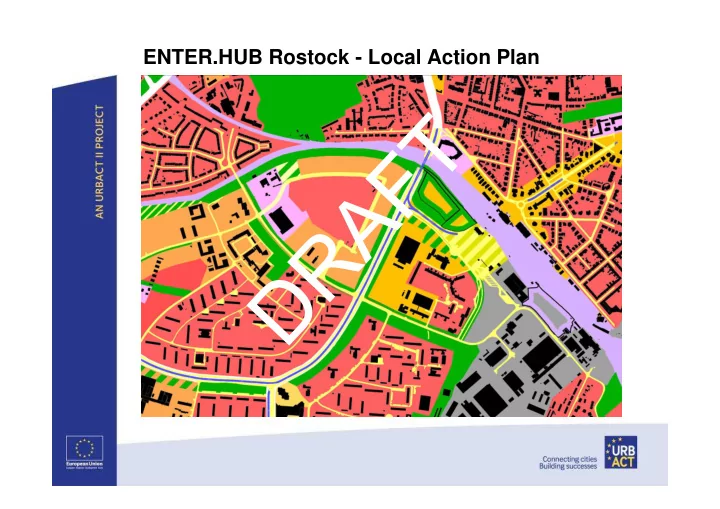
ENTER.HUB Rostock - Local Action Plan

slide-2
SLIDE 2
  • 1. City context

Definition of the initial problem/ policy challenge

  • central railway station: general modernisation

in 2003, no further development

  • Rail tracks work as a barrier
  • car parking and bike parking problems

increasing

  • Directly between Südstadt buildings and train

station: vast empty plots – in the 1960s foreseen and reserved for central urban functions (+ vacant industrial buildings and Stadthalle)

  • Südstadt: large-scale housing from the 60s

(monofunctional, green, ageing population) AND university campus Spatial Context: City Center ← Central Station → Südstadt

slide-3
SLIDE 3
  • 1. City context

Definition of the initial problem/ policy challenge

Main challenges of Enter HUB

  • 1. Upgrading of southern railway station

area as a passenger traffic hub

  • 2. Utilisation of location advantage as a

hub for the creative entrepreneur scene, addressing University-milieus as well as creatives and freelancers of the surrounding “Regiopol” region, catering the needs of the University and creative milieus in Rostock

  • 3. connecting the Südstadt to the city

center

slide-4
SLIDE 4
  • 1. City context

Definition of the initial problem/ policy challenge

Main challenge of Enter HUB (1)

Upgrading of southern railway station area as a passenger traffic hub

  • Integrated intermodal traffic: short and

stepless ways, integrated ticketing, integrated information systems and services; priviligation of foot- and bike and public traffic, e-mobility, Berlin-Rostock- Copenhavn connection

  • Stay qualities in a human dimension

business improvement examples from the northside are the new designed traffic round about; new coffee shop and backery, “railway station lounch feeling“

slide-5
SLIDE 5
  • 1. City context

Definition of the initial problem/ policy challenge

Main challenge of Enter HUB (2)

  • Utilisation of location advantage as a hub for

the creative entrepreneur scene, addressing University-milieus as well as creatives and freelancers of the surrounding “Regiopol” region, catering the needs of the University and creative milieus in Rostock

  • potential analysis, benchmarking, creation of

positive intellectual atmosphere = support by key persons, transformation of a gardener area into a Rostock´s creative milieu supportive special area

slide-6
SLIDE 6
  • 1. City context

Definition of the initial problem/ policy challenge

Main challenge of Enter HUB (3) connecting the Südstadt to the city center by a bucket of interventions like:

  • directional system
  • bicycle highway
  • Südstadt boulevard
  • connection between students dwelling quarter

and faculty of economy with Südstadt Campus by bridge and new tunnel

slide-7
SLIDE 7
  • 2. Focus and objectives: Creative Hub

Creative Milieus in Rostock*:

  • Creative enterprises are spreading along the inner city banks of the

Warnow and KTV (inner city district)

  • Südstadt is at the moment not considered a desirable location for cultural

entrepreneurs, BUT…

  • IT and digital media companies are more dispersed – science and

university oriented stakeholders are interested in a development of the site south of the train station

  • In general the creative milieus in Rostock have an optimistic spirit; desire

to be engaged in the city; some lack markets and distribution, international buzz. A new hub has to address the following needs:

  • Flexible space for early stage startups, facilitating access to markets,

networking with clients and partners, (international/interregional) visibility; strong links to University and existing startup-centres (especially towards the direct surrounding of Rostock)

* Demand and potential analyses Aug-Dec 2014

slide-8
SLIDE 8
  • 3. Actions / schedule 1/2
  • A potential and demand analysis was conducted for specifying goal

III – the creative hub south of the train station = start of the dialogue about a possible development (Aug. – Dec. 2014). Next Steps:

  • Presentation of the results of the demand analysis in Rostock in form
  • f a workshop in Feb./March 2015.
  • Setting up an e.g. INTERREG project for the development of the

detailed concept for a creative hub in Rostock (program targeted: INTERREG V A South Baltic or alternatively “Kommune Innovativ”*).

  • The development of a creative hub is tob be considered in the

Wissenschaftskonzeption (Masterplan Science) in 2015 ( synergies with other developments).

*program of the Federal Ministry of Science and Education Germany.

slide-9
SLIDE 9
  • 4. Funding scheme

Our aproach: we have enough funding, but at first we have to define the urban development aim.

With our LAP we contribute to definition to binding planning and development aims. A wide public and political discussion will follow. After that it is the right time to search for optimal funding. To enable further investigation, planing and communication a Interreg project (ERDF funded) seems to be nessesary. Also it seems possible to use city and university / region own grants; may be ERDF (technical support) from our region.

Summarizing: We are (Rostock) the land owner. Each excellent idea gets grants and bank credits (by city owed bank); also private investors like to be involved.

Red=owner Rostock

slide-10
SLIDE 10
  • 5. Framework for delivery
  • The City of Rostock is responsible for the communication of

the results of the demand and potential analysis (supported by thematic expert/external consulting);

  • The conception and application process of an INTERREG

project is coordinated by the City of Rostock.

  • Within the scope of the LAP a circle of key stakeholders was

defined (e.g. University, surrounding businesses) who can serve as a steering committee in the future to advise and accompany the INTERREG process.

slide-11
SLIDE 11
  • 6. Description of the process

The URB ACT ENTER.HUB project and the resulting LAP gave substantial inspiration, knowledge and research resources for the planning process. In particular:

  • SUPSI Lugano served a as inspiration and reference for the

development of a creative hub in Rostock;

  • The process of narrowing and specification of the

development goals was set up together with the partner towns and the thematic expert for economy;

  • The demand and support analysis for a creative hub helped

involving key stakeholders in Rostock, and will lead to a demand driven development (asking potential users and stakeholders about their needs and demands).

slide-12
SLIDE 12
  • 7. Risk analysis

Risk 1: Uncertainty about the developments in the surrounding Südstadt area (Stadthalle, Dieselmotorenwerk, demographic changes in the neigh- bourhood); Risk 2: Lack of critical mass for a new creative hub (redundancy of supply in Rostock and the near surrounding with existing Technology centres and incubators, creative places); Risk 4: There is no “recipe” for creating a creative milieu, the process generally has a low external steering capacity; Risk 5: The management structure as of such a creative hub can be a risk itself. This can be due to the challenges of a very heterogeneous user and management structure (diverging interests and commitment).

slide-13
SLIDE 13

Conclusions

From URB ACT and INTERREG project Rostock´s planner learned: make a spatial plan, add it with action-, communication and funding plan. In the ENTER.HUB project we are in the excellent situation, because we are land owners, we have planning autonomy to create in a very early stadium of planing aim definition a complexe development strategy. Now we implement in step 2 –basing on LAP- a wide discussion and political decision making process, no high risks given. Our suggestions has to find an appropriate position in the city development project ranking list. Evaluating the 1990s: we prefer public and non profit investments.

Realisation happens sooner or later, defenitely not before 2018 – the 800th aniversary of Rostock.

slide-14
SLIDE 14

contact@urbact-project.eu, oliver.koeppen@rostock.de www.urbact.eu/project