ENSC 427 Final Project VoIP Over Campus Area Network Group 15 Mark - - PowerPoint PPT Presentation

ensc 427 final project voip over campus area network
SMART_READER_LITE
LIVE PREVIEW

ENSC 427 Final Project VoIP Over Campus Area Network Group 15 Mark - - PowerPoint PPT Presentation

ENSC 427 Final Project VoIP Over Campus Area Network Group 15 Mark Zhiyu Zhou Kevan Thompson Elisa Xuan Lu Overview Background Project Details Implementation Details Implementation Details Discussion References &


slide-1
SLIDE 1

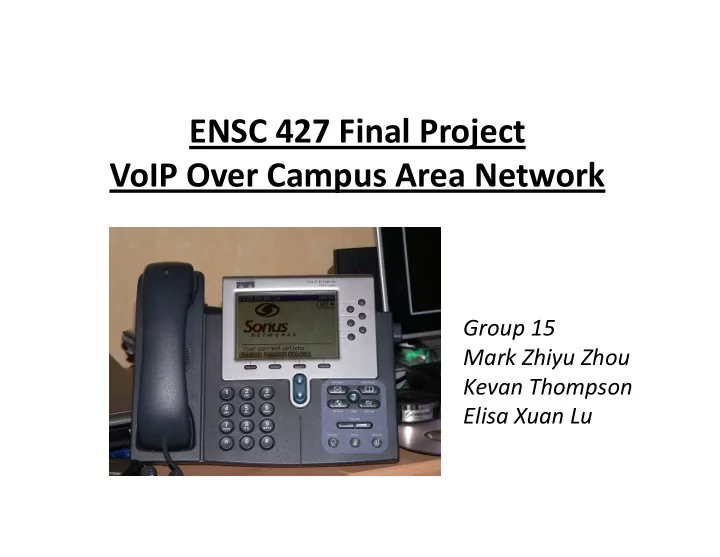
ENSC 427 Final Project VoIP Over Campus Area Network

Group 15 Mark Zhiyu Zhou Kevan Thompson Elisa Xuan Lu

slide-2
SLIDE 2

Overview

Background Project Details Implementation Details Implementation Details Discussion References & Questions

2

slide-3
SLIDE 3

Overview

Background Project Details Implementation Details Implementation Details Discussion References & Questions

3

slide-4
SLIDE 4

What is VoIP?

Voice Communications over IP networks Voice is sampled by a microphone Sample is compressed using a Codec Data is formed into Packets and sent over IP Data is formed into Packets and sent over IP network Packets are received, decoded, and played Packets may not arrive in the order that they are sent!!

4

slide-5
SLIDE 5

What is VoIP?

A VoIP phone can take the form of:

An analog phone An analog phone using an ATA Dedicated VoIP phone VoIP Software

  • n a PC

5

slide-6
SLIDE 6

Quality of Service

Depends mostly on Jitter, Delay, and Packet Loss Jitter is variation in delay, can result in choppy voice or temporary glitches voice or temporary glitches Packet Loss requires receiving codec to fill in the gaps. (PLC) Excess Delay may mean that Packets are dropped simply because they’re to old.

6

slide-7
SLIDE 7

Overview

Background Project Details Implementation Details Implementation Details Discussion References & Questions

7

slide-8
SLIDE 8

Past Studies and Related Work

Performance Evaluation of Voice Over IP on WiMAX and WiFi Based Networks Evaluation of VoIP Stability for Long-Distance Evaluation of VoIP Stability for Long-Distance Call Using OPNET An OPNET-based simulation approach for deploying VoIP

8

slide-9
SLIDE 9

Project Details

Motivation:

VoIP is rapidly gaining popularity and may eventually take over standard telephone services Potential cost saving in using VoIP for Universities Potential cost saving in using VoIP for Universities

  • r large companies

Details:

Started with a simple LAN and expanded the number of workstations and background traffic. Compared wired to wireless LANs

9

slide-10
SLIDE 10

Project Details

Simulated:

Average Jitter (sec) Average End to End Delay (sec) Mean Opinion Score [MOS] Mean Opinion Score [MOS]

5: Perfect 4: Fair 3: Annoying 2: Very Annoying 1: Impossible to Communicate

10

slide-11
SLIDE 11

Overview

Background Project Details Implementation Details Implementation Details Discussion References & Questions

11

slide-12
SLIDE 12

Network Topologies

12

Campus Location Campus Network

slide-13
SLIDE 13

Wired Network Topologies

13

Residence Building Server Node

slide-14
SLIDE 14

Wireless Network Topologies

14

10 Workstations 30 Workstations

slide-15
SLIDE 15

Overview

Background Project Details Implementation Details Implementation Details Discussion References & Questions

15

slide-16
SLIDE 16

Simulation Results for 10 Nodes

16

As background load increases End to End Delay and Jitter increase MOS is approximately the same so User will not notice the difference.

slide-17
SLIDE 17

10 Nodes VS 30 Nodes

17

Big Packet loss

slide-18
SLIDE 18

10 Nodes VS 30 Nodes

18

Big Packet loss

slide-19
SLIDE 19

Wired LAN Vs Wireless LAN

19

Voice quality is still acceptable

slide-20
SLIDE 20

10 Wireless Workstations Vs 30 Wireless Workstations

20

Voice quality drops significantly as the number of workstations increases

slide-21
SLIDE 21

Pulse Code Modulation Vs Global System for Mobile Communications

21

Voice quality is still acceptable

slide-22
SLIDE 22

Conclusions

Wired LAN

Voice quality is still acceptable with large numbers

  • f workstations or with large amounts of

background traffic background traffic

Wireless LAN

Voice quality is unacceptable with a large number

  • f workstations.

22

slide-23
SLIDE 23

Future Work

Simulate larger Campus Area Networks Include Mobile Users Include WIMAX Trace Individual Traffic within the Network

23

slide-24
SLIDE 24

Overview

Background Project Details Implementation Details Implementation Details Discussion References & Questions

24

slide-25
SLIDE 25

References

[1] Olejniczak, Stephen P., ¡° Reviewing VoIP Basics¡±, VoIP deployment for dummies, Hoboken, N.J.,2009, pp.10-12. [2] Dwivedi, Himanshu., ¡°An Introduction to VoIP Security¡±, Hacking VoIP, Sebastopol, Calif.,2009, pp.10-12. [3] Bates, Regis J. "Bud, ¡°Voice-over IP (VoIP)¡±, Voice-over [3] Bates, Regis J. "Bud, ¡°Voice-over IP (VoIP)¡±, Voice-over IP(VoIP), Blacklick, OH, USA, 2002, pp.537-538. [4] Hersent, Olivier., ¡°Voice Quality¡±, Beyond VoIP Protocols: Understanding Voice Technology and Networking Techniques for IP Telephony, Hoboken, NJ, 2005, pp.377-380. [5] Fine-tuning Voice over Packet service[Online]. Available: http://www.protocols.com/papers/voip2.htm.

25

slide-26
SLIDE 26

Questions

26