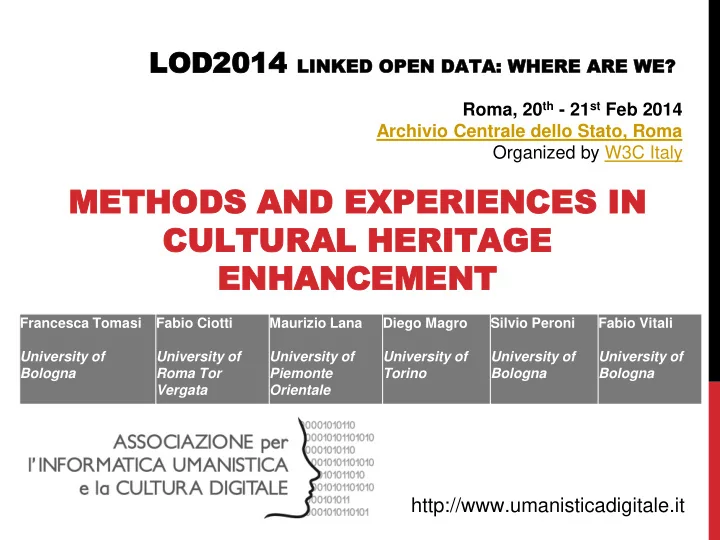
SLIDE 1 LOD LOD20 2014 14 LINKE
LINKED D OPE OPEN DA N DATA: WHERE AR TA: WHERE ARE WE E WE?
MET METHODS HODS AND AND EX EXPE PERI RIENCES ENCES IN IN CULTUR CULTURAL AL HERI HERITA TAGE GE ENHANCEMENT ENHANCEMENT
Roma, 20th - 21st Feb 2014 Archivio Centrale dello Stato, Roma Organized by W3C Italy
Francesca Tomasi University of Bologna Fabio Ciotti University of Roma Tor Vergata Maurizio Lana University of Piemonte Orientale Diego Magro University of Torino Silvio Peroni University of Bologna Fabio Vitali University of Bologna
http://www.umanisticadigitale.it
SLIDE 2 THE PROJECT
❖CH and LOD ❖our appoach: conversion, extraction, creation ❖database conversion into LOD (ontology reuse); ❖extraction of LOD from XML/TEI texts; ❖creation of new ontologies to produce LOD.
❖ the CH domain: people and roles, ancient and modern places, books and archival documents ❖ the aim: best practices in LOD production and dissemination in the CH domain
❖common strategy: ❖ontologies creation and reuse ❖standoff markup and Open Annotation data Model
SLIDE 3
THE CASE STUDIES
❖relational database
❖Zeri Photo Archive database http://www.fondazionezeri.unibo.it/catalogo
❖digital edition
❖Vespasiano da Bisticci Letters doi:10.6092/unibo/vespasianodabisticciletters
❖geographical ontology
❖Geolat project http://www.geolat.it
❖archival ontology
❖Proles ontology http://www.essepuntato.it/2013/10/politicalroles
SLIDE 4
ZERI PHOTO ARCHIVE
❖ “it is a rich digital catalog, and is today considered one of the most important repertories of Italian art on the web”. ❖ our mission is to convert the database to LOD: ❖reengineer the E/R model implemented by the database tables, which contain data according to the Scheda F, into OWL, to obtain a first version of an ontology; ❖iteratively enhance the ontology according to the specifications described by the Scheda F and CIDOC-CRM, (changing the whole conceptual organisation and entity naming of the existing model as less as possible); ❖transform data originally stored in the database into RDF statements compliant to the OWL ontology developed, by using appropriate scripts ; ❖apply automatic and semi-automatic mechanisms to generate links to existing datasets, such as DBpedia and Europeana.
SLIDE 5 ZERI: THE PROCESS
ONTOLOGY REUSE AND LOD POPULATION
Scheda F Photograph Scheda OA WorkOfArt
describes describes describes has subject
FRBR Work FRBR Expression FRBR Manifestation FRBR Item
Database Fondazione Zeri
Create the
from the E/R Model and the data in DB
Add links to LOD
FRBR
SLIDE 6
VESPASIANO, LETTERS A DIGITAL EDITION
❖ a digital annotated (XML/TEI) collection of letters form the XV century sent/received to/by the florentine copyist Vespasiano da Bisticci. ❖ a web environment that focuses on: persons mentioned in the documents; classical latin and greek manuscripts requested/copied/proposed to/by Vespasiano da Bisticci’s school and their description. ❖ the purpose is to identify persons related to manuscripts in order to expose datasets of people related to manuscripts, these last described by technical words. ❖ the XML/TEI annotation (persons, manuscripts and technical terms) has been realized with embedded markup (@ref=”URI”) pointing to stand-off RDF file (with assertion) and controlled form of the names (VIAF, LCA, Geonames, etc.) for managing attributes values.
SLIDE 7 VESPASIANO: THE MODEL
RDF SUPPORT TO STANDOFF ANNOTATION
SUBJECT PREDICATES OBJECT people.rdf#PdM URI: http://vespasianodabisticciletters/pe
has_normalized_form Medici, Piero de’: Dbpedia: http://eu.dbpedia.org/page/Piero_de_Medici VIAF: http://viaf.org/viaf/25406033 has_variant_forms Piero, Piero di Cosimo de’ Medici, Principe di Firenze is_owner_of manuscripts.rdf#P_SN manuscripts.rdf#L_D_III manuscripts.rdf#L_D_IV_E SUBJECT PREDICATES OBJECT manuscripts.rdf#P_SN URI: http://vespasianodabisticciletters/m anuscripts/P_SN has_normalized_form Plinio, Storia naturale is_requested_by is_owned_by is_copied_by is_illuminated_by people.rdf#PdM people.rdf#PdM people.rdf#PS people.rdf#FT SUBJECT PREDICATES OBJECT lexicon.rdf#min URI: http://vespasianodabisticciletters/le xicon/min has_normalized_form miniare, miniatura, miniato is_referred_to manuscripts.rdf#L_D_IV_E
SLIDE 8
GEOLAT
❖geolat-geography for latin literature, is a research project now funded by Fondazione Compagnia di SanPaolo
❖main aims: ❖increasing the value of geographic references in latin texts ❖enabling innovative access to latin works (e.g. through geography) ❖contributing to the LOD cloud ❖work in progress
SLIDE 9 GEOLAT
THE FRAMEWORK
Geographic entities RDF data Ancient World Geographic Ontology (awgo) specified according to
digilibLT (XML/TEI Resources) Bibliographic Resources RDF data Annotations
Bibliographic Resource Ontology (bro) automatic extraction
computer-aided annotation (Geographic NER)
specified according to specified according to Open Annotation Data Model (oa)
bridges the gap
Mappings to other datasets (e.g. Pleiades)
SLIDE 10 GEOLAT THE MODEL
rdf:type Primae frugiparos fetus mortalibus aegris dididerunt quondam praeclaro nomine Athenae et recreaverunt vitam legesque rogarunt [...] De rerum natura – Book VI athenaeWord bro:TextFragment bro:Book isPartOf rdf:type bro:LiteraryWork rdf:type isPartOf athens awgo:GreekPolis rdf:type awgo:locatedIn
bro:identifies
anno1
t trig:Graph rdf:type
rdf:type DRN_BookVI rdf:type pleiades: 579885 skos:closeMatch
SLIDE 11 AN ARCHIVAL ONTOLOGY: PROLES
❖the Political Roles (PRoles) Ontology is an OWL 2 DL
- ntology that allows one to represent political role
attributions and their possible links to related events by means of particular classes and properties imported and used by several concepts from PRO, n-ary participation pattern and PROV-O. ❖we are now managing an experiment on Andrea Costa fonds, by exploiting the related authority record (http://archivi.ibc.regione.emilia-romagna.it/eac-cpf/IT- ER-IBC-SP00001-0000264), in collaboration with IBC, Soprintendenza per i Beni librari e documentari.
SLIDE 12 PROLES: THE MODEL
The first layer of the PRoles Ontology: role attribution The third layer of the PRoles Ontology: provenance information The second layer of the PRoles Ontology: participation to events
SLIDE 13
FINAL REMARKS
the shared method: ontology reuse; definition of new classes and predicates; ontology as the basis for LOD characterization; stand-off markup and OA data model; LOD cloud population; mapping to other datasets
SLIDE 14
THANK YOU!
FRANCESCA, FABIO C., MAURIZIO, DIEGO, SILVIO, FABIO V.