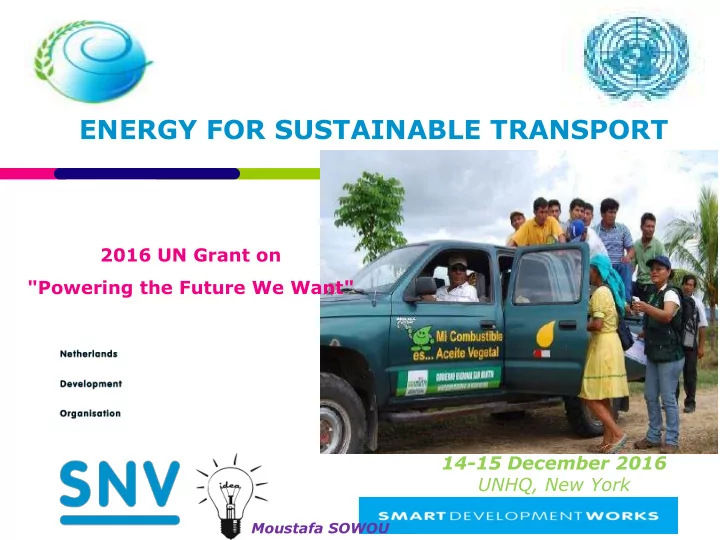
ENERGY FOR SUSTAINABLE TRANSPORT 2016 UN Grant on "Powering - - PowerPoint PPT Presentation

energy for sustainable transport
SMART_READER_LITE
LIVE PREVIEW

ENERGY FOR SUSTAINABLE TRANSPORT 2016 UN Grant on "Powering - - PowerPoint PPT Presentation

ENERGY FOR SUSTAINABLE TRANSPORT 2016 UN Grant on "Powering the Future We Want" 14-15 December 2016 UNHQ, New York Moustafa SOWOU I. Institution Background Who we are SNV is an international not-for-profit development organization


slide-1
SLIDE 1

ENERGY FOR SUSTAINABLE TRANSPORT

2016 UN Grant on "Powering the Future We Want" 14-15 December 2016 UNHQ, New York

Moustafa SOWOU

slide-2
SLIDE 2

2

  • I. Institution Background

What we aim for Who we are SNV is an international not-for-profit development organization founded in 1965 with headquarter in the Hague's. SNV is active in 38 of the poorest countries in Asia, Africa and Latin America in Agriculture, Renewable Energy, and Water, Sanitation &

  • Hygiene. SNV is present in Niger since 1978.

SNV and its local partners work to equip communities, business and organizations with the tools, knowledge and connections to increase incomes and gain access to basic services in a sustainable way What we do In 2015, SNV improved the lives of over 8.2 million people, and from 2016 to 2018 it will improve the quality of life for over 20 million. SNV uses its technical knowledge, 50 plus years of experience, passionate staff, extensive local presence and global footprint, to make a lasting difference in people’s lives.

slide-3
SLIDE 3

3

*1.5 million of people made use

  • f renewable energy sources

(Through successful market development for improved cook stoves, solar PV lamps and solar home systems, our impact increased substantially in 2015 compared to 2014 (1,475,329 people gained access to clean and affordable energy in 2015 vs 895,000 in 2014) *2.5 million of people increased their income *81,000 people with employment *2,060,930 tons of greenhouse gas emissions were reduced due to the adoption of energy and energy efficient solutions *71, 000 people increased their resilience to climate change *2.2 million of people made use

  • f improved sanitation facilities

SNV: Figures

slide-4
SLIDE 4

4

  • I. SNV LOCAL PARTNER: INOVATECH

Who we are INOVATECH is social company which operates in Niger in research and technological innovations What we do and aim for The company has in its repertoire 9 inventions all with a social purpose including 5 five patents. Its lucrativeness is limited, The principles of the Enterprise focus on community-based economic empowerment and sustainable development : Finding a new solution to a social problem that is more effective and sustainable

slide-5
SLIDE 5

5

  • II. SNV and SUSTAINABLE TRANSPORT:

Solutions

Transport systems have significant impacts

  • n

the environment, accounting for between 20% and 25% of world energy consumption and carbon dioxide emissions. The majority

  • f the emissions, almost 97%,

came from direct burning of fossil fuels. Greenhouse gas emissions from transport are increasing at a faster rate than any other energy using sector. Road transport is also a major contributor to local air pollution. The National GHG inventory report recorded in Niger INDC (2015) for COP21, the first GHG emission sector is transportation (41% of the total emission in the country)

Migrating transportation from fossil-based energy to other alternatives such as renewable energy is one of the target of SNV in Niger SNV Bioenergy

intervention in the world

slide-6
SLIDE 6

6

  • IiI. SNV ACHIEVEMENTS IN SUSTAINABLE TRANSPORT

Projects implemented in Latin America: Inclusive Business approach

slide-7
SLIDE 7

7

Sustainable transport

  • IiI. SNV ACHIEVEMENTS IN SUSTAINABLE TRANSPORT

Peru

slide-8
SLIDE 8

Jatropha based biofuel for transport in Peru

8

Jatropha production in San Martin is oriented for now to local buyers, this offering the most practical means for commercializing the still small quantities of Jatropha seed and oil. The oil is oriented for use in vehicles converted to straight vegetable oil (with a conversion kit from Elsbett, Germany; cost: USD 1,200), of which 3 units were installed in San Martin; 2 in pick-up trucks of DRASAM (2011; see photo beneath), 1 in a transport truck of the Jatropha farmers’ cooperative in Leoncio Prado (2009); 700 gallons/year would be needed per vehicle. DRASAM buys the oil at the local price of diesel: 12.50 Peruvian Soles per gallon in May 2011 (USD 4.50 approx). In 2009-2010, the Leoncio Prado cooperative produced 800 gallons of Jatropha oil. It is aimed for to promote further use of the diesel-to-SVO conversion kits in the transport sector (with adapted local technology to make it cheaper; aiming at less than USD 200 per kit), as such to further promote local Jatropha markets.

Local market development around Jatropha in San Martin is oriented towards the use of vegetable oil in converted vehicles.

slide-9
SLIDE 9

Biofuel with Palm oïl in Peru

9

* Market power and economies of scale * Cooperation with other parts of the value chain * Expert knowledge to improve raw material quality and yields * Expert knowledge and collaborations for cleaner production, effective anticipation and informed of Energy, Climate, and Biofuel Policies * National governmental support through collaborations with SERNA & SIC * Political support in national and international institutions * Influence in creating supply push and demand pull to increase/facilitate market penetration * Actively focusing on high quality palm oil and biodiesel through enhanced production methods and biodiesel marketing

  • Leader in palm oil and

biodiesel

  • Cooperative structure
  • 600 members
  • 150 independents
  • 45 MT/hr processing
  • 600gls/day biodiesel
  • 300 direct
  • 2000 indirect

employees

slide-10
SLIDE 10

Sustainable transportation in Niger Neem seeds Biofuel

10

The raw oil from neem has enabled to run local equipment (diesel vehicle) to produce electricity, and pump up groundwater. Tests were performed successfully over a period of one month with a new diesel motor pump without any special modifications to the structure of the

  • apparatus. Chemical analysis of the

quality of the biofuel was done by the German laboratory "ASG ANALYTIK SERVICE mbH Trentiner Ring 30 D-86356 Neusass the resulting fuel fits very much with Standards Specifications V DIN 51605. This biofuel has been processed innovatively in the villages of Dossado, Manga Koira, and Tounga Baouchi. The project has impacted more than 2,000 people and greenhouse gas emissions were reduced.

slide-11
SLIDE 11

11

  • Iv. CHALLENGES

 The sector presents risks (food versus fuel; land

use change, etc.) but at the same time important

  • pportunities for economic development with

social inclusion.  There is a need to contribute to the development

  • f adequate business models and the

identification of production schemes based on criteria for sustainability and inclusive business that contribute to local economic development.  R&D is key: knowledge development, technical innovation and concrete cases to demonstrate best/next practices.  Public-private partnerships and development of integrated policies are needed to facilitate a sustainable and inclusive development for the biofuels sector.  Look for synergies beyond the biofuels (for transport) market: use of sub products,

  • pportunities for rural electrification, carbon

credits, etc.

slide-12
SLIDE 12

12

  • Iv. FUTURE PLAN: Bio4tdev

Niger is a poverty-stricken country with a large rural population (85%

  • f total). The Government

prioritizes the energy sector for both socio-economic development and climate adaptation and specific targets have been set: by 2020 10% renewable energy (RE) in the energy mix, and 40% access to basic energy by 2018. Based on the achievements and lessons learnt from the previous experience, SNV and INOVATECH intend to develop Bio4TDev project in order to improve the living conditions for rural households and promote sustainable transport in Tahoua municipality.

slide-13
SLIDE 13

Bio4TDev: Project structure

13

slide-14
SLIDE 14

14

Bio4TDev: RESULTS AND IMPACTS

 Direct investments for community use (diesel transit vehicles, ambulance, mills, motor pumps), which will consume 37600 liters of biofuel/year for  A GHG emission reduction estimated at 85.35tons of CO2/year.  The monetary gain on the use of this biofuel is 33710 USD/year rewarding at least 7120 households from 7 different villages involved in seed collection.  More than 1330 biofuel trees (Neem, Pongamia pinnata) will be planted by beneficiaries’ in various communities. The project will be implemented jointly by SNV and INOVATECH through a Project Management Unit. Local NGO and municipalities will be involved to ensure sustainability and skills transfer.

slide-15
SLIDE 15

The future plan, Bio4TDev and governmental priorities

15

According to “National Action Plan for Renewable Energy” (NREAP) adopted in March 2015, the government of Niger has planned to increase by 5% in 2030 the consumption of

  • biofuel. The neem seeds biofuel project

received formal support from the government. At COP22 in Marrakech, Morocco, the National Council for the Environment for Sustainable Development of Niger (CNEDD) which is the national focal point of climate change conventions since Rio 1992 , together with the Prime Minister, introduced this project in the agenda of the President of the Republic for the need of the COP. The CNEDD has already given its support to the Bio4TDev project through an endorsement letter.

slide-16
SLIDE 16

16