SLIDE 1
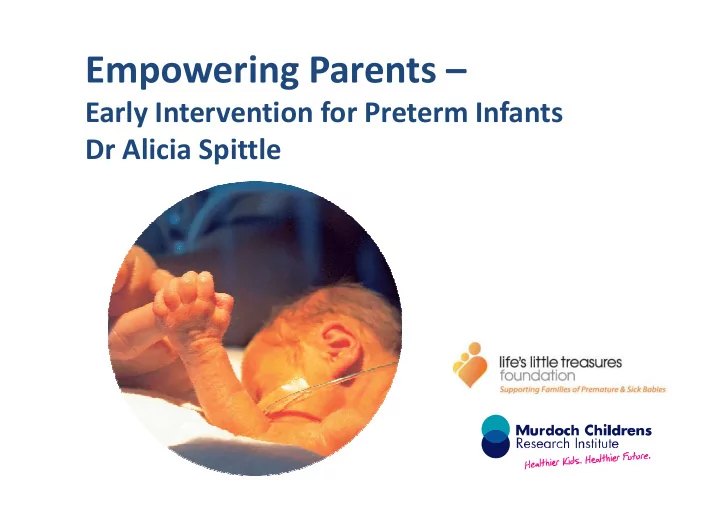
Empowering Parents –
Early Intervention for Preterm Infants Dr Alicia Spittle Click to edit Master title style
SLIDE 2
Victorian Infant Brain Study (VIBeS)
Click to edit Master title style
SLIDE 3
Click to edit Master title style
SLIDE 4 Disclaimer
- Every baby is different!
- Please talk to your Paediatrician, MCHN or
relevant health professional
Click to edit Master title style
SLIDE 5
What, why, who, how and when of Early Intervention
SLIDE 6 Question
How do you define preterm - is it related to how many weeks early the baby was delivered? Is it related to the baby's weight
- r a combination of these factors?
SLIDE 7 Prematurity definitions
Gestational age at birth
- Term = 37 -42 weeks
- Preterm = less than 37 weeks
- Late or moderate preterm = 32 to 36 weeks
- Very preterm = less than 32 weeks
- Very preterm = less than 32 weeks
- Extremely preterm = less than 28 weeks
Birth weight
- Low birth weight = less than 2500g
- Very low birth weight = less than 1500g
- Extremely low birth weight = less than 1000g
SLIDE 8 How do prem babies grow up?
- Developmental problems are related to gestational age
- Early childhood:
neurodevelopmental delay and recurrent health problems
academic difficulties and behavioural problems
most children born preterm adjust remarkably well Saigal and Doyle, Lancet, 2007
SLIDE 9 Early Childhood
Delay or difficulties
- Gross motor
- Fine motor
- Feeding
- Language
- Cognitive
- Cognitive
Impairments or diagnosis
- Cerebral palsy
- Autism
- ADHD
- Intellectual impairment
SLIDE 10 What is Early Intervention (EI)?
DEFINITION
EI consists of multidisciplinary services provided to children 0-5…promote child health, enhance emerging competencies…minimize delays… remediate
CHILD FAMILY MOTOR COGNITIVE
Click to edit Master title style
competencies…minimize delays… remediate emerging disabilities….prevent deterioration…promote family functioning Shonkoff et al, 2000
COGNITIVE SOCIAL PREMATURE DISABILITY LOW SES AT RISK
SLIDE 11
Why is “early” important?
Click to edit Master title style
SLIDE 12
Question
Early results of the LaPrem study indicate that late preterm babies have smaller brains? Is a smaller brain less effective or just smaller?
Click to edit Master title style
SLIDE 13
Click to edit Master title style
2nd Trimester Term
SLIDE 14
Developing in the womb versus neonatal intensive care
Click to edit Master title style
SLIDE 15
Early experiences alters brain development
Control Group Intervention Group
Click to edit Master title style
Als, Pediatrics, 2004
SLIDE 16
Who needs EI?
Click to edit Master title style
SLIDE 17 Early Childhood
- Delay or difficulties
- Gross motor
- Fine motor
- Feeding
- Language
- Cognitive
Prevention
Click to edit Master title style
- Impairments or diagnosis
- Cerebral palsy
- Autism
- ADHD
- Blind
- Deaf
Targeted early intervention
SLIDE 18 VIBeS Plus
- Children in study either receive standard care or our
– unique home intervention program
- Our team visits the home to help improve parental mental
health, parental-infant bonding and the infants’ development
Click to edit Master title style
SLIDE 19 Behavioural problems at 2 years
20% 0% 0%
Intervention
Impairment No impairments 0% 0%
Control
Impairment No impairments
Click to edit Master title style
80% 50% 50% Pediatrics 2009
SLIDE 20 Parental anxiety at 2 years
21% 0% 0%
Intervention
Anxiety No anxiety 43% 0% 0%
Control
Anxiety No anxiety
Click to edit Master title style
79% 57%
SLIDE 21 What is the evidence for early intervention for infants born preterm?
– randomised controlled trials – infants <37 weeks gestation
Click to edit Master title style
– infants <37 weeks gestation – Early intervention began within first 12 months – Focus on motor and/or cognitive
Spittle A, Cochrane Database Systematic review, 2012
SLIDE 22
Cognitive outcome - infant age (<3 years)
Click to edit Master title style
SLIDE 23
Cognitive outcome - preschool age (3-5 years)
Click to edit Master title style
SLIDE 24
Cognitive outcome - School age (6-13 years)
Click to edit Master title style
SLIDE 25
Motor outcome - infant age (<3 years)
Click to edit Master title style
SLIDE 26 Question
What are the day to day, practical things that you can do to help your prem develop post the first year. What is the research saying in this area? It feels like there is a big hole in the literature about how to support your prem baby (and child!), when they might not have any ongoing medical problems. What can be
Click to edit Master title style
might not have any ongoing medical problems. What can be done to proactively help your prem thrive in the first three years
SLIDE 27 I am ready to learn!
Infant discovery learning
Click to edit Master title style
SLIDE 28 What do we know about discovery learning with infants?
- Tasks are defined by adults
- Infants discover the tasks that are relevant
- The “relevance” of tasks can be influenced by
environment
Click to edit Master title style
environment
- How should we characterize the feedback from the
environment?
- Learning takes practice
- Trial and error
SLIDE 29
Play with your baby
Click to edit Master title style
SLIDE 30
Practice
Click to edit Master title style
SLIDE 31
Sitting
Click to edit Master title style
SLIDE 32
Baby walkers
Click to edit Master title style
SLIDE 33
Encourage independence
Click to edit Master title style
SLIDE 34
Jolly Jumpers
Click to edit Master title style
SLIDE 35
Read to your baby
Click to edit Master title style
SLIDE 36 Plagiocephaly
- http://www.rch.org.au/kidsinfo/fact_sheets/Pl
agiocephaly_misshapen_head/
Click to edit Master title style
SLIDE 37 Look after yourself
Click to edit Master title style
SLIDE 38
Question
Would you recommend all prems have regular reviews with staff who specialize in prematurity? For example, our GP/MHCN say early intervention not required for our daughter yet she is not meeting all milestones.
Click to edit Master title style
SLIDE 39 Correct for prematurity
- http://raisingchildren.net.au/articles/prematu
re_baby_corrected_age.html
- Corrected age = Chronological age – number
- f weeks preterm
Click to edit Master title style
- f weeks preterm
- For example, a one-year-old who was born
three months early would have a corrected age of nine months.
SLIDE 40 Question
- Do general illnesses such as colds/flus/ear infections etc add
extra time onto development details? For example, our daughter is healthy, however she regularly has illnesses which knock her around.
Click to edit Master title style
SLIDE 41 Delay vs impairment
Difficulty lifting head Stiff legs with little or no movement Pushes back with head Keeps hands fisted and lacks arm movement
Signs to Watch for in Physical Development*
Click to edit Master title style
www.pathways.org
Rounded back Unable to lift head up Poor head control Difficult to bring arms forward to reach out Arches back and stiffens legs Uses one hand predominately Rounded back Poor use of arms in sitting Difficulty crawling Uses only one side of body to move Arms held back Stiff legs Inability to straighten back Cannot take weight on legs
SLIDE 42 Chronic Disease Management — GP services
- http://www.health.gov.au/internet/main/publ
ishing.nsf/Content/mbsprimarycare- chronicdiseasemanagement
Click to edit Master title style
SLIDE 43
Question
What is the most important thing that midwives can do to support parents with a premature baby?
Click to edit Master title style
SLIDE 44
Support parents and infant
Click to edit Master title style
SLIDE 45
Question
Our baby was born at 32wks, no health concerns at birth but has been diagnosed with CP at 10 months. Four months down the line we are still waiting for intake with ECIS, VPRS and a proper diagnosis.
Click to edit Master title style
Why is it so difficult? We're currently doing everything privately but we're still looking for some therapy that focus on neuroplasticity, can you make a recommendation please
SLIDE 46
Question
My ex28 weeker son who is now 4 was not referred for early intervention services. I have spent the last year getting him in the see all of the different types of therapists due to his obvious development delays and having mild cp and epilepsy.
Click to edit Master title style
What is the best way for me to coordinate his intervention so that he can have the best life possible. He is such a beautiful loving boy that his differences can be often overlooked by professionals.
SLIDE 47 Definition of CP
- CP describes a group of disorders of the development of
movement and posture, causing activity limitation, that are attributed to non-progressive disturbances that occurred in the developing fetal or infant brain
Click to edit Master title style
SLIDE 48 Cerebral Palsy
- Term = 0.1%
- 32- 36 weeks = 0.7%
- 28-31 weeks = 6.2%
- 22-27 weeks = 14.6%
- Average age of diagnosis = 19 months
Click to edit Master title style
- Average age of diagnosis = 19 months
SLIDE 49
Risk of Cerebral Palsy
Click to edit Master title style
SLIDE 50 Click to edit Master title style
NOVAK, 2014
SLIDE 51
- Click to edit Master title style
SLIDE 52
- Collaborative goal setting
- Analysis of goal limiting factors
- Scaffolding of tasks for optimising
self generated motor activity
- Minimisation of handling (passive)
Goal Oriented Activity Based Motor Training
Click to edit Master title style
- Minimisation of handling (passive)
- Trial and error
- Encourage active movement
- Early weight bearing + reach and
grasp
- Increasing complexity
- Written home programme
Shepherd, 2013; Lobo, 2013, Fetters 2010; Novak 2009
SLIDE 53
- Parent coaching in simple
- bservation
- Optimisation of awake time for
learning
- Active practice focus
- Increasing complexity and variability
Parent Education
Click to edit Master title style
- Increasing complexity and variability
- ver time
- Allowing trial and error
- Delivery of prognostic information
and specific information about CP
- Practice motor training with feedback
Novak 2006; Whittingham 2014; Mahoney 2004
SLIDE 54 Environmental enrichment
- Toy selection to match motor
task
- Evidence based early learning
stimulation
Click to edit Master title style
- Sleep/feeding routines
- Variable daily experience
- Inclusion of extended family
- Construction of home play
environment
Greaves 2012; Bradley and Caldwell, 1984
SLIDE 55 Useful websites for CP
www.cerebralpalsy.org.au
- Early Childhood Intervention Services
http://www.education.vic.gov.au/childhood/parents/needs/page s/ecis.aspx
Click to edit Master title style
s/ecis.aspx
http://betterstart.net.au
SLIDE 56 Better Start
- The Better Start for Children with Disability
initiative provides funding for early intervention services.
- Up to $12,000 (maximum $6,000 per year)
Click to edit Master title style
- Up to $12,000 (maximum $6,000 per year)
- Need to register before child turns 6 years old
(funding until they turn 7 to access funding)
SLIDE 57
Question
Is Asperger's common in premature babies?
Click to edit Master title style
SLIDE 58 Autism Spectrum Disorder (ASD)
– Impaired communication and social interaction – Restricted, repetitive patterns of behaviour, interests or activities
Click to edit Master title style
– Associated with changes in brain development. – A combination of genetic and environmental factors
– 1 out of 100 - 110 children in Australia – 4 of 100 children born very preterm
SLIDE 59 Early signs of ASD
- Research conducted in the general community
– Eye contact – Social smiling – Joint attention – Use of gestures
raisingchildren.net.au
Click to edit Master title style
– Use of gestures
- More work needed to identify early signs of ASD in premie
children
- If you are worried about ASD, contact your health care
provider
SLIDE 60 Early intervention for ASD
- Starting early is most effective in helping the development of
children with ASD
- Many types of interventions:
– Behavioural
Click to edit Master title style
– Behavioural – Medical – Developmental – Family based – Therapy based – Alternative approaches
SLIDE 61 Further information
- www.raisingchildren.net.au/children_with_au
tism_landing.html
Click to edit Master title style
(previously Autism Victoria)
- Helping children with Autism
SLIDE 62 Question
When do you consider a referral for Early Childhood Intervention Services? Is the referral made on the assumption that the child has a risk
- f developmental delay which is not overly evident at the point
- f developmental delay which is not overly evident at the point
- f referral or the referral is made when it is evident that there
will be need for an ongoing long term service.
SLIDE 63
Question
In a child born preterm who appears to be progressing with age appropriate normal development, at what point can you begin to "relax" ? ie is there a time at which all complications of bring premature will have declared themselves?
SLIDE 64 Question
- My twins girls were born 26 weeks. They are now 3 years old
and attend an early intervention centre.
- When they go to school, do u think premature will be delay
their studying?
Click to edit Master title style
their studying?
SLIDE 65 The VIBeS Family
Paediatrics
Terrie Inder Lex Doyle Rod Hunt Jeanie Cheong Gehan Roberts Jennifer Walsh Noni Davis Julianne Duff
Nursing
Merilyn Bear Physiotherapy Alicia Spittle Lucy Lorefice Katy de Valle Jane Orton Ros Boyd Leesa Allinson
Occupational Therapy
Nisha Brown
Psychology
Peter Anderson Karli Treyvaud Megan Spencer-Smith Leona Singam Carly Molloy Jeremy Lim Natalie Reidy Shannon Scratch Alexandra Ure Carmel Ferretti Anastasiya Suetin
Neuro-imaging
Deanne Thompson Jeffrey Neil Chris Smyser David Van Essen Jim Alexopoulos Yuning Zhang Meredith Estep Michael Kean Marc Seal Zohra Ahmadzai Claire Kelly
Biostatistics
Katherine Lee
Office Manager
Debbie Cations Merilyn Bear Emma McInnes Kate Callanan Marion McDonald Nisha Brown Abbey Eeles Joy Olsen
Speech Pathology
Angela Morgan
Funding support
NHMRC, National Institutes of Health, Jack Brockhoff Foundation, Murdoch Childrens Research Institute, Howard Florey Institute, Royal Women’s Hospital Foundation, Thyne Reid Foundation, Myer Foundation, CP Foundation, CCRE Newborn Medicine Anastasiya Suetin Carmen Pace Cristina Omizzolo Sacha Stokes Cody Potter Andrea McInnes Michelle Wilson-Ching Claire Kelly Lillian Gabra Fam Linda Chan Dolly Thai
Neuroscience
Sandra Rees
Collaborating Centres
Murdoch Childrens Research Institute, The Royal Women’s Hospital, The University of Melbourne, Washington University (St Louis), Children’s MRI Centre (Royal Children’s Hospital)
SLIDE 66
Thank you