Empowering DAP Strategies for Literacy in Early Childhood Programs - - PDF document

empowering dap strategies for literacy in early childhood
SMART_READER_LITE
LIVE PREVIEW

Empowering DAP Strategies for Literacy in Early Childhood Programs - - PDF document

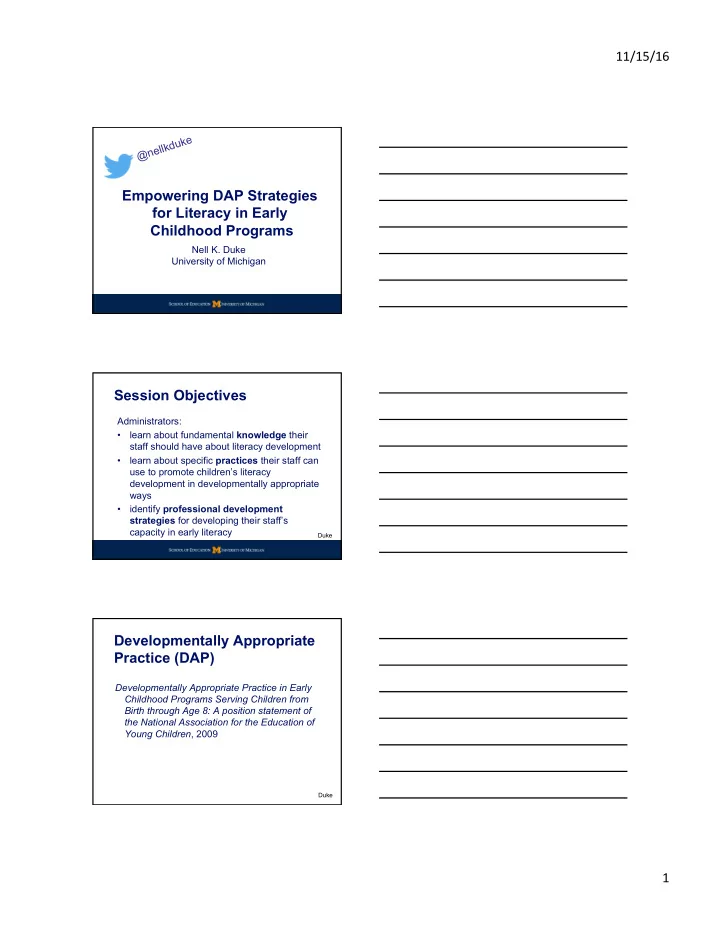
11/15/16 e k u d k l l e n @ Empowering DAP Strategies for Literacy in Early Childhood Programs Nell K. Duke University of Michigan Session Objectives Administrators: learn about fundamental knowledge their staff should have


slide-1
SLIDE 1

11/15/16 1 Empowering DAP Strategies for Literacy in Early Childhood Programs

Nell K. Duke University of Michigan

@ n e l l k d u k e

Session Objectives

Administrators:

  • learn about fundamental knowledge their

staff should have about literacy development

  • learn about specific practices their staff can

use to promote children’s literacy development in developmentally appropriate ways

  • identify professional development

strategies for developing their staff’s capacity in early literacy

Duke

Developmentally Appropriate Practice (DAP)

Developmentally Appropriate Practice in Early Childhood Programs Serving Children from Birth through Age 8: A position statement of the National Association for the Education of Young Children, 2009

Duke

slide-2
SLIDE 2

11/15/16 2 Defining DAP

“Practice that promotes young children’s optimal learning and development” (p. 16)

Duke

Myths about DAP

There are so many. Here are three:

  • 1. DAP means no explicit teaching.
  • 2. DAP means all play all day.
  • 3. DAP means all experiences have to be

initiated by children based on what interests them.

Duke

From Page 14, quoting Bowman, B.T., S. Donovan, & M.S. Burns. 2000. Eager to learn: Educating our

  • preschoolers. Washington, DC: National

Academies Press, page 8: “Good teachers acknowledge and encourage children’s efforts, model and demonstrate, create challenges and support children in extending their capabilities, and provide specific directions or

  • instruction. All of these teaching strategies can be

used in the context of play and structured activities. Effective teachers also organize the classroom environment and plan ways to pursue educational goals for each child as opportunities arise in child- initiated activities and in activities planned and initiated by the teacher.”

Duke

slide-3
SLIDE 3

11/15/16 3 Literacy is Not the Be All and End All

“All the domains of development and learning— physical, social and emotional, and cognitive —are important, and they are closely

  • interrelated. Children’s development and

learning in one domain influence and are influenced by what takes place in other domains.” (p. 11)

Duke

Session Objectives

Administrators:

  • learn about fundamental knowledge their

staff should have about literacy development

  • learn about specific practices their staff can

use to promote children’s literacy development in developmentally appropriate ways

  • identify professional development

strategies for developing their staff’s capacity in early literacy

Duke

Knowledge of Standards

Teachers need to know the relevant standards. Examples for literacy from the Head Start Outcomes Framework 2015:

  • Names 18 upper- and 15 lower-case letters.
  • Knows the sounds associated with several

letters.

Duke

slide-4
SLIDE 4

11/15/16 4 Knowledge of Standards

Example for literacy from the Head Start Outcomes Framework 2015:

  • Re-tells or acts out a story that was read,

putting events in the appropriate sequence, and demonstrating more sophisticated understanding of how events relate, such as cause and effect relationships.

Duke

Knowledge of Standards

Examples for literacy from the Head Start Outcomes Framework 2015:

  • Produces the beginning sound in a spoken

word, such as “Dog begins with /d/.”

  • Provides a word that fits with a group of

words sharing an initial sound, with adult support, such as “Sock, Sara, and song all start with the /s/ sound. What else starts with the /s/ sound?”

Duke

Why is initial phoneme segmentation so important?

  • Children need it to write:

I L M (I love Mom.)

  • Children need it for keyword instruction to

make sense: “A is for apple” “Z is for Zeshawn”

Duke

slide-5
SLIDE 5

11/15/16 5 An Approach to Unpacking Standards

Standard What does this standard mean? How can I observe

  • r assess for this

standard? How can I support children in meeting this standard? Duke

A PLC Activity

Knowledge of Content

The Case of Quality Key Words

  • The word should have the key sound, or one of

the two key sounds, of the letter. For example, not A is for Airplane

  • The word should not start with a letter name.

For example, not E is for Elephant

  • Generally, the word should not start with a

blend because it may be harder for the child to segment. For example, not D is for Drum

Duke

  • The word should be easy to depict
  • For example, apple generally works well.
  • The word should not be something that is easily

confused with another item that begins with a different sound.

  • For example, b is for boat can be problematic

because kids may be inclined to say, “ship.”

  • The word should be likely to be known to or easily

learned by children, which will vary depending on children’s backgrounds.

Duke

Knowledge of Content

The Case of Quality Key Words

slide-6
SLIDE 6

11/15/16 6

Available free at: http:// www.naeyc.org/ yc/files/yc/file/ 201503/ YC0315_Block_O nline.pdf

A PLC Activity

For Further Information

An Article:

For Further Information About Instruction

An Article: Piasta, S. B. (2014). Moving to assessment- guided differentiated instruction to support young children’s alphabet knowledge. The Reading Teacher, 68, 202–211. http://

  • nlinelibrary.wiley.com/

doi/10.1002/trtr.1316/full A Book:

https://www.amazon.com/More- Teaching-Letter-Week-This/dp/ 0325062560

PLC Activities

Knowledge of Children

  • Children’s
  • interests
  • experiences
  • cultural and linguistic background(s)
  • points in development
  • strengths
  • needs

Duke

slide-7
SLIDE 7

11/15/16 7

Knowledge of Children

Case of the Need to Understand Cultural and Linguistic Background

In English, readers read from left to right and have a return sweep at the end of of each line.

Duke

Knowledge of Children

Case of the Need to Understand Cultural and Linguistic Background

In Arabic, readers read from right left and have a return sweep at the end of of each line.

Duke اهل نوكيو راسيلا يهميلا نم اهتءارقو ،ةيبرعلا ةغللاب .رطس لك ةياهن يف ةدوع حايتجلبا

Knowledge of Children

  • Children’s
  • interests
  • experiences
  • cultural and linguistic background
  • points in development
  • strengths
  • needs
  • Child development

Duke

slide-8
SLIDE 8

11/15/16 8 Knowledge of Children

The Case of Vocabulary Acquisition

  • Children may need

many exposures to a word in different contexts in order to learn it.

  • Nonverbal supports can

be very helpful.

  • for example: videos,

photos, movement, props, experiences

  • Non-examples can be

very helpful.

Duke

Session Objectives

Administrators:

  • learn about fundamental knowledge their

staff should have about literacy development

  • learn about specific practices their staff can

use to promote children’s literacy development in developmentally appropriate ways

  • identify professional development

strategies for developing their staff’s capacity in early literacy

Duke

Of course, there’s much more to learn. . .

Example Practice to Develop Literacy

Print-referencing Read Aloud

Print referencing is a research-supported instructional practice for preschool (e.g., Justice & Ezell, 2002; Justice, McGinty, Piasta, Kaderavek, & Fan, 2010). Print referencing involves verbal and non- verbal strategies for drawing children’s attention to print during adult-child read aloud.

Duke

slide-9
SLIDE 9

11/15/16 9 Example Practice to Develop Literacy

Print-referencing Read Aloud

  • running finger under words
  • pointing out, or engaging children in

pointing out, where to start reading

  • pointing out letters and their associated

sounds

  • pointing out other features of print
  • pointing out print within pictures
  • counting words

Duke

For Further Information

Zucker, T. A., Ward, A. E., & Justice, L. M. (2009). Print referencing during read-alouds: A technique for increasing emergent readers' print knowledge. The Reading Teacher, 63, 62-72. Stable URL: http://www.jstor.org/stable/40347652. Currently available free at: http://ici-bostonready- pd-2009-2010.wikispaces.umb.edu/file/view/ Print+Referencing+During+Read+Alouds.pdf

A PLC Activity

Duke

Example Practice to Develop Literacy

Interactive Writing

Interactive writing is a research-supported instructional practice for preschool (e.g., Hall, Toland, Grisham-Brown, & Graham, 2014). Interactive writing involves the teacher leading the writing and the children contributing much of the content and some of the writing.

Duke

slide-10
SLIDE 10

11/15/16 10 Interactive Writing

From an activity in

Presentation on Interactive Writing Posted by the Michigan Department of Education

https://www.youtube.com/watch?v=Pl7ljSy3xsY Duke

A PLC Activity

Demonstration of Interactive Writing Posted by the Michigan Department of Education

https://www.youtube.com/watch? v=ne57TprUTPw

Duke

A PLC Activity

P r e s c h

  • l
  • s

p e c i f i c d e m

  • n

s t r a t i

  • n

s c

  • m

i n g s

  • n

!

slide-11
SLIDE 11

11/15/16 11 Example Practice to Develop Literacy

Literacy-enriched Dramatic Play

Play provides a context for developing literacy (e.g., Neuman & Roskos, 1992; Roskos, Christie, Widman, & Holding, 2010). There are specific practices we can use to increase literacy development opportunities within play.

Duke

Example Practice to Develop Literacy

Literacy-enriched Dramatic Play

We can enrich every area of the classroom in which children play with materials to read and write.

Duke

Example Practice to Develop Literacy

Literacy-enriched Dramatic Play

Duke

Generating ideas for this can be a PLC Activity

slide-12
SLIDE 12

11/15/16 12 Example Practice to Develop Literacy

Literacy-enriched Dramatic Play

Materials can be used to encourage children to develop and reenact stories. For example, for Little Red Riding Hood and variants:

  • Basket
  • Red hood
  • Some way to symbolize a forest
  • Something like a bed
  • Wolf mask

Duke

Generating ideas for this can be a PLC Activity

Example Practice to Develop Literacy

Literacy-enriched Dramatic Play

Materials can be added to a dramatic play area that are authentic to that dramatic play

  • theme. For example, for a farmer’s market:
  • vegetables and fruits
  • seed packets
  • pots
  • baskets
  • labels for food

Duke

Generating ideas for this can be a PLC Activity

  • pads of paper
  • pencils
  • play money
  • garden-supply

catalogs

For Further Information

An article: Neuman, S. B., & Roskos, K. (1990). Play, print, and purpose: Enriching play environments for literacy development. The Reading Teacher, 44, 214-221. Stable URL: http://www.jstor.org/ stable/20200594 A book:

PLC Activities

https://www.amazon.com/Literacy- Youngest-Learner-Practices-Educators/dp/ 0439714478

slide-13
SLIDE 13

11/15/16 13 More Practices

A v a i l a b l e f r e e a t : h t t p : / / t i n y u r l . c

  • m

/ l i t e r a c y e s s e n t i a l s p r e K Michigan Association of Intermediate School Administrators General Education Leadership Network Early Literacy Task Force (2016). Essential instructional practices in early literacy:

  • Prekindergarten. Lansing,

MI: Authors.

PLC Activities

As You Read Through the Document on the Previous Slide:

  • Read for detail. Every single bullet—arguably

every single word—is there for a reason.

  • Read for affirmation. Some items will be

things your staff is already doing.

  • Read for improvement. Some items,

perhaps many items, will be things your staff could improve on.

  • Read for research. See the endnotes for

references to research studies that support each practice. Research, not philosophy.

Duke

Session Objectives

Administrators:

  • learn about fundamental knowledge their

staff should have about literacy development

  • learn about specific practices their staff can

use to promote children’s literacy development in developmentally appropriate ways

  • identify professional development

strategies for developing their staff’s capacity in early literacy

Duke

slide-14
SLIDE 14

11/15/16 14 Effective Professional Development

Desmione, L. M. (2009). Improving impact studies of teachers’ professional development: Toward better conceptualizations and measures. Educational Researcher, 38, 181-199. Stable URL: http:// www.jstor.org/stable/20532527

Desmione, 2009

Concludes that there is a consensus about five characteristics of PD that are effective:

  • 1. Content focus
  • 2. Active learning, for example:
  • observing expert teachers
  • being observed, followed by interactive

feedback and discussion

  • reviewing children’s work related to the PD
  • discussions

Desmione, 2009

  • 3. Coherence
  • 4. Duration (hours and span)
  • 10 hours? (Gerde, Duke, Moses, Spybrook,

& Shedd, 2014)

  • 14 hours? (Yoon, Duncan, Lee, Scarloss, &

Shapley, 2007)

  • 20 hours? (Desmione, 2009)
slide-15
SLIDE 15

11/15/16 15 Desmione, 2009

  • 5. Collective participation

“This feature can be accomplished through participation of teachers from the same school, grade, or department. Such arrangements set up potential interaction and discourse, which can be a powerful form of teacher learning (Banilower & Shimkus, 2004; Barko, 2004; Desimone, 2003; Pullan, 1991; Guskey, 1994; Little, 1993; Loucks- Horsley et al., 1998; Rosenholtz, 1989).” (p. 184)

P L C s !

Effective Professional Development

Killion, J. (2013). Establishing time for professional learning. Oxford, OH: Learning Forward.

Effective Professional Development

I recommend grounding professional development in:

  • The NAEYC Statement on Developmentally

Appropriate Practice (2009) discussed earlier

  • Research studies, when possible
  • Research-informed articles, books, videos,

websites (e.g., the What Works Clearinghouse), and other documents

  • Curriculum materials that are strongly

research-based and up-to-date

slide-16
SLIDE 16

11/15/16 16 Questions? Comments?

@ n e l l k d u k e

Thank you for all you do for children!