Employment Litigation and Claim Settlements: Tax Withholding and - - PowerPoint PPT Presentation

employment litigation and claim settlements tax
SMART_READER_LITE
LIVE PREVIEW

Employment Litigation and Claim Settlements: Tax Withholding and - - PowerPoint PPT Presentation

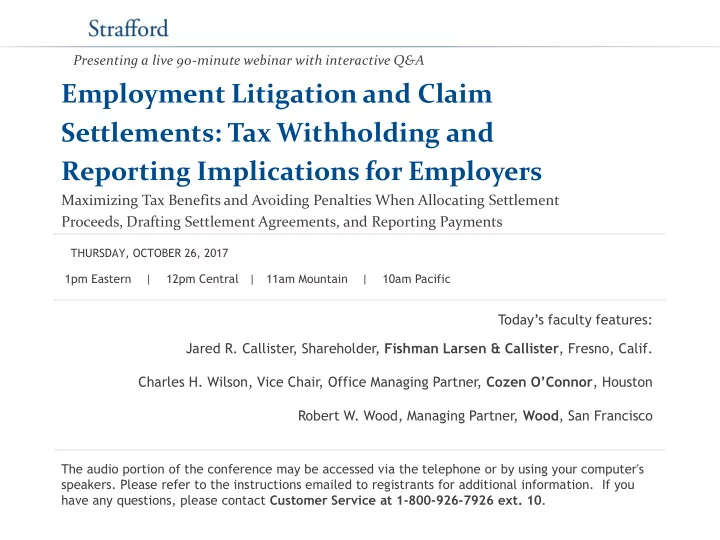
Presenting a live 90-minute webinar with interactive Q&A Employment Litigation and Claim Settlements: Tax Withholding and Reporting Implications for Employers Maximizing Tax Benefits and Avoiding Penalties When Allocating Settlement


slide-1
SLIDE 1

The audio portion of the conference may be accessed via the telephone or by using your computer's

  • speakers. Please refer to the instructions emailed to registrants for additional information. If you

have any questions, please contact Customer Service at 1-800-926-7926 ext. 10.

Presenting a live 90-minute webinar with interactive Q&A

Employment Litigation and Claim Settlements: Tax Withholding and Reporting Implications for Employers

Maximizing Tax Benefits and Avoiding Penalties When Allocating Settlement Proceeds, Drafting Settlement Agreements, and Reporting Payments

Today’s faculty features:

1pm Eastern | 12pm Central | 11am Mountain | 10am Pacific THURSDAY, OCTOBER 26, 2017

Jared R. Callister , Shareholder, Fishman Larsen & Callister, Fresno, Calif. Charles H. Wilson, Vice Chair , Office Managing Partner, Cozen O’Connor, Houston Robert W. Wood, Managing Partner, Wood, San Francisco

slide-2
SLIDE 2

Tips for Optimal Quality

Sound Quality If you are listening via your computer speakers, please note that the quality

  • f your sound will vary depending on the speed and quality of your internet

connection. If the sound quality is not satisfactory, you may listen via the phone: dial 1-866-370-2805 and enter your PIN when prompted. Otherwise, please send us a chat or e-mail sound@straffordpub.com immediately so we can address the problem. If you dialed in and have any difficulties during the call, press *0 for assistance. Viewing Quality To maximize your screen, press the F11 key on your keyboard. To exit full screen, press the F11 key again.

FOR LIVE EVENT ONLY

slide-3
SLIDE 3

Continuing Education Credits

In order for us to process your continuing education credit, you must confirm your participation in this webinar by completing and submitting the Attendance Affirmation/Evaluation after the webinar. A link to the Attendance Affirmation/Evaluation will be in the thank you email that you will receive immediately following the program. For additional information about continuing education, call us at 1-800-926-7926

  • ext. 35.

FOR LIVE EVENT ONLY

slide-4
SLIDE 4

Taxation of Employment Settlements

Strafford Webinars

October 26, 2017

by Robert W. Wood Wood LLP

LLP

www.WoodLLP.com wood@WoodLLP.com

slide-5
SLIDE 5
  • 1. Origin of the Claim Controls.

 Underlying Dispute. Payments are taxed

according to the underlying nature of the

  • claim. Hence, a suit for breach of employment

contract results in taxable wages.

 Wages. If payments constitute wages, they

are also subject to employment taxes, including income tax withholding, Social Security (FICA), and unemployment tax (FUTA).

Robert W. Wood www.WoodLLP.com

5

slide-6
SLIDE 6
  • 2. Wage and Employment Taxes.

 Should a discrimination or wrongful

termination recovery (in the absence of physical injury) be treated as taxable tort damages (and hence not as wages), or treated as wages?

 See Wood, IRS Speaks Out on Employment

Lawsuit Settlements, Vol. 124, No. 11, Tax Notes (Sept. 14, 2009), p. 1091.

Robert W. Wood www.WoodLLP.com

6

slide-7
SLIDE 7
  • 3. Wage Caution.

 The safest approach may be for employers to

treat all settlements as wages, but this is

  • verinclusive.

 If an amount is truly a tort settlement, even if

it is now taxable income, there should be no employment taxes. Allocate between W-2 and 1099 amounts.

Robert W. Wood www.WoodLLP.com

7

slide-8
SLIDE 8
  • 4. Wage Authorities.

 Former employees can still receive wages.  Numerous authorities examine many different

types of payments.

 But most wage issues are factual.

Robert W. Wood www.WoodLLP.com

8

slide-9
SLIDE 9
  • 5. Don’t Assume Wages are Terrible.

 In employment disputes, some amount is almost

always intended as wages. Yet many plaintiff lawyers seem to think wage treatment is terrible and try to avoid it. This can be short-sighted for several reasons.

 With wages, the employer and the employee

each pay half of the Social Security tax.

 If it is self-employment income, the former

employee must pay the entire tax.

Robert W. Wood www.WoodLLP.com

9

slide-10
SLIDE 10
  • 5. Don’t Assume Wages are Terrible.

(Cont.)

 If there is no or little wage withholding, the

former employee may not have tax withholding for the first time and may therefore have to budget for paying taxes.

Robert W. Wood www.WoodLLP.com

10

slide-11
SLIDE 11
  • 6. Consider W-2s and Withholding vs.

1099s.

 The wage vs. non-wage allocation issue

should be considered in every employment case!

 Checks and Forms 1099

 Be very explicit.  Don’t leave reporting to chance.

Robert W. Wood www.WoodLLP.com

11

slide-12
SLIDE 12
  • 7. Using Structured Settlements.

 In P.I. cases, structured settlements are used

so all payments (including interest) are tax- free.

 In employment cases, payments can be

spread over many years, but each payment is taxed when received.

 You cannot structure wages.

Robert W. Wood www.WoodLLP.com

12

slide-13
SLIDE 13
  • 8. Structure Details.

 Structures must be implemented as part of

settlement agreement to avoid constructive receipt.

 Some defendants will balk at the additional

documentation.

 Consider the numbers and have someone

run examples and pro forma tax returns.

Robert W. Wood www.WoodLLP.com

13

slide-14
SLIDE 14
  • 9. Qualified Settlement Funds.

 Used frequently in class actions and cases with

multiple plaintiffs.

 Allows defendant to pay and be out of the picture.  Allows time to consider structures.  Properly done, not a tax event for plaintiffs or

lawyers.

 See Wood, The QSF, The Employee Advocate

(Spring/Summer 2009), p. 25.

Robert W. Wood www.WoodLLP.com

14

slide-15
SLIDE 15
  • 10. Section 104 Exclusion.

 For over 80 years, our tax system has

exempted from taxation recoveries in personal injury cases.

 But it was only in 1996 that this time worn rule

was cut back to exempt only damages for personal physical injuries and physical

  • sickness. See O’Gilvie v. U.S., 519 U.S. 79

(1996) and the parallel changes to § 104 as a result of the 1996 Act.

Robert W. Wood www.WoodLLP.com

15

slide-16
SLIDE 16
  • 11. Exclusion Checklist.

 What happened?  What language can you get?  What tax reports will be issued?  What level of certainty does the client need?

Robert W. Wood www.WoodLLP.com

16

slide-17
SLIDE 17
  • 12. Domeny v. Commissioner,

T.C. Memo 2010-9.

 The Tax Court held that a portion of a payment

that Domeny received from her former employer was compensation for physical illness, an intensification of her multiple sclerosis symptoms caused by her hostile and stressful work

  • environment. Therefore excluded from gross

income under Section 104(a)(2).

 See Wood, Is Physical Sickness the New

Emotional Distress?, Vol. 126, No. 8, Tax Notes (Feb. 22, 2010), p. 977.

Robert W. Wood www.WoodLLP.com

17

slide-18
SLIDE 18
  • 13. Parkinson v. Commissioner,

T.C. Memo 2010-142.

 The Tax Court held one half of Parkinson’s settlement

was for emotional distress, and the other was for physical injuries and sickness after a heart attack on the job.

 The court appeared to distinguish symptoms of

emotional distress from signs of emotional distress by defining a symptom as “subjective evidence of disease or a patient’s condition.” In contrast, a sign is evidence perceptible to the examining physician.

 See Wood, Tax-Free Physical Sickness Recoveries in

2010 and Beyond, Vol. 128, No. 8, Tax Notes (Aug. 23, 2010), p. 883.

Robert W. Wood www.WoodLLP.com

18

slide-19
SLIDE 19
  • 14. Blackwood v. Commissioner,

T.C. Memo. 2012-190.

 The Tax Court ruled that Blackwood’s $100k

settlement for depression symptoms exacerbated by her wrongful discharge did not qualify under Section 104.

 Qualitatively and quantitatively, Blackwood’s

evidence did not show the level of physical injury

  • r physical sickness present in Domeny. See

Wood, Are Damages for Exacerbation of Depression Tax Free?, Vol. 136, No. 10, Tax Notes (Sept. 3, 2012), p. 1211.

Robert W. Wood www.WoodLLP.com

19

slide-20
SLIDE 20
  • 15. Perez v. Commissioner, 144 T.C.
  • No. 4 (Jan. 22, 2015).

 The Tax Court concluded that amounts received by

a donor for use in fertility treatments were taxable.

 This is the first answer by a court. It is unlikely to be

the last, even though some people are reading the case as conclusive regarding egg donations and perhaps even for other medical procedures.

 See Wood, Taxing Egg Donations With The Wisdom

  • f Solomon, Vol. 147, No. 13, Tax Notes (June 29,

2015), p. 1581.

Robert W. Wood www.WoodLLP.com

20

slide-21
SLIDE 21
  • 16. Settlement Wording is Key.

 Settlement agreement wording is very

important.

 Remember that the Murphy award was for

“emotional distress or mental anguish” and for “injury to professional reputation.” Physical injury and physical sickness were not mentioned in the order.

Robert W. Wood www.WoodLLP.com

21

slide-22
SLIDE 22
  • 17. Tax Treatment of Attorney Fees.

 If a case is truly a personal physical injury case

and 100% of the recovery will be tax-free, there will be no problem with the tax treatment of the attorney fees. See PLR 9024017 (Mar. 14, 1990).

 But note how terribly qualified is this rule. The

case must be a true personal physical injury case (a wrongful death case for this purpose will qualify), and 100% of the recovery must be tax- free.

Robert W. Wood www.WoodLLP.com

22

slide-23
SLIDE 23
  • 18. Above-the-Line Deduction.

 Attorney fees can be deducted above-the-line

in employment cases and False Claims Act cases.

 In 100% wage cases, are attorney fees also

wages?

Robert W. Wood www.WoodLLP.com

23

slide-24
SLIDE 24
  • 19. Capital vs. Ordinary?

 Consider capital gain vs. ordinary income in

equity cases.

 Ask about:

 Options  ISO vs. NSO  Section 83(b) election

Robert W. Wood www.WoodLLP.com

24

slide-25
SLIDE 25
  • 20. Expect Forms 1099!

 Many defendants and insurance companies

still issue them.

 The only reliable way to insure that no such

form is issued is to expressly so provide in the settlement agreement.

Robert W. Wood www.WoodLLP.com

25

slide-26
SLIDE 26
  • 21. Indemnity Issue.

 Should you include an indemnity obligation

  • n the part of the recovering plaintiff to hold

the defendant harmless in the event failure to withhold or employment tax penalties are imposed on the defendant?

 Is it:

 Worthwhile?  Risky/Red Flag?

Robert W. Wood www.WoodLLP.com

26

slide-27
SLIDE 27
  • 22. Consider Taxes Early.

 In all of this, the timing is important.  Obviously, these issues must be addressed

before signing a settlement agreement. In fact, it's rarely too early to start discussing it.

 Don't leave it for the last minute, or there may

not be time to set it up properly.

Robert W. Wood www.WoodLLP.com

27

slide-28
SLIDE 28

Employment Settlements

Wage Characterization & Reporting

October 26, 2017 Jared R. Callister flclaw.net

slide-29
SLIDE 29

Disclaimer

The materials presented in this outline are for seminars and training exercises conducted by Fishman, Larsen & Callister (“FLC”). No other or entity may use or reproduce this document, in full or part, without the express written authorization of FLC. The materials do not constitute an integrated text or an exhaustive analysis of the law or the subject matter. The materials are not intended to be, and should not be construed as constituting legal advice with regard to a specific case, set

  • f facts, or transaction, or an opinion or advice of FLC.

Jared R. Callister Flclaw.net 29

slide-30
SLIDE 30

Origin of the Claim Doctrine

  • As mentioned previously, the origin of the claim doctrine

dictates whether settlement payments are taxable income.

  • Once a payment is considered taxable income, one must

also consider the nature or origin of the claim to determine whether the proceeds are taxable as wages.

  • Any payments constituting wages will be subject to

employment taxes, including income tax withholding, Social Security (FICA), and unemployment tax (FUTA).

Jared R. Callister Flclaw.net 30

slide-31
SLIDE 31

What Are Wages?

General Rule: Anything that constitutes “remuneration” related to an employee’s services is taxable as a wage for withholding and reporting purposes. So payments related to back pay, front pay*, severance payments, and overtime are wages. Meal & Rest Period Payments: Classified wages as considered extra compensation for the employee’s additional services. (distinguished from “penalties” like waiting time penalties) *Except for the Fifth Circuit

Jared R. Callister Flclaw.net 31

slide-32
SLIDE 32

What Are Not Wages?

Compensatory Damages: So damages for emotional distress (e.g., insomnia, weight loss, stress, insomnia) as the result of alleged discrimination or hostile work environment are not classified as wages (although included in income unless the result of a battery). Costs & Interest Punitive/Liquidated Damages: Punitive or liquidated damages are not considered wages (but are included in income) “Waiting Time Penalties”: Statutorily imposed penalty for not timely paying an employee’s wages. Based on employer’s misconduct (typically based on number of days late).

Jared R. Callister Flclaw.net 32

slide-33
SLIDE 33

Reporting & Withholding

Unfortunately, the reporting and withholding requirements

  • f employment settlements are not necessarily intuitive and

depend on the nature of the claim, classification of wages, how attorneys’ fees are to be paid and how checks are actually cut. Generally:

– Amounts allocated to “wages” are reported on a W-2 (with appropriate withholdings – Amounts NOT considered wages and included in income are reported on a 1099-MISC (Box 3). – If not income then no W-2 or 1099 reporting

Jared R. Callister Flclaw.net 33

slide-34
SLIDE 34

Complications With Reporting & Withholding

  • If a single check is made payable to employee and the attorney then:

Employee: Amounts determined wages reported on W-2. Non wages (including attorneys’ fees) reported on 1099-MISC (box 3). Attorneys: Full amount of the check reported on Box 14 of 1099- MISC.

  • If separate checks, to attorneys for their fees, rest to employee then:

Employee: Amounts determined wages reported on W-2. Non wages (including attorneys’ fees) reported on 1099-MISC (box 3). Attorneys: Amount of check payable to attorneys reported on Box 14 of 1099-MISC.

Jared R. Callister Flclaw.net 34

slide-35
SLIDE 35

Complications With Reporting & Withholding

  • If single check made payable to Employee then:

Employee: Amounts determined wages reported on W-2. Non wages (including attorneys’ fees) reported on 1099-MISC (box 3). Attorney: No reporting by employer

  • If single check made payable to Attorney then:

Employee: Amounts determined wages reported on W-2. Non wages (including attorneys’ fees) reported on 1099-MISC (box 3) Attorney: Total amount of check reported on box 14 of 1099-MISC.

For helpful tables on withholding & reporting in employment cases see Program Manager Technical Advice (PMTA) 2009-035, Oct. 2, 208, Doc 2009- 15305, 2009 TNT 129-19. Can’t be cited as precedent but still helpful.

Jared R. Callister Flclaw.net 35

slide-36
SLIDE 36

Charles H. Wilson Cozen O’Connor, P.C. 1221 McKinney, Suite 2900 Houston, Texas 77010 cwilson@cozen.com 713-750-3117 Presented By:

36

slide-37
SLIDE 37

37

slide-38
SLIDE 38

38

slide-39
SLIDE 39

39

slide-40
SLIDE 40

40

slide-41
SLIDE 41

41

slide-42
SLIDE 42

42

slide-43
SLIDE 43

43

slide-44
SLIDE 44

44

slide-45
SLIDE 45

45

slide-46
SLIDE 46

46

slide-47
SLIDE 47

47

slide-48
SLIDE 48

48

slide-49
SLIDE 49

49

slide-50
SLIDE 50

50

slide-51
SLIDE 51

51

slide-52
SLIDE 52

52

slide-53
SLIDE 53

53

slide-54
SLIDE 54

54