Eminent Domain After Senate Bill 18 Robert F . Brown Brown & - - PDF document

eminent domain after senate bill 18
SMART_READER_LITE
LIVE PREVIEW

Eminent Domain After Senate Bill 18 Robert F . Brown Brown & - - PDF document

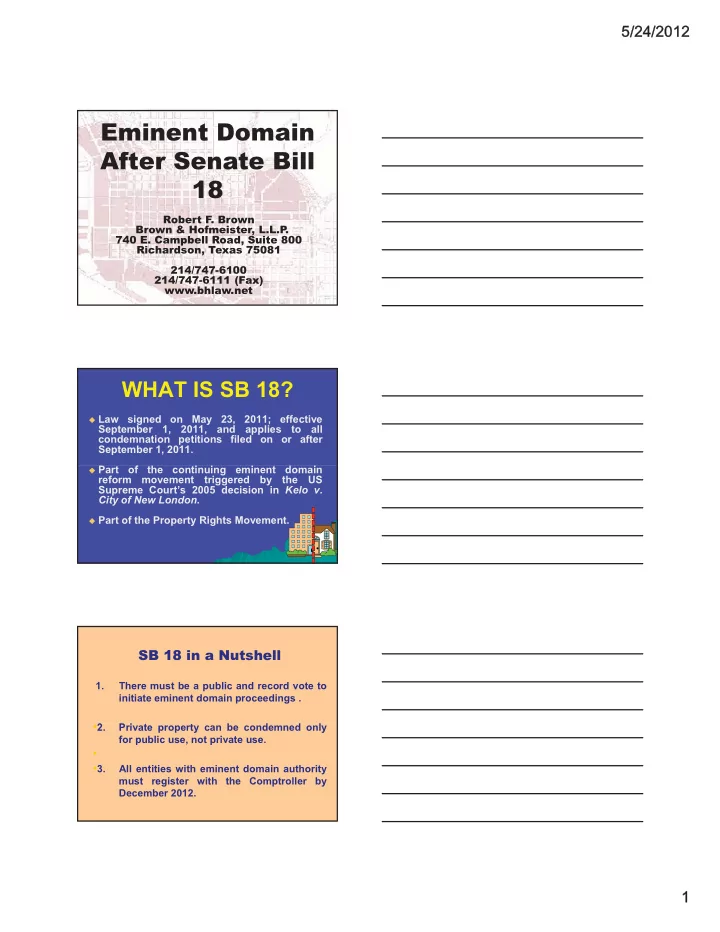
Eminent Domain After Senate Bill 18 Robert F . Brown Brown & Hofmeister, L.L.P . 740 E. Campbell Road, Suite 800 Richardson, Texas 75081 214/747-6100 214/747-6111 (Fax) www.bhlaw.net WHAT IS SB 18?


slide-1
SLIDE 1
  • Eminent Domain

After Senate Bill 18

Robert F . Brown Brown & Hofmeister, L.L.P . 740 E. Campbell Road, Suite 800 Richardson, Texas 75081 214/747-6100 214/747-6111 (Fax) www.bhlaw.net

WHAT IS SB 18?

Law

signed

  • n

May 23, 2011; effective September 1, 2011, and applies to all condemnation petitions filed on or after September 1, 2011. P t f th ti i i t d i

Part

  • f

the continuing eminent domain reform movement triggered by the US Supreme Court’s 2005 decision in Kelo v. City of New London.

Part of the Property Rights Movement.

SB 18 in a Nutshell

1. There must be a public and record vote to initiate eminent domain proceedings . 2 P i t t b d d l

  • 2.

Private property can be condemned only for public use, not private use.

  • 3.

All entities with eminent domain authority must register with the Comptroller by December 2012.

slide-2
SLIDE 2
  • SB 18 in a Nutshell

4. Condemning entities must make a bona fide offer in writing and, if not, pay the landowner’s expenses and attorney’s fees.

  • 5.

Landowners will be compensated for damages from a loss of direct access to their property. Landowners will receive relocation assistance when forced to move off of their property.

  • SB 18 in a Nutshell
  • 6. Under

certain conditions, landowners will have the right to repurchase their condemned p land at the original price (not market price) if it is not used for the public use for which it was condemned within 10 years.

“Public Use” vs. “Public Purpose”

  • C

Clarified that takings must be for a public use.

  • A

Amended laws to remove “public purpose” and replaced it with “public use.”

  • A

Avoid “public purpose” in your condemnations.

slide-3
SLIDE 3
  • Truth in Condemnation

Procedures Act

New Procedures to Initiate

Condemnation Proceedings.

Government Code Chapter 2206. Designed to Promote Transparency and

Accountability for Initiations of Condemnations.

Required Agenda Notice

Must state that the city may consider

using eminent domain.

Can

no longer “discuss land acquisition” in executive session and upon returning from executive session “take appropriate action.”

Record Vote Required

Minutes should reflect and identify each person who voted for the motion, who voted for the motion, who voted against motion and, if applicable, who abstained from voting.

slide-4
SLIDE 4
  • Approval Motion

The new law requires that the approval motion to adopt an ordinance, resolution

  • r order authorizing condemnation state

the following phrase, or a phrase that is substantially similar to the following phrase: “I move that the (name

  • f

governmental entity) authorize the use of the power of eminent domain to acquire (describe the property) for (describe the public use).”

Property Description

Property description in approval motion must be good enough for condemnation petition. The sufficiency of a condemnation petition’s description of the property to be condemned is tested by the standards used for adequacy

  • f

description in a deed.

Property Description

While a metes and bounds description is not required in the condemnation motion, the property does need to be described with does need to be described with enough certainty and specificity that a surveyor, using the description, could locate the described property

  • n the ground.
slide-5
SLIDE 5
  • Combined or Separate

Motions to Condemn

  • Depends on whether project is for water,

waste water, flood control or drainage. Si l d ti di

Single

condemnation

  • rdinance
  • r

resolution can be used for these projects.

  • If

Council Member

  • bjects

to single motion for all properties, must take record vote on each tract.

Specific Property Identifications

For water, waste water, flood control and drainage projects, can use a map to show “the general area to be covered by the project or the general route” that will be used by the city as long as it provides “reasonable notice” that property may be condemned.

Specific Property Identifications

For other projects, like road projects, the city will have to identify each separate property interest to be acquired and describe such interests with enough certainty and specificity that a surveyor, using the description, could locate the described property

  • n the ground.
slide-6
SLIDE 6
  • Sunset Provisions

Government

Code Section 2206.101 requires that all entities, whether they be governmental

  • r

private, that possess the power of eminent domain to identify each provision of law that grants such power in a letter to the State Comptroller. The letter must be submitted by December 31, 2012. Failure to submit the required letter results in the expiration of that entity’s condemnation power.

Property Code Chapter 21 Changes

Property Code Chapter 21 governs condemnation procedures procedures. SB 18 creates additional

  • bligations on condemning

cities.

Disclosure of Appraisal Reports

With initial offer letter, city must send

all appraisals on property for last ten years.

Landowner only required to disclose

the appraisal upon which he relies in his opinion of value; must be disclosed 3 business days before SC hearing (10 days under old law).

slide-7
SLIDE 7
  • No Confidentiality Restrictions

A

city may not include a confidentiality provision in any offer or purchase agreement.

The city must inform the owner of his right to

discuss the offer or agreement with others, or to keep the offer or agreement confidential, subject to the city’s disclosure obligations under the Public Information Act.

Bona Fide Offer Required and Defined

  • Prerequisite to maintain condemnation

proceeding.

  • The final offer must be based on a

written appraisal from a certified appraiser.

  • The final offer letter must include the

deed, easement or other conveyance instrument.

Bona Fide Offer Required and Defined

The final offer letter must provide the

  • wner

at least 14 days to respond before the city may file suit. If the trial court determines that the city did not make the required bona fide

  • ffer

prior to instituting a condemnation suit, the court shall abate, but not dismiss, the suit; pay attorney’s fees and expenses.

slide-8
SLIDE 8
  • Petition Changes

City must state “with specificity” the public “use”

(vs. the public “purpose”) for which the city intends to acquire the property to acquire the property.

City must plead that it has made the required bona

fide offer.

The following language will suffice:

“The City, through its duly authorized agent, made a bona fide

  • ffer to acquire the required property interests from

the fee simple owner of the property voluntarily as provided by Texas Property Code Section 21.0113.”

Commissioners’ Hearing

SB Bill 18 requires the court to give each party “a reasonable period to strike one of the three commissioners appointed by the judge.” pp y j g Requires that the special commissioners not convene a hearing “before the 20th day after the date the special commissioners were appointed.”

Commissioners’ Hearing

Notice

  • f

the special commissioners’ hearing must be served on a party not later than 20th (formerly the 11th) day before the (formerly the 11th) day before the day set for the hearing. New law adds around 40 to 50 days to the process allowed under the old law.

slide-9
SLIDE 9
  • Right to

Repurchase

If land not used for particular public use for which land was condemned within 10 years (or at least some within 10 years (or at least some substantial progress towards the use has not

  • ccurred),

landowner can repurchase at the price paid for the land by the city.

Right to Repurchase

SB gives the

  • wner
  • f

the property a right to “progress reports”

  • n

the status

  • f

whether or not the property condemned is being used for the public use for which it was condemned.

Mandatory Relocation Assistance Program

Cities

are required to provide a relocation assistance program for the displacement of persons or entities due to an acquisition of real property to an acquisition of real property.

Follows

Federal Uniform Relocation Assistance and Real Property Acquisition Policies Act of 1970, 42 USC §§ 4622-4626, on expenditure limits.

slide-10
SLIDE 10
  • Mandatory Relocation

Assistance Program

Residential displacees reimbursement for reasonable moving costs up to a 50-mile g p distance, purchase supplements of up to $22,500 or rental assistance payments up to $5,250 per month for 42-months.

Mandatory Relocation Assistance Program

Businesses, farms and nonprofit

  • rganizations

displaced by condemnation may be reimbursed y

  • n the basis of actual reasonable

moving costs and related expenses

  • r, under certain circumstances, a

fixed payment of up to $20,000.

Changes in Access Impairment Compensability Standard

Property Code Section 42.042, regarding the assessment of damages, d d b ll i d f amended by allowing damages for “material impairment of direct access on

  • r
  • ff

the remaining property that affects the market value

  • f

the remaining property.”

slide-11
SLIDE 11
  • Changes in Access Impairment

Compensability Standard

  • Cannot consider an injury or benefit that the

property owner experiences in common with the general community including circuity of the general community, including circuity of travel and diversion of traffic.

  • “Direct access” defined as “ingress and

egress on or off a public road, street, or highway at a location where the remaining property adjoins that road, street,

  • r

highway.”

Changes in Access Impairment Compensability Standard

The prior standard of “material and substantial impairment of access” focused on access to the entire remainder and asked whether there was entire remainder and asked whether there was still “reasonable access” to the remainder after the city’s restriction of access. Access to a different secondary public road could constitute reasonable access resulting in a finding of no material and substantial impairment of access.

Changes in Access Impairment Compensability Standard

The new standard focuses on direct access to the property from the road. The operative factors are whether the impairment to “direct factors are whether the impairment to direct access” (ingress and egress on and off the remaining property to or from the improved road) is “material” and, if so, whether it “affects the market value of the remaining property.”

slide-12
SLIDE 12
  • Bottom Line on SB 18

Land acquisition will take more time, involve

more risk, and cost more.

City Attorneys will need to remain diligent to

comply with the law’s new requirements as comply with the law s new requirements as the new legal landscape is filled with landmines, booby-traps and quicksand designed to impede, if not totally derail, legitimate condemnation efforts.

Eminent Domain After Senate Bill 18

Robert F . Brown Brown & Hofmeister, L.L.P . 740 E. Campbell Road, Suite 800 Richardson, Texas 75081 214/747-6100 214/747-6111 (Fax) www.bhlaw.net