
SLIDE 1
ELDER WORK
Regaining the Straying
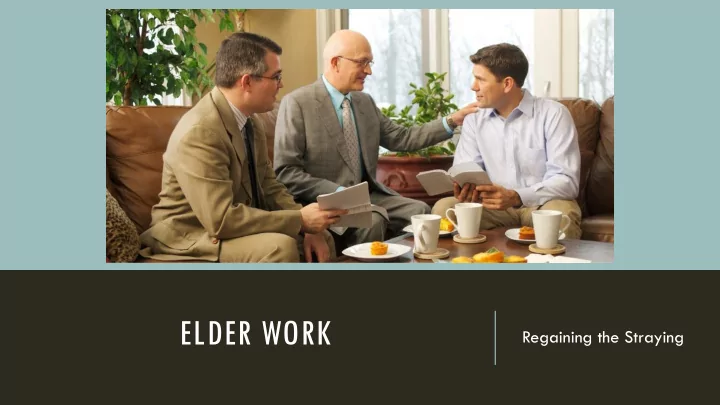
ELDER WORK Regaining the Straying OUR ATTITUDE TOWARD THE STRAYING - - PowerPoint PPT Presentation
ELDER WORK Regaining the Straying OUR ATTITUDE TOWARD THE STRAYING What terms have been used to describe congregation members who neglect word and sacrament? What kind of attitude do those terms reflect toward those who are neglecting the
Regaining the Straying
What terms have been used to describe congregation members who neglect word and sacrament? What kind of attitude do those terms reflect toward those who are neglecting the means of grace?
Rid yourselves of all the offenses you have committed, and get a new heart and a new spirit. Why will you die, people of Israel? For I take no pleasure in the death of anyone, declares the Sovereign LORD. Repent and live! (Ezekiel 18:31-32) “Jerusalem, Jerusalem, you who kill the prophets and stone those sent to you, how often I have longed to gather your children together, as a hen gathers her chicks under her wings, and you were not willing. (Luke 13:34)
What do you think? If a man has a hundred sheep and one of them goes astray, will he not leave the ninety-nine on the hills and go
finds it, truly I tell you, he rejoices more over that
go astray (Matthew 18:12,13)
Law Let the prophet who has a dream recount the dream, but let the one who has my word speak it faithfully. For what has straw to do with grain?” declares the LORD. “Is not my word like fire,” declares the LORD, “and like a hammer that breaks a rock in pieces? (Jeremiah 23:28,29) Gospel For I am not ashamed of the gospel, because it is the power of God that brings salvation to everyone who believes: first to the Jew, then to the Gentile. For in the gospel the righteousness of God is revealed—a righteousness that is by faith from first to last, just as it is written: “The righteous will live by faith.” (Romans 1:16,17)
Remember the Sabbath day by keeping it holy. (Exodus 20:8) But grow in the grace and knowledge of our Lord and Savior Jesus Christ. To him be glory both now and forever!
And let us consider how we may spur one another on toward love and good deeds, not giving up meeting together, as some are in the habit of doing, but encouraging one another—and all the more as you see the Day approaching. If we deliberately keep on sinning after we have received the knowledge of the truth, no sacrifice for sins is left, but only a fearful expectation of judgment and of raging fire that will consume the enemies
"Come now, let us settle the matter," says the LORD. "Though your sins are like scarlet, they shall be as white as snow; though they are red as crimson, they shall be like wool. (Isaiah 1:18)
“But while he was still a long way off, his father saw him and was filled with compassion for him; he ran to his son, threw his arms around him and kissed him. “The son said to him, ‘Father, I have sinned against heaven and against you. I am no longer worthy to be called your son.’ “But the father said to his servants, ‘Quick! Bring the best robe and put it on him. Put a ring on his finger and sandals on his
was lost and is found.’ So they began to celebrate. (Luke 15:20-24)
Upset or offended by someone or something in the church. Health issues Doctrinal disagreement. Entertainment: sports, arts, movies, video games Work Worldliness Guilt/Shame
Share approaches you have used to regain the straying. What corresponding perception did that approach evoke?
What is the desired perception we want the straying to have of our visit? How might we adjust our approach to better avoid our gospel encouragement coming across as law?
Why do we plan for the work of Elders and how do we carry out the plan
Why do we need a plan to reach those who are not attending regularly?
What prevents us from having such a plan? What makes it difficult to carry it out?
What is your plan currently for reaching out to those not attending? How effective is this plan?
We need to have data:
What data do we need? How do we record the data? Where do we store this data? Who has access to this data?
We need to have people to do the work:
How many do we need? Who should be chosen and how? How do we go about training them?
You can Find it at https://welscongregationalservices.net/download/d001/ “A system that lovingly addresses absenteeism through a series
absent person to return to worship. After repeated discussions, the contact includes loving admonition to follow God’s directive to make faithful use of the means of grace.” A number of scripts, letters, report forms etc. are included in the information on the website
Oversees plan Provides training for Discipleship Committee members and Elders Makes some of the visits at set stages
Service position (Can be carried out by any spiritually mature person) Confidentiality and organization a must Could be paid position/secretarial duty Sees that data is entered into computer program for tracking attendance Prints out lists of those absent and conveys to appropriate person (pastor, head elder or elder)
Position of authority. Must be a man of high spiritual maturity. Works closely with pastor to assign individuals on 4 week absentee list to a member of the Discipleship Committee and to an elder Seeks to match Discipleship Committee member and elder to the individual on basis of some connection to the individual
Position of authority. Must be a man of high spiritual maturity. A “caseworker” for those persistently absent Receives from head elder names of individuals absent for 4 weeks Manages the report form for those individuals
Service position Receives list from Head Elder of those absent 4 weeks. Makes contact with the member to see if there is a reason for them being absent Reports contact and information gathered to assigned elder
Member of Discipleship Committee assigned to individual makes contact with member Receives information about absence from member Encourages return Reports contact and information gathered to assigned elder
The pastor contacts the absent individual by phone. The tone is still one of encouragement. He may schedule a meeting with the absent individual. Reports contact and information gathered to assigned elder
An elder sends the absent member a letter that outlines concern. The elder then follows up on that letter shortly after. He may schedule a meeting with the absent individual. The primary goal of this contact is still encouragement, not admonition. After this contact, the absent member will have had three different individuals try to encourage him to return.
The pastor sends a letter to the absent member, explaining the seriousness of the situation. The letter also indicates the pastor desires to meet with the absent member face-to-face sometime that week. At this time—close to six months absent from worship— encouragement must be followed by loving admonition and, if necessary, rebuke. Reports contact and information gathered to assigned elder
The same elder who wrote and visited the absent member at twelve weeks attempts a “pop in” (unannounced) visit on the absent member. Goal is to provide further warning and admonition to the absent member. This is done, however, with a spirit of gentleness and love. The member should feel that he is genuinely missed and cared for. The elder is visiting out of a spirit of concern, not anger or judgment.
The same elder who has been working with the absent individual sends a joint letter with the pastor. This is now the third letter that has been sent. It expresses concern that repeated admonition from both the elder and the pastor has not been heeded. It makes clear that if the member does not return to worship attendance, the congregation will eventually have to enact church discipline.
The elder and pastor schedule a visit with the absent member. If the absent member refuses that visit, either the pastor or elder can attempt to have this final conversation by phone. If that is refused, the process goes to Step 9.
A letter is sent by the pastor, informing the individual he is no longer a member. At next voters meeting the individual is either released or excommunicated as appropriate
A person may return for a Sunday or two and fall into previous practice The elder and pastor will want to discuss next steps on an individual basis Likely would skip several of these steps in that situation if no longer term change is noted
What do you like about the Peter Plan? What would you improve on the Peter Plan? What would be the most difficult obstacle if you were to implement something like the Peter Plan?
Video based course available in the Congregational Services material on the synod website: https://welscongregationalservices.net/downloa d/d001/#wpdmpp-product-files An older resource but has valuable material in it: https://online.nph.net/books/theology- doctrine/pastoral-theology/shepherds- assistants.html