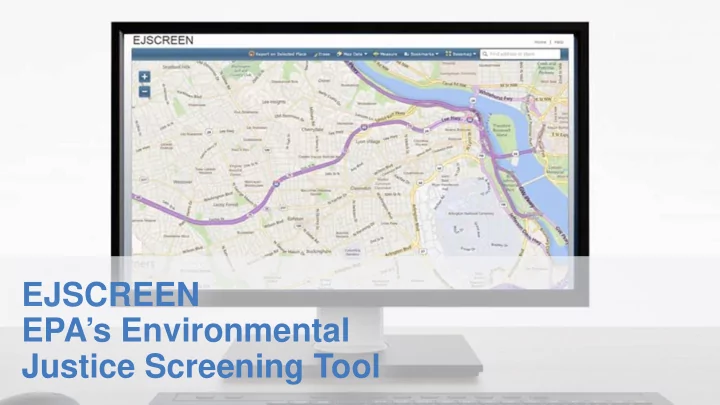
EJSCREEN EPAs Environmental Justice Screening Tool E JSCRE E N - - PowerPoint PPT Presentation
EJSCREEN EPAs Environmental Justice Screening Tool E JSCRE E N E PAS AS E E NVIR VIRONME NTAL SCRE CRE E E N NING TO G TOOL EJSCREEN Key Features EJ Indexes Combine demographic and environmental data to highlight
E JSCRE E N E PA’S A’S E E NVIR VIRONME NTAL SCRE E N CRE E NING TO G TOOL
EJSCREEN Key Features
page 07
Combine demographic and environmental data to highlight vulnerable/susceptible populations
EJ Indexes
from most recent U.S. Census Bureau American Community Survey (ACS).
Annually Updated Data
Standard printable reports, maps, and bar graphs
Accessible and Intuitive
Census block group and tracts for units
- f analysis
High Resolution Data
About Vulnerability
page 04
social determinants
How we… are born grow live learn work play
distribution factors
Race Ethnicity Social Standing Income Education
About Susceptibility
page 05
nutritional status age biological factors gender pre-existing diseases
Understand these caveats before using
page 10
- Environmental indicators are mostly screening-level proxies for
actual exposure or risk.
- Indicators vary in vintage. Estimates are based on historical data.
and may not reflect current or future conditions.
- EJSCREEN does not cover all environmental issues.
- EJSCREEN does not identify “EJ communities.”
UNITS OF ANALYSIS
United States State
primary governmental divisions of the United States.
County
Largest divisions within states.
Census Tract
Collection of Census block groups, mostly between 1,200 and 8,000 people.
Block Group
Collection of residential blocks, mostly, between 600 and 3,000 people.
Block
Residential block, bounded on all sides by streets.
Results are ranked as percentiles
page 10
- Percentiles put indicators into common
units of 0 – 100.
- For example, a place at the 80th
percentile nationwide means 20% of the US population has a higher value.
- Ranking values as percentiles allows comparison of indicators measured with