Efficient and Reliable Lock-Free Memory Introduction The Problem - - PDF document

efficient and reliable lock free memory
SMART_READER_LITE
LIVE PREVIEW

Efficient and Reliable Lock-Free Memory Introduction The Problem - - PDF document

Outline Efficient and Reliable Lock-Free Memory Introduction The Problem Reclamation Lock-free synchronization Based on Reference Counting Our solution Anders Gidenstam, Marina Papatriantafilou, Idea Hkan Sundell and


slide-1
SLIDE 1

1

Efficient and Reliable Lock-Free Memory Reclamation

Based on Reference Counting

Anders Gidenstam, Marina Papatriantafilou, Håkan Sundell and Philippas Tsigas

Distributed Computing and Systems group, Department of Computer Science and Engineering,

Chalmers University of Technology

2

Outline

 Introduction  The Problem  Lock-free synchronization  Our solution  Idea  Properties  Experiments  Conclusions

3

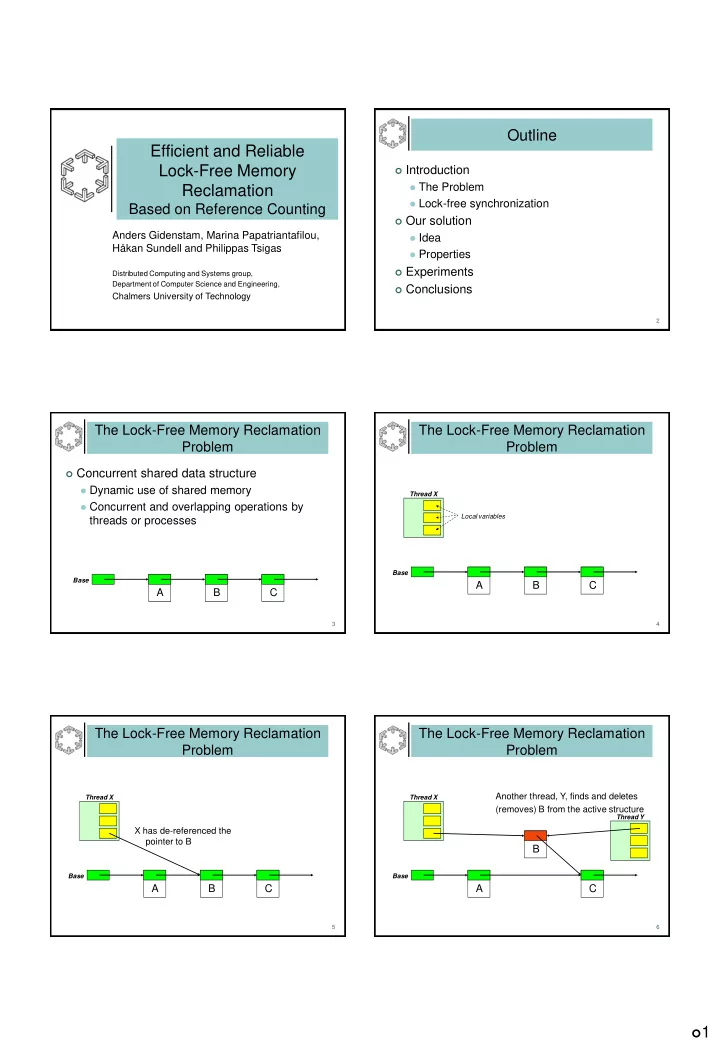
The Lock-Free Memory Reclamation Problem

 Concurrent shared data structure  Dynamic use of shared memory  Concurrent and overlapping operations by

threads or processes

A B C

Base

4

A B C

The Lock-Free Memory Reclamation Problem

Thread X Base Local variables

5

A B C

The Lock-Free Memory Reclamation Problem

Thread X Base

X has de-referenced the pointer to B

6

A B C

The Lock-Free Memory Reclamation Problem

Thread X Base

Another thread, Y, finds and deletes (removes) B from the active structure

Thread Y

slide-2
SLIDE 2

2

7

A B C

The Lock-Free Memory Reclamation Problem

Thread X Base

Thread Y wants to reclaim(/free) B

Thread Y

?

Property I: A (de-)referenced node is not reclaimed

8

A C D

The Lock-Free Memory Reclamation Problem

Thread X Base

?

The nodes B and C are deleted from the active structure.

B Property II: Links in a (de-)referenced node should always be de-referencable.

9

The Lock-Free Memory Reclamation Problem

Thread X Base

A

1

D

2

B

1

C

1

Solutions?

 Garbage collection?  Reference counting?

Needs to be lock-free!

10

Lock-free synchronization

 A lock-free shared data structure

 Allows concurrent operations without enforcing

mutual exclusion (i.e. no locks)

 Guarantees that at least one operation always

makes progress

 Avoids:

  • Blocking, deadlock and priority inversion

 Hardware synchronization primitives

 Built into CPU and memory system

  • Typically: atomic read-modify-write instructions

Examples

  • Test-and-set, Compare-and-Swap, Load-Linked / Store-Conditional

11

Previous solutions

 Hazard Pointers  Michael 2002  “Secure your foothold”

Thread X Base

Thread X

A B C

12

Previous solutions

 Hazard Pointers  Michael 2002  “Secure your foothold”

Thread X Base

Thread X

A B C

slide-3
SLIDE 3

3

13

Previous solutions

 Hazard Pointers  Michael 2002  “Secure your foothold”

Thread X Base

Thread X

A B C

Thread Y removes A from the structure

14

Previous solutions

 Hazard Pointers  Michael 2002  “Secure your foothold”

Thread X Base

Thread X

A B C

?

15

Previous solutions

 Hazard Pointers  Michael 2002  “Secure your foothold”

Thread X Base

Thread X

A C

?!

B

Thread Z removes B from the structure and deletes B.

16

Previous solutions

 Lock-free Reference Counters  Valois + Michael & Scott 1995  Detlefs et al. 2001  Herlihy et al. 2002

Thread X Base

A

1

B

1

C

1 17

 Lock-free Reference Counters  Valois + Michael & Scott 1995  Detlefs et al. 2001  Herlihy et al. 2002

Previous solutions

Thread X Base

A

1

B

2

C

1 18

 Lock-free Reference Counters  Valois + Michael & Scott 1995  Detlefs et al. 2001  Herlihy et al. 2002

Previous solutions

Thread X Base

A

1

B

1

C

2

Thread Y removes B from the structure

slide-4
SLIDE 4

4

19

 Lock-free Reference Counters  Valois + Michael & Scott 1995  Detlefs et al. 2001  Herlihy et al. 2002

Previous solutions

Thread X Base

A

1

B

1

C

2

?

20

Previous solutions

Thread X Base

A

1

B

1

C

1

?

Thread Z removes C from the structure.

 Lock-free Reference Counters  Valois + Michael & Scott 1995  Detlefs et al. 2001  Herlihy et al. 2002

21

 Lock-free Reference Counting  Valois + Michael & Scott 1995  Detlefs et al. 2001  Herlihy et al. 2002  Remaining issues  A slow thread might prevent reclamation  Cyclic garbage  Implementation practicality issues

 Reference-count field MUST remain forever (Valois + Michael &

Scott)

 Needs double word CAS (Detlefs et al.)  Needs double width CAS (Herlihy, 2002)  Large overhead

Previous solutions

B

1

C

1

A

1

Slow

22

Our approach – The basic idea

 Combine the best of  Hazard pointers (Michael 2002)

  • Tracks references from threads
  • Fast de-reference
  • Upper bound on the amount of unreclaimed deleted nodes
  • Compatible with standard memory allocators

 Reference counting

  • Tracks references from links in shared memory
  • Manages links within dynamic nodes
  • Safe to traverse links (also) in deleted nodes

 Practical  Uses only single-word Compare-And-Swap

23

The basic idea

 API  DeRefLink  ReleaseRef  CompareAndSwapRef  StoreRef  NewNode  DeleteNode

Thread X

Hazard pointers Base

A

1

B

1

C

1

Thread X

Deletion list 24

The basic idea

 API  DeRefLink  ReleaseRef  CompareAndSwapRef  StoreRef  NewNode  DeleteNode

Thread X

Hazard pointers Base

A

1

B

1

C

1

Thread X

Deletion list

slide-5
SLIDE 5

5

25

The basic idea

 API  DeRefLink  ReleaseRef  CompareAndSwapRef  StoreRef  NewNode  DeleteNode

Thread X

Hazard pointers Base

A

1

B

1

C

1

Thread X

Deletion list 26

The basic idea

 API  DeRefLink  ReleaseRef  CompareAndSwapRef  StoreRef  NewNode  DeleteNode

Thread X

Hazard pointers Base

A

1

B

1

C

1

Thread X

Deletion list

D

27

The basic idea

 API  DeRefLink  ReleaseRef  CompareAndSwapRef  StoreRef  NewNode  DeleteNode

C

Thread X

Hazard pointers Base

A

1

B

1

C

2

Thread X

C

Deletion list

D

28

The basic idea

 API  DeRefLink  ReleaseRef  CompareAndSwapRef  StoreRef  NewNode  DeleteNode

B C A

Thread X

Hazard pointers Base

A

1

B C

2

Thread X

C A

Deletion list

D

1

B

29

The basic idea

 API  DeRefLink  ReleaseRef  CompareAndSwapRef  StoreRef  NewNode  DeleteNode

Thread X

Hazard pointers Base

A

1

B C

2

Thread X

Deletion list

D

1 30

Breaking chains of garbage

Thread X

Hazard pointers Base

A

1

B

1

E

2

Thread X

Deletion list

C D

1

 Clean-up deleted nodes  Update links to point to

live nodes

 Performed on nodes in

  • Own deletion list
  • All deletion lists
slide-6
SLIDE 6

6

31

Breaking chains of garbage

 Clean-up deleted nodes  Update links to point to

live nodes

 Performed on nodes in

  • Own deletion list
  • All deletion lists

Thread X

Hazard pointers Base

A

1

B

1

E

3

Thread X

Deletion list

C D

32

Bound on unreclaimed nodes

 A deleted node can be reclaimed when  The reference count is zero and  No hazard pointer is pointing to it and  There is no ongoing clean-up of this node  With a rate relative to the number of threads of  Scanning hazard pointers  Cleaning up nodes as needed  Then the maximum size of each deletion list depends on  The number of hazard pointers  The number of links per node  The number of threads 33

Experimental evaluation

 Lock-free deque (Sundell and Tsigas 2004)

(deque – double-ended queue)

 The algorithm needs traversal of deleted nodes  10000 random operations/thread  Tested memory reclamation schemes  Reference counting, Valois et al.  The new algorithm  Systems  4 processor Xeon PC / Linux (UMA)  8 processor SGI Origin 2000 / IRIX (NUMA)

34

Experimental evaluation

35

Experimental evaluation

36

Conclusions

 First lock-free memory reclamation scheme

that

 Only uses atomic primitives available in

contemporary architectures

 Guarantees safety of

  • Local and
  • Global references

 Has an upper bound on the amount of deleted

but unreclaimed nodes

 Allows arbitrary reuse of memory