EECS 373 Homework 2 was posted on 1/13 is due on 1/20 Design of - - PDF document

eecs 373
SMART_READER_LITE
LIVE PREVIEW

EECS 373 Homework 2 was posted on 1/13 is due on 1/20 Design of - - PDF document

Announcements EECS 373 Homework 2 was posted on 1/13 is due on 1/20 Design of Microprocessor-Based Systems No office hours next week Prabal Dutta University of Michigan Lecture 3: Assembly, Tools, and ABI January 15, 2015 Slides


slide-1
SLIDE 1

1

EECS 373

Design of Microprocessor-Based Systems

Prabal Dutta

University of Michigan Lecture 3: Assembly, Tools, and ABI January 15, 2015

Slides developed in part by Mark Brehob & Prabal Dutta 2

Announcements

  • Homework 2 was posted on 1/13 is due on 1/20
  • No office hours next week

Today… Walk though of the ARM ISA Software Development Tool Flow Application Binary Interface (ABI)

3 4

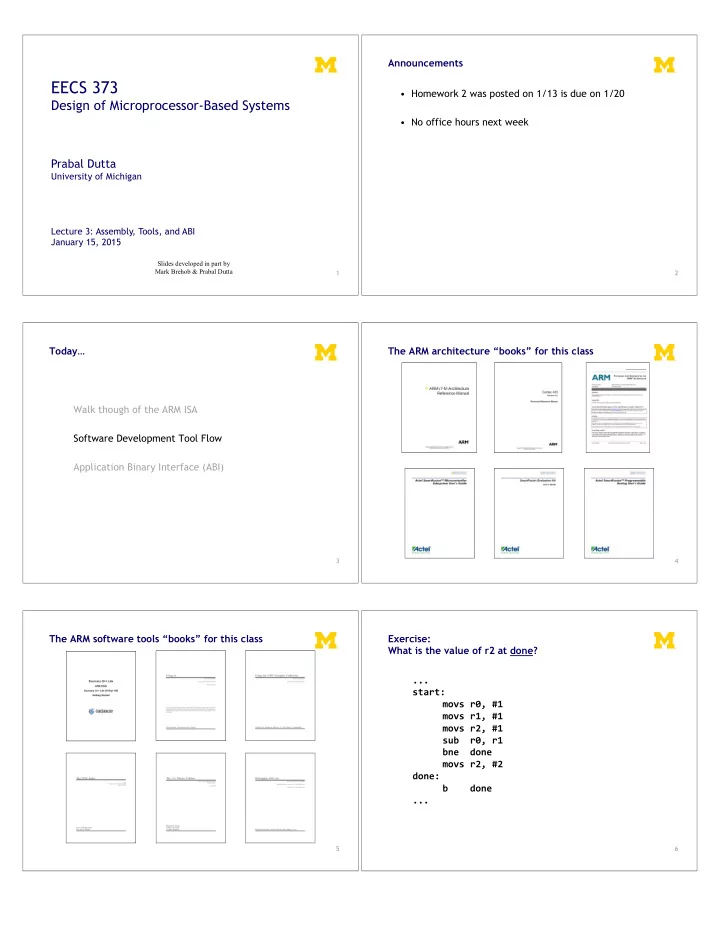
The ARM architecture “books” for this class

5

The ARM software tools “books” for this class

6

..." start:" "movs"r0,"#1" "movs"r1,"#1" "movs"r2,"#1" "sub""r0,"r1" "bne""done" "movs"r2,"#2" done:" "b""""done" ..." Exercise: What is the value of r2 at done?

slide-2
SLIDE 2

Updating the APSR

  • SUB Rx, Ry

– Rx = Rx - Ry – APSR unchanged

  • SUBS

– Rx = Rx - Ry – APSR N, Z, C, V updated

  • ADD Rx, Ry

– Rx = Rx + Ry – APSR unchanged

  • ADDS

– Rx = Rx + Ry – APSR N, Z, C, V updated

Application Program Status Register (APSR) Conditional execution: Append to many instructions for conditional execution

10

..." start:" "movs"r0,"#1 "//"r0"!"1,"Z=0" "movs"r1,"#1 "//"r1"!"1,"Z=0" "movs"r2,"#1 "//"r2"!"1,"Z=0" "sub""r0,"r1 "//"r0"!"r08r1" " " " "//"but"Z"flag"untouched " " " " "//"since"sub"vs"subs" "bne""done " "//"NE"true"when"Z==0" " " " "//"So,"take"the"branch" "movs"r2,"#2 "//"not"executed" done:" "b""""done " "//"r2"is"still"1" ..." Solution: what is the value of r2 at done?

11 ".equ "STACK_TOP,"0x20000800 "/*"Equates"symbol"to"value"*/" ".text " " " "/*"Tells"AS"to"assemble"region"*/" ".syntax"unified" " "/*"Means"language"is"ARM"UAL"*/" ".thumb " " " "/*"Means"ARM"ISA"is"Thumb"*/" ".global"_start " " "/*".global"exposes"symbol"*/" " " " " "/*"_start"label"is"the"beginning"*/" " " " " "/*"...of"the"program"region"*/" ".type "start,"%function " "/*"Specifies"start"is"a"function"*/" " " " " "/*"start"label"is"reset"handler"*/" _start:" " " " "" ".word "STACK_TOP,"start " "/*"Inserts"word"0x20000800"*/" " " " " "/*"Inserts"word"(start)"*/" start: " " " " "" "movs"r0,"#10 " " "/*"We’ve"seen"the"rest"..."*/" "movs"r1,"#0 " " "" loop: " " " " "" "adds"r1,"r0 " " "" "subs"r0,"#1 " " "" "bne""loop " " "" deadloop: " " " "" "b""""deadloop " " "" ".end" "

Real assembly example

12 ".equ "STACK_TOP,"0x20000800 "/*"Sets"symbol"to"value"(#define)*/" ".text " " " "/*"Tells"AS"to"assemble"region"*/" ".syntax"unified" " "/*"Means"language"is"ARM"UAL"*/" ".thumb " " " "/*"Means"ARM"ISA"is"Thumb"*/" ".global"_start " " "/*".global"exposes"symbol"*/" " " " " "/*"_start"label"is"the"beginning"*/" " " " " "/*"...of"the"program"region"*/" ".type "start,"%function " "/*"Specifies"start"is"a"function"*/" " " " " "/*"start"label"is"reset"handler"*/" _start:" " " " "" ".word "STACK_TOP,"start " "/*"Inserts"word"0x20000800"*/" " " " " "/*"Inserts"word"(start)"*/" start: " " " " "" "movs"r0,"#10 " " "/*"We’ve"seen"the"rest"..."*/" "movs"r1,"#0 " " "" loop: " " " " "" "adds"r1,"r0 " " "" "subs"r0,"#1 " " "" "bne""loop " " "" deadloop: " " " "" "b""""deadloop " " "" ".end" "

What’s it all mean?

slide-3
SLIDE 3

What happens after a power-on-reset (POR)?

  • ARM Cortex-M3 (many others are similar)
  • Reset procedure

– SP ! mem(0x00000000) – PC ! mem(0x00000004)

_start:' '.word'__STACKTOP ' '/*'Top'of'Stack'*/' '.word'Reset_Handler ' '/*'Reset'Handler'*/' '.word'NMI_Handler ' '/*'NMI'Handler'*/' '.word'HardFault_Handler '/*'Hard'Fault'Handler'*/' '.word'MemManage_Handler '/*'MPU'Fault'Handler'*/' '.word'BusFault_handler '/*'Bus'Fault'Handler'*/' '...'

13

Today… Walk though of the ARM ISA Software Development Tool Flow Application Binary Interface (ABI)

14 15

How does an assembly language program get turned into a executable program image?

Assembly " files"(.s) " Object " files"(.o) " as " (assembler) " ld " (linker) "

" Memory " layout "

Linker " script"(.ld) " Executable " image"file " Binary"program " file"(.bin) " Disassembled " code"(.lst) " 16

What are the real GNU executable names for the ARM?

  • Just add the prefix “arm-none-eabi-” prefix
  • Assembler (as)

– arm-none-eabi-as

  • Linker (ld)

– arm-none-eabi-ld

  • Object copy (objcopy)

– arm-none-eabi-objcopy

  • Object dump (objdump)

– arm-none-eabi-objdump

  • C Compiler (gcc)

– arm-none-eabi-gcc

  • C++ Compiler (g++)

– arm-none-eabi-g++

Real-world example

  • To the terminal!

(code at https://github.com/brghena/eecs373_toolchain_examples)

17 18 $"arm8none8eabi8as"8mcpu=cortex8m3"8mthumb"example1.s"8o"example1.o" " "

How are assembly files assembled?

  • $ arm-none-eabi-as

– Useful options

  • -mcpu
  • -mthumb
  • -o
slide-4
SLIDE 4

19 all:" "arm8none8eabi8as"8mcpu=cortex8m3"8mthumb"example1.s"8o"example1.o" "arm8none8eabi8ld"8Ttext"0x0"8o"example1.out"example1.o" "arm8none8eabi8objcopy"8Obinary"example1.out"example1.bin" "arm8none8eabi8objdump"8S"example1.out">"example1.lst"

A simple (hardcoded) Makefile example

20

What information does the disassembled file provide?

".equ "STACK_TOP,"0x20000800"" ".text" ".syntax "unified" ".thumb" ".global "_start" ".type "start,"%function" " _start:" ".word "STACK_TOP,"start" start:" "movs"r0,"#10" "movs"r1,"#0" loop:" "adds"r1,"r0" "subs"r0,"#1" "bne""loop" deadloop:" "b""""deadloop" ".end" " " example1.out:"""""file"format"elf328littlearm" " " Disassembly"of"section".text:" " 00000000"<_start>:" """0: "20000800" ".word "0x20000800" """4: "00000009" ".word "0x00000009" " 00000008"<start>:" """8: "200a"""""""movs "r0,"#10" """a: "2100"""""""movs "r1,"#0" " 0000000c"<loop>:" """c: "1809"""""""adds "r1,"r1,"r0" """e: "3801"""""""subs "r0,"#1" ""10: "d1fc"""""""bne.n "c"<loop>" " 00000012"<deadloop>:" ""12: "e7fe"""""""b.n "12"<deadloop> " "

all:" "arm8none8eabi8as"8mcpu=cortex8m3"8mthumb"example1.s"8o"example1.o" "arm8none8eabi8ld"8Ttext"0x0"8o"example1.out"example1.o" "arm8none8eabi8objcopy"8Obinary"example1.out"example1.bin" "arm8none8eabi8objdump"8S"example1.out">"example1.lst"

Linker script

OUTPUT_FORMAT("elf32-littlearm") OUTPUT_ARCH(arm) ENTRY(main) MEMORY { /* SmartFusion internal eSRAM */ ram (rwx) : ORIGIN = 0x20000000, LENGTH = 64k } SECTIONS { .text : { . = ALIGN(4); *(.text*) . = ALIGN(4); _etext = .; } >ram } end = .;

  • Specifies little-endian arm in ELF

format.

  • Specifies ARM CPU
  • Should start executing at label named

main

  • We have 64k of memory starting at
  • 0x20000000. You can read, write and

execute out of it. Weve named it ram

  • . is a reference to the current

memory location

  • First align to a word (4 byte) boundary
  • Place all sections that include .text at

the start (* here is a wildcard)

  • Define a label named _etext to be the

current address.

  • Put it all in the memory location

defined by the ram memory location. 21 22

How does a mixed C/Assembly program get turned into a executable program image?

Assembly " files"(.s) " Object " files"(.o) " as " (assembler) " gcc " (compile " +"link) "

" Memory " layout "

Linker " script"(.ld) " Executable " image"file " Binary"program " file"(.bin) " Disassembled " code"(.lst) " ld " (linker) " Library"object " files"(.o) " C"files"(.c) "

Real-world example #2

  • To the terminal! Again!

(code at https://github.com/brghena/eecs373_toolchain_examples)

23

Today… Finish ARM assembly example from last time Walk though of the ARM ISA Software Development Tool Flow Application Binary Interface (ABI)

24
slide-5
SLIDE 5

25

ABI Basic Rules

  • 1. A subroutine must preserve the contents of the

registers r4-11 and SP

– Lets be careful with r9 though.

  • 2. Arguments are passed though r0 to r3

– If we need more, we put a pointer into memory in one

  • f the registers.
  • Well worry about that later.
  • 3. Return value is placed in r0

– r0 and r1 if 64-bits.

  • 4. Allocate space on stack as needed. Use it as
  • needed. Put it back when done…

– Keep word aligned.

26

When is this relevant?

  • The ABI is a contract with the compiler

– All assembled C code will follow this standard

  • You need to follow it if you want C and Assembly

to work together correctly

  • What if you are writing everything in Assembly

by hand?

– Maybe less important. Unless you’re ever going to extend the code

27

Let’s write a simple ABI routine

  • int bob(int a, int b)

– returns a2 + b2

  • Instructions you might need

– add adds two values – mul multiplies two values – bx branch to register

Other useful facts

  • Stack grows down.

– And pointed to by sp

  • Address we need to go back to in lr

28 29

Questions? Comments? Discussion?