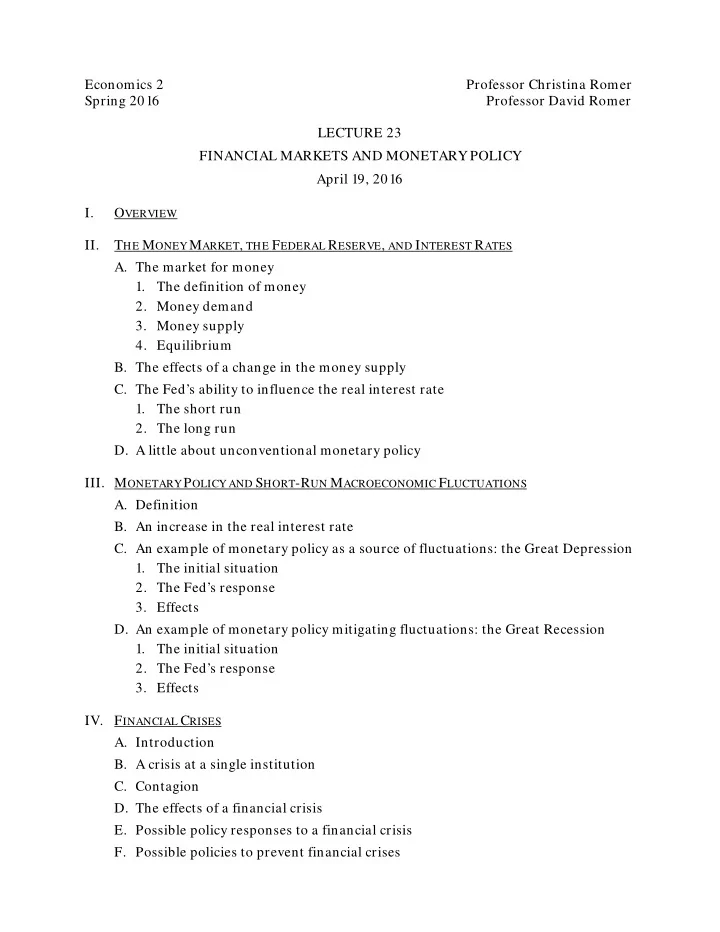
SLIDE 1 Economics 2 Professor Christina Romer Spring 2016 Professor David Romer LECTURE 23 FINANCIAL MARKETS AND MONETARY POLICY April 19, 2016 I. OVERVIEW
- II. THE MONEY MARKET, THE FEDERAL RESERVE, AND INTEREST RATES
- A. The market for money
- 1. The definition of money
- 2. Money demand
- 3. Money supply
- 4. Equilibrium
- B. The effects of a change in the money supply
- C. The Fed’s ability to influence the real interest rate
- 1. The short run
- 2. The long run
- D. A little about unconventional monetary policy
- III. MONETARY POLICY AND SHORT-RUN MACROECONOMIC FLUCTUATIONS
- A. Definition
- B. An increase in the real interest rate
- C. An example of monetary policy as a source of fluctuations: the Great Depression
- 1. The initial situation
- 2. The Fed’s response
- 3. Effects
- D. An example of monetary policy mitigating fluctuations: the Great Recession
- 1. The initial situation
- 2. The Fed’s response
- 3. Effects
- IV. FINANCIAL CRISES
- A. Introduction
- B. A crisis at a single institution
- C. Contagion
- D. The effects of a financial crisis
- E. Possible policy responses to a financial crisis
- F. Possible policies to prevent financial crises
SLIDE 2 LECTURE 23
Financial Markets and Monetary Policy
April 19, 2016
Economics 2 Christina Romer Spring 2016 David Romer
SLIDE 3 Announcement
- The only reading for next time is p. 674 of the
textbook.
SLIDE 5
Determination of Short-Run Output: The “Keynesian Cross”
Y PAE PAE Y=PAE Y1
SLIDE 6
- II. THE MONEY MARKET, THE FEDERAL RESERVE, AND
INTEREST RATES
SLIDE 7 Economists’ Definition of “Money”
- Assets that can be used to make purchases.
- Concretely, you can usually think of money as
meaning currency.
SLIDE 8 The Nominal Interest Rate and Money Demand
- Because you don’t earn interest on cash, the
- pportunity cost of holding money is what you
could earn on other assets.
- That is, the opportunity cost of holding money is
the nominal interest rate.
- So: Money demand is a decreasing function of the
nominal interest rate.
SLIDE 9
The Demand for Money
M i
SLIDE 10 Money Supply
- Determined by the central bank.
- The Fed decreases the money supply by selling
bonds in exchange for currency; it increases the money supply by buying bonds in exchange for currency.
- These transactions are known as “open-
market operations.”
- Usually, the bonds are short-term
government bonds.
- We take the money supply as given.
SLIDE 11
The Supply of Money
M i
SLIDE 12
Equilibrium in the Market for Money
M i MS M1 i1 MD
SLIDE 13
A Decrease in the Money Supply
M i MS1 M1 i1 MD1
SLIDE 14 The Fed’s Ability to Influence the Real Interest Rate—the Short Run
- By changing the money supply, the Fed can
change the nominal interest rate, i.
- Recall: r = i − π (or r = i − πe), and there is inflation
inertia (inflation only changes slowly).
- So: When the Fed changes i, it changes r.
SLIDE 15 Nominal and Real Interest Rates (1-year nominal interest rate, and 1-year nominal rate minus 1-year inflation rate)
Source: FRED.
Nominal Real
SLIDE 16 The Fed’s Ability to Influence the Real Interest Rate—the Short Run versus the Long Run
- As we have just seen, the Fed can affect the real
interest rate in the short run.
- However, in the long run, r must be at the level
that equilibrates S* and I*.
- The Fed cannot keep r away from this level
indefinitely.
- We will discuss next time what prevents the Fed
from doing this.
SLIDE 17 Unconventional Monetary Policy—Motivation
- The main motive for unconventional monetary
policy: nominal interest rates cannot go (much) below zero.
SLIDE 18 The Two Main Forms of Unconventional Monetary Policy
- Forward guidance: Statements or actions that
influence expectations about future nominal interest rates.
- Quantitative easing: Buying bonds other than
short-term government debt with currency.
- Both forward guidance and quantitative easing
lower at least some real interest rates.
- For simplicity, in our analysis we will continue to
talk about “the” real interest rate, r.
SLIDE 19
- III. MONETARY POLICY AND SHORT-RUN
MACROECONOMIC FLUCTUATIONS
SLIDE 20 Monetary Policy
- Actions taken by the central bank to affect
nominal and real interest rates.
- Contractionary monetary policy: Federal Reserve
actions to increase nominal and real interest rates.
- Expansionary monetary policy: Federal Reserve
actions to decrease nominal and real interest rates.
SLIDE 21 The Real Interest Rate and Planned Aggregate Expenditure (PAE)
Recall: PAE = C + Ip + G + NX.
- Ip is lower when r is higher.
- Saving is higher when r is higher, so C is lower
when r is higher.
- We will see next week that NX is lower when r
is higher.
Conclusion: An increase in r reduces PAE at a given Y.
SLIDE 22
An Increase in the Real Interest Rate
Y PAE1 PAE Y=PAE Y*
SLIDE 23 Industrial Production, 1927–1934
Source: FRED.
SLIDE 24 The Money Stock, 1922–1933
Source: FRED.
SLIDE 25 Inflation, 1923–1933
Source: FRED.
SLIDE 26 Estimated Real Interest Rate (i−πe), 1929–1942
Source: Christina Romer, “What Ended the Great Depression?”
SLIDE 27
Monetary Policy in the Great Depression
Y PAE1 PAE Y=PAE Y* PAE2 Y2
PAE2 shows the effects of the fall in autonomous consumption (discussed in Lecture 21)
SLIDE 28 Industrial Production, 1927–1934
Source: FRED.
SLIDE 29 What happened to PAE in 2008?
- Decline in investment (particularly in housing)
- Housing bust reduced expected future MRPK
- f housing (which is a kind of capital).
- Financial crisis hurt animal spirits and made it
hard for firms to get credit.
- Decline in consumption
- Housing bust and stock market decline
destroyed wealth.
- Financial crisis hurt consumer confidence and
made it hard for households to get credit.
SLIDE 30 The Federal Funds Rate, 2007–2009
Source: FRED.
SLIDE 31
Monetary Policy in 2007–2008
Y PAE1 PAE Y=PAE Y* PAE2 Y2
PAE2 shows the effects of the housing bust and the financial crisis (discussed in Lecture 22)
SLIDE 32 Industrial Production, 2005–2010
Source: FRED.
SLIDE 34 Financial Intermediation
- The process of getting saving into productive
investment.
- Financial intermediaries are the markets and
institutions that do this.
- Financial intermediaries include banks, investment
banks, money market mutual funds, pension funds, etc.
SLIDE 35 What Is a Financial Crisis?
- A time when:
- A number of financial institutions are in danger
- f failing.
- People lose confidence in many financial
institutions.
- As a result, there is widespread disruption of
financial intermediation.
SLIDE 36
A Stylized Financial Institution Balance Sheet
Assets Liabilities Loans Deposits Securities Borrowings Capital
SLIDE 37 Why Financial Institutions Are Subject to Crises
- If the value of the loans and securities is less than
the value of the deposits and borrowings, the institution is insolvent.
- Defaults and changes in asset values can reduce the
value of an institution’s loans and securities.
- Because of asymmetric information, concerns about
the solvency of a financial institution may take the form not of the institution facing a high interest rate to borrow, but of the institution being unable to get funding on any terms.
SLIDE 38 House Prices, 1987–2015
Source: Federal Reserve Bank of St. Louis, FRED.
50 100 150 200 250
Jan-87 Jan-89 Jan-91 Jan-93 Jan-95 Jan-97 Jan-99 Jan-01 Jan-03 Jan-05 Jan-07 Jan-09 Jan-11 Jan-13 Jan-15
Case-Shiller House Price Index, January 2000 = 100
April 2006
SLIDE 39 Nonperforming Loans, 1995–2015
Source: FRED.
SLIDE 40
Contagion of Crises across Financial Institutions
SLIDE 41 Credit Spreads during the Financial Crisis
Source: Economic Report of the President, February 2010.
SLIDE 42 Reduced Credit Availability in the Great Recession
Source: Federal Reserve, Senior Loan Officer Opinion Survey, January 2016.
SLIDE 43 Bank Failures in the Great Depression
Source: www.econreview.com.
SLIDE 44 The Effects of a Financial Crisis on PAE
- Makes it harder for firms to get credit, and so
planned investment falls.
- Makes it harder for households to get credit, and
so consumption (at a given level of Y − T) falls.
- Harms firms’ and consumers’ confidence.
SLIDE 45
The Effects of a Financial Crisis on Output
Y PAE1 PAE Y=PAE Y* PAE2 Y2
SLIDE 46 Percentage Change in Real GDP
Source: Federal Reserve Bank of St. Louis, FRED
0.0 2.0 4.0 6.0 8.0 10.0
2000-I 2001-I 2002-I 2003-I 2004-I 2005-I 2006-I 2007-I 2008-I 2009-I 2010-I 2011-I 2012-I 2013-I 2014-I 2015-I
Percent Change (at an Annual Rate)
SLIDE 47
Possible Policies to Respond to a Financial Crisis
SLIDE 48
Possible Policies to Prevent Financial Crises