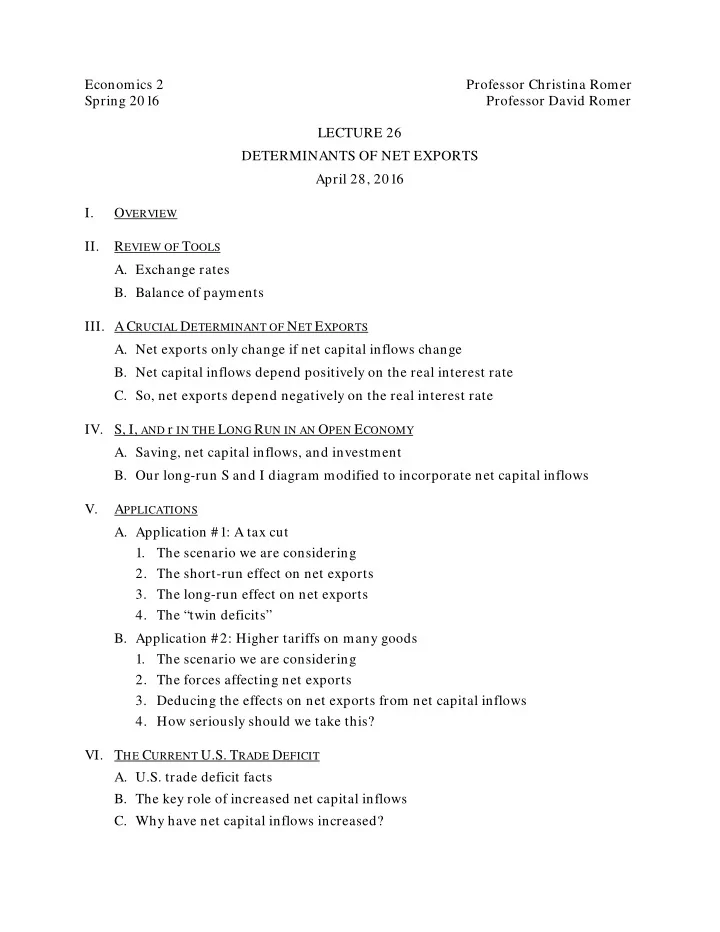
SLIDE 1 Economics 2 Professor Christina Romer Spring 2016 Professor David Romer LECTURE 26 DETERMINANTS OF NET EXPORTS April 28, 2016 I. OVERVIEW
- II. REVIEW OF TOOLS
- A. Exchange rates
- B. Balance of payments
- III. A CRUCIAL DETERMINANT OF NET EXPORTS
- A. Net exports only change if net capital inflows change
- B. Net capital inflows depend positively on the real interest rate
- C. So, net exports depend negatively on the real interest rate
- IV. S, I, AND r IN THE LONG RUN IN AN OPEN ECONOMY
- A. Saving, net capital inflows, and investment
- B. Our long-run S and I diagram modified to incorporate net capital inflows
V. APPLICATIONS
- A. Application #1: A tax cut
- 1. The scenario we are considering
- 2. The short-run effect on net exports
- 3. The long-run effect on net exports
- 4. The “twin deficits”
- B. Application #2: Higher tariffs on many goods
- 1. The scenario we are considering
- 2. The forces affecting net exports
- 3. Deducing the effects on net exports from net capital inflows
- 4. How seriously should we take this?
- VI. THE CURRENT U.S. TRADE DEFICIT
- A. U.S. trade deficit facts
- B. The key role of increased net capital inflows
- C. Why have net capital inflows increased?
SLIDE 2 LECTURE 26
Determinants of Net Exports April 28, 2016
Economics 2 Christina Romer Spring 2016 David Romer
SLIDE 3
SLIDE 5 Net Exports
- Exports: The value of all the goods and services we
sell abroad.
- Imports: The value of all the goods and services we
buy from abroad.
NX = Exports − Imports
- Another term for net exports is the “trade balance”:
- NX < 0 is a trade deficit.
- NX > 0 is a trade surplus.
SLIDE 6 Net Capital Inflows
- Capital Inflows: The value of all the U.S. assets
purchased by foreigners.
- Capital Outflows: The value of all the foreign
assets purchased by Americans.
- Net Capital Inflows (KI):
KI = Capital Inflows − Capital Outflows
SLIDE 7 How NX and KI Enter Our Analysis—Preview
- Net exports are a component of PAE, and so
matter for our analysis of short-run fluctuations: PAE = C +Ip + G + NX
- We will see that net capital inflows matter for our
analysis of saving, investment, and the real interest rate in the long run.
- We will also see that, since NX + KI = 0, net exports
and net capital inflows are not independent of one another!
SLIDE 9
Foreign Exchange Market for Dollars
SLIDE 10
A Key Assumption
The exchange rate does not affect purchases of assets.
SLIDE 11 The Balance of Payments
- Equilibrium in the foreign exchange market for dollars:
Value of foreign purchases of American goods and services and of American assets = Value of American purchases of foreign goods and services and of foreign assets
Exports + Capital Inflows = Imports + Capital Outflows
(Exports − Imports) + (Capital Inflows − Capital Outflows) = 0
NX + KI = 0
SLIDE 12 Net Exports (NX) and Net Capital Inflows (KI)
Source: Bureau of Economic Analysis
200 400 600 800 1000 1975 1978 1981 1984 1987 1990 1993 1996 1999 2002 2005 2008 2011 2014 Billions
KI NX
SLIDE 13
- III. A CRUCIAL DETERMINANT OF NET EXPORTS
SLIDE 14 NX Only Moves If KI Moves
NX = −KI
- So:
- If something does not change net capital
inflows, it does not change net exports.
- If something does changes net capital
inflows, it changes net exports in the
SLIDE 15 What Determines Net Capital Inflows?
Net capital inflows = Value of U.S. assets purchased by foreigners − Value of foreign assets purchased by Americans
- Attractiveness of American assets relative to foreign
assets depends on:
- The real interest rate, r: If r rises, American assets
become more attractive relative to foreign assets, and so net capital inflows rise.
- Also, “tastes” for assets: If Americans and/or
foreigners find American assets more attractive at a given r, net capital inflows rise.
SLIDE 16 Implication for Net Exports: The Real Interest Rate Is a Crucial Determinant of NX
NX = −KI
- A rise in the real interest rate raises KI; a fall in the
real interest rate lowers KI.
- Therefore: A rise in r lowers NX; a fall in r raises
NX.
SLIDE 17
Foreign Exchange Market for Dollars A Rise in the Real Interest Rate in the U.S.
D1 Q of $ Price of $ in Euros S1 e1
SLIDE 18
- IV. SAVING, INVESTMENT, AND THE REAL INTEREST
RATE IN THE LONG RUN IN AN OPEN ECONOMY
SLIDE 19 The Real Interest Rate
- r is a crucial determinant of KI, and hence of NX.
- We will continue to assume (realistically!) that in
the short run and in the medium run, r is determined by the Fed responding to inflation according to its reaction function.
- But, what about the long run?
SLIDE 20
Saving and Investment in the Long Run
SLIDE 21
The Real Interest Rate in the Long Run
SLIDE 23 Application #1: A Long-Lasting Tax Cut
- The scenario we’re considering:
- The economy starts in long-run equilibrium.
- There is then a long-lasting cut in taxes, T.
- As always when we change T (unless we
explicitly say otherwise), we are holding G fixed.
- Determining the behavior of net exports:
- To figure out what happens to NX, we need to
figure out what happens to KI.
- To figure out what happens to KI, we need to
figure out what happens to r.
SLIDE 24
The Short-Run Effect on Net Exports
SLIDE 25 r* I*, S*+KI* I1
I1
S1 + KI1
The Long-Run Effect on Net Exports
r1
SLIDE 26 Net Exports (NX) and Net Capital Inflows (KI)
Source: Bureau of Economic Analysis
200 400 600 800 1000 1975 1978 1981 1984 1987 1990 1993 1996 1999 2002 2005 2008 2011 2014 Billions
KI NX
SLIDE 27 Application #2: Higher Tariffs on Many Goods
- The scenario we’re considering:
- The economy starts in long-run equilibrium.
- There is then a permanent increase in tariffs
- n many goods.
SLIDE 28
Forces Affecting Net Exports
SLIDE 29
Foreign Exchange Market for Dollars The U.S. Raises Tariffs on Many Goods
D1 Q of $ Price of $ in Euros S1 e1
SLIDE 30
Determining the Effect on Net Exports
SLIDE 31
How Seriously Should We Take This?
SLIDE 32
- VI. THE CURRENT U.S. TRADE DEFICIT
SLIDE 33 Net Exports as a Share of GDP, 1975–2015
Source: FRED
SLIDE 34 Mistaken Explanations of the U.S. Trade Deficit
- We aren’t productive enough; our goods and
services are of low quality.
- Americans have strong tastes for foreign goods.
- Foreign countries engage in widespread
protectionist polices.
- The problem: These theories predict a weak dollar,
not a large trade deficit.
SLIDE 35
Foreign Exchange Market for Dollars The Quality of U.S. Goods Deteriorates
D1 Q of $ S1 e1 Price of $ in foreign currency
SLIDE 36 Understanding the U.S. Trade Deficit
- Recall: NX = −KI.
- So, to understand why NX is large and negative,
we need to understand why KI is large and positive.
SLIDE 37 Net Exports (NX) and Net Capital Inflows (KI)
Source: Bureau of Economic Analysis
200 400 600 800 1000 1975 1978 1981 1984 1987 1990 1993 1996 1999 2002 2005 2008 2011 2014 Billions
KI NX
SLIDE 38
S, I, and NX as Shares of GDP, 1975–2015
SLIDE 39
The Federal Budget Deficit (percent of GDP) and the Personal Saving Rate, 1975–2015
SLIDE 40 One Factor That Has Contributed to the U.S. Trade Deficit
- U.S. assets look highly attractive.
- Perhaps because safe interest rates in the U.S.
are high relative to other countries’ (for example, the U.S. vs. Europe and Japan now).
- Perhaps because people think risky U.S. assets
are likely to pay off especially well (for example, tech in the 1990s, housing in the early 2000s).
- As a result, KI is big and positive high—so NX is big
and negative.