Economic Presence Nexus for State and Local Taxes: Meeting the - - PowerPoint PPT Presentation

economic presence nexus for state and local taxes meeting
SMART_READER_LITE
LIVE PREVIEW

Economic Presence Nexus for State and Local Taxes: Meeting the - - PowerPoint PPT Presentation

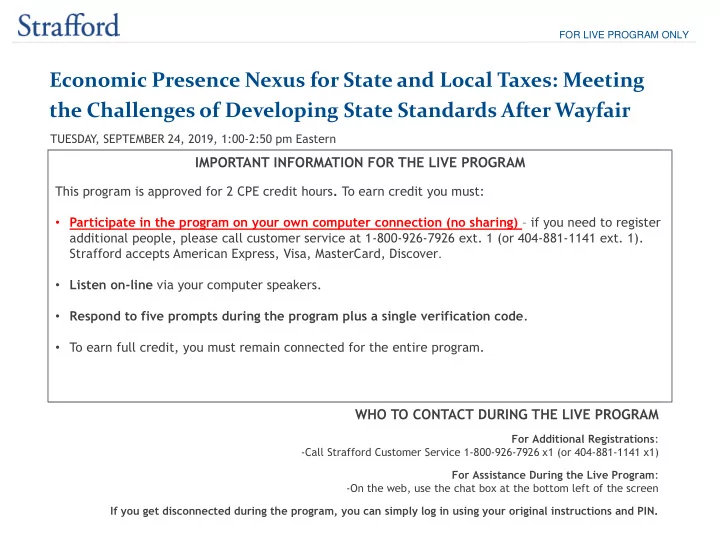
FOR LIVE PROGRAM ONLY Economic Presence Nexus for State and Local Taxes: Meeting the Challenges of Developing State Standards After Wayfair TUESDAY , SEPTEMBER 24, 2019, 1:00-2:50 pm Eastern IMPORTANT INFORMATION FOR THE LIVE PROGRAM This


slide-1
SLIDE 1

WHO TO CONTACT DURING THE LIVE PROGRAM

For Additional Registrations:

  • Call Strafford Customer Service 1-800-926-7926 x1 (or 404-881-1141 x1)

For Assistance During the Live Program:

  • On the web, use the chat box at the bottom left of the screen

If you get disconnected during the program, you can simply log in using your original instructions and PIN.

IMPORTANT INFORMATION FOR THE LIVE PROGRAM

This program is approved for 2 CPE credit hours. To earn credit you must:

  • Participate in the program on your own computer connection (no sharing) – if you need to register

additional people, please call customer service at 1-800-926-7926 ext. 1 (or 404-881-1141 ext. 1). Strafford accepts American Express, Visa, MasterCard, Discover.

  • Listen on-line via your computer speakers.
  • Respond to five prompts during the program plus a single verification code.
  • To earn full credit, you must remain connected for the entire program.

Economic Presence Nexus for State and Local Taxes: Meeting the Challenges of Developing State Standards After Wayfair

TUESDAY , SEPTEMBER 24, 2019, 1:00-2:50 pm Eastern

FOR LIVE PROGRAM ONLY

slide-2
SLIDE 2

Tips for Optimal Quality

FOR LIVE PROGRAM ONLY

Sound Quality When listening via your computer speakers, please note that the quality

  • f your sound will vary depending on the speed and quality of your internet

connection. If the sound quality is not satisfactory, please e-mail sound@straffordpub.com immediately so we can address the problem.

slide-3
SLIDE 3

September 24, 2019

Economic Presence Nexus for State and Local Taxes: Meeting the Challenges of Developing State Standards After Wayfair

Martin Eisenstein, Managing Partner Brann & Isaacson meisenstein@brannlaw.com Matthew P . Schaefer, State and Local Tax Partner Brann & Isaacson, Lewiston, Maine mschaefer@brannlaw.com

slide-4
SLIDE 4

Notice

ANY TAX ADVICE IN THIS COMMUNICATION IS NOT INTENDED OR WRITTEN BY THE SPEAKERS’ FIRMS TO BE USED, AND CANNOT BE USED, BY A CLIENT OR ANY OTHER PERSON OR ENTITY FOR THE PURPOSE OF (i) AVOIDING PENALTIES THAT MAY BE IMPOSED ON ANY TAXPAYER OR (ii) PROMOTING, MARKETING OR RECOMMENDING TO ANOTHER PARTY ANY MATTERS ADDRESSED HEREIN.

You (and your employees, representatives, or agents) may disclose to any and all persons, without limitation, the tax treatment or tax structure, or both, of any transaction described in the associated materials we provide to you, including, but not limited to, any tax opinions, memoranda, or other tax analyses contained in those materials. The information contained herein is of a general nature and based on authorities that are subject to change. Applicability of the information to specific situations should be determined through consultation with your tax adviser.

slide-5
SLIDE 5

Nexus Standards and Their Implications

Matthew Schaefer, Brann & Isaacson mschaefer@brannlaw.com

slide-6
SLIDE 6

Nexus After South Dakota v. Wayfair, Inc.

  • Begin with a review of nexus standards before Wayfair.
  • Physical presence nexus.
  • Rumblings of economic nexus (“factor presence”).
  • Wayfair and the new substantial nexus standard.
  • What changed?
  • “Economic and virtual contacts.”
  • Practical implications.

6

slide-7
SLIDE 7

Nexus Before Wayfair

  • The U.S. Constitution places limits on state taxing

authority through the Commerce Clause (art. I, sec. 8, cl. 3) and the Due Process Clause (via the 14th Amendment).

  • The U.S. Supreme Court consolidated its jurisprudence

concerning state taxes into a four-part test in Complete Auto Transit, Inc. v. Brady, 430 U.S. 274 (1977).

  • Test applies to all types of state tax (e.g., income tax, sales tax, etc.).
  • First prong requires that the tax must be applied to an activity with a

“substantial nexus” with the taxing state.

7

slide-8
SLIDE 8

Nexus Before Wayfair

  • With regard to sales/use tax, the Court interpreted the

“substantial nexus” test to require that a taxpayer must have a physical presence in a state before the state could impose a tax collection obligation.

  • National Bellas Hess, Inc. v. Ill. Dep’t of Revenue, 387 U.S. 753 (1967).
  • Quill Corp. v. North Dakota, 504 U.S. 298 (1992).
  • Physical presence nexus could be established by:
  • Property, either real (offices, facilities) or personal (equipment,

inventory);

  • Employees in the state, permanently or temporarily; or
  • Representatives in the state acting on behalf of the out-of-state

company.

8

slide-9
SLIDE 9
  • For other types of state tax (income tax, gross receipts tax),

a series of state supreme court decisions held that a “physical presence” was not required to establish nexus, but there was no uniform standard set in these cases.

  • Geoffrey (S.C. 1993) – Presence of intangible property (such as

trademarks);

  • K.F.C. Corp. (Iowa 2010) - “Functional equivalent of physical presence”;

and

  • MBNA (W.V. 2006) - “Substantial economic presence” test.
  • “Factor presence”: Many states adopted statutory nexus

tests based on the typical income tax apportionment factors of property, payroll, and sales.

9

Nexus Before Wayfair

slide-10
SLIDE 10

Factor Presence Standards

  • Factor presence first arose in 2002 under the MultiState

Tax Commission’s guidance for member states, “Factor Presence Nexus Standard for Business Activity Taxes.”

  • Defined “substantial nexus” based on thresholds:
  • $50,000 in property or payroll in a state; or
  • $500,000 for sales into the state; or
  • 25% of business’ property, payroll or sales in the state.
  • Property and payroll factors equate to physical presence

in the state.

  • Using sales into the state as the basis for nexus,

however, was effectively an economic presence test.

10

slide-11
SLIDE 11

Sales Factor Thresholds For Income Tax

  • A number of states adopted a sales or gross receipts

threshold for corporate net income tax pursuant to which a company was deemed to be engaged in business in the state, and required to report corporate net income taxes, merely by virtue of having a minimum level of sales to customers in the jurisdiction.

  • Many other states — by far the majority based on

informal surveys — purported to require state income tax reporting based on a “economic presence” theory of substantial nexus.

11

slide-12
SLIDE 12

Sales Factor Thresholds For Income Tax

  • States that adopted a “factor presence” sales threshold

for corporate net income tax include:

  • Alabama Income Tax: $500,000 (eff. Dec. 1, 2014);
  • California Franchise (Income) Tax: started at $500,000 (eff. Jan. 1,

2011) and adjusted up annually;

  • Colorado Income Tax: $500,000 (eff. April 30, 2010);
  • Connecticut Corporation Business Tax: $500,000 (eff. Jan. 1, 2010);
  • Michigan Corporate Income tax: $350,000 (eff. Jan 1, 2012);
  • New York Franchise (Income) Tax: $1,000,000 (eff. Jan. 1, 2015); and
  • Tennessee Excise (Income) Tax: $500,000 (eff. Jan. 1, 2016).
  • Note: federal Public Law 86-272 (15 U.S.C. § 381)

continues to apply despite sales factor threshold.

12

slide-13
SLIDE 13

Economic Nexus for Gross Receipts Tax

  • Certain States adopted gross receipts taxes based on

economic nexus principles.

  • Ohio Commercial Activity Tax (2005) - gross receipts threshold
  • f $500,000.
  • Washington Business & Occupation Tax:
  • Wholesale sales and sales of services (2010) - gross receipts

threshold of $250,000 (increased to $285,000 by 2019; down to $100,000 for 2020)

  • Retail sales (2017) - gross receipts threshold of $267,000 (increased

to $285,000 by 2019; down to $100,000 for 2020).

  • Tennessee Business Tax – threshold of $500,000 in gross

receipts.

  • Nevada Commerce Tax - threshold of $4,000,000 in gross

receipts.

13

slide-14
SLIDE 14

Sales Tax Economic Nexus

  • In 2015-16, states began to adopt economic nexus

statutes and rules for sales tax in order to challenge the physical presence standard of National Bellas Hess and Quill.

  • Alabama Department of Revenue was the first to act, adopting

a rule targeted specifically at retailers that had no physical presence but made sales into the state of at least $250,000.

  • The first state to adopt an economic nexus statute was South

Dakota in 2016. The law required a retailer without physical presence to collect sales tax if it had either :

  • $100,000 in annual SD sales; or
  • at least 200 transactions for delivery into the state.

14

slide-15
SLIDE 15

The Wayfair Case

  • In 2016, South Dakota sued retailers Wayfair Inc.,

Overstock.com, Inc. and Newegg Inc. to test the constitutionality of the new law.

  • In 2018, the case reached the U.S. Supreme Court as

South Dakota v. Wayfair, Inc. The Court issued a decision on June 21, 2018.

  • In a 5-4 decision, the Wayfair Court:
  • Overruled Quill and National Bellas Hess; and
  • Held that the “physical presence” test was an incorrect

interpretation of the Commerce Clause. [South Dakota v. Wayfair, Inc., 138 S.Ct. 2080, 2099 (2018).]

15

slide-16
SLIDE 16

Wayfair Substantial Nexus

  • In abrogating the physical presence nexus rule, the

Court created no new “bright line” test.

  • Instead, the Court established a new “substantial nexus”

test under the framework of Complete Auto.

  • A company has substantial nexus when it “avails itself of the

substantial privilege of carrying on business in the jurisdiction.”

  • Substantial nexus may be established by sufficient “economic or

virtual contacts” with a state.

  • New standard applies to all types of state taxes.

16

slide-17
SLIDE 17
  • What are economic contacts?
  • Court indicated approval of SD statutory standards of $100,000

in sales or 200 transactions as a sufficient “quantity of business” in the state.

  • Unclear if the level changes with the size of the state (per capita
  • r market size) or the type of tax.
  • What are virtual contacts?
  • Court gave no clear guidance, but referred to “instant access to

most consumers through an internet-enabled device,” a “virtual showroom,” and a “continuous and pervasive virtual presence.”

  • MTC working group has seized upon this to attack PL 86-272

immunity from state income taxes.

17

Wayfair Substantial Nexus

slide-18
SLIDE 18

Nexus After Wayfair

  • With regard to sales/use tax, states responded quickly

by adopting economic thresholds.

  • 44 states have now adopted economic nexus standards by

statute or by rule.

  • Many have adopted South Dakota levels of $100,000 or 200

transactions, but some have selected higher levels (e.g., CA, NY, TN, and TX are at $500,000).

  • Kansas recently announced enforcement without a specific

standard.

  • Among states that have a state sales tax, only Florida and

Missouri have not announced enforcement based on economic nexus.

18

slide-19
SLIDE 19

Post-Wayfair Economic Nexus for Sales Tax

State Threshold(s) Enforcement Date Alabama $250,000 10/01/2018 Arizona $200,000 / $150,000 / $100,000 10/01/19 – 01/01/20 – 01/01/21 Arkansas $100,000 or 200 transactions 07/01/2019 California $500,000 04/01/2019 Colorado $100,000 12/01/2018 Connecticut $250,000 and 200 transactions; $100,000 and 200 transactions 12/01/2018; 07/01/2019 District of Columbia $100,000 or 200 transactions 01/01/2019 Georgia $250,000 or 200 transactions ; $100,000 01/01/2019; 01/01/2020 Hawaii $100,000 or 200 transactions 07/01/2018 Idaho $100,000 06/01/2019 Illinois $100,000 or 200 transactions 10/01/2018 (change to ROT 7/1/19)

19

slide-20
SLIDE 20

Post-Wayfair Economic Nexus for Sales Tax

State Threshold(s) Enforcement Date Indiana $100,000 or 200 transactions 10/01/2018 Iowa $100,000 01/01/2019 Kansas No threshold 10/01/2019 Kentucky $100,000 or 200 transactions 10/01/2018 Louisiana $100,000 or 200 transactions 07/01/2020 (likely) Maine $100,000 or 200 transactions 07/01/2018 Maryland $100,000 or 200 transactions 11/01/2018 (and after) Massachusetts $500,000 and 100 transactions (Internet); $100,000 gross receipts (all sellers) 10/01/2017; 10/01/2019 Michigan $100,000 or 200 transactions 10/01/2018 Minnesota 100 retail sales or 10 retail sales > $100k; $100,000 or 200 transactions 10/01/2018; 10/01/2019

20

slide-21
SLIDE 21

Post-Wayfair Economic Nexus for Sales Tax

State Threshold(s) Enforcement Date Mississippi $250,000 and regular solicitation 09/01/2018 Nebraska $100,000 or 200 transactions 04/01/2019 Nevada $100,000 or 200 transactions 11/01/2018 New Jersey $100,000 or 200 transactions 11/01/2018 New Mexico $100,000 in gross receipts 07/01/2019 (state level tax) New York $500,000 and 100 transactions 06/21/18 (but enacted later) North Carolina $100,000 or 200 transactions 11/01/2018 North Dakota $100,000 10/01/2018 Ohio $100,000 or 200 transactions 08/01/2019 Oklahoma $10,000 or notice and reporting; $100,000 07/01/2018; 11/01/2019 Pennsylvania $10,000 or notice and reporting; $100,000 04/01/2018; 07/01/2019

21

slide-22
SLIDE 22

Post-Wayfair Economic Nexus for Sales Tax

State Threshold(s) Enforcement Date Rhode Island $100,000 / 200 transactions or notice; $100,000 or 200 transactions 07/01/2018; 07/01/2019 South Carolina $100,000 in gross sales 11/01/2018 South Dakota $100,000 or 200 transactions 11/01/2018 Tennessee $500,000 10/01/2019 Texas $500,000 10/01/2019 Utah $100,000 or 200 transactions 01/01/2019 Vermont $100,000 or 200 transactions 07/01/2018 Virginia $100,000 or 200 transactions 07/01/2019 Washington $100,000 or 200 transactions 10/01/2018 West Virginia $100,000 or 200 transactions 01/01/2019 Wisconsin $100,000 or 200 transactions 10/01/2018 Wyoming $100,000 or 200 transactions 02/01/2019

22

slide-23
SLIDE 23

Nexus After Wayfair

  • Lingering issues:
  • Should sales thresholds depend on state / market size?
  • Which sales count toward the threshold? All sales? Taxable sales ? What about

sales made through a marketplace? [These questions answered in some states.]

  • What is a “transaction”? A single order? What about multiple use situations?
  • Good development: A number of states have eliminated the

threshold based on transactions, instead focusing solely on sales volume.

  • Disturbing development: Some states are moving away from

simplification.

  • Tennessee has eliminated, and Louisiana will phase out, a system by which

remote sellers could collect at a uniform combined state and local rate.

  • Illinois has adopted a measure to change the tax due from remote sellers from

use tax to the Retailer’s Occupation Tax, requiring application of local rates.

23

slide-24
SLIDE 24
  • With regard to business activity taxes, states are

moving more slowly, but some changes take effect in 2020.

  • Oregon adopted a gross receipts tax with a threshold of

$750,000 in sales for filing purposes, but which applies only to companies with at least $1,000,00 in sales.

  • Washington has recently enacted legislation to reduce its

formerly higher gross receipts standards for B&O Tax to the same level it has adopted for sales tax ($100,000 in sales).

  • Hawaii recently adopted thresholds of $100,000 in gross

receipts or 200 sales for purposes of its state income tax.

24

Nexus After Wayfair

24

slide-25
SLIDE 25

Implications of Wayfair

  • A seismic shift in the state sales and use tax landscape.
  • States increasingly are signaling a willingness to test the

limits of their constitutional authority.

  • Although limited activity to date, the new nexus

concept of “economic or virtual contacts” bodes a dramatic change for other types of state tax.

  • Expect new gross receipts taxes.
  • Beware the MTC assault on PL 86-272 with regard to income tax.
  • Action at the local level, by both large municipalities

and tiny towns, is next.

25

slide-26
SLIDE 26

Economic Presence As A Basis For States’ Extension Of State Taxes

Martin Eisenstein, Brann & Isaacson meisenstein@brannlaw.com

slide-27
SLIDE 27

Topics

  • Application of Wayfair To State Taxes

Other Than Sales And Use Tax Collection

  • Efforts By States and Local Jurisdictions

to Extend Economic Presence

  • Defenses to States’ Overeaching

27

slide-28
SLIDE 28

Direct Taxes

  • Use Taxes Based on Purchases by Company
  • Income Taxes
  • Gross Receipts Taxes
  • Franchise Taxes
  • Taxes based on Income (CA)
  • Taxes Based on Paid In Capital (IL)/Net

Worth (AL) (13 states have such taxes)

28

slide-29
SLIDE 29

The Wayfair Effect: Physical Presence Is Not a Commerce Clause Requirement

  • Effect One: Removes the Commerce Clause physical

presence requirement for all direct taxes (including use tax obligations) as well as tax collection

 Court confirmed the Complete Auto four part test

applies to all state taxes

 The Court reinterpreted the substantial nexus

prong to make clear that physical presence is not required

 First time that the U.S. Supreme Court ruled that

physical presence not required for any tax

29

slide-30
SLIDE 30

The Irony of Wayfair

  • Prior to Wayfair, the states argued (and largely

prevailed) that physical presence test of nexus

  • nly applied to sales taxes.
  • Income taxes: Geoffrey v. 437 S.E.2d 13 (S.C.

1993). KFC Corp. v. Iowa Dep’t of Revenue, 792 N.W.2d 308 (Iowa 2010), cert. denied, 565 U.S. 817 (2011)

  • Gross Receipts taxes: MTC Factor Presence

test adopted in 2002. Crutchfield Corp. v. Testa, 2016-Ohio-7760

30

slide-31
SLIDE 31

States’ Responses to Wayfair

  • Sales and Use Taxes
  • All but FL, MO and KS have adopted laws that sales

alone create nexus.

  • Laws probably apply to use tax obligations of

purchaser (e.g. distribution of direct mail materials in the state)

  • Gross Receipts Tax
  • So far only Oregon but TX proposed rule.
  • Income Tax: None thus far (except HI)

31

slide-32
SLIDE 32

Local Jurisdictions Impose Gross Receipts Taxes Based on Sales Alone

  • Effect Two: Local jurisdictions have sought to impose

taxes on companies without a physical presence.

  • Portland, Oregon referendum adopted on 11/6/18: 1% gross

receipts tax on sales in Portland on a “large retailer,”

  • San Francisco referendum adopted on 11/6/18: 1% gross

receipts tax if more than $500,000 of SF gross receipts

  • Amendment to Philadelphia BIRT (Business Income and

Receipts Tax): $100,000 of receipts may create nexus

  • However, regulation continues to recognize PL 86-272 for

income taxes.

32

slide-33
SLIDE 33

Home Rule Sales Tax Jurisdictions

 Effect Three : Home Rule sales tax jurisdictions

 Six states with home rule jurisdictions: Alabama,

Alaska, Arizona, Colorado, Idaho, and Louisiana.

  • Tax is administered by the local jurisdictions, so

that there is registration and tax filings at both the state and local level as well as separate tax base and audit enforcement.

  • Only states with home rule jurisdictions that so far

threaten to impose sales tax on companies without a physical presence are Louisiana and Alaska (Nome).

33

slide-34
SLIDE 34

Economic Nexus: Factor Presence Pre-Wayfair

  • MTC “Factor Presence Nexus Standard for Business Activity

Taxes”

  • Issued on October 17, 2002
  • First time MTC or any other state organization

promulgated a factor presence test

  • Available only for “business activity taxes”
  • No definition but commonly understood to mean

gross receipts taxes and income taxes

  • Exclusion for state income taxes to the extent entity

exempt under Public Law 86-272

34

slide-35
SLIDE 35

Origins and Definition

  • MTC “Factor Presence Nexus Standard for Business Activity

Taxes”

  • Defines “substantial nexus” based on satisfaction of any of property,

payroll or sales thresholds in a state.

  • $50,000 for property or payroll or
  • $500,000 for sales or
  • 25% of business’ property, payroll or sales in the state.
  • Tax Administrator to review thresholds annually based on CPI

changes

  • Definitions of property, payroll and sales in state
  • Sales in a state include sales of tangible personal property and

lease of tangible personal property and real estate located in the state.

35

slide-36
SLIDE 36
  • Definitions of sales in a state for sales of services, intangibles and

digital products

  • Test is less straightforward than for sales of tangible personal

property

  • Creates numerous issues. See Eisenstein and Carey, Where’s Waldo:

Sourcing IT and Cloud Services, State Tax Notes, August 1, 2016

  • Based on “primary use” by a purchaser known by seller
  • If seller knows states of multiple use, apportionment based on usage
  • If seller does not know states of use, then initially based on

purchaser’s address from business records and if not available then address given in consummation of sale.

  • Unclear how to handle: When the billing address is not the purchaser’s

address.

Origins and Definition (Cont’d)

36

slide-37
SLIDE 37

Origins and Definition (Cont’d)

  • Special rules re commonly owned enterprises
  • Aggregation of property, payroll and sales of such entities that have

a minimum presence in state of $5,000 of combined property, payroll and sales in state.

  • If aggregate number exceeds thresholds described on prior slide,

the combined entity required to file an information return

  • If the commonly owned enterprises are part of a unitary business

group conducting business in the state, and if the aggregate of all entities within the unitary business group exceeds the thresholds described on prior slide, then each member of the unitary group is deemed to have substantial nexus.

37

slide-38
SLIDE 38
  • MTC Factor presence designed to “represent a simple, certain

and equitable standard“ of substantial nexus

  • It certainly is simple.
  • Is it certain?
  • Note OH CAT permits the satisfaction of the factor presence standard
  • r the constitutional test of nexus
  • Is it fair?
  • Is it fair for one state to specify a different threshold than another

state?

  • Congress has the power to change the standard under the Commerce

Clause based on considerations of a national economy

Origins and Definition (Cont’d)

38

slide-39
SLIDE 39

States’ Adoption of Factor Presence Pre-Wayfair

  • It is more common that state statute limits the tax to those

companies engaged in business activities in the states

  • Exceptions (MTC Factor presence states)(Sales alone):
  • Income Tax: Alabama; California; Colorado; Connecticut;

New Hampshire; Michigan; New York; Tennessee; Wisconsin; and Virginia

  • Gross Receipts Tax: WA, OH, TN, and NV but not TX
  • Franchise Taxes: 13 states require payment of tax if “doing

business in the state” or company obtains certificate of authority

39

slide-40
SLIDE 40
slide-41
SLIDE 41

Limitations on a State’s Power to Tax

  • Limitations
  • Commerce Clause
  • Economic nexus standard: “Taxpayer ‘avails itself
  • f the substantial privilege of carrying on

business’ in that jurisdiction.”

  • Discrimination
  • Undue Burden-Retroactivity
  • External consistency-fair apportionment prong of

Complete Auto

41

slide-42
SLIDE 42

COMMERCE CLAUSE: THE WAYFAIR FACTORS FOR LOCAL TAXES

  • The Court referred to the following factors

(the Wayfair Factors) of the SD law as likely avoiding undue burden:

  • Safe Harbor for small seller to State
  • Annual sales of $100,000 or 200 transactions
  • “[N]o obligation to remit the sales tax may be

applied retroactively.” Id. at 2099

  • SSUTA membership

42

slide-43
SLIDE 43

Limitations on the States Power to Tax

  • Other Limitations
  • Due Process Clause:
  • requires “some definite link, some

minimum connection, between a state and the person, property or transaction it seeks to tax.”

  • Tax Must Be Authorized by Underlying State

Statute

  • Public Law 86-272

43

slide-44
SLIDE 44

The Wayfair Factors: The SSUTA

  • Benefits of the SSUTA
  • SSUTA standardizes taxes to reduce compliance costs:
  • a single, state level administration;
  • uniform definitions of products and services and
  • ther uniform rules (e.g. exemption certificates)
  • simplified tax rate.
  • SSUTA provides access to software paid for by the State:

“Certified Service Providers” are paid by the State.

  • Use of the software provides immune from audit liability.

44

slide-45
SLIDE 45

The Due Process Clause

  • Different but similar test as Commerce Clause
  • Provides protection for geographically agnostic

interstate businesses: J. McIntyre Ltd. v. Nicastro (2011); Daimler AG v. Bauman (2014)

  • “At no time did petitioner engage in any activities in

New Jersey that reveal an intent to invoke or benefit from the protection of its laws.”

  • Selling nationally via the “stream of commerce” is not

enough: “These facts may reveal an intent to serve the U.S. market, but they do not show that J. McIntyre purposefully availed itself of the New Jersey market.”

45

slide-46
SLIDE 46

Does Wayfair Permit Imposition of Income Taxes Based on Sales Alone

  • Kentucky and Oklahoma automatic response to

sales tax registration per Wayfair was to register the companies for income tax

  • Should companies be reserving for potential income

tax and franchise tax liability based on Wayfair?

  • Wells Fargo announcement of increase of its

income tax reserves by $481 million as a result of Wayfair.

46

slide-47
SLIDE 47

Does Wayfair Affect P.L. 86-272 Protection?

  • The short answer to the question is no.
  • Wayfair is a dormant commerce clause case that

relates to the restrictions on a state power’s to impose tax on interstate commerce in the absence of federal legislation.

  • P.L. 86-272 preempts state tax laws under the

supremacy clause of the Constitution.

47

slide-48
SLIDE 48

What Protections Are Provided By P.L. 86-272?

  • P.L. 86-272 provides that a state (or political

subdivision) may not “impose . . . a net income tax

  • n the income derived within such State by any

person from interstate commerce if the only business activities within such State by or on behalf

  • f such person” are as follows: the solicitation of
  • rders in such State for sales of tangible personal

property if orders are sent outside the state for approval and are fulfilled from outside of the State

48

slide-49
SLIDE 49

What Protections Are Provided By P.L. 86-272?

  • Protected activities also include:
  • The maintenance in the state by an independent

contractor of an office in the state so long as the independent contract is engaged in mere solicitation of the sale of tangible personal property.

  • An independent contractor is defined as an

agent that does work for more than one principal.

49

slide-50
SLIDE 50

What Companies And Activities Are Not Protected By P.L. 86-272?

  • Protection is not provided to companies incorporated in

the taxing state.

  • Protection is not provided for taxes other than taxes

based on net income.

  • Protection is not provided if the activities in the state

exceed mere solicitation. Wisconsin Dep’t of Revenue v. William Wrigley, Jr., 505 U.S. 214 (1992); See Statement of Information Concerning Practices of MTC and Signatory States.

50

slide-51
SLIDE 51

Is a Company That Sells Services Protected By PL 86-272?

  • Not if it engages in any activity in the state with regard

to the provision of services.

  • Protection under the statute is limited to

solicitation of sales of tangible personal property

  • A provider of cloud services likely does not engage in

activities in a state but a party that installs networks would not be protected

51

slide-52
SLIDE 52

Is a Company That Sells Services Automatically Denied PL 86-272 Protection?

  • The majority of commentators assert that the

protection does not extend to companies that sell services even if they don’t engage in activities in the

  • state. Richard Cram, “No Shade for Cloud

Computing Income Under P.L. 86-272” State Tax Notes, Sept. 24, 2018.

  • Wis. Admin. Code Tax § 2.82(3)(b)(2)(a) - PL 86-

272 does not apply to those businesses that sell services, intangibles or real estate.

52

slide-53
SLIDE 53

The Controversy Regarding the Scope of PL 86-272

  • This presenter thinks that the majority
  • pinion is wrong. See, Eisenstein and Bessey,

"Wayfair and P.L. 86-272 in a Services Economy," State Tax Notes, November 5, 2018

  • Note the Multistate Tax Commission

Uniformity Committee formed a working group on January 17, 2019 to update its Policy Statement of Signatory States on PL 86-272.

53

slide-54
SLIDE 54

The Controversy Regarding the Scope of PL 86-272

  • Working Group Draft of July 2019:
  • PL 86-272 does not protect service

providers

  • Doing business on the Internet in all but

certain circumstances constitutes activities

  • n behalf of an out-of-state company, thus

eliminating PL 86-272 protection

54

slide-55
SLIDE 55

The Argument That Service Providers Are Protected By P.L. 86-272

  • The starting point for the argument is that the protection

in P.L. 86-272 is not limited to income derived from the sales of tangible personal property, but extends to a state’s tax on “income derived within such State by any person from interstate commerce.”

  • The reference regarding sales of tangible personal

property relates only to the in-state activities

  • Under the Supremacy Clause the intent of Congress is

critical—the language of the statute is essential to determining intent.

  • The legislative history supports the presenter’s view.

55

slide-56
SLIDE 56

Does Doing Business On the Internet Void the P.L. 86-272 Protection?

  • Wayfair concluded that the virtual contacts with a state of an

Internet site created nexus for the Commerce Clause.

  • Eisenstein and Bessey article:
  • Standard under the Commerce Clause is not same under P.L.

86-272 because different basis for limitations on state

  • powers. The question is one of legislative intent.
  • Argument that it voids PL 86-272 protection proves too

much: A telephone call responding to a customer’s complaint regarding the quality of tangible personal property is not solicitation and would void PL 86-272 protection.

56

slide-57
SLIDE 57

Takeaways

  • Wayfair’s effect highlights the importance of good tax

planning

  • P.L. 86-272 limits should not be inadvertently

tripped

  • Adopt guidelines
  • Carefully consider registration to do business in a

state.

  • May be a concession that company is doing
  • business. See Louisiana Private Letter Ruling No.

08-007

  • Dilution of the sales factor

57

slide-58
SLIDE 58

Status of Challenges to Nexus Laws

Matthew Schaefer, Brann & Isaacson mschaefer@brannlaw.com

slide-59
SLIDE 59

Nexus Challenges After Wayfair

  • This is largely a story of “the dog that did not bark.”
  • Litigation challenging new state enforcement positions

has been expected by many but with each new step taken by the states, it has not developed.

  • Nexus thresholds lower than South Dakota’s (measured per capita or

based on market size) have generated no court challenge.

  • Unreasonable enforcement dates set immediately after the Court

issued its decision in Wayfair have resulted no litigation.

  • States outside of the SSUTA that offer no software and no meaningful

vendor compensation, but demand compliance, have gone unchallenged.

  • States with burdensome local tax systems and no solution for retailers,

have faced no challenge.

59

slide-60
SLIDE 60

Massachusetts Litigation

  • The only issue to generate litigation to date is the

retroactive imposition of sales/use tax liability for periods prior to Wayfair.

  • While most states have forsworn the retroactive

application of Wayfair, Massachusetts has fully endorsed it and defended its approach.

  • The MA DOR has issued dozens of sales/use tax

assessments for pre-Wayfair periods.

  • A suit brought by six companies in Massachusetts

Superior Court (Blue Nile) was dismissed for failure to exhaust administrative remedies.

60

slide-61
SLIDE 61

Massachusetts Litigation

  • One company continues to challenge Massachusetts’

pre-Wayfair enforcement practices in court.

  • Crutchfield Corp. v. Harding, et al., pending in the

Circuit Court for the County of Albemarle, Virginia.

  • Crutchfield filed suit in 2017 based a statute adopted in

2004 that grants the Virginia Circuit Court jurisdiction

  • ver a declaratory judgment action brought against an
  • ut-of-state tax official who asserts the Virginia business

is required to collect sales/use tax.

  • Commissioner moved to dismiss for lack of personal

jurisdiction.

61

slide-62
SLIDE 62

Massachusetts Litigation

  • Case was in discovery when Wayfair was decided.
  • Briefing on the motion to dismiss was completed

after Wayfair and the case was recently presented to the Circuit Court on oral argument.

  • Decision on the jurisdictional issue is now pending.
  • Merits issues will be joined if the Court denies the

motion.

62

slide-63
SLIDE 63

Marketplace Litigation

  • Rather than nexus issues, two prominent cases raise the

question of whether a state may treat a marketplace platform as the seller of goods.

  • Normand v. Wal-Mart.com USA LLC.
  • Wal-Mart.com is contesting an assessment by a Louisiana
  • parish. Wal-Mart.com lost in lower court.
  • Now pending before the Louisiana Supreme Court.
  • Amazon Servs. LLC v. South Carolina Dep’t of Revenue.
  • Amazon Services argues it is not the seller of items sold on

Amazon.com.

  • Administrative law judge disagreed (decision 9/10/19).

63

slide-64
SLIDE 64

Litigation on the Horizon?

  • Impossible to predict whether disputes of

constitutional dimension will arise.

  • Much depends upon state enforcement practices.
  • Most businesses prefer to avoid litigation.
  • There are signs that states are taking an aggressive

approach in different ways.

  • Expansive interpretations of state power vs. narrow

conception of federal constraints.

  • Could come to a head if pushed too far.

64

slide-65
SLIDE 65

65

Other Nexus Developments Impacting Remote Sellers

Edward J. (Ted) Bernert, Baker & Hostetler ebernert@bakerlaw.com

65

slide-66
SLIDE 66

66

Marketplace Facilitators

Numerous jurisdictions (including DC) impose or will impose collection duties on marketplace facilitators: Alabama, Arkansas, Arizona California, Colorado, Connecticut, DC, Hawaii, Idaho, Illinois, Indiana, Iowa, Kentucky, Maine, Maryland, Minnesota, Massachusetts, Nebraska, New Jersey, New Mexico, New York, Nevada, North Dakota, Ohio, Oklahoma, Pennsylvania, Rhode Island, South Carolina, South Dakota, Texas, Utah, Vermont, Virginia, Washington, Wisconsin, West Virginia and Wyoming. There are differing effective dates, including some in the future.

66

slide-67
SLIDE 67

67

Marketplace Facilitators

A marketplace facilitator is a person which owns or

  • perates a marketplace and directly or indirectly

processes sales or payments for marketplace sellers. A marketplace can be a physical or electronic place. The marketplace sellers are the merchants contracting with the marketplace facilitator and the marketplace facilitator arranges the sale. The model for the marketplace facilitator is Amazon or eBay but the concept is not limited to the entities normally thought

  • f in this context.

There are many similarities among the state statutes but there are important variations.

67

slide-68
SLIDE 68

68

Marketplace Facilitators

1. Broad versus narrow model: There are two models, the broad and the narrow. States that have adopted a broad definition of marketplace facilitator include CA, IA, ID, KY, MA, ND, NJ, NV, OH, RI, UT, VA, VT, WA, and WV. States (and DC) that have adopted a narrow definition of marketplace facilitator include AR, AZ, CO, CT, DC, HI, IL, MD, ME, MN, NE, NM, NY, OK, PA, SC, SD, TX, WI, and WY.

68

slide-69
SLIDE 69

69

Marketplace Facilitators

1. Broad versus narrow model: (cont.) One important difference between the broad and narrow models is whether the third party must account for the tax irrespective of whether the third party collects the funds. The broad model applies the obligation even when the third party does not have access to the funds. The broad model has been criticized by observers. The states seem to believe that by imposing the requirement broadly, the industry will change its method of doing business to accommodate the state statutes.

69

slide-70
SLIDE 70

70

Marketplace Facilitators

2. Not all sales are subject to this regime: Many statutes are limited to the sale of tangible personal property only. A few states (e.g. Ohio) apply the concept to the providing of services. Some statutes also apply to digital products. States differ as to whether only taxable sales are used to determine quantity of sales.

70

slide-71
SLIDE 71

71

Marketplace Facilitators

3. Allowing sellers to agree to collect tax. Most state statutes demand that only the marketplace facilitator be responsible for the tax but some states allow the parties to contract away the responsibility to collect and report tax or the state statutes permit the taxing authority to waive the requirement that only the marketplace facilitator account for the tax. Note that the marketplace seller will be responsible for sales made directly (not through the marketplace facilitator) and in some states, sellers must aggregate the sales made by seller through facilitators when determining whether the seller must separately collect in a state.

71

slide-72
SLIDE 72

72

Marketplace Facilitators

4. Other issues to be examined: Which entity (facilitator or seller) collects exemption certificates, accounts for bad debts, applies price adjustments, etc.? Which entity is audited? Which entity seeks refunds? Should marketplace facilitators be insulated from class action suits? Note that some statutes have specific carveouts such as for entities involved only in advertising.

72

slide-73
SLIDE 73

73

Local Taxes

Not addressed in Wayfair The rationale by the Supreme Court in Wayfair expanding the authority of the states to require collection of tax by remote sellers is of doubtful application when considering complex tax systems that permit the localities to separately administer a separate tax scheme such as the systems in place in Colorado and Louisiana.

73

slide-74
SLIDE 74

74

Local Taxes

  • In Colorado, a remote seller must include local tax for those

localities whose taxes are collected by the Department of Revenue. But according to Bloomberg Law for September 5, 2019, Kevin Bommer, Executive Director, Colorado Municipal League, confirmed that Colorado home-rule localities are not imposing collection responsibility on remote sellers.

  • In Louisiana, the Sales and Use Tax Commission for Remote

Sellers continues to review the issues raised by Louisiana’s complicated system. Meanwhile, the Louisiana Supreme Court is considering whether the pre-existing concept of “dealer” can include Wal-Mart in transactions involving third party retailers . The State Court of Appeals upheld the obligation against Wal- Mart, which appealed the case. Normand v. Wal-Mart.Com USA, LLC, Docket No. 2019-C-263.

74

slide-75
SLIDE 75

75

Local Taxes

In Chicago, the Department of Finance has announced that companies that contract with third parties providing services are required to collect certain local taxes including amusement (which includes some streaming services), hotel, lease and parking taxes. In Alaska, which has local but no state sales taxes, there are discussions about instituting a streamlined-type agreement for the localities.

75

slide-76
SLIDE 76

76

Local Taxes

One open issue is whether a remote seller surpassing the economic threshold for a state then must collect the local tax in every locality in the state. California has provided that being subject to California state nexus requirement then obligates the remote seller to collect for each locality regardless of the volume of sales into the locality.

  • Cal. Rev. & Tax. Code Section 7262(a)(1).

76

slide-77
SLIDE 77

77

Foreign Seller Implications

The Wayfair Court did not address the issue. In the case of sales into Canada, some of the provinces, e.g. British Columbia, are looking at the U.S. decision in Wayfair as a way to increase revenue so there may be increased scrutiny of sales into Canada. As a theoretical matter, foreign sellers seemingly are subject to the same considerations after Wayfair as domestic sellers. Treaties have little role here because subnational levels of government are at issue not the national governments. Not just sales and use taxes but could also include income and gross receipts taxes.

77

slide-78
SLIDE 78

78

Foreign Seller Implications

States may perceive an obligation to pursue some foreign sellers to protect domestic sellers. Little evidence currently that states are pursuing foreign sellers unless those sellers have property, an affiliate, or some other presence in the U.S. Use of marketplace facilitators selling within U.S. could trigger collection obligation by the marketplace facilitator. It may be that sellers into the U.S. may need to comply because of relationships in the U.S. including lenders, possible buyers of the business, etc. The ability of the states to enforce assessments would likely be affected by property in the U.S. or because of contractual relationship of the foreign companies with U.S. entities.

78

slide-79
SLIDE 79
slide-80
SLIDE 80

PLANNING STRATEGIES TO MINIMIZE STATE TAX LIABILITY

Martin Eisenstein, Brann & Isaacson meisenstein@brannlaw.com

slide-81
SLIDE 81

Planning Regarding Factor Presence

  • Planning to limit exposure vs. planning to maximize tax

savings

  • Planning should make sure Company does not trigger the

nexus tripwire and, if it does, to take appropriate action either to mitigate the exposure or begin remitting tax

  • Depends on type of tax at issue
  • Depends on nature of items sold
  • Tangible Personal Property vs. Services
  • Public Law 86-272
  • Sourcing of Services

81

slide-82
SLIDE 82
  • Good planning should consider the nexus profile of the

company

  • Should be a nexus audit done under attorney client privilege
  • Consider states’ position re factor presence
  • Is this an opportunity to obtain a deal
  • Consider alternatives
  • Restructure activity
  • Discontinue activity
  • Silent registration based on bright line event
  • Consider VDAs and amnesty programs (e.g. IL)

Planning Regarding Factor Presence

82

slide-83
SLIDE 83
  • State Income Tax Issues: Protect your PL 86-272 exemption
  • Guidelines to limit in-state visits to solicitation of sales of

tangible personal property

  • No in-state :
  • Installation or Repair
  • Collection of bills
  • Approval of credit
  • Acceptance of orders
  • Terms and Conditions of Contracts of Sale: All orders subject

to acceptance outside state

Planning: Seller of Tangible Personal Property

83

slide-84
SLIDE 84
  • State Income Tax Issues: Protect your PL 86-272 exemption
  • Inventory for shipment of product
  • Drop shipping within state?
  • Restrictions regarding employee or representative’s in-state

home office

  • Business cards and correspondence
  • Telephone number and listing
  • Ownership of equipment
  • Limitation of nature of activities at office

Planning: Seller of Tangible Personal Property

84

slide-85
SLIDE 85
  • Gross Receipts Tax Issues
  • Protect your constitutional nexus position
  • Nexus self audit and guidelines regarding:
  • Third parties and employees operating in the state
  • Ownership of property in the state
  • Determine whether to fight:
  • Assess constitutional arguments: Due Process and

Commerce Clause

Planning: Seller of Tangible Personal Property

85

slide-86
SLIDE 86

Planning: Seller of Tangible Personal Property

  • Sales Tax Issues
  • Protect your constitutional nexus position
  • Nexus self audit and guidelines as for gross receipts

tax cases

  • Consider FBA and similar services by marketplaces.
  • Does it establish nexus
  • Review availability of VDAs in light of nexus profile
  • Determine sales in state

86

slide-87
SLIDE 87

Planning: Seller of Services

  • General
  • Similar to seller of tangible personal property,

but

  • May not have PL 86-272 protection
  • Issues as to sourcing
  • Protect your constitutional nexus position
  • As for sales of tangible personal property for

gross receipts tax purposes

87

slide-88
SLIDE 88
  • Issues as to Sourcing of Services in States that Have

Adopted Factor Presence

  • Need to know the states to source services in order to

determine whether the sales factor is satisfied.

  • See CT, SD and TX laws that tax many services.
  • Services are sourced to SD if delivered into SD.
  • How does a seller of cloud services or other

services know whether the services are delivered into SD?

  • Is a seller able to rely on the SSUTA sourcing

approach for services?

Planning: Seller of Services

88

slide-89
SLIDE 89

Planning: Seller of Services

  • Issues as to Sourcing of Services for Sales Tax Factor

Presence

  • Section 310 of SSUTA provides a Waterfall approach: The

Tiers

  • First: Received at vendor’s place of business?
  • Second: Location of receipt known to the vendor?
  • Third: If neither of the above, then at the address of the

customer known from the vendor’s business records

  • Fourth: Address given in the transaction
  • Fifth: Where the service was provided
  • Recommendation: Service Providers request from their

customers location(s) of customer’s use per form

89

slide-90
SLIDE 90
  • Issues as to Sourcing of Services for Gross Receipts Factor

Presence

  • Ohio Rev. Code 5751.03(I): sources services to extent of

benefit in OH

  • Rule 5703-29-17(A) repeats the statutory provision that services

are sitused based on where the purchaser receives the benefits.

  • How does seller know where the benefit is received?
  • Rule 5703-29-17(A) requires the taxpyer to make a good faith

effort to situs receipts from services in a reasonable, consistent, and uniform method supported by the taxpayer's business records

  • Recommendation: As for sales tax, Seller should obtain a

certificate of where customer’s users are located and should adopt a form for that purpose.

90

Planning: Seller of Services

slide-91
SLIDE 91
  • General
  • Similar to seller of tangible personal property,

but

  • Should have PL 86-272 protection, but law

evolving as to whether sale of digital goods are sale of tangible personal property

  • Issues as to sourcing to determine where

customers are located

  • Similar as to services.

Planning: Seller of Digital Products

91

slide-92
SLIDE 92

Planning: Seller of Digital Products

  • Limit activities to PL 86-272 protected activities
  • Understand the physical presence footprint of the

Company so as to determine constitutional nexus

  • Providers of services and digital products should

have a prewritten form for customers to identify the locations of the users of the services, and the company should source based on the certificate.

  • If customers do not complete the certificate, then the

company should source based on the billing address.

92

slide-93
SLIDE 93

Putting It All Together

  • Compile findings in a matrix on a state by state

basis:

  • List company sales (dollars and transactions)
  • Describe state law and enforcement
  • Determine sourcing methodology based on the type
  • f services provided and information to obtain from

customers

  • Identify possible exposures and defenses
  • Determine a proposed plan of action per state

93

slide-94
SLIDE 94

94

Special Nexus Issues Regarding Services

94

Edward J. (Ted) Bernert, Baker & Hostetler ebernert@bakerlaw.com

slide-95
SLIDE 95

95

Services

Selected nexus-related issues for sellers of service vary by tax Credit for tax paid. ⁻ The state in which the service is performed can subject that service to a sales tax. The fact that the destination state asserts a use tax may nevertheless not result in double taxation because states customarily provide a credit when sales and use tax has already been paid to another state on the transaction. ⁻ If the state where the service is performed charges sales or use tax, then the customer’s state should accept the credit and not impose the use tax a second time.

95

slide-96
SLIDE 96

96

Services

For gross receipts and corporate income taxes, however, no such credits are available. The real possibility of double taxation arises especially when states use inconsistent methods of sourcing sales. In Corporate Executive Board Co v. Virginia Dept. of

  • Rev. , 822 S.E.2d 918 (Va. 2019), the Virginia

Supreme Court upheld a corporate income tax based

  • n the location of services rendered even when the

Court knew that the same receipts would be taxed a second time where the customers were located when the “destination” states used a market approach to source sales.

96

slide-97
SLIDE 97

97

Basic Principles

Increasingly, sourcing sales is based on destination and not based on origin (i.e. where the service is performed). Services are sourced based on the location of the (i) delivery of the service or (ii) receipt of the benefit and not where the services are rendered. Receipt of the delivery of the service may differ from where the benefit is received.

97

slide-98
SLIDE 98

98

Evolving Issues

  • 1. Choice of sourcing method.

Statutes typically provide a hierarchy of methods used to source the sales. Does the choice of a taxpayer to use a secondary tier of the “cascade”--such as sourcing services consistently based on the address of the customers--trigger a requirement to seek authority from the taxing authority to do so?

98

slide-99
SLIDE 99

99

Evolving Issues

  • 1. Choice of sourcing method (cont.)

Some auditors take the position that any lower tier sourcing method based on addresses or methods other than “determining” the benefit received requires approval. At least one final determination in Ohio seems to say that even when the methodology chosen by the taxpayer is reasonable, consistent and uniform, the decision whether to accept the alternate method is within the discretion of the Ohio Tax Commissioner.

99

slide-100
SLIDE 100

100

Evolving Issues

  • 2. When must the taxpayer seek deviation?

If the use of alternative methods is discretionary with the taxing authority, that would suggest a need to request deviation.

100

slide-101
SLIDE 101

101

Evolving Issues

3. Who bears the burden for making the case for deviating? Taxing authority will argue that the presumption of correctness means that the taxpayer carries the burden to show that the taxing authority is wrong. The better rule would be that whoever seeks deviation has the burden. A taxpayer within an industry that uses one of the described methods or is entitled to elect the use of an alternative method should not have the same burden as one seeking deviation under the statute.

101

slide-102
SLIDE 102

102

Evolving Issues

  • 4. Determining where sales are made.

Must the taxpayer’s tax department consult

  • ther departments like the marketing

department when determining where sales are made? The traditional rule is that the taxpayer need not upgrade its tax accounting system to determine the proper sourcing of receipts.

102

slide-103
SLIDE 103

103

Evolving Issues

4. Determining where sales are made. (cont.) Expect the tax agents to argue that while the taxpayer’s tax staff may not have the information, the marketing department of the taxpayer “certainly” does monitor sales and does have data that could be used to determine where the customers are located for purposes of sourcing sales to the locations of those customers. The taxing authority likely assumes that the companies possess sophisticated marketing information that could be used to source the sales and accordingly, the agents are skeptical that sourcing information is not available.

103

slide-104
SLIDE 104

104

Evolving Issues

5. “Look through” When must a taxpayer look through to the customers of its customers rather than sourcing based on the location of the first tier customer? Consider the maintenance of a horoscope website where subscribers consult the website but a different group of advertisers pays to have ads on the website. What if none of the advertisers paying for the advertising are located in the taxing state but there are subscribers that are residents?

104

slide-105
SLIDE 105

105

Evolving Issues

5. “Look through” (cont.) One taxing authority has taken the position that the benefit is received in state based on the locations of the in-state subscribers even though the subscribers are not the taxpayer’s customers and pay nothing to consult the site. It may be that there is a special sourcing rule when marketing services are involved versus non- marketing services with marketing services more likely requiring a look through to the markets rather than to the source of payments.

105

slide-106
SLIDE 106

106

Evolving Issues

5. “Look through” (cont.) In the absence of that company-specific data, some taxing authorities use general demographic data that purports to determine the market share based

  • n the percentage of residents of the state compared

with the entire U.S. This raises the question of when it is appropriate to determine the ratio of sales in state compared with sales in the U.S. when the subscribers (ones enjoying the benefit of the service) could be located

  • utside the U.S. as well as inside.

106

slide-107
SLIDE 107

107

Evolving Issues

6. Use of sourcing rules to create nexus It is vital to distinguish between sourcing and nexus rules. While the sourcing rules may assign a sale to the ultimate destination, it does not follow that the seller always has nexus where the delivery or the benefit of the service is made. Just because the customer enjoys the receipt or benefit of the service in a state should not create nexus when the seller otherwise has no connection with the state in which the customer receives or benefits from the service.

107

slide-108
SLIDE 108

108

Evolving Issues

  • 6. Use of sourcing rules to create nexus (cont.)

When imposing taxes on services provided across state lines, the case law requires that there be nexus over the transaction and not just the actor. Allied-Signal, Inc. v.

  • Div. of Taxation, 504 U.S. 766 (1992).

Due Process requires that there be a rational relationship between the tax and the thing being taxed. In Norfolk & Western Railway Co. v. State Tax Commission, 390 U.S. 317 (1968), the U.S. Supreme Court found that a state may not tax tangible or intangible property “unconnected” to the state. In that case, the taxpayer showed that Missouri’s property tax formula was improperly subjecting the value of railcars that were in Virginia to Missouri tax and struck down the formula in that case as not being rationally related to a connection between the state and the railcars.

108

slide-109
SLIDE 109

109

Evolving Issues

6. Use of sourcing rules to create nexus (cont.) A service unconnected to the state should not be subject to tax even when the customer or the service provider has nexus with the state when the service itself has no connection to the taxing state. Even if there is a basis to attribute use by the consumer in the state to create nexus for sales and use tax purposes, that same logic should not apply for income or gross receipts taxes where the tax is imposed on the seller and not the buyer.

109

slide-110
SLIDE 110

110

Evolving Issues

6. Use of sourcing rules to create nexus (cont.) The service provider may not know where the service is received or the benefit of the service is realized by the customer. No requirement is imposed on the service provider to know where the customer receives

  • r benefits from the service, especially when no

tangible personal property is transferred in conjunction with the service.

110

slide-111
SLIDE 111

111

Evolving Issues

6. Use of sourcing rules to create nexus (cont.) Moreover, it should not be enough that the records

  • f a taxpayer show where the item will be

delivered. In Town Fair Tire Centers, Inc. v. Massachusetts Commissioner of Revenue, Massachusetts Supreme Judicial Court, No. SJ. 10360, August 25, 2009, the Commissioner had demanded that a tire dealer with a physical presence in Massachusetts be required to collect Massachusetts use tax on transactions wholly conducted at tire stores in New Hampshire (a state with no sales tax) when the taxpayer was charged with “knowing” that the motor vehicles were destined to return to Massachusetts.

111

slide-112
SLIDE 112

112

Evolving Issues

6. Use of sourcing rules to create nexus (cont.) The Commissioner of Revenue focused on the fact that customers were identified as possessing Massachusetts addresses and the motor vehicles on which the tires were mounted reflected Massachusetts license plates and inspection stickers. The taxpayer had collected tax on sales made in Massachusetts but not on the sales made in its New Hampshire locations. The Massachusetts Supreme Judicial Court on appeal applied state law and reversed the Appellate Board. The Court found an absence of a legal presumption that the tires would be used in Massachusetts despite the fact that the tires were installed on automobiles registered in Massachusetts. For additional discussion, see Bernert and Lawrence, Beware: This CAT Refuses To Stay in Its Home Territory, State Tax Notes, Volume 93, Number 8, August 19, 2019.

112

slide-113
SLIDE 113

113

Mediation

  • 7. Relief from Double Taxation

The possibilities for conflicts in sourcing services among the states is inherent so long as some states use cost of performance and others use market sourcing and while states have non- uniform standards for determining where services are sourced.

113

slide-114
SLIDE 114

114

Mediation

  • 7. Relief from Double Taxation (cont.)

One possible remedy is through the Multistate Tax Commission (MTC), which now has a procedure by which taxpayers that are subjected to different sourcing methodologies by multiple states are permitted to request non- binding mediation to resolve the conflict between or among the states involved.

114

slide-115
SLIDE 115

115

Mediation

  • 7. Relief from Double Taxation (cont.)

The provision of the Model General Allocation and Apportionment Regulations, Reg. IV.17(h) is as follows: Whenever a taxpayer is subjected to different sourcing methodologies regarding intangibles or services, by the [State Tax Agency] and one or more other state taxing authorities, the taxpayer may petition for, and the [State Tax Agency] may participate in, and encourage the

  • ther state taxing authorities to participate in, non-

binding mediation in accordance with the alternative dispute resolution rules promulgated by the Multistate Tax Commission from time to time, regardless of whether all the state taxing authorities are members of the Multistate Tax Compact.

115

slide-116
SLIDE 116

116

Mediation

  • 7. Relief from Double Taxation (cont.)

This procedure is a variation of the one that had been proposed by the American Bar Association State and Local Taxes Committee.

116

slide-117
SLIDE 117

117

Preserving Records

  • 8. Preparing for Audit

Because the sourcing rules distinguish between providing tangible personal property and services, the classification of what is being sold affects how the thing is sourced. Thus, companies must focus on how the invoices and agreements describe the thing being provided and the impact on the classification of the thing as tangible personal property, an intangible, or a service.

117

slide-118
SLIDE 118

118

Preserving Records

  • 8. Preparing for Audit (cont.)

A company relying on safe harbors, e.g. address or primary place of business of its customers must remain alert to the possibility that states may require due diligence in determining where the service is delivered or the benefit is received before the service provider is permitted to rely on the address provided by the customer. It is an open question whether a taxpayer can develop evidence later on audit.

118

slide-119
SLIDE 119

119

Preserving Records

When using an alternate method, it would be helpful to have a contemporaneous or earlier file memorandum explaining why the alternate method is necessary.

119