
SLIDE 1
10/30/2018 1
Early Childhood Collaborative Series
Child Development
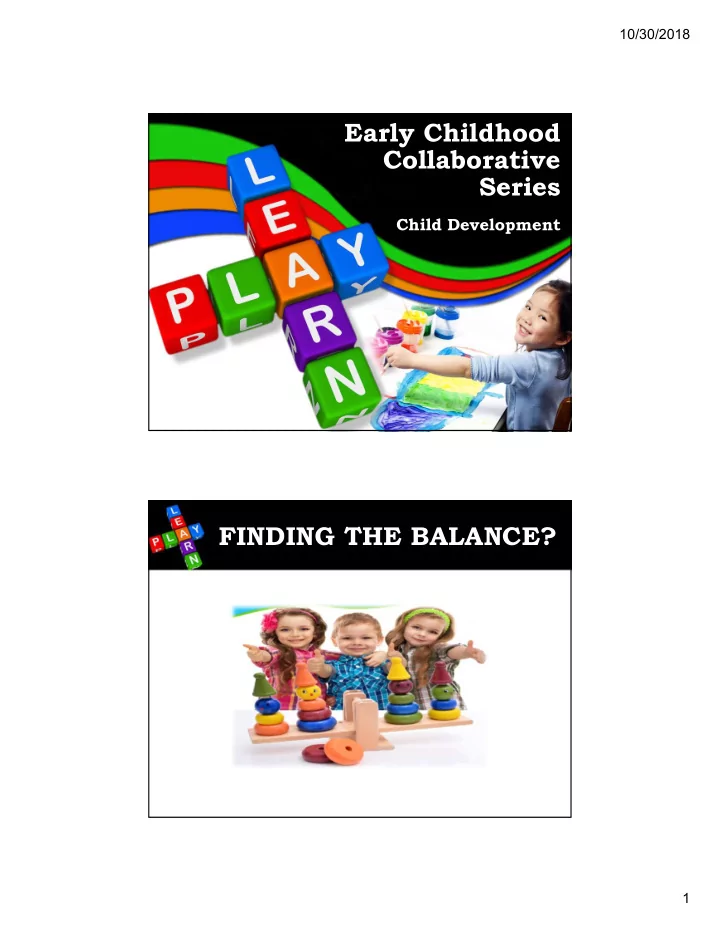
Early Childhood Collaborative Series Child Development FINDING - - PDF document
10/30/2018 Early Childhood Collaborative Series Child Development FINDING THE BALANCE? 1 10/30/2018 DR. THOMAS ARMSTRONG https://www.youtube.com/watch?v=aMx4Ui-F-tA SHIFT TO FULL DAY KINDERGARTEN Rationale Crunch for time with competing
10/30/2018 1
Child Development
10/30/2018 2
https://www.youtube.com/watch?v=aMx4Ui-F-tA
Crunch for time with competing interests
Academic Achievement Discourse vs Human Development Discourse
10/30/2018 3
Language Skills
him/her
Literacy Skills
to the back
their name and familiar printed words
10/30/2018 4
Numeracy Skills
touches objects as he/she counts)
and triangles
attributes
today, or tomorrow)
Physical/Motor Skills
(e.g. markers, chalk, pencils, etc.)
stringing beads, or cutting with scissors
10/30/2018 5
Creative/Aesthetic Skills
experiences
(e.g. singing, clapping, drumming, or dancing)
Personal/Social Skills
cooperatively
identify conflicts
10/30/2018 6
10/30/2018 7
Fine motor coordination skills are especially important for school aged children, since they spend much of their day manipulating small
coloring, cutting, and gluing activities.
Examples of Activities
Collect a box of objects. With eyes closed, have the child pick up an object and see if s/he can guess what it is. Collect objects that feel different to each other (i.e. hard, soft, bumpy, prickly, rough, smooth). Have the children “bury” their hands in a bucket filled with sand, rice, or very small beads for sensory input. *Practice writing letters, numerals, and words in the sand!
10/30/2018 8
Examples of Activities
Squeeze Ball/Stress Balls! Clothespins! Students can use clothespins to hang their artwork on the clotheslines in the classroom. Playdough! Roll into small balls or use scissors to cut playdough.
Gross motor skills are involved in movement and coordination of the arms, legs, and other large body parts and
divided into two subgroups of locomotor skills and non-locomotor skills. Introduction
10/30/2018 9
Locomotor movements Examples of Activities Walking Running Hopping Jumping Sliding Skipping and galloping are tough!
Non-locomotor movements Examples of Activities Bending Twisting Turning Kicking a stationary object Throwing underhand (not yet ready for overhand with proper form)
10/30/2018 10
Music on…music off. Move a certain way while music plays demonstrating body control and when music stops touch a body part to a paper plate or beanbag Examples of Activities
10/30/2018 11