Ecien t relational learning from sparse data Lub o P op - - PowerPoint PPT Presentation

e cien t relational learning from sparse data lub o p op
SMART_READER_LITE
LIVE PREVIEW

Ecien t relational learning from sparse data Lub o P op - - PowerPoint PPT Presentation

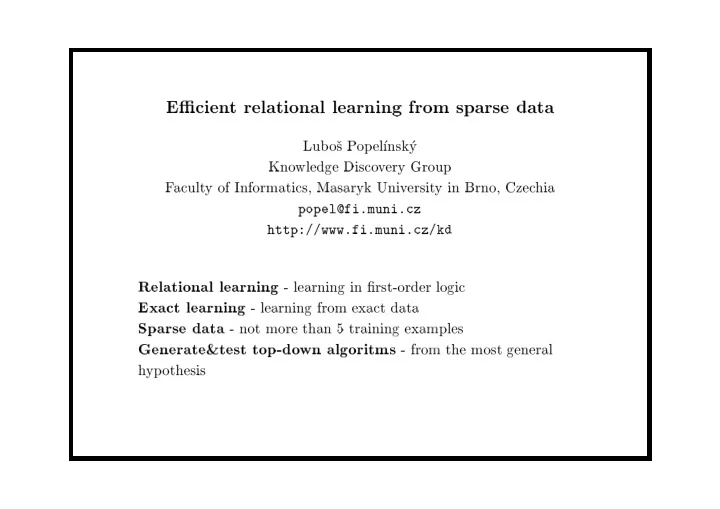
Ecien t relational learning from sparse data Lub o P op elnsk Kno wledge Disco v ery Group F acult y of Informatics, Masaryk Univ ersit y in Brno, Czec hia popel@fi.muni.cz http://www.fi.muni.cz/ kd


slide-1
SLIDE 1 Ecien t relational learning from sparse data Lub
  • P
  • p
elnsk Kno wledge Disco v ery Group F acult y
  • f
Informatics, Masaryk Univ ersit y in Brno, Czec hia popel@fi.muni.cz http://www.fi.muni.cz/ kd Relational learning
  • learning
in rst-order logic Exact learning
  • learning
from exact data Sparse data
  • not
more than 5 training examples Generate&test top-do wn algoritms
  • from
the most general h yp
  • thesis
slide-2
SLIDE 2 Assumption-based learning . . . . . . . . . . . . . . . . . . . . . . . . . . . . . . . . . . . . . . . . . . . . . . . . . .
  • .
. . . . . . . . . . . . . . . . . . . . . . . . . . . . . . . . . . . . . . . . . . . . . . . . . . . . . . . . . . . . . . . . . . . . . . . . . . . BK, E, bias, A=true inductiv e engine A acceptable? generate assumption fails program P assumption A fails return(P) assumption A true 2
slide-3
SLIDE 3 Generic algorithm
  • f
assumption-based learning Giv en: domain k now l edg e B K ; exampl e set E ; bias, assumption A = tr ue inductiv e engine I ,
  • v
ergeneral program P function f , that computes an assumption A acceptabilit y mo dule AM 1. Call I
  • n
B K [ P ; E [ A; bias.
  • if
I succeeds resulting in program P then call AM to v alidate the assumption A. if A is accepted then return(P ) else go to (2).
  • else
go to (2). 2. Call f to generate a new assumption A. If it fails, return(fail) and stop else go to (1). 3
slide-4
SLIDE 4 WiM inductiv e engine M ar k us + depth-rst searc h automatic setting
  • f
bias m ultiple predicate learning 2nd-order sc hema ma y b e emplo y ed generator
  • f
assumptions c ho
  • se
the simplest p
  • sitiv
e example nd its ne ar-miss acceptabilit y criterion mem b ersh ip
  • racle
4
slide-5
SLIDE 5 WiM: results 2
  • 4
examples for learning most
  • f
ILP b enc hmark predicates (list pro cessing, P eano v a aritmetik a) learning from p
  • sitiv
e examples
  • nly;
negativ e examples, if an y , generated with W iM itself max. 1 query to the user less dep enden t
  • n
qualit y
  • f
examples easy to use 5
slide-6
SLIDE 6 C R U S T AC E AN , S K I Lit a W iM : Randomly generated examples C R U S T AC E AN S K I Lit W iM 2 3 2 3 5 2 3 5 mem b er 0.65 0.76 0.70 0.89 0.95 0.80 0.97 0.97 last 0.74 0.89 0.71 0.72 0.94 0.76 0.89 0.94 app end 0.63 0.74 0.76 0.80 0.89 0.77 0.95 0.95 delete 0.62 0.71 0.75 0.88 1.00 0.85 0.88 0.97 rev erse 0.80 0.86 0.66 0.85 0.87 0.85 0.95 0.99 6
slide-7
SLIDE 7 Randomly generated examples: Learning with assumptions # p
  • s.
2 3 5 b ez s TP b ez s TP b ez s TP last 0.885 0.896 6 0.906 0.934 7 0.932 0.971 8 delete 0.882 0.962 8 0.857 0.937 7 0.874 0.943 7 leq 0.380 0.703 0.527 0.795 4 0.572 0.932 9 length 0.540 0.659 0.692 0.816 1 0.728 0.956 4 7
slide-8
SLIDE 8 D WiM sc hema database sc hema and
  • b
ject descriptions in F-logic ? GENERA TE
  • @
@ R Learning set Domain kno wledge predicates @ @ R
  • WiM
? the new class/attribute denition in F OL ? TRANSLA TE ? the new class/attribute denition in F-logic 8
slide-9
SLIDE 9 Spatial database sc hema

Object1 Object 2 HIGHWAY_BRIDGE LINEAR BRIDGE Geometry Importance ROAD RIVER RAILWAY PLANAR Geometry FORESTRY BUILDING FOREST WOOD FOREST_HOUSE Forest Named State Named

9
slide-10
SLIDE 10 Inductiv e query language for mining in geographic data [PKDD'98] extract c haracteristic rule for bridge from road, riv er. bridge(X,Y):- road(X),roadGeometry( X,Z) , river(Y),riverGeometr y(Y, U), member(V,Z),member(W, U),W =V. extract discriminate rule for forest in con trast to w
  • d
from p
  • in
t
  • f
view area. forest(F) :- geometry(F,GForest), area(GForest,Area), 100 < Area. 10
slide-11
SLIDE 11 extract dep endency rule for dieren tHouses from forestHouse, forest, building where building(B, GB), not forestHouse(B, F) from p
  • in
t
  • f
view distance, less differentHouses(FH,F,H) :- distance(FH,F,D1), distance(H,F,D2), D1<D2. 11