Dynamic crossovers in hydration water at 252 and 181 K from - - PowerPoint PPT Presentation

dynamic crossovers in hydration water at 252 and 181 k
SMART_READER_LITE
LIVE PREVIEW

Dynamic crossovers in hydration water at 252 and 181 K from - - PowerPoint PPT Presentation

Dynamic crossovers in hydration water at 252 and 181 K from experiments, theory and simulations G. Franzese (U. Barcelona) V. Bianco (U. Barcelona) M. G. Mazza (Max-Plank Gottingen) K. Stokely (Columbia U.) F. Bruni (Roma Tre) H. E. Stanley


slide-1
SLIDE 1

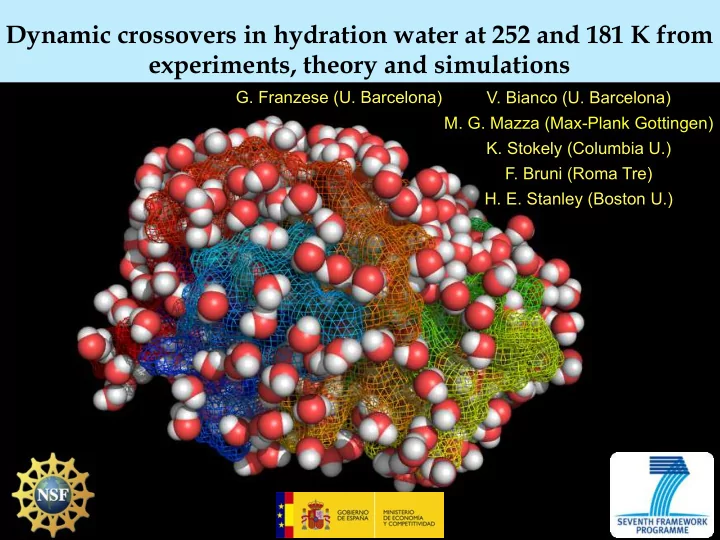
Dynamic crossovers in hydration water at 252 and 181 K from experiments, theory and simulations

  • V. Bianco (U. Barcelona)
  • M. G. Mazza (Max-Plank Gottingen)
  • K. Stokely (Columbia U.)
  • F. Bruni (Roma Tre)
  • H. E. Stanley (Boston U.)
  • G. Franzese (U. Barcelona)
slide-2
SLIDE 2

Thanks to

  • M. Bernabei (U. Barcelona)
  • S. V. Buldyrev (Yeshiva U.)
  • K. A. Dawson (U.C. Dublin)
  • A. De Simone (Imperial C.)
  • H. Hermann (ETH Zurich)
  • T. Kesselring (ETH Zurich)
  • P. Kumar (Rockfeller U.)
  • F. Leoni (U. Barcelona)
  • E. Lescaris (Boston U.)
  • P. Martin (U. Birmingham)
  • S. Pagnotta (Donostia)
  • I. Santamaría-Holek (UNAM)
  • F. de los Santos (U. Granada)
  • E. G. Strekalova (MIT)
  • E. Valsami-Jones (U. Birmingham)
  • O. Vilanova (U. Barcelona)
  • P. Vilaseca (Trinity C.)
  • L. Xu (Peking U.)

...

slide-3
SLIDE 3

Why water has dynamic crossovers?

Water hydrating biological surfaces Water in nanoconfinement

slide-4
SLIDE 4

forms a water monolayer with no translational diffusion but with rotational diffusion and HB dynamics h=0.3 Water hydrating lysozyme at low hydration (and low T)

slide-5
SLIDE 5

An Hamiltonian model for a water monolayer

Kumar, Franzese, Stanley, PRL (2008) Franzese, Marqués, Stanley PRE (2003) Mazza, Stokely, Pagnotta, Bruni, Stanley, Franzese PNAS (2012) Strekalova, Mazza, Stanley, Franzese PRL (2011)

Many-body model for water

slide-6
SLIDE 6

An Hamiltonian model for a water monolayer

Kumar, Franzese, Stanley, PRL (2008) Franzese, Marqués, Stanley PRE (2003) Mazza, Stokely, Pagnotta, Bruni, Stanley, Franzese PNAS (2012) Strekalova, Mazza, Stanley, Franzese PRL (2011)

We introduce a density field n(x,y) to identify water-like and gas-like cells

Many-body model for water

slide-7
SLIDE 7

An Hamiltonian model for a water monolayer

E=U(r)

Many-body model for water vdW interaction

E = U(r)

slide-8
SLIDE 8

J

E=U(r)-JNHB

Directional and covalent component of the hydrogen bond The state of a water molecule is described introducing 4 bonding variables

A many-body model for a water monolayer

E = U(r) - J NHB

Many-body model for water

  • cfr. Sastry et al. PRE (1996)
slide-9
SLIDE 9

An Hamiltonian model for a water monolayer

E=U(r)-J-Jσ

V=Nv0+NHBvHB

E = U(r) - J NHB - Jσ Nσ

Many-body model for water 1st shell (five-body) interaction Coopertivity (Quantum effect)

V = Nv0 + NHB vHB

slide-10
SLIDE 10

200 600 1000 1400 0.05 0.15 0.25 0.35 0.05 0.1 0.15

D|| (A2/ps)

T (K) P (GPa)

D|| (A2/ps) 0.02 0.03 0.04 0.05 0.06 0.07 0.08 0.09 0.1 0.11 0.12 0.13

iso-D line Liquid-Gas D-maxima D-minima TMD Density minima cP-max L-L T0 iso-D line Liquid-Gas D-maxima D-minima TMD Density minima cP-max L-L T0

  • F. de los Santos & G. Franzese J. Phys. Chem B 115, 14311 (2011)
  • G. Franzese, et al. JPCM 14, 2201 (2002); PRE 67, 011103 (2003);
  • G. Franzese, et al. JPCM 19, 205126 (2007); JPCM 20, 494210 (2008)

Phase diagram and Anomalies

  • f a hydration monolayer

Supercooled Liquid Water

D

75% hydrated surface

Amorphous Glassy Water (Sub-diffusive)

slide-11
SLIDE 11

Settles & Doster, Faraday Disc (1996), h=0.35

Simulations

Comparison with experiments for hydrated Myoglobin at low hydration (h=0.35): Subdiffusion at 320K and below

~ t

0.7

NS Experiments Result: Subdiffusion is not a consequence of heterogeneity in water-surface interaction, but results from increasing H-bonds correlation

  • F. de los Santos & G. F., J.Phys. Chem B 115, 14311 (2011)
slide-12
SLIDE 12

At high T: Diffusion maxima and minima

Average NHB/molecule Average (free volume)/molecule

are both monotonic!!

  • F. de los Santos & G. F., PRE 85, 010602(R) (2012)
slide-13
SLIDE 13
  • F. de los Santos & G. F., PRE 85, 010602(R) (2012)

Theoretical explanation

Anomalous Diffusion results from competition between H-bonds breaking and free-volume in Cooperative Rearranging Regions of 1nm size

Simulations

Experiments show change in diffusion for confinement below 1nm !!

Joint probability: to have molecules with at least

  • ne free n.n. cell

+ to break bonds + to have a given enthalpy H at a given (P , T)

Theory

slide-14
SLIDE 14

Glassy Dynamics at low T (< TminD < TMD)

G.Franzese and F. de los Santos J. Phys. Cond Mat. 21, 504107 (2009) >P(C)

LargeCAVITY

# H bonds(T)

≈T(MD) >T(C) <T(C)

slide-15
SLIDE 15

Glassy Dynamics at low T (< TminD < TMD)

G.Franzese and F. de los Santos J. Phys. Cond Mat. 21, 504107 (2009) >P(C) <<P(C) ≈T(MD) >T(C) <T(C)

GLASS LargeCAVITY

GLASS

# H bonds(T)

≈T(MD) >T(C) <T(C)

slide-16
SLIDE 16

Glassy Dynamics at low T (< TminD < TMD)

G.Franzese and F. de los Santos J. Phys. Cond Mat. 21, 504107 (2009) >P(C) <P(C) <<P(C) ≈T(MD) >T(C) <T(C)

GLASS LargeCAVITY Small Cavities

GLASS

DEHYDRATION

# H bonds(T)

large τ β=0.7

≈T(MD) >T(C) <T(C)

slide-17
SLIDE 17

Glassy Dynamics at low T (< TminD < TMD)

G.Franzese and F. de los Santos J. Phys. Cond Mat. 21, 504107 (2009) >P(C) ≈P(C) <P(C) <<P(C) ≈T(MD) >T(C) <T(C)

β[>T(C)]=0.8, β[<T(C)]=0.4 !!! Max heterogeneity as effect

  • f cooperativity

GLASS LargeCAVITY Small Cavities

GLASS

DEHYDRATION

LLCP

Prediction

# H bonds(T)

large τ β=0.7

≈T(MD) >T(C) <T(C)LLCP

slide-18
SLIDE 18

Doster, BBA (2010), h=0.34 Settles & Doster, Faraday Disc (1996), h=0.35

Comparison with experiments: Myoglobin at low hydration (h=0.35):

β[P(C);<T(C)]=0.4

G.Franzese and F. de los Santos J.

  • Phys. Cond Mat.

21, 504107 (2009)

P<<P(C), T<T(C) P<P(C)

slide-19
SLIDE 19

Doster, BBA (2010), h=0.34 Settles & Doster, Faraday Disc (1996), h=0.35

Comparison with experiments: Myoglobin at low hydration (h=0.35):

β[P(C);<T(C)]=0.4 GLASS

DEHYDRATION

LLCP large τ β=0.7

G.Franzese and F. de los Santos J.

  • Phys. Cond Mat.

21, 504107 (2009)

β[>T(C)]=0.8, β[<T(C)]=0.4 !!! Max heterogeneity as effect

  • f cooperativity

Prediction

P<<P(C), T<T(C) P<P(C)

slide-20
SLIDE 20
  • V. Bianco & G.F. arXiv1212.2847B

TWO MAXIMA IN RESPONSE FUNCTIONS

slide-21
SLIDE 21

Exploring the Phase Diagram

Two loci of extrema in the thermal expansivity αP along isotherms and isobars STRONGER MINIMUM

Valentino Bianco & G.F. arXiv1212.2847B

“diverging” maxima

Two maxima in response functions

slide-22
SLIDE 22

Exploring the Phase Diagram

Two loci of extrema in the thermal expansivity αP along isotherms and isobars

LIQUID-LIQUID CRITICAL POINT LIQUID-LIQUID PHASE TRANSITION

Valentino Bianco & G.F. arXiv1212.2847B

slide-23
SLIDE 23

Order Parameter and Scaling Behavior

D e n s i t y Energy Gibbs Free Energy Using the mixed-field approach we define the order parameter as m=ρ+sE In the thermodynamic limit the probability distribution of The order parameter at the critical point approaches the 2D-Ising model critical distribution

Wilding, Binder Phys A (1996)

Valentino Bianco & G.F. arXiv1212.2847B

slide-24
SLIDE 24

Increasing confinement: increasing fluctuations (2D-3D Crossover)

Kullback-Leibler deviation Liu-Panagiotopoulos-Debenedetti deviation

Crossover at L/h=50 !!

In water stronger confinement could lead to bulk-like behavior for the fluctuations

  • V. Bianco & G.F. arXiv1212.2847B
slide-25
SLIDE 25

Confining Effect: Critical Crossover

For LIQUID-GAS CRITICAL POINT of LJ system the crossover is observed for (Liu et al 2010)

L/h ~ 5

The high cooperative behavior of HB enhances the spreading of critical fluctuations along the network.

While at the LLCP the crossover occurs at L=25 nm

L/h = 50!!!

Increasing confinement: increasing fluctuations (2D-3D Crossover)

  • V. Bianco & G.F. arXiv1212.2847B
slide-26
SLIDE 26

TMD TMD TMD Singularity-Free Liquid-liquid Crit. Point

  • Crit. Point-Free

Stanley & Teixeira1980 Sastry et al. 1996

Poole et al. 1992

Tuning the Cooperativity Strength

ALL THE SCENARIOS FROM THE SAME MECHANISM

Angell 2008

slide-27
SLIDE 27

Parameters from Experiments: Liquid-Liquid Critical Point (LLCP)

From Experiments: from Ih - liq. => Jσ≈1 kJ/mol 4ε≈5.5 kJ/mol (Jσ/4ε≈0.2) EHB(ε, J, Jσ)≈5.8 kJ/mol => J≈ 6-12 kJ/mol (J/4ε≈1.1-2)

*

LLCP predicted in a region inaccessible in experiments so far

slide-28
SLIDE 28

Widom line? Locus of maxima of correlation length

Valentino Bianco & G. Franzese. arXiv1212.2847B Valentino Bianco PhD thesis (2013)

slide-29
SLIDE 29

Correlation Length and Widom Line

WIDOM LINE: LOCUS OF MAXIMA OF ξ

Valentino Bianco & G.F. arXiv1212.2847B Valentino Bianco PhD thesis (2013)

slide-30
SLIDE 30

Widom line consistent with fitting from experiments, Weak Cp Max line consistent with “Widom line” from simulations

Bianco & Franzese arXiv1212.2847B Fuentevilla and Anisimov PRL (2006) Abascal and Vega JCP (2010)

TIP4P/2005

slide-31
SLIDE 31

Holten and Anisimov SciRep (2012) Vega & Abascal JCP (2010) Kumar et al. PNAS (2007) Holten et al. arXiv:1302.5691 (2013)

Bianco & Franzese arXiv1212.2847B Valentino Bianco PhD thesis (2013) TIP4P/2005 mW

slide-32
SLIDE 32

Connecting dynamics and thermodynamics

slide-33
SLIDE 33

Crossing the line of weak Max Cp

Kumar, Kumar, Franzese Franzese and Stanley and Stanley

  • Phys. Rev.
  • Phys. Rev. Lett
  • Lett. 100,

. 100, 105701 105701 (2008) (2008)

w w

slide-34
SLIDE 34

Crossing the line of weak Max Cp

H-Bond Prob.

Kumar, Kumar, Franzese Franzese and Stanley and Stanley

  • Phys. Rev.
  • Phys. Rev. Lett
  • Lett. 100,

. 100, 105701 105701 (2008) (2008)

w w

few HBs many HBs

slide-35
SLIDE 35

Crossing the line of weak Max Cp

H-Bond Prob.

Kumar, Kumar, Franzese Franzese and Stanley and Stanley

  • Phys. Rev.
  • Phys. Rev. Lett
  • Lett. 100,

. 100, 105701 105701 (2008) (2008)

Max fluctuation of NHB (single bonds) at CpMAX (weak)

w w

few HBs many HBs

slide-36
SLIDE 36

Dynamic Crossover ?

Arrhenius

VTF Arrhenius

Liquid-liquid Critical Point Singularity-Free interpretation Crossover in BOTH scenarios ! In both cases is T(cross.)~T(CpMax) Crossover is not Crossover is not a a difference difference between the two scenarios between the two scenarios 1st PREDICTION: 1st PREDICTION: isochronic isochronic log log τ τ ( (Tcross Tcross.) ~ constant .) ~ constant

Kumar, Kumar, Franzese Franzese and Stanley Phys. Rev. and Stanley Phys. Rev. Lett Lett. . 100, 100, 105701 105701 (2008) (2008)

weak Max Cp

? ?

slide-37
SLIDE 37

Other Predictions

Liq.-Liq. Crit. Point Singularity Free

2nd 2nd PREDICTION PREDICTION

3rd 3rd PREDICTION PREDICTION 4th 4th PREDICTION PREDICTION

increase ~1% Kumar, Kumar, Franzese Franzese and Stanley Phys. Rev. and Stanley Phys. Rev. Lett Lett. . 100, 100, 105701 105701 (2008) (2008)

  • J. Phys.: Condens. Matter 20, 244114 (2008)
slide-38
SLIDE 38

Comparison with Experiments on Lysozyme (QENS)

1st Prediction (isochronic crossover) 2nd Prediction 3rd Prediction 4th Prediction (error > 1%)

X.-Q. Chu, S.-H. Chen, et al. J Phys Chem B (2009)

Franzese et al. J. Phys. Cond Mat. 20, 494210 (2008)

Lines = Theory Symbols = Experiment

slide-39
SLIDE 39

Why Crossover at T(Cp Max)?

Hp: Hp: Activation barrier Activation barrier (function of T) EA = ∆U + P ∆V - T ∆S

  • Energy to break one H-bond

+ Energy to reorient as a tetrahedron to form a new H-Bond (=0 in SF case) + P times variation of volume (decrease)

  • T times variation of entropy (increase)

Liquid-liquid Critical Point Singularity-Free T>T( T>T(C Cp

pMAX

MAX),

), Numb. of H-bonds

  • Numb. of H-bonds

when T when T E EA

A increases

increases T< T<T( T(C Cp

pMAX

MAX),

), Numb. of H-bonds

  • Numb. of H-bonds ~

~ const.

  • const. when T

when T E EA

A const.

const. Crossover Crossover

BUT is not exactly Arrhenius

confirmed by Vogel J Chem Phys B (2009)

Kumar, Kumar, Franzese Franzese and Stanley Phys. Rev. and Stanley Phys. Rev. Lett Lett. . 100, 100, 105701 105701 (2008) (2008)

w

+ form w w

slide-40
SLIDE 40

Simul./Theo.: 2 Max in Cp T≈180 K T≈250 K

2 Structural changes !!

Mazza, Stokely, Pagnotta, Bruni, Stanley, Franzese PNAS 108, 19873 (2011) Mazza, Stokely, Stanley, Franzese

  • J. Chem. Phys. 137, 204502 (2012)

higher T: at the largest increase of NHB lower T: at the largest increase of tetrahedrally oriented HBs = WIDOM LINE

slide-41
SLIDE 41

Simulations: 2 Crossovers in HB relaxation time Exper.(DS) : 2 Crossovers T≈180 K T≈250 K (1 atm)

Simul./Theo.: 2 Max in Cp T≈180 K T≈250 K Simul./Theory: 2 Structural changes !!

2nd crossover at the Widom line due to LLCP!

compare with QENS for Rutile (TiO2) at low hydration [Chu, Ehlers, Mamontov, et al. PRE 2011] and with EINS for low-hydr. perdeut. C-phycocyanin [S. Combet & J.-M. Zanotti PCCP 2012] Mazza, Stokely, Pagnotta, Bruni, Stanley, Franzese PNAS 108, 19873 (2011)

slide-42
SLIDE 42

At higher P

PREDICTION: at higher P the intermediate non-Arrhenius regime disappears

Mazza, Stokely, Stanley, Franzese

  • J. Chem. Phys. 137, 204502 (2012)

Same on αP: consistent with results in MCM-41 by S.-H. Chen group

slide-43
SLIDE 43

Conclusions

  • Many-body model predicts that water has Cooperative Rearranging Regions of 1nm

(consistent with increased diffusivity for water in nanotubes of diameter < 1nm)

  • Hydration water (at low hydration level) is subdiffusive (at ambient T) for the increasing

HB correlation (consistent with NS experiments for low hydrated proteins)

  • (i) The formation of a macroscopic number of HBs and (ii) the cooperative

rearrangement of HBs leads to the LLCP

  • Water has Max dynamic heterogeneity near the LLCP (consistent with NS experiments

for low hydrated proteins)

  • (i) and (ii) marks two structural changes
  • Response functions (Cp, conpressibility, expansivity) of Many-body model at (i) resembles

what is commonly observed in simulations

  • (ii) corresponds to the Widom line and is consistent with fitting from experimental data
  • (i) and (ii) lead to two dynamic crossovers (non-Arr––non-Arr––Arr)
  • Two crossovers consistent with DS, QENS, EINS data for low-hydrated systems (at ~

250 K and ~180 K and ambient P)

  • The crossover at (i) is isochronic as verified in QENS experiments
  • The intermediate non-Arr regime disappears at higher P (or higher hydration)
slide-44
SLIDE 44

38

Marco Bernabei Oriol Vilanova Fabio Leoni Valentino Bianco

Valentino Bianco & GF arXiv1212.2847B +

  • V. Bianco PhD Thesis

(2013) +

  • V. Bianco et al. in

Proceedings of “Symposium on the Fragility of Glass- formers” (2014)

Thanks!

http:/ /www.ffn.ub.es/gfranzese