Duraid Alkazraji Pipeline Specialist Inspector This is what I - - PowerPoint PPT Presentation

duraid alkazraji
SMART_READER_LITE
LIVE PREVIEW

Duraid Alkazraji Pipeline Specialist Inspector This is what I - - PowerPoint PPT Presentation

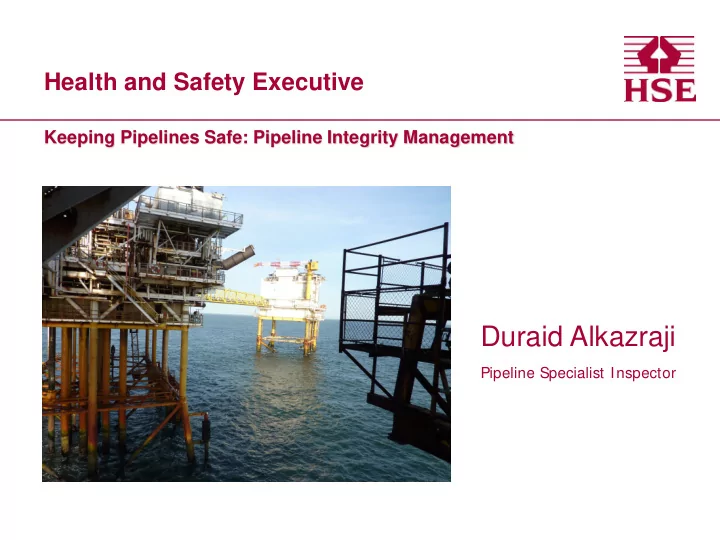
Health and Safety Executive Keeping Pipelines Safe: Pipeline Integrity Management Duraid Alkazraji Pipeline Specialist Inspector This is what I intend to cover HSEs role Why is Integrity Management so Important Legislation -

slide-1
SLIDE 1

Health and Safety Executive

Keeping Pipelines Safe: Pipeline Integrity Management

Duraid Alkazraji

Pipeline Specialist Inspector

slide-2
SLIDE 2

This is what I intend to cover

  • HSE’s role
  • Why is Integrity Management so Important
  • Legislation - Pipeline Safety Regulations
  • Standards
  • Integrity Management

– PIMS

  • Key Messages
slide-3
SLIDE 3

HSE’s Role

  • Specialist Inspector within Energy Division gas and pipelines unit.

– Inspection of pipeline operators – Investigation of Accidents and Incidents – Enforcement Action

  • Improvement Notice
  • Prohibition Notice
  • Prosecution

– HSE is not a first responder

  • HSE is a Category 2 responder under the Civil Contingencies Act 2004 and plays a

supporting role in emergency planning and response. Inspectors should not become involved in the incident command and control arrangements established by Category 1 responders

slide-4
SLIDE 4

UK North Sea and Irish Sea

  • The UK offshore oil and gas industry consists of 107 oil and gas plus 181 gas

producing installations, located on 383 producing fields. There is a supporting infrastructure of 14,000 km of pipelines connecting installations to beach

  • terminals. Industry commissioned many of these assets in the early 1970s and

some are now forecast to continue operating to 2030 and beyond

  • Currently, the majority of activity is in the North Sea, with other activity in the Irish

Sea and West of Shetland

  • Operators and contractors employ over 32,000 workers in offshore activities
  • Oil and gas production is strategically important to the UK economy, meeting

around 50% of our total primary energy needs

HSE’s Role

slide-5
SLIDE 5

Why is managing UK Offshore pipeline integrity important

  • Original design life typically 25 years
  • Approx 25% of UK offshore pipelines have

exceeded original design life

  • Current projections are that this will increase to

50% by 2020

  • Likely continued and extended production from

existing fields

  • Challenges from deeper, hotter and higher

pressure fields

slide-6
SLIDE 6

Why is Managing Pipeline Integrity Important?

  • Safety risk
  • Environmental damage
  • Reputation
  • Legal requirement
  • Production facility down time
  • Loss of production/profit
  • HSE approach is identical for onshore and
  • ffshore pipelines
slide-7
SLIDE 7

Why is Managing Pipeline Integrity Important?

slide-8
SLIDE 8
slide-9
SLIDE 9

The Pipelines Safety Regulations (PSR)

  • PSR (primary legislation)

replaced earlier, prescriptive legislation

  • focus on management of

pipeline safety – to secure pipeline integrity – cover both onshore and

  • ffshore pipelines
  • overall aim: ensure that

pipelines are designed, constructed, operated and maintained properly

slide-10
SLIDE 10
  • Scope of Regulations –refer to PSR Reg 3;

The Pipelines Safety Regulations (PSR)

slide-11
SLIDE 11

The legal framework

  • Pipeline Safety Regulations
  • Regulation 13, Maintenance is essential

– Maintain to ensure remains safe and fit for purpose – Consider maintenance and inspection requirements for the pipeline – Maintenance under this regulation also includes maintaining any safety system

slide-12
SLIDE 12
  • Regulation 23, Major Accident Prevention

Document Identify hazards relating to the pipeline Record and document findings Implement a management system Revise and replace MAPD as appropriate

slide-13
SLIDE 13

Integrity Management Standards

slide-14
SLIDE 14

Integrity Management Standards

slide-15
SLIDE 15

Integrity Management - The aging pipeline – physical challenges

  • Aging – not simply related to chronological age
  • Aging is a product of corrosion, fatigue,

erosion, damage, modifications, changes to flow rate etc over time

slide-16
SLIDE 16

Failure Probability

Time Construction Testing Intended design life Operational life [Failure probability verses time]

slide-17
SLIDE 17

Aim is to maintain Integrity

  • Fit for Service as per

PSR Reg 13

  • Managing

Deterioration is the Key

slide-18
SLIDE 18
  • Must show clear management focus on major

hazards and pipeline system safety.

  • Essential to have effective record keeping and

management/data analysis.

  • 'Threat identification' should be well thought out and

robust.

  • Pipeline repairs must be planned and managed.
  • Resources available for pipeline integrity

assessments must be effectively managed

  • Bottlenecks or unexpected operational issues must

not mean important work not done (e.g. repairs or assessment work)

Source: NTSB

Integrity Management

slide-19
SLIDE 19

Integrity Management

  • Major theme of HSE’s strategy
  • Must permeate throughout the organisation
  • Take ownership of risks and managing them
  • This is a strategic challenge
slide-20
SLIDE 20

PIMS – Key Elements

PIMS (Pipeline Integrity Management System)

GIS Risk Profiles

  • Damage
  • corrosion
  • Spanning
  • Buckling

Pipeline Data

  • ILI
  • CP
  • Defects
  • Pipeline changes

Maintenance/ Repair Plans Quarterly, Annual Reports Trends

  • Frequency of events

(Corrosion, Spans, movement, other)

Asset Register Documentation

  • Well documented processes

and procedures

slide-21
SLIDE 21

Key Messages

  • The people best placed to make workplaces

safer from harm are the staff and managers who work in them

  • We are committed to being a good partner –

working with others to improve pipeline safety

  • PSR provides a single framework for pipeline

safety & integrity with a goal setting focus

  • Drive to continue improvement in safety record

for UK pipelines

  • Sensible health and safety approach
slide-22
SLIDE 22

Key Messages

  • Pipeline Integrity Management remains a key priority focus

for HSE, both offshore and onshore.

  • HSE expect duty holders to have robust/effective integrity

management systems throughout the pipeline lifecycle: – Systems should reflect good practice and must be subject to regular monitoring, audit and review – Strong leadership, effective use of SPI’s and sharing of lessons learned and good practice are important factors

  • Formal review of Pipeline Life Extension expected in line with

good practice

slide-23
SLIDE 23
  • Asset Age (deciding when is revalidation necessary)
  • Ensuring competent staff and follow and apply safe systems
  • f work
  • Ensuring operators follow industry best practice
  • Effective procedures in management of pipelines and risers
  • Operational Intelligence

– ESD performance testing and trending (pipelines) – Key Performance Indicators – Quarterly & Annual Integrity Reviews

  • New developments in technology

– E.g. Integrity management of flexibles

  • Decommissioning and the management of projects

Key Messages