DSWMA SOUTH LANDFILL FINAL COVER CONSTRUCTION Engineering and - - PowerPoint PPT Presentation

dswma south landfill final cover construction
SMART_READER_LITE
LIVE PREVIEW

DSWMA SOUTH LANDFILL FINAL COVER CONSTRUCTION Engineering and - - PowerPoint PPT Presentation

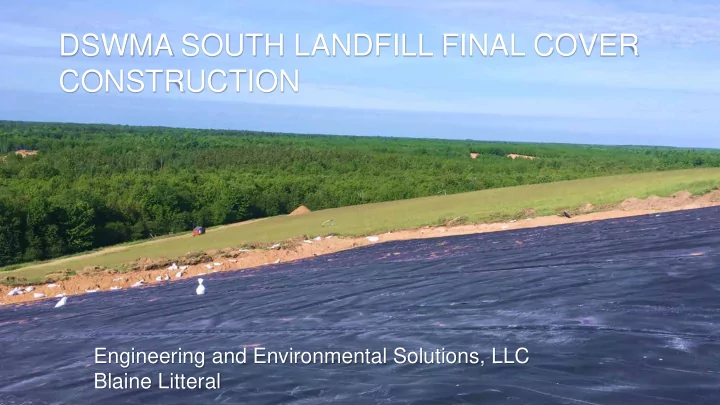
DSWMA SOUTH LANDFILL FINAL COVER CONSTRUCTION Engineering and Environmental Solutions, LLC Blaine Litteral CLOSURE OVERVIEW Final cover was completed in three phases. Phase I of closure was completed in 1997 & 1998 closed 6.59 acres.


slide-1
SLIDE 1

DSWMA SOUTH LANDFILL FINAL COVER CONSTRUCTION

Engineering and Environmental Solutions, LLC Blaine Litteral

slide-2
SLIDE 2

CLOSURE OVERVIEW

§Final cover was completed in three phases. §Phase I of closure was completed in 1997 & 1998 closed 6.59 acres. §Phase II was completed in 2013 closing 11.05 acres. §Phase III was completed in 2016 closing the final 5.27 acres of the south landfill. §Active gas collection was installed in 3 phases in 1997, 2012 and 2016.

E & E Solutions, LLC

slide-3
SLIDE 3

South Landfill Map

E & E Solutions, LLC

slide-4
SLIDE 4

CLOSURE OVERVIEW

§Phase I included PVC cover FML over areas lined with single PVC liner. §Phase II and III included a composite cover system of LLDPE FML and GCL materials over areas lined with a double composite liner system that included GCL, HDPE FML, and drainage composite components.

E & E Solutions, LLC

slide-5
SLIDE 5

SETTLEMENT ISSUES IN DESIGN

§Observed significant settlement of final cover between construction of each phase. §Required redesign of cover grades resulting in loss of airspace. §Expect field adjustments at the tie in to older cover areas.

E & E Solutions, LLC

slide-6
SLIDE 6

Adjustment between 2013 and 2016 final cover.

E & E Solutions, LLC

slide-7
SLIDE 7

LIMITTING AIRSPACE LOSS DUE TO SETTLEMENT

§Use of temporary covers to increase time before closure to allow refilling settled areas. §Avoid terminated closure phase perpendicular to the slope and avoid closure boundary that runs across slope when possible.

E & E Solutions, LLC

slide-8
SLIDE 8

The flow from the secondary collection system began exceeding regulatory limits following construction of the second phase of final cover.

SECONDARY FLOW EXCEEDANCES

E & E Solutions, LLC

slide-9
SLIDE 9

INVESTIGATION OF SOURCES

§Analytical testing showed liquid was representative of storm water. §Investigation into the source identified two suspected points of entry for the storm water.

E & E Solutions, LLC

slide-10
SLIDE 10

Leakage around leachate pump station and poor drainage combined with flaws in primary to secondary welds at site perimeter.

TWO CAUSES IDENTIFIED BY THE INVESTIGATION

E & E Solutions, LLC

slide-11
SLIDE 11

LEAKAGE AT PUMP HOUSE

§It was discovered that storm water was building up on top of the final cover/exposed primary liner. §Attachment of liner system to pump house provided liquid entry to secondary.

E & E Solutions, LLC

slide-12
SLIDE 12

Primary liner connection at building corner.

E & E Solutions, LLC

slide-13
SLIDE 13

Leakage around leachate pump station was addressed by sealing apparent openings, installing a rain flap to direct storm water away from the building liner connection and providing additional drainage.

PUMP HOUSE LEAK CORRECTIVE ACTION

E & E Solutions, LLC

slide-14
SLIDE 14

PERIMETER ANCHOR TRENCH

§Storm water was also found to be building up within the perimeter anchor trench . §Flaws in the primary liner within the trench were believed to be a source of water to the secondary collection system. §Road at perimeter of site prevents drainage away from lined area.

E & E Solutions, LLC

slide-15
SLIDE 15

Recommended Cover - Primary - Secondary Liner connection at perimeter.

E & E Solutions, LLC

slide-16
SLIDE 16

A rain flap and toe drain was installed

  • ver the perimeter welds to prevent

storm water from collecting over the perimeter anchor trench.

PREVENT STORM WATER ACCUMILATION IN THE COVER

E & E Solutions, LLC

slide-17
SLIDE 17

OTHER CONSIDERATIONS

§Pump houses should be set sufficiently away from liner system so liner does not need to be connected to the

  • building. Standard side slope riser pumping system may

be preferred. §Provide space between landfill liner system and perimeter road to allow storm water to be drained away from landfill.

E & E Solutions, LLC

slide-18
SLIDE 18

ANY QUESTIONS?

Blaine Litteral - 616.566.4609 blaine.litteral@goeeesolutions.com Engineering & Environmental Solutions, LLC www.goEESolutions.com