DSL Design Language Implementation Strategies g g p g Generic - - PowerPoint PPT Presentation

dsl design
SMART_READER_LITE
LIVE PREVIEW

DSL Design Language Implementation Strategies g g p g Generic - - PowerPoint PPT Presentation

DSL Design Language Implementation Strategies g g p g Generic Language Technology 2IS15 g g gy Model Transformations Stand-alone Embedding Marcel van Amstel Translation / Software Engineering and Technology 9-1-2012


slide-1
SLIDE 1

Generic Language Technology 2IS15 g g gy Model Transformations

Marcel van Amstel

DSL Design

Language Implementation Strategies g g p g

  • Stand-alone
  • Embedding
  • Translation

/ Software Engineering and Technology

PAGE 2 9-1-2012

Model Transformations

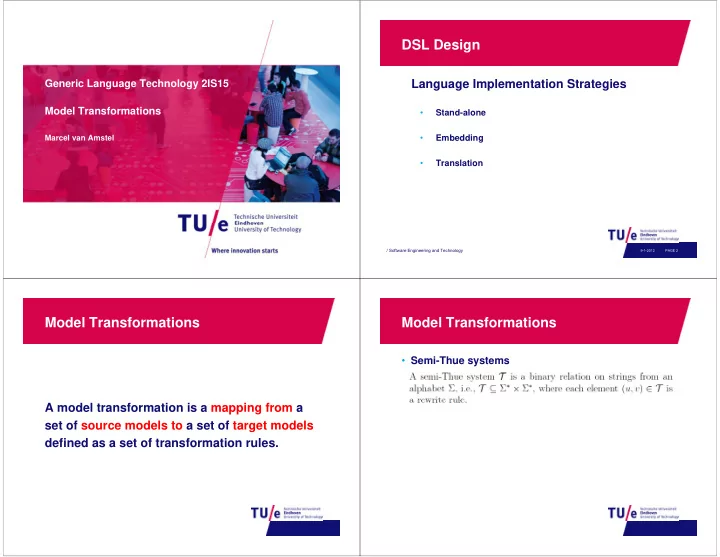
A model transformation is a mapping from a set of source models to a set of target models defined as a set of transformation rules.

Model Transformations

  • Semi-Thue systems

y

slide-2
SLIDE 2

Model Transformations

  • Model transformation

Model transformations

/ Faculteit Wiskunde en Informatica

PAGE 6 9-1-2012

Model Transformations

Implementation approaches p pp

  • Direct model manipulation
  • Intermediate representation
  • Model transformation language

Model transformations

  • Model transformation formalisms
  • ATL
  • Xtend
  • ASF+SDF
  • Stratego/XT
  • Xtext
  • Xpand
  • QVT Relations
  • VIATRA
  • Tefkat
  • ETL (Epsilon)
  • QVT Operations
  • QVT Core

( p )

  • GrGen
  • Platform: Eclipse and EMF

/ Faculteit Wiskunde en Informatica

PAGE 8 9-1-2012

slide-3
SLIDE 3

Model Transformations

  • ATL characteristics:

ATL characteristics:

  • Hybrid language (declarative and imperative constructs)
  • Transformation is a set of transformation rules and

helpers

  • OCL for source model navigation
  • Limited escape mechanism to use Java
  • In-place transformation simulated using refining mode
  • Documentation: www eclipse org/m2m/atl/doc/
  • Documentation: www.eclipse.org/m2m/atl/doc/

Model transformations

  • The Atlas Transformation Language (ATL) is a hybrid language

(a mix of declarative and imperative constructions) designed to express model transformations

  • A model transformation in ATL is expressed as a set of

transformation rules

  • Hybrid style of programming:
  • Declarative  transformation based on simple mappings
  • Imperative  for complex mappings
  • OCL is used to expression constraints on rules
  • Guards (constraints) on the entry point for a rule

( ) y p

  • Documentation: http://www.eclipse.org/gmt/atl/doc

/ Faculteit Wiskunde en Informatica

PAGE 10 9-1-2012

Model transformations

  • An ATL transformation program is composed of

g rules that define how

  • source model elements are matched and navigated
  • to create and initialize the elements of the target models
  • to create and initialize the elements of the target models
  • The ATL programs for model to model

transformation are called modules

/ Faculteit Wiskunde en Informatica

PAGE 11 9-1-2012

Model transformations

  • An example of an ATL specification
  • The goal is to present a use case of a model to model

transformation written in ATL

  • This use case is named: “Books to Publications”
  • Initially we have a text describing a list of books

t a y e a e a te t desc b g a st o boo s

  • We want to transform this into another text

describing a list of publications

/ Faculteit Wiskunde en Informatica

PAGE 12 9-1-2012

slide-4
SLIDE 4

Model transformations

  • ATL: Book2Publication example

MMM MM MMt MM

conformsTo conformsTo conformsTo

MMa MMb

conformsTo conformsTo conformsTo

Ma Mt Mb

Transformation

/ Faculteit Wiskunde en Informatica

PAGE 13 9-1-2012

Model transformations

  • ATL: Book2Publication example

Ecore MM ATL MM

conformsTo conformsTo conformsTo

MMBook MMPublication

conformsTo conformsTo conformsTo

Book

Book2Publication

Publication

Transformation

/ Faculteit Wiskunde en Informatica

PAGE 14 9-1-2012

Model transformations

  • Meta-model of Book:

E l f B k

  • Example of Book:

/ Faculteit Wiskunde en Informatica

PAGE 15 9-1-2012

Model transformations

  • Meta-model of Publication:

/ Faculteit Wiskunde en Informatica

PAGE 16 9-1-2012

slide-5
SLIDE 5

Model transformations

  • First we create an ATL

project

  • Getting started

S l t i E li

  • Select in Eclipse

− File/New/ATL Project

  • Select then the Finish

b tt button

/ Faculteit Wiskunde en Informatica

PAGE 17 9-1-2012

Model transformations

  • First we have to create/
  • btain meta-models

N t t ATL fil

  • Next we create an ATL file
  • Getting started
  • Select in Eclipse

Select in Eclipse

− File/New/ATL File

  • Select then the Next button

/ Faculteit Wiskunde en Informatica

PAGE 18 9-1-2012

Model transformations

  • Next we have to set the

Input/Output parameters

  • f ATL transformation:
  • Select then the Finish

Select then the Finish button

  • This will generate

automatically the header section section

/ Faculteit Wiskunde en Informatica

PAGE 19 9-1-2012

Model transformations

  • A detailed description of the transformation can be

found at:

http://wiki.eclipse.org/ATL/Tutorials_- Create a simple ATL transformation _Create_a_simple_ATL_transformation

/ Faculteit Wiskunde en Informatica

PAGE 20 9-1-2012

slide-6
SLIDE 6

Model transformations

  • ATL transformation code
  • A header section that defines some attributes that are

relative to the transformation module

  • An optional import section that enables to import some

existing ATL libraries

  • A set of helpers that can be viewed as an ATL

equivalent to Java methods equivalent to Java methods

  • A set of rules that defines the way target models are

t d f generated from source ones

/ Faculteit Wiskunde en Informatica

PAGE 21 9-1-2012

Model transformations

  • Header:
  • The header section names the transformation module and

names the variables corresponding to the source and target models ("IN" and "OUT") together with their meta-models (“Book" and “Publication") acting as types. module Book2Publication; module Book2Publication; create OUT : Publication from IN : Book;

/ Faculteit Wiskunde en Informatica

PAGE 22 9-1-2012

Model transformations

  • Libraries:
  • The optional import section enables to declare which ATL

libraries have to be imported

  • The declaration of an ATL library is achieved as follows:

uses extensionless library file name; uses extensionless_library_file_name;

  • For example:

uses strings;

/ Faculteit Wiskunde en Informatica

PAGE 23 9-1-2012

Model transformations

  • ATL helpers
  • ATL helpers can be viewed as the ATL equivalent to Java

methods

  • They make it possible to define factorized ATL code that can

They make it possible to define factorized ATL code that can be called from different points of an ATL transformation

  • Body of helpers is OCL code

/ Faculteit Wiskunde en Informatica

PAGE 24 9-1-2012

slide-7
SLIDE 7

Model transformations

  • An ATL helper is defined by the following elements:

y g

  • a name
  • a context type

− The context type defines the context in which this attribute is − The context type defines the context in which this attribute is defined − Optional

  • a return value type
  • a return value type.

− Note that, in ATL, each helper must have a return value

  • an OCL expression that represents the code of the ATL

helper; helper;

  • an optional set of parameters, in which a parameter is

identified by a couple (parameter name, parameter type).

/ Faculteit Wiskunde en Informatica

PAGE 25 9-1-2012

Model transformations

  • Helper functions:
  • A helper is an auxiliary function that computes a

result needed in a rule

helper context Book!Book def : getAuthors() : String = self.chapters-> collect(e | e.author)-> S t() > asSet()-> iterate(authorName, acc : String = '' | acc + if acc = '' if acc then authorName else ' and ' + authorName endif);

/ Faculteit Wiskunde en Informatica

PAGE 26 9-1-2012

Model transformations

Select the chapters Get the authors of each chapter Filter duplicates

helper context Book!Book def : getAuthors() : String =

each chapter

self.chapters-> collect(e | e.author)-> asSet()-> iterate(authorName; acc : String = '' | iterate(authorName; acc : String = | acc + if acc = '' then authorName else ' and ' + authorName endif);

/ Faculteit Wiskunde en Informatica

PAGE 27 9-1-2012

Build a list

Model transformations

  • To iterate over a collection

source -> iterate(elem, var : Type = init_exp | body )

  • var is an accumulator which gets an initial value
  • elem is an iterator which iterates on each element of

the collection

  • For each iteration body is
  • evaluated and then
  • used to update var

/ Faculteit Wiskunde en Informatica

PAGE 28 9-1-2012
slide-8
SLIDE 8

Model transformations

  • Helper
  • To get the total of pages

helper context Book!Book def : getNbPages() : Integer = self.chapters-> collect(f|f.nbPages)-> iterate(pages, acc : Integer = 0 | acc + pages);

  • Alternative

helper context Book!Book def : getNbPagesEasy() : Integer = self.chapters -> collect(f | f.nbPages) -> sum();

/ Faculteit Wiskunde en Informatica

PAGE 29 9-1-2012

Model transformations

  • It is possible to consider a helper that returns the

maximum of two integer values:

  • the contextual integer and an additional integer value which

is passed as parameter: is passed as parameter:

helper context Integer def : max(x : Integer) : Integer = ...;

/ Faculteit Wiskunde en Informatica

PAGE 30 9-1-2012

Model transformations

  • ATL Rules
  • There exist three different kinds of rules that correspond to

the two different programming modes − matched rules (declarative programming), matched rules (declarative programming), − lazy rules, − called rules (imperative programming).

/ Faculteit Wiskunde en Informatica

PAGE 31 9-1-2012

Model transformations

  • ATL matched rule mechanism provides a mean to

specify the way target model elements must be generated from source model elements.

  • A matched rule enables to specify:
  • A matched rule enables to specify:

1. which source model element must be matched, 2. the number and the type of the generated target model yp g g elements, and 3. the way these target model elements must be initialized from the matched source elements initialized from the matched source elements

/ Faculteit Wiskunde en Informatica

PAGE 32 9-1-2012

slide-9
SLIDE 9

Model transformations

  • Each matched rule is identified by its name (rule_name).
  • A matched rule name must be unique within an ATL

transformation.

  • An ATL matched rule is composed of
  • two mandatory sections

− from and to parts.

  • two optional sections:

two optional sections:

− using and do parts.

  • The different variables that may be declared in the scope of a

rule (the source and target pattern elements and the local rule (the source and target pattern elements and the local variables) must have a unique name.

/ Faculteit Wiskunde en Informatica

PAGE 33 9-1-2012

Model transformations

  • Matched rules

rule rule_name{ from in: MM1!MetaClass(<matching condition>) using{<variable definitions>} to

  • ut1:

MM2!MetaClass1( <bindings1> ),

  • ut2:

MM2!MetaClass2( <bindings2> <bindings2> ) do{<imperative block>} }

M t h ll d l l t f t

  • Matches on all model elements of type MM1!MetaClass,

similar to ASF’s traversal functions

Model transformations

  • Rules

rule Book2Publication { from b : Book!Book ( b getNbPages() > 2 ) b : Book!Book ( b.getNbPages() > 2 ) to

  • ut : Publication!Publication (

title <- b title title <- b.title, authors <- b.getAuthors(), nbPages <- b.getNbPages() ) }

/ Faculteit Wiskunde en Informatica

PAGE 35 9-1-2012

Model transformations

  • Assigning attributes in ATL rules:

Meta model identification Meta model element identification In/out pattern Attribute assignment

rule example1{ from in: MM1!MetaClassA to

  • ut:

MM2!MetaClassB( to

  • ut:

MM2!MetaClassB( attr <- in.attr ) }

/ Faculteit Wiskunde en Informatica

PAGE 36 9-1-2012

slide-10
SLIDE 10

Model transformations

  • Source pattern
  • The from section corresponds to the rule source pattern.
  • This pattern (a single source pattern element) contains

− the source variable declaration (in var) of the type of the source the source variable declaration (in_var) of the type of the source model elements that will be matched by the rule (in_type). − It may contain, between brackets, an optional boolean expression (condition)

  • The following code illustrates the syntax of the from section:

from p : MMPerson!Person

  • p :

e so ! e so ( p.name = 'Smith' )

/ Faculteit Wiskunde en Informatica

PAGE 37 9-1-2012

Model transformations

Assignment statement enables

− to assign target model element features

target <- exp;

/ Faculteit Wiskunde en Informatica

PAGE 38 9-1-2012

Model transformations

If statement enables

− to define alternative treatments

if(condition) then { statement1 } else { statement2 } else { statement2 } endif C diti i OCL i − Condition is an OCL expression

/ Faculteit Wiskunde en Informatica

PAGE 39 9-1-2012

Model transformations

  • ATL imperative code
  • For statement enables to define iterative imperative

computations:

for(iterator in collection) for(iterator in collection) { statements }

/ Faculteit Wiskunde en Informatica

PAGE 40 9-1-2012

slide-11
SLIDE 11

Model transformations

  • The initialization of the attributes of a generated

g target model element by assigning references:

Model target element generated by current rule

  • Model target element generated by current rule
  • Default target model element generated by another rule

g g y

  • Non-default target model element generated by another

rule rule

Model transformations

  • The first case (assigning a model element produced

( g g by the same rule) is the simplest one:

  • the considered reference can be initialized with the name of

the other target pattern element the other target pattern element

  • consider the following example in which the rule Case1 has

two target pattern model elements (o_1 and o_2), with o_1 having a reference to a Class2 model element defined having a reference to a Class2 model element defined (linkToClass2):

rule Case1 { from i : MM_A!ClassA _ to o_1 : MM_B!Class1 ( linkToClass2 <- o_2 ),

  • _2 : MM_B!Class2 ( ... )

}

Model transformations

  • In the second case (assigning the default target

( g g g element of another rule):

  • the considered reference has to be initialized with the source

model element which is matched by the remote rule for model element which is matched by the remote rule for generating the target model element to be assigned

Model transformations

  • In the following example, the rule Case2_R1 aims to generate a target

model element (o 1) that has a reference to a target model element model element (o_1) that has a reference to a target model element that corresponds to the default target pattern (o_1) of the rule Case2_R2

  • Assuming that the source model element matched by Case2_R1 has a

reference (linkToClassB) to the relevant MM A!ClassB source model ( ) _ element, this assignment is expressed as follows:

rule Case2_R1 { from i : MM_A!ClassA to o 1 : MM B!Class1 ( _ _ ( linkToClass2 <- i.linkToClassB ) } rule Case2_R2 { from i : MM_A!ClassB to o_1 : MM_B!Class2 ( ... ), ... }

slide-12
SLIDE 12

Model transformations

rule Case2_R1 { from i : MM_A!ClassA to o_1 : MM_B!Class1 ( linkToClass2 <- i.linkToClassB ) } rule Case2_R2 { from i : MM_A!ClassB to o 1 : MM B!Class2 ( ) to o_1 : MM_B!Class2 ( ... ), ... }

  • Alternative (also used in the non-default target element)

rule Case2_R1 { from i : MM A!ClassA from i : MM_A!ClassA to o_1 : MM_B!Class1 ( linkToClass2 <- thisModule.resolveTemp(i.linkToClassB, ‘o_1’) ) } rule Case2_R2 { from i : MM A!ClassB _ to o_1 : MM_B!Class2 ( ... ), ... }

Model transformations

  • Example of assignments

p g

/ Faculteit Wiskunde en Informatica

PAGE 46 9-1-2012

/ Faculteit Wiskunde en Informatica

PAGE 47 9-1-2012

Model transformations

  • Lazy rules

y

  • Lazy rules are like matched rules, but are only applied when

called by another rule

/ Faculteit Wiskunde en Informatica

PAGE 48 9-1-2012

slide-13
SLIDE 13

Model transformations

  • Lazy rules

lazy rule rule_name{ from in: MM1!MetaClass using{<variable definitions>} to

  • ut1:

MM2!MetaClass1( <bindings1> ),

  • ut2:

MM2!MetaClass2( <bindings2> g ) do{<imperative block>} }

Generates ne target elements for e er call to the r le

  • Generates new target elements for every call to the rule
  • Invoked from other rules as follows:

thisModule.rule_name(<model element of type MM1!MetaClass>)

Model transformations

/ Faculteit Wiskunde en Informatica

PAGE 50 9-1-2012

Model transformations

  • Unique lazy matched rules

unique lazy rule rule_name{ from in: MM1!MetaClass using{<variable definitions>} to

  • ut1:

MM2!MetaClass1( <bindings1> ),

  • ut2:

MM2!MetaClass2( <bindings2> g ) do{<imperative block>} }

Al a s ret rns the same target elements for a gi en so rce

  • Always returns the same target elements for a given source

element, i.e., target elements are generated only once per source element

Model transformations

  • Called rules
  • The called rules provide ATL developers with convenient

imperative programming facilities.

  • Called rules can be seen as a particular type of helpers:

Called rules can be seen as a particular type of helpers:

− they have to be explicitly called to be executed and they can accept parameters − called rules can generate target model elements as matched rules g g do

  • A called rule has to be called from an imperative code

section, either from a matched rule or another called rule

  • A called rule does not include a source pattern

/ Faculteit Wiskunde en Informatica

PAGE 52 9-1-2012

slide-14
SLIDE 14

Model transformations

  • Called rules

[entrypoint]? rule rule_name(<parameters>){ using{<variable definitions>} to

  • ut1:

MM2!MetaClass1( <bindings1> ),

  • ut2:

MM2!MetaClass2( <bindings2> <bindings2> ) do{<imperative block>} }

  • For generating target elements from imperative code
  • No from clause

Model transformations

  • Example of a called rule

rule NewPerson (na: String, s_na: String) { to p : MMPerson!Person ( name <- na ) do { p.surname <- s_na } }

/ Faculteit Wiskunde en Informatica

PAGE 54 9-1-2012

Model transformations

  • Besides matched rules, ATL defines an additional

kind of rules enabling to explicitly generate target model elements from imperative code

  • Except for the entrypoint called rule this kind of
  • Except for the entrypoint called rule, this kind of

rules must be explicitly called from an ATL imperative block.

/ Faculteit Wiskunde en Informatica

PAGE 55 9-1-2012

Model transformations

  • A called rule is identified by its name (rule_name).
  • A called rule name must be unique within an ATL transformation
  • must not collide with a helper name
  • a called rule cannot be called "main"
  • A called rule can optionally be declared as the transformation

entrypoint/endpoint. yp p

  • an ATL transformation can include one entrypoint/endpoint called

rule.

  • it is implicitly invoked at the beginning/ending of the transformation

execution

/ Faculteit Wiskunde en Informatica

PAGE 56 9-1-2012

slide-15
SLIDE 15

Model transformations

  • Helper with context

helper context MM!MetaClass def: helper_name(<parameters>): return_type = let <variable definition> in <expression>;

  • Invocation:

Invocation:

<model element of type MM!MetaClass>.helper_name(<parameters>)

  • The context should never be of a collection type
  • Helper without context

p

helper def: helper_name(<parameters>): return_type = let <variable definition> in <expression>;

  • Invocation:
  • Invocation:

thisModule.helper_name(<parameters>)

  • For OCL functions refer to the ATL user guide
  • For OCL functions refer to the ATL user guide

Model transformations

  • More reading material

g

  • http://wiki.eclipse.org/ATL/User_Guide_-

_Overview_of_the_Atlas_Transformation_Language

  • http://wiki.eclipse.org/ATL/User_Guide_-

_The_ATL_Language

/ Faculteit Wiskunde en Informatica

PAGE 58 9-1-2012

Quality of Model Transformations MDE is gaining popularity MDE is gaining popularity

Academia Industry

/ Faculteit Wiskunde en Informatica

Quality of Model Transformations

Model transformations are software too Model transformations are software too

Reuse Maintenance Design Methodology Methodology

slide-16
SLIDE 16

Quality of Model Transformations

  • 1. As-is

Reuse

  • 2. With modify

PAGE 61 9-1-2012

/ Faculteit Wiskunde en Informatica

Quality of Model Transformations

Maintenance

  • 1. Corrective
  • 2. Adaptive
  • 3. Perfective

PAGE 62 9-1-2012

/ Faculteit Wiskunde en Informatica

Quality of Model Transformations

Model transformations are software too

Reuse Maintenance Design Methodology

They should not become the next maintenance nightmare g

PAGE 63 9-1-2012

/ Faculteit Wiskunde en Informatica

Quality of Model Transformation

  • Internal vs. external quality

Q lit tt ib t

  • Quality attributes
  • Understandability

M difi bilit

  • Modularity

C l t

  • Modifiability
  • Reusability
  • Consistency
  • Completeness
  • Conciseness

/ Faculteit Wiskunde en Informatica

  • Consistency
slide-17
SLIDE 17

Quality of Model Transformations

  • Quality assessment techniques

y

  • Direct quality assessment

M t i − Metrics

  • Indirect quality assessment

d ect qua ty assess e t

PAGE 65 9-1-2012

/ Faculteit Wiskunde en Informatica

Quality of Model Transformations

  • Debugging of domain-specific models
  • Analysis of domain-specific models
  • Determining the effect of a source model change
  • Determining the effect of a source model change

PAGE 66 9-1-2012

/ Faculteit Wiskunde en Informatica

Quality of Model Transformations

PAGE 67 9-1-2012

/ Faculteit Wiskunde en Informatica

Quality of Model Transformations

PAGE 68 9-1-2012

/ Faculteit Wiskunde en Informatica