Dramatic Life Saving 2 11/5/2013 Plan Ahead Forethought - - PowerPoint PPT Presentation

dramatic
SMART_READER_LITE
LIVE PREVIEW

Dramatic Life Saving 2 11/5/2013 Plan Ahead Forethought - - PowerPoint PPT Presentation

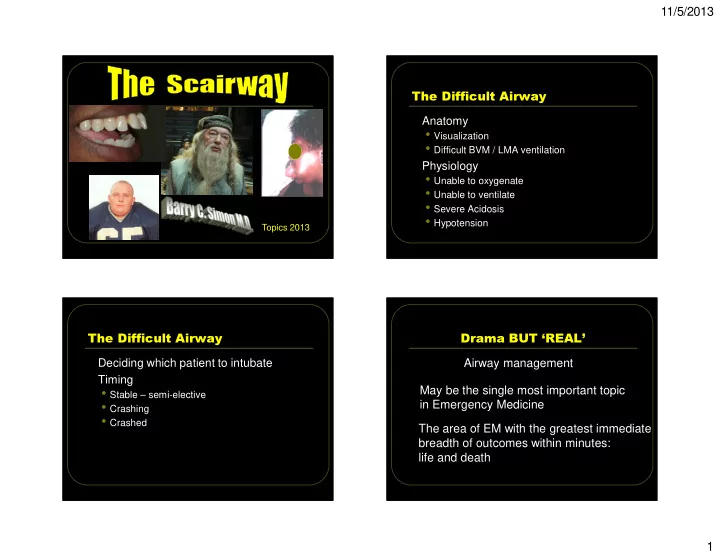
11/5/2013 The Difficult Airway Anatomy Visualization Difficult BVM / LMA ventilation Physiology Unable to oxygenate Unable to ventilate Severe Acidosis Hypotension Topics 2013 The Difficult Airway Drama BUT


slide-1
SLIDE 1

11/5/2013 1

Topics 2013

The Difficult Airway

Anatomy

  • Visualization
  • Difficult BVM / LMA ventilation

Physiology

  • Unable to oxygenate
  • Unable to ventilate
  • Severe Acidosis
  • Hypotension

The Difficult Airway

Deciding which patient to intubate Timing

  • Stable – semi-elective
  • Crashing
  • Crashed

Drama BUT ‘REAL’

May be the single most important topic

in Emergency Medicine Airway management The area of EM with the greatest immediate breadth of outcomes within minutes: life and death

slide-2
SLIDE 2

11/5/2013 2 Sexy

HEROIC

Dramatic

Life Saving

slide-3
SLIDE 3

11/5/2013 3

Forethought Planning Attention to detail Knowledge

Plan Ahead

Equipment Drugs Positioning Check lists…

An intervention to dec complications related to EI in the ICU…..Int Care Med

2010

Severe Mild to Moderate Death Difficult tube Cardiac Arrest Esophageal Severe Hypoxemia Aspiration Severe Cardiovascular Collapse Arrhythmia requiring RX Dangerous agitation

Presence of two operators Fluid Loading Pre-oxygenation RSI drug prep Sellick Placement confirmation – capnography Pressor support Longer term sedation Protective low volume vent

slide-4
SLIDE 4

11/5/2013 4 Difficult / High Risk

Hypoxic Hypotensive Acidotic Shock Obstruction Anatomic difficulty

slide-5
SLIDE 5

11/5/2013 5 Oxygenation

Preoxygenation Positioning DSI Apneic Oxygenation

Positioning

Head up 20 degrees /reverse

trendelenberg

  • Delay time to desat by about 100 seconds

Jaw thrust

Apneic Oxygenation

Prolong time to desat:

  • Normal BMI – by 2-3 minutes
  • BMI > 30 – by about 100 seconds
slide-6
SLIDE 6

11/5/2013 6

Journal of Clinical Anesthesia 2010

Preoxygenation Strategies

NIV

  • USE NIV mask or BVM
  • 5cm of PEEP / 100% O2 / High flow
  • Sat >95% for >3 min
  • Leave Mask in place while pushing drugs
  • Leave NC on at all times

strategies

Ventilator to drive the BVM

  • Oral airway
  • Standard BVM vent
  • Ventilator on AC at 550ml
  • Flow at 30 L /min
  • 12 vent / min + 5-15 PEEP
  • Attach the vent to the mask

strategies

Ventilator Vs. Bagging Peep Atelectasis Saturation

slide-7
SLIDE 7

11/5/2013 7 Delayed Sequence Intubation

  • Ketamine 1mg/kg slow push (glycopyrrolate)
  • NIV / non-rebreather / LMA…….
  • Sat >95% for >3 min
  • Paralytic – leave mask while inducing
  • Leave nasal cannula and intubate

Hydration before induction

Most critically ill are dry Loss of sympathetic support Loss of muscle tone Peep / Pos Pressure vent Drugs Hydration Phenylephrine

PLAN AHEAD

What drugs do you have available What tools do you have What are you experienced and

comfortable to perform

slide-8
SLIDE 8

11/5/2013 8

Can you bag – valve –mask ventilate this patient? Will you be able to see cords? Oral endotracheal intubation fails – what next? This pt develops stridor and sat’s begin to fall??

This asthmatic becomes agitated – her PH is 6.8 PCO2 = 110

Difficult Airway Management Steps (7)

  • 1. Always assume the intubation will be

difficult! **

  • 2. Familiarize yourself: **

Where are your airway tools located What devices are at your disposal

  • 3. Have backup plans A B & C

developed before the scairway arrives ** ** MAJOR TAKE HOME POINTS

slide-9
SLIDE 9

11/5/2013 9

Airway Plans A B & C

Optimize Oral Endotracheal Intubation conditions LMA – Combitube – Stylet guided Intubation Surgical: Needle, Seldinger, or Traditional

A B C More Steps

  • 4. Consider the urgency of the case

Airway control is needed: NOW!! Within minutes Semi – elective 5.Can the patient be bag-valve-mask ventilated?

More Steps

  • 4. Consider the urgency of the case
  • 5. Can the patient be bag-valve-mask ventilated?
  • 6. Assess airway anatomy
  • 7. How great is the risk of aspiration?

1ST ATTEMPT HAS FAILED

Start with back up plan A

slide-10
SLIDE 10

11/5/2013 10

Preparing for the second attempt

Positioning can make a huge difference

  • Raise the bed
  • Top of patients head at very end of gurney
  • Flex neck 30o - extend head / ramp up

Change blades – or use the Mac like a Miller BURP maneuver

  • Back – UP - Right - Pressure

Things to Do in Every Airway

Alternative Airway Approaches / Devices

Nasal intubation Fiberoptic intubation Gum elastic bougie Lighted Stylet Laryngeal Mask Airway (LMA) Combitube / King

Alternative Airway Approaches / Devices

Tactile digital intubation Retrograde intubation Percutaneous transtracheal intubation Cricothyrotomy – traditional Cricothyrotomy – needle guided Video laryngoscopes

slide-11
SLIDE 11

11/5/2013 11 Personal recommendations

Bougie

slide-12
SLIDE 12

11/5/2013 12

Bougie 60 cm long – 15 French

Use a laryngoscope Advance with the concavity facing anterior As the tip of the bougie enters the glottic opening

feel for ‘clicks’ as it passes over the tracheal rings

Rotate the ETT counter-clockwise

Percutaneous Transtracheal Ventilation (PTV)

Ventilation via a catheter placed through the cricoid membrane

  • High frequency jet ventilation (small volumes
  • f oxygen at rates of 100-200/min)
  • High pressure standard ventilation (large

volumes at 50psi at a rate of 12-20.min)

  • Traditional bag valve ventilation (intermediate

volumes, low pressure std rate)

Percutaneous Transtracheal Ventilation

Indications:

  • Rescue airway – especially in children

Contraindications:

  • *Complete airway obstruction
  • Unable to identify landmarks

Complications:

  • Barotrauma
  • Esophageal perforation
  • Hypercapnea

Percutaneous Transtracheal Ventilation

Google search Manual Jet Ventilator

slide-13
SLIDE 13

11/5/2013 13

Percutaneous Transtracheal Ventilation

(The MacGuyver Approach)

Ketamine Ketamine

Can be used IM Doesn’t require refrigeration Wide safety index No apnea Rapid onset

Dexmedetomidine

Alpha 2 agonist Dissociative state Preserves airway reflexes Hypotension, bradycardia, nausea

slide-14
SLIDE 14

11/5/2013 14

Midazolam

No refrigeration IM Reversible Rapid onset

Vomiting blood

45 yr old male with hematemesis + past hx of ETOH and GI bleed 92/64 134 26 94% Actively vomiting blood Awake but confused

Hematemesis

What are the immediate issues / questions

that need to be answered?

Can the pt be bag mask ventilated? Is aspiration a real threat? How difficult is traditional oral tracheal intubation likely to be? How much time do we have?

Hematemesis

BVM vent likely to be very difficult A secure airway is needed NOW!!! Aspiration is a major threat Too crashed for nasal (+probable

coagulopathy)

+- one attempt at traditional oral

intubation ….

slide-15
SLIDE 15

11/5/2013 15 Hematemesis

I recommend trying to pass a bougie if

you can see some anatomy but have the ILMA and a needle cric kit ready

KETAMINE!

Needle Cricothyrotomy

I suggest using a # 10 blade to produce a larger skin ‘nick’

Needle Cricothyrotomy Needle Cricothyrotomy

slide-16
SLIDE 16

11/5/2013 16

Airway Pearls

DSI and NIV as a preoxygenation tool

  • Apneic Oxygenation should be standard
  • The BVM – bag – holds about 2 L of air – one
  • nly needs to administer about 1/4 of the bag to

ventilate

  • Ketamine is invaluable

Summary

Expect the worst and be prepared Consider the urgency Don’t forget BVM ventilation Balance the needs for ventilation & oxygenation vs.

the risk of aspiration

Become familiar with

  • LMA or Combitube
  • Lightwand or Bougie
  • Traditional or Seldinger cric
  • PTV