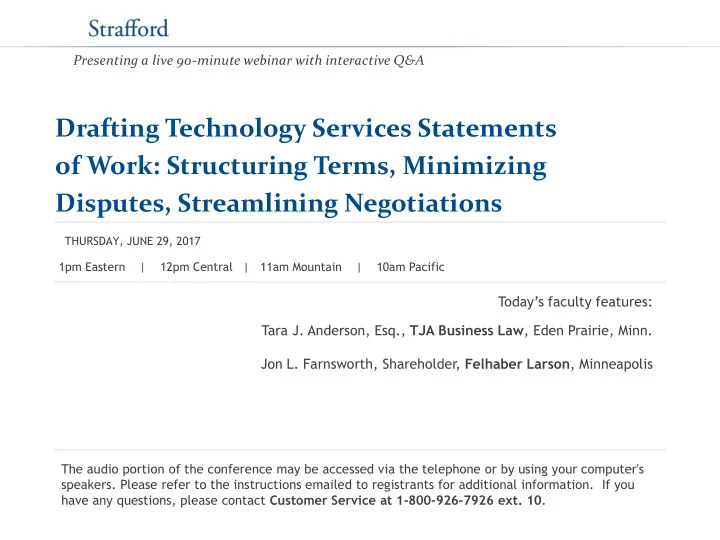
Drafting Technology Services Statements of Work: Structuring Terms, - - PowerPoint PPT Presentation

drafting technology services statements of work
SMART_READER_LITE
LIVE PREVIEW

Drafting Technology Services Statements of Work: Structuring Terms, - - PowerPoint PPT Presentation

Presenting a live 90-minute webinar with interactive Q&A Drafting Technology Services Statements of Work: Structuring Terms, Minimizing Disputes, Streamlining Negotiations THURSDAY, JUNE 29, 2017 1pm Eastern | 12pm Central | 11am


slide-1
SLIDE 1

The audio portion of the conference may be accessed via the telephone or by using your computer's

  • speakers. Please refer to the instructions emailed to registrants for additional information. If you

have any questions, please contact Customer Service at 1-800-926-7926 ext. 10.

Presenting a live 90-minute webinar with interactive Q&A

Drafting Technology Services Statements

  • f Work: Structuring Terms, Minimizing

Disputes, Streamlining Negotiations

Today’s faculty features:

1pm Eastern | 12pm Central | 11am Mountain | 10am Pacific THURSDAY, JUNE 29, 2017

Tara J. Anderson, Esq., TJA Business Law, Eden Prairie, Minn. Jon L. Farnsworth, Shareholder, Felhaber Larson, Minneapolis

slide-2
SLIDE 2

Tips for Optimal Quality

Sound Quality If you are listening via your computer speakers, please note that the quality

  • f your sound will vary depending on the speed and quality of your internet

connection. If the sound quality is not satisfactory, you may listen via the phone: dial 1-866-961-8499 and enter your PIN when prompted. Otherwise, please send us a chat or e-mail sound@straffordpub.com immediately so we can address the problem. If you dialed in and have any difficulties during the call, press *0 for assistance. Viewing Quality To maximize your screen, press the F11 key on your keyboard. To exit full screen, press the F11 key again.

FOR LIVE EVENT ONLY

slide-3
SLIDE 3

Continuing Education Credits

In order for us to process your continuing education credit, you must confirm your participation in this webinar by completing and submitting the Attendance Affirmation/Evaluation after the webinar. A link to the Attendance Affirmation/Evaluation will be in the thank you email that you will receive immediately following the program. For additional information about continuing education, call us at 1-800-926-7926

  • ext. 35.

FOR LIVE EVENT ONLY

slide-4
SLIDE 4

Program Materials

If you have not printed the conference materials for this program, please complete the following steps:

  • Click on the ^ symbol next to “Conference Materials” in the middle of the left-

hand column on your screen.

  • Click on the tab labeled “Handouts” that appears, and there you will see a

PDF of the slides for today's program.

  • Double click on the PDF and a separate page will open.
  • Print the slides by clicking on the printer icon.

FOR LIVE EVENT ONLY

slide-5
SLIDE 5

This material and presentation are provided for educational purposes only. They should not be construed as providing legal advice nor establishing any attorney-client relationship.

Drafting Technology Services Statements of Work: Avoiding Contracting Pitfalls

Tara Anderson

952-303-2895

tara.anderson@tjabusinesslaw.com

Jon L. Farnsworth

612-373-8455

jfarnsworth@felhaber.com

Special thanks to Jeff Maleska for his assistance in helping prepare these materials.

slide-6
SLIDE 6
  • What is a Statement of Work (“SOW”)?
  • Key Issues of SOWs
  • Drafting considerations
  • Understanding common commercial terms
  • Defining terms
  • Drafting tips

Overview

6

slide-7
SLIDE 7
  • Helpful tools in the contracting process
  • Recent trends
  • Avoid common pitfalls
  • Explore negotiation techniques

Learning Objectives

7

slide-8
SLIDE 8

What is a Statement

  • f Work?

8

slide-9
SLIDE 9
  • Master Services Agreement (“MSA”)
  • Framework for future engagements
  • Legal terms and conditions (representation,

warranty, indemnification, and limitation of liability)

  • Statement of Work
  • Specifics for a particular engagement
  • Business terms

Definitions

9

slide-10
SLIDE 10
  • Exhibit/Schedule to MSA
  • Describes service to be performed or goods to be

delivered

  • Often contains significant detail
  • Covers projects:
  • At time of master agreement; or
  • Future projects during the term of master

agreement

What is a Statement of Work?

10

slide-11
SLIDE 11
  • Examples of SOW content:
  • Description of supplier’s work product
  • Metrics to determine if work is complete
  • Conditions for acceptance of work product
  • How scope of work may change
  • Price and delivery terms

What is a Statement of Work?

11

slide-12
SLIDE 12
  • Often negotiated by the business people
  • SOW may not be reviewed by all necessary parties
  • Ensure MSA is still valid
  • Subjective vs. objective terms
  • Terms may conflict with MSA

SOW Pitfalls

12

slide-13
SLIDE 13
  • SOWs can:
  • Undermine the MSA’s beneficial protections
  • Cause ambiguity and disagreement
  • Impose unforeseen obligations
  • Enhance the risk of breach (e.g., hyper-technical

standards)

  • Lead to litigation/financial losses

SOW Pitfalls

13

slide-14
SLIDE 14
  • Overview
  • Introduction
  • Order of Precedence
  • Scope/Objective
  • Project Assumptions
  • Contract Type of This SOW
  • Definitions/Acronyms
  • Staffing Plan and Project Schedule
  • Supplier Responsibilities, Deliverables, and

Milestones

Example Structure

14

slide-15
SLIDE 15
  • Personnel
  • Key [Supplier] Personnel
  • Customer Responsibilities
  • Mutual Tasks and Responsibilities
  • Project Management
  • Progress Meetings
  • Project Managers and Procurement Contacts

Example Structure (Cont.)

15

slide-16
SLIDE 16
  • Change Management Process
  • How to initiate a change
  • Who gives approval for a change
  • Cost estimate preparation
  • How to confirm the change was made
  • Logistics for making the change

Example Structure (Cont.)

16

slide-17
SLIDE 17
  • Completion Criteria
  • When is the project over?
  • Objective vs. subjective standards
  • Acceptance and rejection process
  • Payment Terms
  • Expense reimbursement (e.g., travel)
  • Holdback provisions
  • Time and material with not-to-exceed price

Example Structure (Cont.)

17

slide-18
SLIDE 18

Issues to Consider Before Drafting the SOW

18

slide-19
SLIDE 19
  • Negotiate MSA and/or review MSA
  • Identify your business objectives
  • Confirm your budget
  • Evaluate cost of alternatives
  • Understand your negotiating leverage
  • Determine timeline/deadlines
  • Assign personnel/decision-makers

Before You Start: Planning Analysis

19

slide-20
SLIDE 20
  • Who is producing the initial draft?
  • Checklists and/or sample SOW
  • Update frequently to:
  • Keep current
  • Reflect industry standards and industry trends

Tools

20

slide-21
SLIDE 21
  • Choose an appropriate format
  • MSA may include required form
  • Tailored to the engagement
  • Fixed-price contracts = more technical and

detailed; whereas

  • Time and materials contracts = less detail
  • Review to ensure MSA and SOW do not conflict
  • Party drafting the SOW may not have drafted MSA

Form Selection

21

slide-22
SLIDE 22
  • If using the other party’s SOW, review it carefully
  • Is it one-sided?
  • Does it contain legal terms?
  • Do terms conflict with MSA?
  • How does the SOW impact the MSA?
  • Compliment or conflict?

Form Selection (Cont.)

22

slide-23
SLIDE 23
  • Avoid unintended consequences from pre-

execution behavior

  • Parties negotiating should have authority to bind

their companies

  • Consider if NDA is needed
  • Marketing puffery = (mis)representation?
  • MSA may specify how SOW must be created

Marketing and Sales Content

23

slide-24
SLIDE 24

Understand and Define Key Commercial Terms and Conditions

24

slide-25
SLIDE 25
  • SOW should contains commercial terms and

conditions, not legal.

  • Legal terms should be in MSA
  • Legal terms only in SOW when appropriate in light of

the project-specific needs. For example:

  • Product sale in an otherwise services engagement
  • Unique security protocol
  • “Off the shelf” products
  • Ownership and/or licensing of IP rights
  • Amendment to MSA may be appropriate

Commercial Terms and Conditions

25

slide-26
SLIDE 26
  • If SOW contains legal terms:
  • Ensure the terms are applicable for the specific

engagement

  • Determine whether MSA terms are amended, superseded
  • Why legal terms may appear in SOW
  • Unable to renegotiate MSA
  • Terms are unique to specific engagement
  • Safety measures
  • Order of precedence in event of conflict
  • Requirements that any SOW terms that conflict with MSA

are only binding if signed off by owner/counsel

Conflicting Terms

26

slide-27
SLIDE 27

StratMar Retail Servs. v. FirstEnergy Serv. Co., 2015 U.S. Dist. LEXIS 128479 (N.D. Ohio, Sept. 24, 2015). Facts

  • StratMar contracts with FES
  • MSA: FES can terminate with 30-day notice
  • StratMar & FES negotiate new SOW
  • StratMar emails new SOW; FES never signs

Conflicting Terms Example

27

slide-28
SLIDE 28

Facts Cont.

  • StratMar begins to work under new SOW
  • FES compensates StratMar under new SOW
  • New SOW: 60-day notice to terminate
  • FES sends StratMar 30-day notice to terminate
  • StratMar alleges 60-day notice required

Conflicting Terms Example (Cont.)

28

slide-29
SLIDE 29

Holding

  • FES wins; no breach
  • Express Contract:
  • New SOW never signed
  • 60-day notice never approved
  • Implied Contract:
  • FES payment under new SOW immaterial
  • SOW was “exhibit” to MSA; MSA governs

Conflicting Terms Example (Cont.)

29

slide-30
SLIDE 30
  • Identify and define requirements
  • How many resources are required?
  • Resources on or off-site?
  • Resources require system/network access?
  • Subcontractors required?
  • What products are being provided?
  • What’s the timeline?

Identification

30

slide-31
SLIDE 31
  • Identify vendor’s key personnel
  • Engagement Director, Project

Managers, Key Personnel, Additional Personnel

  • Limits on vendor’s ability to replace /

Consistency of staff over project term

  • No additional fees (ramp-up costs) if

vendor must replace staff

  • Trend: Background and security checks

Personnel

31

slide-32
SLIDE 32
  • Pre-qualification – if so, how?
  • Right to review and approve staff, particularly
  • nsite personnel
  • Right to replace
  • English proficiency
  • Training
  • Skilled in the type of services at issue, minimum

experience requirements

  • Workstations
  • Responsibility for work negligently performed

Personnel (Cont.)

32

slide-33
SLIDE 33
  • Is the engagement for the benefit of the named

entity or affiliates, subsidiaries, customers, etc?

  • Is the performance by the named entity, or its

affiliates, subsidiaries, subcontractors?

  • Consider geographic issues
  • Diligence on other parties / Know your parties
  • Primary responsibility for performance
  • Critical v. generic services
  • Responsibility
  • Assignment

Additional Parties

33

slide-34
SLIDE 34
  • Deliverables / Work

Product / Reports

  • Services
  • Schedules
  • Specifications
  • Information / Data
  • Assumptions

Define

  • Responsibilities
  • Requirements /

Dependencies

  • Excluded Work
  • Acceptance Process
  • How and where

performance will

  • ccur

34

slide-35
SLIDE 35
  • Scheduling, Shipping and Delivery Terms
  • Project start / effective date
  • Key (all) milestones
  • Schedule / Deliverable / Performance dates
  • Project completion date
  • Project termination rights
  • Delivery Terms
  • How shipped
  • Who bears the cost for shipping
  • Who bears the risk of loss
  • When does the risk of loss transfer (not

necessarily tied to payment)

Shipping Defined

35

slide-36
SLIDE 36
  • Specify objective completion criteria for each party's

deliverables, dependencies and responsibilities

  • Objective measures for reviewing Deliverables, Work Product,

and Services

  • Define applicable testing and acceptance criteria and

processes

  • Pre-live testing
  • Post-live testing
  • Who reviews
  • Time for review
  • Level of adherence to acceptance criteria / specifications
  • Deemed acceptance
  • Opportunity to correct deficiencies
  • Termination

Acceptance

36

slide-37
SLIDE 37
  • Versus verification?
  • What types of tests:
  • Unit tests
  • System tests
  • Stress tests
  • Failure to accept
  • Remedies
  • Payment tied to milestones & acceptance

Acceptance (Cont.)

37

slide-38
SLIDE 38

SEC v. Morriss, 2016 U.S. Dist. LEXIS 50194 (E.D. Mo., Apr. 14, 2016). Facts

  • SOW: 50% project costs required to accept
  • Defendant signs SOW; does not pay deposit
  • Plaintiff still starts Defendant’s work
  • Plaintiff never receives deposit; sues

Acceptance Example

38

slide-39
SLIDE 39

Holding

  • Plaintiff wins; Defendant must pay deposit
  • Signing and returning contract bound Defendant
  • Defendant knew Plaintiff started work at signing
  • Starting work without deposit did not invalidate

contract

Acceptance Example (Cont.)

39

slide-40
SLIDE 40
  • Schedule for Payment
  • Timing of payments
  • Date based
  • Performance based
  • Fixed price vs. time and materials
  • Renewal / adjustment in fees over time
  • Consumer Price Index (CPI)
  • Employment Cost Index (ECI)
  • Estimated

Fees

40

slide-41
SLIDE 41
  • Holdbacks and true-ups
  • Travel and out-of-pocket expenses (cap)
  • Lower interest on late payments
  • All fees
  • Performance Credits
  • Cap
  • Not to Exceed
  • Donut / Shared responsibility for overage
  • Third Party Fees (pass though / managed)

Fees (Cont.)

41

slide-42
SLIDE 42
  • Should be structured to:
  • Motivate performance
  • Assist project management
  • Protect against requirement for significant

payments despite dissatisfaction with vendor performance

  • Determine if a Fixed Fee, Time and Materials, or

Hybrid payment method best promotes your goals

Fees (Cont.)

42

slide-43
SLIDE 43
  • Include performance incentives/penalties:
  • Payment withholding pending key milestone

completion

  • Project cost overrun protections
  • Right to withhold payments in the event of non-

performance, dispute

Fees (Cont.)

43

slide-44
SLIDE 44

Blueshift, Inc. v. Advanced Computing Techs., Inc., 616 S.E.2d 816 (Ga. Ct. App. 2005). Facts

  • Blueshift contracts with E-Panacea
  • Blueshift hires ACT (subcontractor) for E-Panacea

contract

  • E-Panacea stops paying Blueshift
  • Blueshift stops paying ACT

Fees Example

44

slide-45
SLIDE 45

Facts, Cont.

  • MSA:
  • Invoice every 15 days;
  • Clause 12.2 shall not be altered by any SOW
  • Blueshift not obligated to pay subcontractor if

client refuses to pay

  • SOW: Invoice every calendar month
  • ACT alleges Clause 12 invalid because conflicting

terms

Fees Example (Cont.)

45

slide-46
SLIDE 46

Holding

  • Court upholds Clause 12.2
  • Per 12.2 – Blueshift not required to pay ACT

* Only if E-Panacea does not pay Blueshift

  • SOW only altered MSA payment schedule
  • SOW cannot alter Clause 12.2 terms

Fees Example (Cont.)

46

slide-47
SLIDE 47
  • Will vendor be rendering development or

customization services resulting in IP company wants to own?

  • Will the vendor have access to any highly sensitive

company IP?

  • Vendor’s materials
  • Clearly describe in Statement of Work or other

exhibit

  • Use of pre-existing IP

Intellectual Property

47

slide-48
SLIDE 48
  • Work product
  • Who owns
  • Restrictions on use
  • Customer data
  • Clearly define
  • Include in what customer owns
  • Third Party IP

Intellectual Property (Cont.)

48

slide-49
SLIDE 49
  • Commitments and Reports
  • Describe the service levels
  • Make sure they are measurable
  • Report frequency
  • Root Cause Analysis
  • Problem Resolution Commitment
  • Service Level Adjustments

Service Levels

49

slide-50
SLIDE 50
  • Termination rights:
  • What constitutes a "material breach"?
  • Bankruptcy
  • Assignment
  • Convenience
  • Effects of termination
  • Disentanglement
  • Termination assistance
  • Return/destruction of software
  • No termination of support services
  • Transition Assistance
  • How does termination affect the MSA?

Termination of SOW

50

slide-51
SLIDE 51
  • Customer and Vendor position not symmetrical when

faced with non-performance

  • Customer should strive to obtain commitment that:
  • Vendor will not suspend services except in the most

limited circumstances

  • A "no suspension of services" clause may not prevent all

ills

  • A vendor bleeding money may still walk away from

contract, notwithstanding clause

  • Courts seldom enforce personal services contracts.

More likely to award damages (subject to liability cap)

  • Negotiate an exception to the typical limit of liability

clause for damages caused by a vendor’s suspension of services

Termination of SOW (Cont.)

51

slide-52
SLIDE 52

Alpha Telecomms., Inc. v. IBM, 194 Fed. App’x 385 (6th Cir. 2006). Facts

  • IBM contracts with Alpha
  • MSA outlines general terms
  • SOW specifies time period – Dec. 1, 2001 to Dec.

1, 2003

  • Feb. 25, 2004 – IBM does not renew SOW
  • Alpha alleges IBM terminated without cause

Termination Example

52

slide-53
SLIDE 53

Holding

  • IBM wins; no breach
  • SOW was unambiguous
  • SOW terminated on Dec. 1, 2003
  • SOW simply expired
  • IBM chose not to renew

Termination Example (Cont.)

53

slide-54
SLIDE 54

Caradigm USA LLC v. PruittHealth, Inc., 2017 U.S.

  • Dist. LEXIS 85869 (N.D. Ga. May 30, 2017).

Facts

  • Pruitt (customer) contracts with Caradigm (vendor)
  • SOW outlines dispute resolution process
  • Pruitt unsatisfied with Caradigm’s performance
  • Pruitt abandons contract
  • Caradigm sued for breach

Dispute Resolution Provision Example

54

slide-55
SLIDE 55

Holding

  • Pruitt’s performance was not conditioned on

satisfaction

  • SOW allowed unilateral termination only after

notice and 90 day cure period

  • Pruitt did not abide by cure period—abandoned K
  • Liability established: Pruitt liable for entire value of

agreement

  • Value of damages TBD

55

Dispute Resolution Provision Example

slide-56
SLIDE 56
  • Satisfaction surveys to evaluate the quality of

vendor’s products and services

  • Require vendor participation in process, but be

careful…

  • If results of survey demonstrate dissatisfaction of

vendor’s products or services:

  • Meeting with high-level officials of vendor and

customer to discuss and resolve the issue

  • Tie performance credit to result of customer

satisfaction surveys

Customer Satisfaction Survey

56

slide-57
SLIDE 57

Drafting Tips

57

slide-58
SLIDE 58
  • Ensure that the legal and commercial terms are

appropriate for the envisioned engagement

  • Procedures in event of Breach
  • Remedies
  • Limitation of Liability
  • Ensure consistency of defined terms (in MSA and

SOW)

Is the SOW Covered by the MSA

58

slide-59
SLIDE 59
  • Only undertakings the SOW explicitly address
  • Nothing beyond the SOW’s express scope
  • External understandings are inconsequential
  • See Bus. Sys. Eng’g, Inc. v. IBM, 547 F.3d 882,

890 (7th Cir. 2008).

What are my obligations?

59

slide-60
SLIDE 60
  • If services are not expressly identified in a SOW,

vendor is under no obligation to perform them

  • Take time to create a SOW that clearly identifies

each party’s tasks and obligations, deliverables, milestones, schedules, and fees

  • Refrain from over-reliance on the vendor to create

the SOW. Vendors normally use their proposal, which generally reads like a marketing brochure, with no specifics

Details, Details, Details

60

slide-61
SLIDE 61
  • SOWs should generally include no legal terms
  • MSA should take precedence over the SOW
  • Remove or limit extensive lists of contingencies or

assumptions on the vendor’s performance

  • Consider applicability of references to proposals or
  • ther generic marketing documents
  • Avoid language that would waive acceptance or

result in services or deliverables being "deemed accepted"

SOW Drafting Tips

61

slide-62
SLIDE 62
  • Consider implications of the following terms:
  • "best efforts" or "all reasonable efforts"
  • "partner" or "agent"
  • "including" and "including but not limited to"
  • "world class," "best in class," "defect free,"

"highest standards" or "industry standards"

  • "guaranty," "warranty," "ensure" and "insure"
  • "time is of the essence"
  • "as directed"
  • "subject to approval"

Terms to Watch Out For

62

slide-63
SLIDE 63
  • "detailed" detailed list"
  • "as required"
  • "average" or "adequate"
  • "to the extent necessary"
  • "solely"
  • "estimate"
  • "shall" versus "may"
  • "would," "could," "would reasonably be expected

to"

Terms to Watch Out For (Cont.)

63

slide-64
SLIDE 64
  • Make sure they work
  • Written algebraically
  • Consult an expert
  • Internal business person
  • Caution: be weary of relying on vendor as the

expert

Formulas

64

slide-65
SLIDE 65
  • Reasonable efforts
  • Diligent efforts
  • Good faith efforts
  • Commercially reasonable efforts
  • Best efforts
  • Best commercially reasonable efforts
  • Tier one efforts

Levels of Effort

65

slide-66
SLIDE 66
  • Typical contract allows a party to terminate for the
  • ther’s “material breach”
  • May be difficult to determine whether a set of facts

amounts to material breach

  • Solution:
  • Identify key scenarios and provide in contract

that such scenarios constitute a material breach

  • Repeated small breaches

Material Breach

66

slide-67
SLIDE 67
  • At all times during the term, Vendor shall fully cooperate, and shall work in a timely

manner, with the other service-providers of Customer as necessary to facilitate the performance of their respective contractual obligations to Customer and the timely resolution of all problems that may arise and impact the Services or the provision thereof,

  • r otherwise adversely affect Customer or its Affiliates (or their respective end-users or

patients) in connection with the Services, regardless of the actual or suspected root-cause

  • f such problems or whether discovered through a Root Cause Analysis. The level of

cooperation and effort provided by Vendor pursuant to the immediately preceding sentence shall in no event be less than that used by Vendor when dealing with its own subcontractors and service-providers. In the event of any dispute as to whether a particular problem was caused by Vendor (or its subcontractors or third-party service- providers) or by Customer or any of its third-party service-providers, Vendor shall promptly perform and share the results of a Root Cause Analysis with the Customer and the involved third parties in an effort to resolve such dispute in an expedited manner. If the dispute is not so resolved, then it shall be addressed in accordance with the dispute resolution process set forth in Section 14 of this Agreement. Vendor shall at all times treat each of Customer’s third-party service providers in a fair and nondiscriminatory manner and refrain from interfering with any such service-provider or Customer’s relationship therewith.

Cooperation

67

slide-68
SLIDE 68
  • When statement of work isn’t enough
  • “The Parties have attempted to delineate in this Agreement,

and in its Attachments, schedules and exhibits, the specific tasks, activities, and Services that shall be performed by Vendor hereunder. Nevertheless, and notwithstanding anything to the contrary herein, the Parties acknowledge and agree that no such delineation may possibly be entirely exhaustive or complete and that all such delineations shall be interpreted as illustrations of the general types and natures of services that are to be provided by Vendor, rather than as complete and exhaustive lists of such Services. Accordingly, Vendor shall in all events perform as reasonable to fulfill both the content and the intent of this Agreement, the Attachments (or any subsequent or additional statements of work mutually agreed upon by the Parties in writing), and all other schedules and exhibits hereto.”

Other Services

68

slide-69
SLIDE 69

Questions?

Jon L. Farnsworth, Esq.

Felhaber Larson 220 South Sixth Street, Suite 2200 Minneapolis, MN 55402 Tel: (612) 373-8455

jfarnsworth@felhaber.com www.felhaber.com/jlf/

http://www.linkedin.com/in/jonfarnsworth Twitter: @JonFarnsworth

Tara Anderson, Esq.

TJA Business Law 11985 Technology Drive, Suite 140 Eden Prairie, Minnesota 55344 Tel: (952) 303-2895

tara.anderson@tjabusinesslaw.com

69