Doug Houghton Box 1120 Beausejour MB R0E 0C0 (204)268-1027 - - PDF document

doug houghton
SMART_READER_LITE
LIVE PREVIEW

Doug Houghton Box 1120 Beausejour MB R0E 0C0 (204)268-1027 - - PDF document

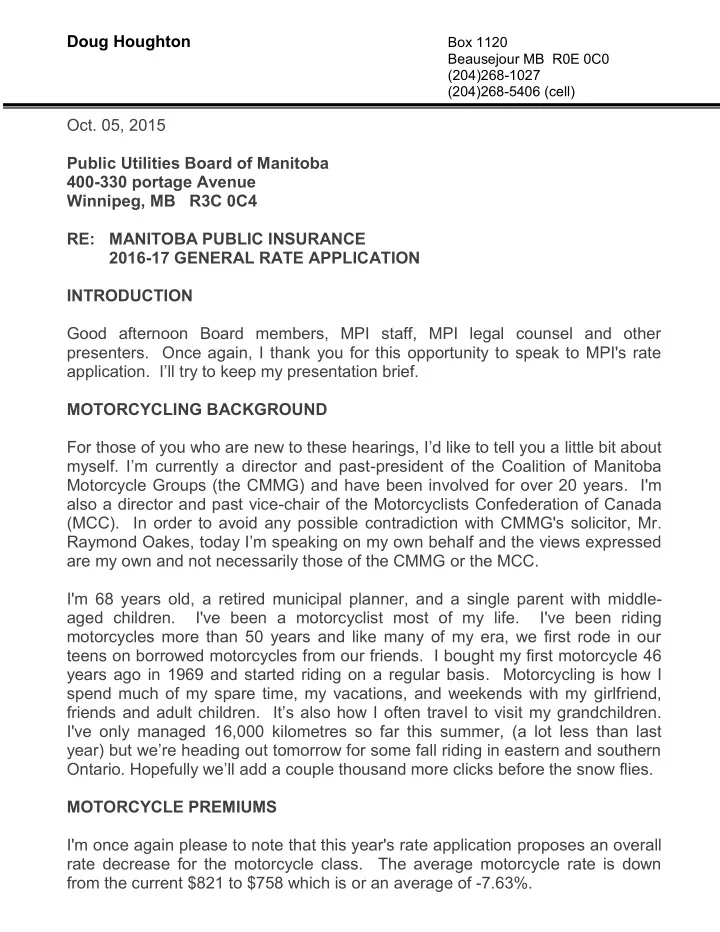
Doug Houghton Box 1120 Beausejour MB R0E 0C0 (204)268-1027 (204)268-5406 (cell) Oct. 05, 2015 Public Utilities Board of Manitoba 400-330 portage Avenue Winnipeg, MB R3C 0C4 RE: MANITOBA PUBLIC INSURANCE 2016-17 GENERAL RATE APPLICATION


slide-1
SLIDE 1

Doug Houghton

Box 1120 Beausejour MB R0E 0C0 (204)268-1027 (204)268-5406 (cell)

  • Oct. 05, 2015

Public Utilities Board of Manitoba 400-330 portage Avenue Winnipeg, MB R3C 0C4 RE: MANITOBA PUBLIC INSURANCE 2016-17 GENERAL RATE APPLICATION INTRODUCTION Good afternoon Board members, MPI staff, MPI legal counsel and other

  • presenters. Once again, I thank you for this opportunity to speak to MPI's rate
  • application. I’ll try to keep my presentation brief.

MOTORCYCLING BACKGROUND For those of you who are new to these hearings, I’d like to tell you a little bit about

  • myself. I’m currently a director and past-president of the Coalition of Manitoba

Motorcycle Groups (the CMMG) and have been involved for over 20 years. I'm also a director and past vice-chair of the Motorcyclists Confederation of Canada (MCC). In order to avoid any possible contradiction with CMMG's solicitor, Mr. Raymond Oakes, today I’m speaking on my own behalf and the views expressed are my own and not necessarily those of the CMMG or the MCC. I'm 68 years old, a retired municipal planner, and a single parent with middle- aged children. I've been a motorcyclist most of my life. I've been riding motorcycles more than 50 years and like many of my era, we first rode in our teens on borrowed motorcycles from our friends. I bought my first motorcycle 46 years ago in 1969 and started riding on a regular basis. Motorcycling is how I spend much of my spare time, my vacations, and weekends with my girlfriend, friends and adult children. It’s also how I often travel to visit my grandchildren. I've only managed 16,000 kilometres so far this summer, (a lot less than last year) but we’re heading out tomorrow for some fall riding in eastern and southern

  • Ontario. Hopefully we’ll add a couple thousand more clicks before the snow flies.

MOTORCYCLE PREMIUMS I'm once again please to note that this year's rate application proposes an overall rate decrease for the motorcycle class. The average motorcycle rate is down from the current $821 to $758 which is or an average of -7.63%.

slide-2
SLIDE 2

Volume 1, Overview page 38 of the GRA depicts both an Indicated Rate Change

  • f -8.2% and an Experience Rate Change of -7.6%. The $63 difference appears

to reflect the latter and not the -8.2% indicated. Motorcyclists, including myself, are often confused by this difference. Why is there a difference? At first, the new average rate of $758 may not appear expensive, but it must be recognized that this premium is only for a 5-month seasonally adjusted rate that that does not include comprehensive coverage. As well, this average also includes great number of scooters and mopeds. Current premiums remain prohibitive for many, and as the following example typifies, the motorcycle rate is still very high when contrasted with rates for passenger vehicles and light trucks: In Winnipeg, (using 2015 rates) the minimum fully discounted pleasure premium (min. liability and max. deductible, excluding registration fees), for a 2015 GMG 4X4 double cab pickup truck valued at $40,000 is about $790 or $66 per month. By contrast, the premium for a 2015 Harley Davidson touring motorcycle costing $30,000 (including comprehensive) is $1,038 or about $207 a month, for the 5 month seasonal rate. This extrapolates to an equivalent annual motorcycle premium of nearly $2,500, about 2½ times the truck rate. Even with the proposed rate reduction for 2016, the equivalent annual motorcycle rate will be about 2,400 per annum. If one acquires the more typical 1 or 2 million liability and $200 deductible, the rates are even more extreme. Sport bike rates can be much higher yet, $2,500 to $3,000 for the riding season. EFFECTS OF HIGH PREMIUMS As a motorcyclist I’m pleased with the premium reductions of the past 5 years and looking forward to next year’s as well. Although significant, these decreases have not yet offset the previous decade of double digit, compounded premium

  • increases. For pensioners, as well as others on moderate incomes, motorcycle

premiums have become an extreme financial burden, especially when coupled with rising fuel costs and other living expenses. A motorcycle insurance premium can be double of that for a home of ten times the value. Even though motorcycle numbers have been increasing over the past few years, there are many former motorcyclists who have quit riding, not because they’ve lost their love for the sport, but solely for the fact that they have modest incomes and can no longer justify paying up to $2000 or more for 5 months of riding. When a husband and wife both ride, the cost can be very prohibitive, even for more affluent families. Many have resorted to using the temporary 5-day permits for special events or vacations. This concerns me as it exposes more motorcyclists to accidents during peak periods, with the resulting claims, but without the total annual premium contribution to the total motorcycle "pool".

slide-3
SLIDE 3

ESCALATING PREMIUMS AND PIPP Motorcyclists welcome the proposed 2016 decreases and are certainly appreciative of the Board's past orders that have resulted in positive changes in motorcycle premiums. I refer specifically to the implementation of "loss transfer" and the allocation of losses for PIPP and collision claims, as well as losses related to wildlife and "hit and run" collisions. As a motorcyclist, I still feel that the current methodology for allocating losses is still discriminatory and inequitable. Today's presentation, therefore, will focus on premium methodology, more specifically, the allocation of Personal Injury Protection Plan (PIPP) losses. The reason for escalating motorcycle premiums goes back to 1993 with the introduction of "no fault" insurance and corresponding Personal Injury Protection Plan (PIPP). Past rulings that there should be no "cross subsidization" between vehicle classifications, meant that premiums for each classification must reflect claims costs for that classification. This resulted in many years of double digit, compounded increases. PIPP PREMIUMS ARE NOT APPLIED EQUITABLY Contrary to what some may believe, motorcycles are not involved in a greater percentage of accidents than automobiles. In fact, past statistics have shown that there are a greater percentage of motorcyclists with full merits than automobile owners. Motorcycles have been placed in a separate rating classification, not because motorcyclists have more accidents, but due to severity of their injuries, which result in greater personal injury (PIPP) costs. It is my understanding that PIPP costs represent about 85% of the motorcycle premium and about 35% of the automobile premium. On the surface, this would seem fair, but many groups don't pay. Although PIPP coverage is paid by most vehicle owners, some vehicle classes do not pay and are still being subsidized by premiums paid by other major

  • classes. Also not paying are those persons with drivers licences, who do not own

vehicles, but who contribute to accident costs. As well, there are others who receive PIPP benefits who neither own a vehicle nor have a drivers licence. It was back in 2011 or 2012 that MPI stats revealed that 12,954 vehicles, or 1.5%

  • f registered vehicles, did not pay for PIPP coverage. This nearly equalled the

13,163 motorcycles which were subject to PIPP premiums at the time. This excluded group includes inter-provincial trucks and exempt vehicles such as Government of Canada vehicles, and fire department vehicles. It’s true that

slide-4
SLIDE 4

interprovincial truck drivers etc. may be eligible to obtain Workman’s Compensation; however, if causing an accident these vehicles would not be contributing to the PIPP costs of other vehicle classes involved. Off road vehicles, dirt bikes, snowmobile and bicycles do not contribute to PIPP; however, if the riders are involved in a collision with an automobile in motion, they receive PIPP benefits, even if at fault. I believe the same applies to pedestrians as well. One-Third of PIPP Claims from Non-Vehicle Owners I apologize for using older data in the next example, but I’m sure the proportions are still relevant. In 2011, one-third of all PIPP claims were from non-vehicle

  • wners. According to MPI there were 11,784 PIPP claims in 2011. Drivers

without a registered vehicle accounted for 3,192 or 27% of these claims. In addition un-licensed, non-vehicle owners account for 693 claims or another 6% of total vehicle claims. Since much of PIPP involves bodily injury, personal care and rehabilitation, it is somewhat analogous to our health care system, which is free and shouldered by all Manitoba taxpayers. Since all Manitobans can receive PIPP benefits and since 1/3 of all PIPP claims are for non-contributors, why then should motorcyclists pay substantially more for this coverage when other vehicle owners, ATV owners, snowmobile owners and licensed non vehicle owners pay nothing? NEW METHODOLOGY FOR ASSIGNING PIPP COSTS I believe it is time for Manitoba Public Insurance to review and re-think its methodology for assigning PIPP costs to premiums. There are a number of different ways this can be accomplished: Flat Rate for PIPP - The fairest way might be to establish a flat rate for PIPP premiums and spread them equally across all vehicle groups, with increases based on experience and driving record, not severity of injuries. I don't believe that a flat rate for will create undue hardships on other vehicle

  • wners. For example, if off-road vehicles, motorcycles and trailers are excluded,

there are 826,724 other insured vehicles that outnumber motorcycles by a ratio of about 56:1. In simple terms, an average $5 premium increase for other vehicles would generate over 4 million dollars, with a resulting premium decrease of about $280 for each motorcycle. Greater Share of PIPP to Larger Vehicles - Motorcyclists are vulnerable road users and more likely to sustain more serious bodily injuries in accidents, but are less likely to inflict serious injury on pedestrians, cyclists or the occupants of automobiles and trucks. Conversely, larger vehicles have the potential to inflict serious injury to pedestrians, riders and occupants of smaller vehicles, but I don't

slide-5
SLIDE 5

believe this is factored into the premium structure of those vehicles. Perhaps premium methodology should be revised so these vehicles bear a greater share

  • f the PIPP costs.

Transfer PIPP Costs to Driver's Licence - It is the driver who causes accidents and not the vehicle; therefore, considering that 27% or nearly 1/3 of PIPP claims are from licensed drivers who do not own a vehicle, it would be a much more equitable system if PIPP premiums were transferred, all or in part, to the drivers licence, rather than placed solely on the vehicle. At present, there is a small insurance portion associated with the drivers licence; however this driver premium is not proportioned among the various coverages. Apparently these premiums are used as a direct offset to the costs of Basic insurance for Highway Traffic Act vehicles, so it is not known if any of it is assigned to offset PIPP costs Transferring PIPP costs to the drivers licence would also lessen the attractiveness of the current system which encourages "high risk drivers" to transfer ownership to other family members so as not to pay higher vehicle premiums and therefore, not contribute fairly into the public insurance system. Transfer Penalties to Driver's licence - The current bonus/malice system of merits and demerits is currently applied in an inequitable manner. Added costs for loss of merits or an increase in demerits is now applied both to the drivers licence and to all vehicles owned by the driver; however, those who don't own vehicles, but drive a vehicle owned by another family member or employer, only pay on the drivers licence. This system also encourages "high risk drivers" to transfer ownership to other family members so as not to pay higher vehicle premiums and therefore, not contribute fairly into the public insurance system. I'm sure if MPI examines its data, it will discover that vehicle ownership increases with the increase in merits and lower premiums and conversely, as drivers go down the scale with increased demerits and potentially higher premiums, the level of vehicle ownership decreases. There is a need to change the methodology for assigning penalties. Multi-vehicle Discounts for Motorcycles - It is my understanding that the premiums for each classification of vehicles is based on the risks and accident history of that vehicle classification independent of other classifications. Like most motorcyclists, I suffer from MPI "double" and "triple dipping". I also

  • wn other passenger vehicles and pay PIPP on all, but only drive one at a time.

Unlike other insurers, MPI provides no discount for a 2nd vehicle, the assumption being that both could be driven at the same time, with risk of accident. It is my

slide-6
SLIDE 6
  • bservation, however, that when the motorcycle is being ridden, in most cases,

the other vehicle remains unused, thereby reducing its risk. According to the table attached to last year’s CMMG(MPI) 1-18, the per unit claims cost for passenger vehicles owned by non motorcycle owners is 68% higher than for those passenger vehicles where the registered owner also has a registered motorcycle. ($397 vs. $236) It would appear that when a motorcycle is also registered, the risk goes down on the owner's passenger vehicle. Although more detailed actuarial investigation may be required, these stats appear to support a multi-vehicle discount where one of the vehicles is a motorcycle. All the above scenarios, or combinations thereof, would, require proper actuarial analysis and actual premiums would have to include many other factors such driving record, and the proportion of PIPP and penalty costs assigned to drivers' licence premiums and so on. PUBLIC POLICY I can certainly appreciate that some of my suggestions may not fall within the board's mandate and that it may be a matter of public policy, to be implemented by government through amendments to the Public Insurance Act or by giving policy direction to MPI. I will, however, request that this board recommend that MPI, and/or the Government of Manitoba, study this issue and advise as to how a PIPP flat rate

  • r an assignment of PIPP to the Drivers Licence would affect average premiums

for all classes, and as well, how premiums would be affected should excluded vehicles classes, such as interprovincial trucking were required to pay PIPP. As well, what would the impact be if PIPP and "penalty" costs were applied solely to the drivers licence. BUY BACK POLICIES Another issue that concerns motorcyclists is the "buy back" policies and formulas

  • f MPI in the case where the repair cost of a damaged motorcycle exceeds its

"market value". Motorcycle owners are noted for spending thousands of dollars and many hours

  • f labour customizing their rides by adding very expensive accessories and motor

upgrades that may not necessarily be reflected in market value. Adjusters need to be better informed in estimating the value of customized and upgraded motorcycles and as well, there needs to be a fairer system for determining a buy back price.

slide-7
SLIDE 7

I’ve been told that at times a vehicle may be sold at auction for less than the “buy back” price offered to the owner. In cases where a motorcycle is "written off", but repairable, the owner should have the option of buying back the motorcycle at a fair price and not have to compete a public auction to buy back their own vehicle. MOTORCYCLE AND PASSENGER VEHICLE INEQUITIES REMOVED This is an area where there has been some good news for motorcyclists and today I’d like to end on a high note by commending MPI for finally making certain extension products available to motorcyclists this past spring. These include:

Rental Vehicle Insurance

Extension Loss of Use

Excess Value Coverage

New and Leased Vehicle Protection Extension Insurance It has long been a thorn in the side of motorcyclists that we were not allowed to purchase these products and I’m sure with more Agent awareness and promotion, there will be a significant uptake in these optional coverages. SAFETY INITIATIVES As a CMMG member, I’d like to thank MPI personnel for their support and participation in our annual Motorcycle Safety Awareness Rally and for attending

  • ur general meetings as guest speakers.

I’m also pleased that our coalition has been invited to participate in the 2016 safety program and pamphlet and as well, sit as a member of MPI’s External Stakeholder Committee on Loss Prevention. SUMMARY That concludes my presentation. Thank you for giving me this opportunity to speak and for your attention to this matter. Respectfully yours, Douglas Houghton