Distributionally Robust Stochastic Optimization and Learning - - PowerPoint PPT Presentation

distributionally robust stochastic optimization and
SMART_READER_LITE
LIVE PREVIEW

Distributionally Robust Stochastic Optimization and Learning - - PowerPoint PPT Presentation

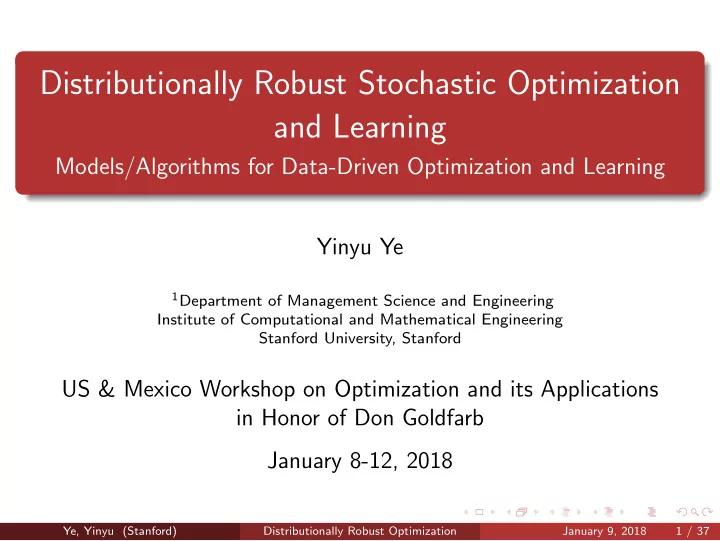
Distributionally Robust Stochastic Optimization and Learning Models/Algorithms for Data-Driven Optimization and Learning Yinyu Ye 1 Department of Management Science and Engineering Institute of Computational and Mathematical Engineering


slide-1
SLIDE 1

. . . . . . . . . . . . . . . . . . . . . . . . . . . . . . . . . . . . . . . .

Distributionally Robust Stochastic Optimization and Learning

Models/Algorithms for Data-Driven Optimization and Learning Yinyu Ye

1Department of Management Science and Engineering

Institute of Computational and Mathematical Engineering Stanford University, Stanford

US & Mexico Workshop on Optimization and its Applications in Honor of Don Goldfarb January 8-12, 2018

Ye, Yinyu (Stanford) Distributionally Robust Optimization January 9, 2018 1 / 37

slide-2
SLIDE 2

. . . . . . . . . . . . . . . . . . . . . . . . . . . . . . . . . . . . . . . .

Outline

Computation and Sample Complexity of Solving Markov Decision/Game Processes Distributionally Robust Optimization under Moment, Likelihood and Wasserstein Bounds, and its Applications

Ye, Yinyu (Stanford) Distributionally Robust Optimization January 9, 2018 2 / 37

slide-3
SLIDE 3

. . . . . . . . . . . . . . . . . . . . . . . . . . . . . . . . . . . . . . . .

Outline

Computation and Sample Complexity of Solving Markov Decision/Game Processes Distributionally Robust Optimization under Moment, Likelihood and Wasserstein Bounds, and its Applications Analyze and develop tractable and provable models and algorithms for optimization with uncertain and sampling data.

Ye, Yinyu (Stanford) Distributionally Robust Optimization January 9, 2018 2 / 37

slide-4
SLIDE 4

. . . . . . . . . . . . . . . . . . . . . . . . . . . . . . . . . . . . . . . .

Table of Contents

1

Computation and Sample Complexity of Solving Markov Decision/Game Processes

2

Distributionally Robust Optimization under Moment, Likelihood and Wasserstein Bounds, and its Applications

Ye, Yinyu (Stanford) Distributionally Robust Optimization January 9, 2018 3 / 37

slide-5
SLIDE 5

. . . . . . . . . . . . . . . . . . . . . . . . . . . . . . . . . . . . . . . .

The Markov Decision/Game Process

Markov decision processes (MDPs) provide a mathematical framework for modeling sequential decision-making in situations where outcomes are partly random and partly under the control

  • f a decision maker.

Ye, Yinyu (Stanford) Distributionally Robust Optimization January 9, 2018 4 / 37

slide-6
SLIDE 6

. . . . . . . . . . . . . . . . . . . . . . . . . . . . . . . . . . . . . . . .

The Markov Decision/Game Process

Markov decision processes (MDPs) provide a mathematical framework for modeling sequential decision-making in situations where outcomes are partly random and partly under the control

  • f a decision maker.

Markov game processes (MGPs) provide a mathematical framework for modeling sequential decision-making of two-person turn-based zero-sum game.

Ye, Yinyu (Stanford) Distributionally Robust Optimization January 9, 2018 4 / 37

slide-7
SLIDE 7

. . . . . . . . . . . . . . . . . . . . . . . . . . . . . . . . . . . . . . . .

The Markov Decision/Game Process

Markov decision processes (MDPs) provide a mathematical framework for modeling sequential decision-making in situations where outcomes are partly random and partly under the control

  • f a decision maker.

Markov game processes (MGPs) provide a mathematical framework for modeling sequential decision-making of two-person turn-based zero-sum game. MDGPs are useful for studying a wide range of

  • ptimization/game problems solved via dynamic programming,

where it was known at least as early as the 1950s (cf. Shapley 1953, Bellman 1957).

Ye, Yinyu (Stanford) Distributionally Robust Optimization January 9, 2018 4 / 37

slide-8
SLIDE 8

. . . . . . . . . . . . . . . . . . . . . . . . . . . . . . . . . . . . . . . .

The Markov Decision/Game Process

Markov decision processes (MDPs) provide a mathematical framework for modeling sequential decision-making in situations where outcomes are partly random and partly under the control

  • f a decision maker.

Markov game processes (MGPs) provide a mathematical framework for modeling sequential decision-making of two-person turn-based zero-sum game. MDGPs are useful for studying a wide range of

  • ptimization/game problems solved via dynamic programming,

where it was known at least as early as the 1950s (cf. Shapley 1953, Bellman 1957). Modern applications include dynamic planning under uncertainty, reinforcement learning, social networking, and almost all other stochastic dynamic/sequential decision/game problems in Mathematical, Physical, Management and Social Sciences.

Ye, Yinyu (Stanford) Distributionally Robust Optimization January 9, 2018 4 / 37

slide-9
SLIDE 9

. . . . . . . . . . . . . . . . . . . . . . . . . . . . . . . . . . . . . . . .

The Markov Decision Process/Game continued

At each time step, the process is in some state i = 1, ..., m, and the decision maker chooses an action j ∈ Ai that is available in state i, and giving the decision maker an immediate corresponding cost cj.

Ye, Yinyu (Stanford) Distributionally Robust Optimization January 9, 2018 5 / 37

slide-10
SLIDE 10

. . . . . . . . . . . . . . . . . . . . . . . . . . . . . . . . . . . . . . . .

The Markov Decision Process/Game continued

At each time step, the process is in some state i = 1, ..., m, and the decision maker chooses an action j ∈ Ai that is available in state i, and giving the decision maker an immediate corresponding cost cj. The process responds at the next time step by randomly moving into a new state i′. The probability that the process enters i′ is influenced by the chosen action in state i. Specifically, it is given by the state transition distribution probability pj ∈ Rm.

Ye, Yinyu (Stanford) Distributionally Robust Optimization January 9, 2018 5 / 37

slide-11
SLIDE 11

. . . . . . . . . . . . . . . . . . . . . . . . . . . . . . . . . . . . . . . .

The Markov Decision Process/Game continued

At each time step, the process is in some state i = 1, ..., m, and the decision maker chooses an action j ∈ Ai that is available in state i, and giving the decision maker an immediate corresponding cost cj. The process responds at the next time step by randomly moving into a new state i′. The probability that the process enters i′ is influenced by the chosen action in state i. Specifically, it is given by the state transition distribution probability pj ∈ Rm. But given state/action j, the distribution is conditionally independent of all previous states and actions; in other words, the state transitions of an MDP possess the Markov property.

Ye, Yinyu (Stanford) Distributionally Robust Optimization January 9, 2018 5 / 37

slide-12
SLIDE 12

. . . . . . . . . . . . . . . . . . . . . . . . . . . . . . . . . . . . . . . .

MDP Stationary Policy and Cost-to-Go Value

A stationary policy for the decision maker is a function π = {π1, π2, · · · , πm} that specifies an action in each state, πi ∈ Ai, that the decision maker will always choose; which also lead to a cost-to-go value for each state

Ye, Yinyu (Stanford) Distributionally Robust Optimization January 9, 2018 6 / 37

slide-13
SLIDE 13

. . . . . . . . . . . . . . . . . . . . . . . . . . . . . . . . . . . . . . . .

MDP Stationary Policy and Cost-to-Go Value

A stationary policy for the decision maker is a function π = {π1, π2, · · · , πm} that specifies an action in each state, πi ∈ Ai, that the decision maker will always choose; which also lead to a cost-to-go value for each state The MDP is to find a stationary policy to minimize/maximize the expected discounted sum over the infinite horizon with a discount factor 0 ≤ γ < 1.

Ye, Yinyu (Stanford) Distributionally Robust Optimization January 9, 2018 6 / 37

slide-14
SLIDE 14

. . . . . . . . . . . . . . . . . . . . . . . . . . . . . . . . . . . . . . . .

MDP Stationary Policy and Cost-to-Go Value

A stationary policy for the decision maker is a function π = {π1, π2, · · · , πm} that specifies an action in each state, πi ∈ Ai, that the decision maker will always choose; which also lead to a cost-to-go value for each state The MDP is to find a stationary policy to minimize/maximize the expected discounted sum over the infinite horizon with a discount factor 0 ≤ γ < 1. If the states are partitioned into two sets, one is to minimize and the other is to maximize the discounted sum, then the process becomes a two-person turn-based zero-sum stochastic game.

Ye, Yinyu (Stanford) Distributionally Robust Optimization January 9, 2018 6 / 37

slide-15
SLIDE 15

. . . . . . . . . . . . . . . . . . . . . . . . . . . . . . . . . . . . . . . .

MDP Stationary Policy and Cost-to-Go Value

A stationary policy for the decision maker is a function π = {π1, π2, · · · , πm} that specifies an action in each state, πi ∈ Ai, that the decision maker will always choose; which also lead to a cost-to-go value for each state The MDP is to find a stationary policy to minimize/maximize the expected discounted sum over the infinite horizon with a discount factor 0 ≤ γ < 1. If the states are partitioned into two sets, one is to minimize and the other is to maximize the discounted sum, then the process becomes a two-person turn-based zero-sum stochastic game. Typically, discount factor γ =

1 1+ρ where ρ is the interest rate,

where we assume it is uniform among all actions.

Ye, Yinyu (Stanford) Distributionally Robust Optimization January 9, 2018 6 / 37

slide-16
SLIDE 16

. . . . . . . . . . . . . . . . . . . . . . . . . . . . . . . . . . . . . . . .

The Optimal Cost-to-Go Value Vector

Let y ∈ Rm represent the cost-to-go values of the m states, one entry for each state i, of a given policy.

Ye, Yinyu (Stanford) Distributionally Robust Optimization January 9, 2018 7 / 37

slide-17
SLIDE 17

. . . . . . . . . . . . . . . . . . . . . . . . . . . . . . . . . . . . . . . .

The Optimal Cost-to-Go Value Vector

Let y ∈ Rm represent the cost-to-go values of the m states, one entry for each state i, of a given policy. The MDP problem entails choosing the optimal value vector y∗ such that it is the fixed point: y ∗

i = min{cj + γpT j y∗, ∀j ∈ Ai}, ∀i,

with optimal policy π∗

i = arg min{cj + γpT j y∗, ∀j ∈ Ai}, ∀i.

Ye, Yinyu (Stanford) Distributionally Robust Optimization January 9, 2018 7 / 37

slide-18
SLIDE 18

. . . . . . . . . . . . . . . . . . . . . . . . . . . . . . . . . . . . . . . .

The Optimal Cost-to-Go Value Vector

Let y ∈ Rm represent the cost-to-go values of the m states, one entry for each state i, of a given policy. The MDP problem entails choosing the optimal value vector y∗ such that it is the fixed point: y ∗

i = min{cj + γpT j y∗, ∀j ∈ Ai}, ∀i,

with optimal policy π∗

i = arg min{cj + γpT j y∗, ∀j ∈ Ai}, ∀i.

In the Game setting, the fixed point becomes: y ∗

i = min{cj + γpT j y∗, ∀j ∈ Ai}, ∀i ∈ I −,

and y ∗

i = max{cj + γpT j y∗, ∀j ∈ Ai}, ∀i ∈ I +.

Ye, Yinyu (Stanford) Distributionally Robust Optimization January 9, 2018 7 / 37

slide-19
SLIDE 19

. . . . . . . . . . . . . . . . . . . . . . . . . . . . . . . . . . . . . . . .

The Linear Programming Form of the MDP

The fixed-point vector can be formulated as maximizey ∑m

i=1 yi

subject to y1 ≤ cj + γpT

j y, ∀j ∈ A1

. . . . . . . . . yi ≤ cj + γpT

j y, ∀j ∈ Ai

. . . . . . . . . ym ≤ cj + γpT

j y, ∀j ∈ Am,

where Ai represents all actions available in state i, and pj is the state transition probabilities to all states when action j is taken.

Ye, Yinyu (Stanford) Distributionally Robust Optimization January 9, 2018 8 / 37

slide-20
SLIDE 20

. . . . . . . . . . . . . . . . . . . . . . . . . . . . . . . . . . . . . . . .

The Linear Programming Form of the MDP

The fixed-point vector can be formulated as maximizey ∑m

i=1 yi

subject to y1 ≤ cj + γpT

j y, ∀j ∈ A1

. . . . . . . . . yi ≤ cj + γpT

j y, ∀j ∈ Ai

. . . . . . . . . ym ≤ cj + γpT

j y, ∀j ∈ Am,

where Ai represents all actions available in state i, and pj is the state transition probabilities to all states when action j is taken. This is the Standard Dual LP form.

Ye, Yinyu (Stanford) Distributionally Robust Optimization January 9, 2018 8 / 37

slide-21
SLIDE 21

. . . . . . . . . . . . . . . . . . . . . . . . . . . . . . . . . . . . . . . .

The Primal LP Form of the MDP

minimizex ∑n

j=1 xj

subject to ∑n

j=1(eij − γpij)xj

= 1, ∀i, xj ≥ 0, ∀j. where eij = 1 when j ∈ Ai and 0 otherwise.

Ye, Yinyu (Stanford) Distributionally Robust Optimization January 9, 2018 9 / 37

slide-22
SLIDE 22

. . . . . . . . . . . . . . . . . . . . . . . . . . . . . . . . . . . . . . . .

The Primal LP Form of the MDP

minimizex ∑n

j=1 xj

subject to ∑n

j=1(eij − γpij)xj

= 1, ∀i, xj ≥ 0, ∀j. where eij = 1 when j ∈ Ai and 0 otherwise. Primal variable xj represents the expected jth action flow or frequency, that is, the expected present value of the number of times action j is chosen. The cost-to-go values are the “shadow Prices” of the LP problem.

Ye, Yinyu (Stanford) Distributionally Robust Optimization January 9, 2018 9 / 37

slide-23
SLIDE 23

. . . . . . . . . . . . . . . . . . . . . . . . . . . . . . . . . . . . . . . .

The Primal LP Form of the MDP

minimizex ∑n

j=1 xj

subject to ∑n

j=1(eij − γpij)xj

= 1, ∀i, xj ≥ 0, ∀j. where eij = 1 when j ∈ Ai and 0 otherwise. Primal variable xj represents the expected jth action flow or frequency, that is, the expected present value of the number of times action j is chosen. The cost-to-go values are the “shadow Prices” of the LP problem. When discount factor γ becomes γj, then the MDP has a non-uniform discount factors.

Ye, Yinyu (Stanford) Distributionally Robust Optimization January 9, 2018 9 / 37

slide-24
SLIDE 24

. . . . . . . . . . . . . . . . . . . . . . . . . . . . . . . . . . . . . . . .

Algorithmic Events of the MDP Methods

Shapley (1953) and Bellman (1957) developed a method called the Value-Iteration (VI) method to approximate the optimal state cost-to-go values and an approximate optimal policy.

Ye, Yinyu (Stanford) Distributionally Robust Optimization January 9, 2018 10 / 37

slide-25
SLIDE 25

. . . . . . . . . . . . . . . . . . . . . . . . . . . . . . . . . . . . . . . .

Algorithmic Events of the MDP Methods

Shapley (1953) and Bellman (1957) developed a method called the Value-Iteration (VI) method to approximate the optimal state cost-to-go values and an approximate optimal policy. Another best known method is due to Howard (1960) and is known as the Policy-Iteration (PI) method, which generate an

  • ptimal policy in finite number of iterations in a distributed and

decentralized way, where two key procedures are the policy evaluation and the policy improvement.

Ye, Yinyu (Stanford) Distributionally Robust Optimization January 9, 2018 10 / 37

slide-26
SLIDE 26

. . . . . . . . . . . . . . . . . . . . . . . . . . . . . . . . . . . . . . . .

Algorithmic Events of the MDP Methods

Shapley (1953) and Bellman (1957) developed a method called the Value-Iteration (VI) method to approximate the optimal state cost-to-go values and an approximate optimal policy. Another best known method is due to Howard (1960) and is known as the Policy-Iteration (PI) method, which generate an

  • ptimal policy in finite number of iterations in a distributed and

decentralized way, where two key procedures are the policy evaluation and the policy improvement. de Ghellinck (1960), D’Epenoux (1960) and Manne (1960) showed that the MDP has an LP representation, so that it can be solved by the simplex method of Dantzig (1947) in finite number of steps, and the Ellipsoid method of Kachiyan (1979) in polynomial time.

Ye, Yinyu (Stanford) Distributionally Robust Optimization January 9, 2018 10 / 37

slide-27
SLIDE 27

. . . . . . . . . . . . . . . . . . . . . . . . . . . . . . . . . . . . . . . .

Open Question on the Complexity of the Policy Iteration Method

In practice, the policy-iteration method, including the simple policy-iteration or Simplex method, has been remarkably successful and shown to be most effective and widely used.

Ye, Yinyu (Stanford) Distributionally Robust Optimization January 9, 2018 11 / 37

slide-28
SLIDE 28

. . . . . . . . . . . . . . . . . . . . . . . . . . . . . . . . . . . . . . . .

Open Question on the Complexity of the Policy Iteration Method

In practice, the policy-iteration method, including the simple policy-iteration or Simplex method, has been remarkably successful and shown to be most effective and widely used. In the past 50 years, many efforts have been made to resolve the worst-case complexity issue of the policy-iteration method, and to answer the question: are they also efficient in Theory?

Ye, Yinyu (Stanford) Distributionally Robust Optimization January 9, 2018 11 / 37

slide-29
SLIDE 29

. . . . . . . . . . . . . . . . . . . . . . . . . . . . . . . . . . . . . . . .

Complexity Theorem for MDP with Discount

The classic simplex method (Dantzig pivoting rule) and the policy iteration method, starting from any policy, terminate in m(n − m) 1 − γ · log ( m2 1 − γ ) iterations (Y MOR10).

Ye, Yinyu (Stanford) Distributionally Robust Optimization January 9, 2018 12 / 37

slide-30
SLIDE 30

. . . . . . . . . . . . . . . . . . . . . . . . . . . . . . . . . . . . . . . .

Complexity Theorem for MDP with Discount

The classic simplex method (Dantzig pivoting rule) and the policy iteration method, starting from any policy, terminate in m(n − m) 1 − γ · log ( m2 1 − γ ) iterations (Y MOR10). The policy-iteration method actually terminates n 1 − γ · log ( m 1 − γ ) , iterations with at most O(m2n) operations per iteration (Hansen/Miltersen/Zwick ACM12).

Ye, Yinyu (Stanford) Distributionally Robust Optimization January 9, 2018 12 / 37

slide-31
SLIDE 31

. . . . . . . . . . . . . . . . . . . . . . . . . . . . . . . . . . . . . . . .

High Level Ideas of the Proof

Create a combinatorial event: a (non-optimal) action will never enter the (intermediate) policy again.

Ye, Yinyu (Stanford) Distributionally Robust Optimization January 9, 2018 13 / 37

slide-32
SLIDE 32

. . . . . . . . . . . . . . . . . . . . . . . . . . . . . . . . . . . . . . . .

High Level Ideas of the Proof

Create a combinatorial event: a (non-optimal) action will never enter the (intermediate) policy again. The event will happen in at most a certain polynomial number

  • f iterations.

Ye, Yinyu (Stanford) Distributionally Robust Optimization January 9, 2018 13 / 37

slide-33
SLIDE 33

. . . . . . . . . . . . . . . . . . . . . . . . . . . . . . . . . . . . . . . .

High Level Ideas of the Proof

Create a combinatorial event: a (non-optimal) action will never enter the (intermediate) policy again. The event will happen in at most a certain polynomial number

  • f iterations.

More precisely, after

m 1−γ · log

(

m2 1−γ

) iterations, a new non-optimal action would be implicitly eliminated from appearance in any future policies generated by the simplex or policy-iteration method.

Ye, Yinyu (Stanford) Distributionally Robust Optimization January 9, 2018 13 / 37

slide-34
SLIDE 34

. . . . . . . . . . . . . . . . . . . . . . . . . . . . . . . . . . . . . . . .

High Level Ideas of the Proof

Create a combinatorial event: a (non-optimal) action will never enter the (intermediate) policy again. The event will happen in at most a certain polynomial number

  • f iterations.

More precisely, after

m 1−γ · log

(

m2 1−γ

) iterations, a new non-optimal action would be implicitly eliminated from appearance in any future policies generated by the simplex or policy-iteration method. The event then repeats for another non-optimal state-action, and there are no more than (n − m) non-optimal actions to eliminate.

Ye, Yinyu (Stanford) Distributionally Robust Optimization January 9, 2018 13 / 37

slide-35
SLIDE 35

. . . . . . . . . . . . . . . . . . . . . . . . . . . . . . . . . . . . . . . .

The Turn-Based Two-Person Zero-Sum Game

Again, the states are partitioned into two sets where one set is to maximize and the other is to minimize.

Ye, Yinyu (Stanford) Distributionally Robust Optimization January 9, 2018 14 / 37

slide-36
SLIDE 36

. . . . . . . . . . . . . . . . . . . . . . . . . . . . . . . . . . . . . . . .

The Turn-Based Two-Person Zero-Sum Game

Again, the states are partitioned into two sets where one set is to maximize and the other is to minimize. It does not admit a convex programming formulation, and it is unknown if it can be solved in polynomial time in general.

Ye, Yinyu (Stanford) Distributionally Robust Optimization January 9, 2018 14 / 37

slide-37
SLIDE 37

. . . . . . . . . . . . . . . . . . . . . . . . . . . . . . . . . . . . . . . .

The Turn-Based Two-Person Zero-Sum Game

Again, the states are partitioned into two sets where one set is to maximize and the other is to minimize. It does not admit a convex programming formulation, and it is unknown if it can be solved in polynomial time in general. Strategy-Iteration Method: One player continues policy iterations from the policy where the other player chooses the best-response action in every one of his or her state set.

Ye, Yinyu (Stanford) Distributionally Robust Optimization January 9, 2018 14 / 37

slide-38
SLIDE 38

. . . . . . . . . . . . . . . . . . . . . . . . . . . . . . . . . . . . . . . .

The Turn-Based Two-Person Zero-Sum Game

Again, the states are partitioned into two sets where one set is to maximize and the other is to minimize. It does not admit a convex programming formulation, and it is unknown if it can be solved in polynomial time in general. Strategy-Iteration Method: One player continues policy iterations from the policy where the other player chooses the best-response action in every one of his or her state set. Hansen/Miltersen/Zwick ACM12 proved that the strategy iteration method also terminates n 1 − γ · log ( m 1 − γ ) iterations – the first strongly polynomial time algorithm when the discount factor is fixed.

Ye, Yinyu (Stanford) Distributionally Robust Optimization January 9, 2018 14 / 37

slide-39
SLIDE 39

. . . . . . . . . . . . . . . . . . . . . . . . . . . . . . . . . . . . . . . .

Deterministic MDP with Discount

Every probability distribution contains exactly one 1 and 0 everywhere else, where the primal LP problem resembles the generalized cycle flow problem.

Ye, Yinyu (Stanford) Distributionally Robust Optimization January 9, 2018 15 / 37

slide-40
SLIDE 40

. . . . . . . . . . . . . . . . . . . . . . . . . . . . . . . . . . . . . . . .

Deterministic MDP with Discount

Every probability distribution contains exactly one 1 and 0 everywhere else, where the primal LP problem resembles the generalized cycle flow problem. Theorem: The simplex method for deterministic MDP with a uniform discount factor, regardless the factor value, terminates in O(m3n2 log2 m) iterations (Post/Y MOR2016).

Ye, Yinyu (Stanford) Distributionally Robust Optimization January 9, 2018 15 / 37

slide-41
SLIDE 41

. . . . . . . . . . . . . . . . . . . . . . . . . . . . . . . . . . . . . . . .

Deterministic MDP with Discount

Every probability distribution contains exactly one 1 and 0 everywhere else, where the primal LP problem resembles the generalized cycle flow problem. Theorem: The simplex method for deterministic MDP with a uniform discount factor, regardless the factor value, terminates in O(m3n2 log2 m) iterations (Post/Y MOR2016). Theorem: The simplex method for deterministic MDP with non-uniform discount factors, regardless factor values, terminates in O(m5n3 log2 m) iterations (Post/Y MOR2016).

Ye, Yinyu (Stanford) Distributionally Robust Optimization January 9, 2018 15 / 37

slide-42
SLIDE 42

. . . . . . . . . . . . . . . . . . . . . . . . . . . . . . . . . . . . . . . .

Deterministic MDP with Discount

Every probability distribution contains exactly one 1 and 0 everywhere else, where the primal LP problem resembles the generalized cycle flow problem. Theorem: The simplex method for deterministic MDP with a uniform discount factor, regardless the factor value, terminates in O(m3n2 log2 m) iterations (Post/Y MOR2016). Theorem: The simplex method for deterministic MDP with non-uniform discount factors, regardless factor values, terminates in O(m5n3 log2 m) iterations (Post/Y MOR2016). Hansen/Miltersen/Zwick 15 were able to reduce a factor m from the bound.

Ye, Yinyu (Stanford) Distributionally Robust Optimization January 9, 2018 15 / 37

slide-43
SLIDE 43

. . . . . . . . . . . . . . . . . . . . . . . . . . . . . . . . . . . . . . . .

The Value-Iteration Method (VI)

Let y0 ∈ Rm represent the initial cost-to-go values of the m states.

Ye, Yinyu (Stanford) Distributionally Robust Optimization January 9, 2018 16 / 37

slide-44
SLIDE 44

. . . . . . . . . . . . . . . . . . . . . . . . . . . . . . . . . . . . . . . .

The Value-Iteration Method (VI)

Let y0 ∈ Rm represent the initial cost-to-go values of the m states. The VI for MDP: y k+1

i

= min{cj + γpT

j yk, ∀j ∈ Ai}, ∀i.

Ye, Yinyu (Stanford) Distributionally Robust Optimization January 9, 2018 16 / 37

slide-45
SLIDE 45

. . . . . . . . . . . . . . . . . . . . . . . . . . . . . . . . . . . . . . . .

The Value-Iteration Method (VI)

Let y0 ∈ Rm represent the initial cost-to-go values of the m states. The VI for MDP: y k+1

i

= min{cj + γpT

j yk, ∀j ∈ Ai}, ∀i.

The VI for MGP y k+1

i

= min{cj + γpT

j yk, ∀j ∈ Ai}, ∀i ∈ I −,

and y k+1

i

= max{cj + γpT

j yk, ∀j ∈ Ai}, ∀i ∈ I +.

The values inside the parenthesis are the so-called Q-values.

Ye, Yinyu (Stanford) Distributionally Robust Optimization January 9, 2018 16 / 37

slide-46
SLIDE 46

. . . . . . . . . . . . . . . . . . . . . . . . . . . . . . . . . . . . . . . .

Sample Value-Iteration

Rather than compute each quantity pT

j yk exactly, we

approximate it by sampling, that is, we construct a sparser sample distribution ˆ pj for the evaluation. (Thus, the method does not need to know pj exactly).

Ye, Yinyu (Stanford) Distributionally Robust Optimization January 9, 2018 17 / 37

slide-47
SLIDE 47

. . . . . . . . . . . . . . . . . . . . . . . . . . . . . . . . . . . . . . . .

Sample Value-Iteration

Rather than compute each quantity pT

j yk exactly, we

approximate it by sampling, that is, we construct a sparser sample distribution ˆ pj for the evaluation. (Thus, the method does not need to know pj exactly). Even we know pj exactly, it may be too dense so that the computation of pT

j yk takes O(m) up to operations.

Ye, Yinyu (Stanford) Distributionally Robust Optimization January 9, 2018 17 / 37

slide-48
SLIDE 48

. . . . . . . . . . . . . . . . . . . . . . . . . . . . . . . . . . . . . . . .

Sample Value-Iteration

Rather than compute each quantity pT

j yk exactly, we

approximate it by sampling, that is, we construct a sparser sample distribution ˆ pj for the evaluation. (Thus, the method does not need to know pj exactly). Even we know pj exactly, it may be too dense so that the computation of pT

j yk takes O(m) up to operations.

We analyze this performance using Hoeffdings inequality and classic results on contraction properties of value iteration. Moreover, we improve the final result using Variance Reduction and Monotone Iteration.

Ye, Yinyu (Stanford) Distributionally Robust Optimization January 9, 2018 17 / 37

slide-49
SLIDE 49

. . . . . . . . . . . . . . . . . . . . . . . . . . . . . . . . . . . . . . . .

Sample Value-Iteration

Rather than compute each quantity pT

j yk exactly, we

approximate it by sampling, that is, we construct a sparser sample distribution ˆ pj for the evaluation. (Thus, the method does not need to know pj exactly). Even we know pj exactly, it may be too dense so that the computation of pT

j yk takes O(m) up to operations.

We analyze this performance using Hoeffdings inequality and classic results on contraction properties of value iteration. Moreover, we improve the final result using Variance Reduction and Monotone Iteration. Variance Reduction enables us to update the Q-values so that the needed number of samples is decreased from iteration to iteration.

Ye, Yinyu (Stanford) Distributionally Robust Optimization January 9, 2018 17 / 37

slide-50
SLIDE 50

. . . . . . . . . . . . . . . . . . . . . . . . . . . . . . . . . . . . . . . .

Sample Value-Iteration Results

Two results are developed (Sidford, Wang, Wu and Y [2017]): Knowing pj: O ( (mn + n (1 − γ)3) log(1 ϵ) log(1 δ) ) to compute an ϵ-optimal policy with probability at least 1 − δ.

Ye, Yinyu (Stanford) Distributionally Robust Optimization January 9, 2018 18 / 37

slide-51
SLIDE 51

. . . . . . . . . . . . . . . . . . . . . . . . . . . . . . . . . . . . . . . .

Sample Value-Iteration Results

Two results are developed (Sidford, Wang, Wu and Y [2017]): Knowing pj: O ( (mn + n (1 − γ)3) log(1 ϵ) log(1 δ) ) to compute an ϵ-optimal policy with probability at least 1 − δ. Pure Sampling: O ( n (1 − γ)4ϵ2 log(1 δ) ) to compute an ϵ-optimal policy with probability at least 1 − δ.

Ye, Yinyu (Stanford) Distributionally Robust Optimization January 9, 2018 18 / 37

slide-52
SLIDE 52

. . . . . . . . . . . . . . . . . . . . . . . . . . . . . . . . . . . . . . . .

Sample Value-Iteration Results

Two results are developed (Sidford, Wang, Wu and Y [2017]): Knowing pj: O ( (mn + n (1 − γ)3) log(1 ϵ) log(1 δ) ) to compute an ϵ-optimal policy with probability at least 1 − δ. Pure Sampling: O ( n (1 − γ)4ϵ2 log(1 δ) ) to compute an ϵ-optimal policy with probability at least 1 − δ. Sample lower bound: O (

n (1−γ)3ϵ2

) .

Ye, Yinyu (Stanford) Distributionally Robust Optimization January 9, 2018 18 / 37

slide-53
SLIDE 53

. . . . . . . . . . . . . . . . . . . . . . . . . . . . . . . . . . . . . . . .

More Results and Extensions

Renewed exciting research work on the simplex method, e.g., Kitahara and Mizuno 2012, Feinberg/Huang 213, Lee/Epelman/Romeijn/Smith 2013, Scherrer 2014, Fearnley/Savani 2014, Adler/Papadimitriou/Rubinstein 2014, etc.

Ye, Yinyu (Stanford) Distributionally Robust Optimization January 9, 2018 19 / 37

slide-54
SLIDE 54

. . . . . . . . . . . . . . . . . . . . . . . . . . . . . . . . . . . . . . . .

More Results and Extensions

Renewed exciting research work on the simplex method, e.g., Kitahara and Mizuno 2012, Feinberg/Huang 213, Lee/Epelman/Romeijn/Smith 2013, Scherrer 2014, Fearnley/Savani 2014, Adler/Papadimitriou/Rubinstein 2014, etc. Lin, Sidford, Wang, Wu and Y 2018 on approximate PI method to achieve the optimal sample complexity.

Ye, Yinyu (Stanford) Distributionally Robust Optimization January 9, 2018 19 / 37

slide-55
SLIDE 55

. . . . . . . . . . . . . . . . . . . . . . . . . . . . . . . . . . . . . . . .

More Results and Extensions

Renewed exciting research work on the simplex method, e.g., Kitahara and Mizuno 2012, Feinberg/Huang 213, Lee/Epelman/Romeijn/Smith 2013, Scherrer 2014, Fearnley/Savani 2014, Adler/Papadimitriou/Rubinstein 2014, etc. Lin, Sidford, Wang, Wu and Y 2018 on approximate PI method to achieve the optimal sample complexity. Lin, Sidford, Wang, Wu and Y 2018 on approximate PI method for solving Ergodic MDP where the dependence on γ is removed.

Ye, Yinyu (Stanford) Distributionally Robust Optimization January 9, 2018 19 / 37

slide-56
SLIDE 56

. . . . . . . . . . . . . . . . . . . . . . . . . . . . . . . . . . . . . . . .

More Results and Extensions

Renewed exciting research work on the simplex method, e.g., Kitahara and Mizuno 2012, Feinberg/Huang 213, Lee/Epelman/Romeijn/Smith 2013, Scherrer 2014, Fearnley/Savani 2014, Adler/Papadimitriou/Rubinstein 2014, etc. Lin, Sidford, Wang, Wu and Y 2018 on approximate PI method to achieve the optimal sample complexity. Lin, Sidford, Wang, Wu and Y 2018 on approximate PI method for solving Ergodic MDP where the dependence on γ is removed. All results are extended to the discounted Markov Game Process.

Ye, Yinyu (Stanford) Distributionally Robust Optimization January 9, 2018 19 / 37

slide-57
SLIDE 57

. . . . . . . . . . . . . . . . . . . . . . . . . . . . . . . . . . . . . . . .

Remarks and Open Problems

Dynamic sampling over actions in each iteration to deal with a large number of actions in each state?

Ye, Yinyu (Stanford) Distributionally Robust Optimization January 9, 2018 20 / 37

slide-58
SLIDE 58

. . . . . . . . . . . . . . . . . . . . . . . . . . . . . . . . . . . . . . . .

Remarks and Open Problems

Dynamic sampling over actions in each iteration to deal with a large number of actions in each state? Dimension reduction to reduce the number of states? Is there a simplex-type method that is (strongly) polynomial for the deterministic MGP (independent of γ)?

Ye, Yinyu (Stanford) Distributionally Robust Optimization January 9, 2018 20 / 37

slide-59
SLIDE 59

. . . . . . . . . . . . . . . . . . . . . . . . . . . . . . . . . . . . . . . .

Remarks and Open Problems

Dynamic sampling over actions in each iteration to deal with a large number of actions in each state? Dimension reduction to reduce the number of states? Is there a simplex-type method that is (strongly) polynomial for the deterministic MGP (independent of γ)? Is there an algorithm whose running time is PTAS for the general MGP?

Ye, Yinyu (Stanford) Distributionally Robust Optimization January 9, 2018 20 / 37

slide-60
SLIDE 60

. . . . . . . . . . . . . . . . . . . . . . . . . . . . . . . . . . . . . . . .

Remarks and Open Problems

Dynamic sampling over actions in each iteration to deal with a large number of actions in each state? Dimension reduction to reduce the number of states? Is there a simplex-type method that is (strongly) polynomial for the deterministic MGP (independent of γ)? Is there an algorithm whose running time is PTAS for the general MGP? Is there a strongly polynomial-time algorithm for MDP regardless the discount factor?

Ye, Yinyu (Stanford) Distributionally Robust Optimization January 9, 2018 20 / 37

slide-61
SLIDE 61

. . . . . . . . . . . . . . . . . . . . . . . . . . . . . . . . . . . . . . . .

Remarks and Open Problems

Dynamic sampling over actions in each iteration to deal with a large number of actions in each state? Dimension reduction to reduce the number of states? Is there a simplex-type method that is (strongly) polynomial for the deterministic MGP (independent of γ)? Is there an algorithm whose running time is PTAS for the general MGP? Is there a strongly polynomial-time algorithm for MDP regardless the discount factor? Is there a strongly polynomial-time algorithm for LP?

Ye, Yinyu (Stanford) Distributionally Robust Optimization January 9, 2018 20 / 37

slide-62
SLIDE 62

. . . . . . . . . . . . . . . . . . . . . . . . . . . . . . . . . . . . . . . .

Table of Contents

1

Computation and Sample Complexity of Solving Markov Decision/Game Processes

2

Distributionally Robust Optimization under Moment, Likelihood and Wasserstein Bounds, and its Applications

Ye, Yinyu (Stanford) Distributionally Robust Optimization January 9, 2018 21 / 37

slide-63
SLIDE 63

. . . . . . . . . . . . . . . . . . . . . . . . . . . . . . . . . . . . . . . .

Introduction to DRO

We start from considering a stochastic optimization problem as follows: maximizex∈X EFξ[h(x, ξ)] (1) where x is the decision variable with feasible region X, ξ represents random variables satisfying joint distribution Fξ.

Ye, Yinyu (Stanford) Distributionally Robust Optimization January 9, 2018 22 / 37

slide-64
SLIDE 64

. . . . . . . . . . . . . . . . . . . . . . . . . . . . . . . . . . . . . . . .

Introduction to DRO

We start from considering a stochastic optimization problem as follows: maximizex∈X EFξ[h(x, ξ)] (1) where x is the decision variable with feasible region X, ξ represents random variables satisfying joint distribution Fξ. Pros: In many cases, the expected value is a good measure of performance Cons: One has to know the exact distribution of ξ to perform the stochastic optimization. Deviant from the assumed distribution may result in sub-optimal solutions. Even know the distribution, the solution/decision is generically risky.

Ye, Yinyu (Stanford) Distributionally Robust Optimization January 9, 2018 22 / 37

slide-65
SLIDE 65

. . . . . . . . . . . . . . . . . . . . . . . . . . . . . . . . . . . . . . . .

Learning with Noises

Ye, Yinyu (Stanford) Distributionally Robust Optimization January 9, 2018 23 / 37

slide-66
SLIDE 66

. . . . . . . . . . . . . . . . . . . . . . . . . . . . . . . . . . . . . . . .

Learning with Noises

Goodfellow et al. [2014]

Ye, Yinyu (Stanford) Distributionally Robust Optimization January 9, 2018 23 / 37

slide-67
SLIDE 67

. . . . . . . . . . . . . . . . . . . . . . . . . . . . . . . . . . . . . . . .

Robust Optimization

In order to overcome the lack of knowledge on the distribution, people proposed the following (static) robust optimization approach: maximizex∈X minξ∈Ξ h(x, ξ) (2) where Ξ is the support of ξ.

Ye, Yinyu (Stanford) Distributionally Robust Optimization January 9, 2018 24 / 37

slide-68
SLIDE 68

. . . . . . . . . . . . . . . . . . . . . . . . . . . . . . . . . . . . . . . .

Robust Optimization

In order to overcome the lack of knowledge on the distribution, people proposed the following (static) robust optimization approach: maximizex∈X minξ∈Ξ h(x, ξ) (2) where Ξ is the support of ξ. Pros: Robust to any distribution; only the support of the parameters are needed. Cons: Too conservative. The decision that maximizes the worst-case pay-off may perform badly in usual cases; e.g., Ben-Tal and Nemirovski [1998, 2000], etc.

Ye, Yinyu (Stanford) Distributionally Robust Optimization January 9, 2018 24 / 37

slide-69
SLIDE 69

. . . . . . . . . . . . . . . . . . . . . . . . . . . . . . . . . . . . . . . .

Motivation for a Middle Ground

In practice, although the exact distribution of the random variables may not be known, people usually know certain

  • bserved samples or training data and other statistical

information.

Ye, Yinyu (Stanford) Distributionally Robust Optimization January 9, 2018 25 / 37

slide-70
SLIDE 70

. . . . . . . . . . . . . . . . . . . . . . . . . . . . . . . . . . . . . . . .

Motivation for a Middle Ground

In practice, although the exact distribution of the random variables may not be known, people usually know certain

  • bserved samples or training data and other statistical

information. Thus we could choose an intermediate approach between stochastic optimization, which has no robustness in the error of distribution; and the robust optimization, which admits vast unrealistic single-point distribution on the support set of random variables.

Ye, Yinyu (Stanford) Distributionally Robust Optimization January 9, 2018 25 / 37

slide-71
SLIDE 71

. . . . . . . . . . . . . . . . . . . . . . . . . . . . . . . . . . . . . . . .

Distributionally Robust Optimization

A solution to the above-mentioned question is to take the following Distributionally Robust Optimization/Learning (DRO) model: maximizex∈X minFξ∈D EFξ[h(x, ξ)] (3) In DRO, we consider a set of distributions D and choose one to maximize the expected value for any given x ∈ X.

Ye, Yinyu (Stanford) Distributionally Robust Optimization January 9, 2018 26 / 37

slide-72
SLIDE 72

. . . . . . . . . . . . . . . . . . . . . . . . . . . . . . . . . . . . . . . .

Distributionally Robust Optimization

A solution to the above-mentioned question is to take the following Distributionally Robust Optimization/Learning (DRO) model: maximizex∈X minFξ∈D EFξ[h(x, ξ)] (3) In DRO, we consider a set of distributions D and choose one to maximize the expected value for any given x ∈ X. When choosing D, we need to consider the following: Tractability Practical (Statistical) Meanings Performance (the potential loss comparing to the benchmark cases)

Ye, Yinyu (Stanford) Distributionally Robust Optimization January 9, 2018 26 / 37

slide-73
SLIDE 73

. . . . . . . . . . . . . . . . . . . . . . . . . . . . . . . . . . . . . . . .

Sample History of DRO

First introduced by Scarf [1958] in the context of inventory control problem with a single random demand variable. Distribution set based on moments: Dupacova [1987], Prekopa [1995], Bertsimas and Popescu [2005], Delage and Y [2009,2010], etc Distribution set based on Likelihood/Divergences: Nilim and El Ghaoui [2005], Iyanger [2005], Wang, Glynn and Y [2012], etc Distribution set based on Wasserstein ambiguity set: Mohajerin Esfahani and Kuhn [2015], Blanchet et al. [2016], Duchi et al. [2016,17], Gao et al. [2017] Axiomatic motivation for DRO: Delage et al. [2017]; Ambiguous Joint Chance Constraints Under Mean and Dispersion Information: Hanasusanto et al. [2017]

Ye, Yinyu (Stanford) Distributionally Robust Optimization January 9, 2018 27 / 37

slide-74
SLIDE 74

. . . . . . . . . . . . . . . . . . . . . . . . . . . . . . . . . . . . . . . .

DRO with Moment Bounds

Define D =   Fξ

  • P(ξ ∈ Ξ) = 1

(E[ξ] − µ0)TΣ−1

0 (E[ξ] − µ0) ≤ γ1

E[(ξ − µ0)(ξ − µ0)T] ≼ γ2Σ0    That is, the distribution set is defined based on the support, first and second order moments constraints.

Ye, Yinyu (Stanford) Distributionally Robust Optimization January 9, 2018 28 / 37

slide-75
SLIDE 75

. . . . . . . . . . . . . . . . . . . . . . . . . . . . . . . . . . . . . . . .

DRO with Moment Bounds

Define D =   Fξ

  • P(ξ ∈ Ξ) = 1

(E[ξ] − µ0)TΣ−1

0 (E[ξ] − µ0) ≤ γ1

E[(ξ − µ0)(ξ − µ0)T] ≼ γ2Σ0    That is, the distribution set is defined based on the support, first and second order moments constraints.

Theorem

Under mild technical conditions, the DRO model can be solved to any precision ϵ in time polynomial in log (1/ϵ) and the sizes of x and ξ

Delage and Y [2010]

Ye, Yinyu (Stanford) Distributionally Robust Optimization January 9, 2018 28 / 37

slide-76
SLIDE 76

. . . . . . . . . . . . . . . . . . . . . . . . . . . . . . . . . . . . . . . .

Confidence Region on Fξ

Does the construction of D make a statistical sense?

Ye, Yinyu (Stanford) Distributionally Robust Optimization January 9, 2018 29 / 37

slide-77
SLIDE 77

. . . . . . . . . . . . . . . . . . . . . . . . . . . . . . . . . . . . . . . .

Confidence Region on Fξ

Does the construction of D make a statistical sense?

Theorem

Consider D(γ1, γ2) =   Fξ

  • P(ξ ∈ Ξ) = 1

(E[ξ] − µ0)TΣ−1

0 (E[ξ] − µ0) ≤ γ1

E[(ξ − µ0)(ξ − µ0)T] ≼ γ2Σ0    where µ0 and Σ0 are point estimates from the empirical data (of size m) and Ξ lies in a ball of radius R such that ||ξ||2 ≤ R a.s.. Then for γ1 = O( R2

m log (4/δ)) and γ2 = O( R2 √m

√ log (4/δ)), P(Fξ ∈ D(γ1, γ2)) ≥ 1 − δ

Ye, Yinyu (Stanford) Distributionally Robust Optimization January 9, 2018 29 / 37

slide-78
SLIDE 78

. . . . . . . . . . . . . . . . . . . . . . . . . . . . . . . . . . . . . . . .

DRO with Likelihood Bounds

Define the distribution set by the constraint on the likelihood ratio. With observed Data: ξ1, ξ2, ...ξN, we define DN = { Fξ

  • P(ξ ∈ Ξ) = 1

L(ξ, Fξ) ≥ γ } where γ adjusts the level of robustness and N represents the sample size.

Ye, Yinyu (Stanford) Distributionally Robust Optimization January 9, 2018 30 / 37

slide-79
SLIDE 79

. . . . . . . . . . . . . . . . . . . . . . . . . . . . . . . . . . . . . . . .

DRO with Likelihood Bounds

Define the distribution set by the constraint on the likelihood ratio. With observed Data: ξ1, ξ2, ...ξN, we define DN = { Fξ

  • P(ξ ∈ Ξ) = 1

L(ξ, Fξ) ≥ γ } where γ adjusts the level of robustness and N represents the sample size. For example, assume the support of the uncertainty is finite ξ1, ξ2, ...ξn and we observed mi samples on ξi. Then, Fξ has a finite discrete distribution p1, ..., pn and L(ξ, Fξ) =

n

i=1

mi log pi.

Ye, Yinyu (Stanford) Distributionally Robust Optimization January 9, 2018 30 / 37

slide-80
SLIDE 80

. . . . . . . . . . . . . . . . . . . . . . . . . . . . . . . . . . . . . . . .

Theory on Likelihood Bounds

The model is a convex optimization problem, and connects to many statistical theories: Statistical Divergence theory: provide a bound on KL divergence Bayesian Statistics with the threshold γ estimated by samples: confidence level on the true distribution Non-parametric Empirical Likelihood theory: inference based on empirical likelihood by Owen Asymptotic Theory of the likelihood region Possible extensions to deal with Continuous Case

Wang, Glynn and Y [2012,2016]

Ye, Yinyu (Stanford) Distributionally Robust Optimization January 9, 2018 31 / 37

slide-81
SLIDE 81

. . . . . . . . . . . . . . . . . . . . . . . . . . . . . . . . . . . . . . . .

DRO using Wasserstein Ambiguity Set

By the Kantorovich-Rubinstein theorem, the Wasserstein distance between two distributions can be expressed as the minimum cost of moving one to the other, which is a semi-infinite transportation LP.

Ye, Yinyu (Stanford) Distributionally Robust Optimization January 9, 2018 32 / 37

slide-82
SLIDE 82

. . . . . . . . . . . . . . . . . . . . . . . . . . . . . . . . . . . . . . . .

DRO using Wasserstein Ambiguity Set

By the Kantorovich-Rubinstein theorem, the Wasserstein distance between two distributions can be expressed as the minimum cost of moving one to the other, which is a semi-infinite transportation LP.

Theorem

When using the Wasserstein ambiguity set DN := {Fξ | P(ξ ∈ Ξ) = 1 & d(Fξ, ˆ FN) ≤ εN}, where d(F1, F2) is the Wasserstein distance function and N is the sample size, the DRO model satisfies the following properties: Finite sample guarantee : the correctness probability ¯ PN is high Asymptotic guarantee : ¯ P∞(limN→∞ ˆ xεN = x∗) = 1 Tractability : DRO is in the same complexity class as SAA

Mohajerin Esfahani & Kuhn [15, 17], Blanchet, Kang, Murthy [16], Duchi and Namkoong [16]

Ye, Yinyu (Stanford) Distributionally Robust Optimization January 9, 2018 32 / 37

slide-83
SLIDE 83

. . . . . . . . . . . . . . . . . . . . . . . . . . . . . . . . . . . . . . . .

DRO for Logistic Regression

Let {(ˆ ξi, ˆ λi)}N

i=1 be a feature-label training set i.i.d. from P, and

consider applying logistic regression : min

x

1 N

N

i=1

ℓ(x, ˆ ξi, ˆ λi) where ℓ(x, ξ, λ) = ln(1 + exp(−λxTξ))

Ye, Yinyu (Stanford) Distributionally Robust Optimization January 9, 2018 33 / 37

slide-84
SLIDE 84

. . . . . . . . . . . . . . . . . . . . . . . . . . . . . . . . . . . . . . . .

DRO for Logistic Regression

Let {(ˆ ξi, ˆ λi)}N

i=1 be a feature-label training set i.i.d. from P, and

consider applying logistic regression : min

x

1 N

N

i=1

ℓ(x, ˆ ξi, ˆ λi) where ℓ(x, ξ, λ) = ln(1 + exp(−λxTξ)) DRO suggests solving min

x

sup

F∈DN

EF[ℓ(x, ξi, λi)] with the Wasserstein ambiguity set.

Ye, Yinyu (Stanford) Distributionally Robust Optimization January 9, 2018 33 / 37

slide-85
SLIDE 85

. . . . . . . . . . . . . . . . . . . . . . . . . . . . . . . . . . . . . . . .

DRO for Logistic Regression

Let {(ˆ ξi, ˆ λi)}N

i=1 be a feature-label training set i.i.d. from P, and

consider applying logistic regression : min

x

1 N

N

i=1

ℓ(x, ˆ ξi, ˆ λi) where ℓ(x, ξ, λ) = ln(1 + exp(−λxTξ)) DRO suggests solving min

x

sup

F∈DN

EF[ℓ(x, ξi, λi)] with the Wasserstein ambiguity set. When labels are considered to be error free, DRO with DN reduces to regularized logistic regression: min

x

1 N

N

i=1

ℓ(x, ˆ ξi, ˆ λi) + ε∥x∥∗

Shafieezadeh Abadeh, Mohajerin Esfahani, & Kuhn, NIPS, [2015]

Ye, Yinyu (Stanford) Distributionally Robust Optimization January 9, 2018 33 / 37

slide-86
SLIDE 86

. . . . . . . . . . . . . . . . . . . . . . . . . . . . . . . . . . . . . . . .

Result of the DRO Learning

Sinha, Namkoong and Duchi [2017]

Ye, Yinyu (Stanford) Distributionally Robust Optimization January 9, 2018 34 / 37

slide-87
SLIDE 87

. . . . . . . . . . . . . . . . . . . . . . . . . . . . . . . . . . . . . . . .

Medical Decision: CT Imaging of Sheep Thorax

Liu et al. [2017]

Ye, Yinyu (Stanford) Distributionally Robust Optimization January 9, 2018 35 / 37

slide-88
SLIDE 88

. . . . . . . . . . . . . . . . . . . . . . . . . . . . . . . . . . . . . . . .

Result of the DRO Medical Decision Making

Liu et al. [2017]

Ye, Yinyu (Stanford) Distributionally Robust Optimization January 9, 2018 36 / 37

slide-89
SLIDE 89

. . . . . . . . . . . . . . . . . . . . . . . . . . . . . . . . . . . . . . . .

Summary of DRO under Moment, Likelihood or Wasserstein Ambiguity Set

The DRO models yield a solution with a guaranteed confidence level to the possible distributions. Specifically, the confidence region of the distributions can be constructed upon the historical data and sample distributions.

Ye, Yinyu (Stanford) Distributionally Robust Optimization January 9, 2018 37 / 37

slide-90
SLIDE 90

. . . . . . . . . . . . . . . . . . . . . . . . . . . . . . . . . . . . . . . .

Summary of DRO under Moment, Likelihood or Wasserstein Ambiguity Set

The DRO models yield a solution with a guaranteed confidence level to the possible distributions. Specifically, the confidence region of the distributions can be constructed upon the historical data and sample distributions. The DRO models are tractable, and sometimes maintain the same computational complexity as the stochastic optimization models with known distribution.

Ye, Yinyu (Stanford) Distributionally Robust Optimization January 9, 2018 37 / 37

slide-91
SLIDE 91

. . . . . . . . . . . . . . . . . . . . . . . . . . . . . . . . . . . . . . . .

Summary of DRO under Moment, Likelihood or Wasserstein Ambiguity Set

The DRO models yield a solution with a guaranteed confidence level to the possible distributions. Specifically, the confidence region of the distributions can be constructed upon the historical data and sample distributions. The DRO models are tractable, and sometimes maintain the same computational complexity as the stochastic optimization models with known distribution. This approach can be applied to a wide range of problems, including inventory problems (e.g., newsvendor problem), portfolio selection problems, image reconstruction, machine learning, etc., with reported superior numerical results

Ye, Yinyu (Stanford) Distributionally Robust Optimization January 9, 2018 37 / 37