Distinguishing between SUSY and Littlest Higgs Model using - - PowerPoint PPT Presentation

distinguishing between susy and littlest higgs model
SMART_READER_LITE
LIVE PREVIEW

Distinguishing between SUSY and Littlest Higgs Model using - - PowerPoint PPT Presentation

Distinguishing between SUSY and Littlest Higgs Model using trileptons at the LHC (Pheno09, Madison) A. Datta, P . Dey, S.K. Gupta, B. Mukhopadhyaya, A. Nyffeler [Phys. Lett. B] We will work with R-parity conserving MSSM and T-parity


slide-1
SLIDE 1
  • p. 1/12

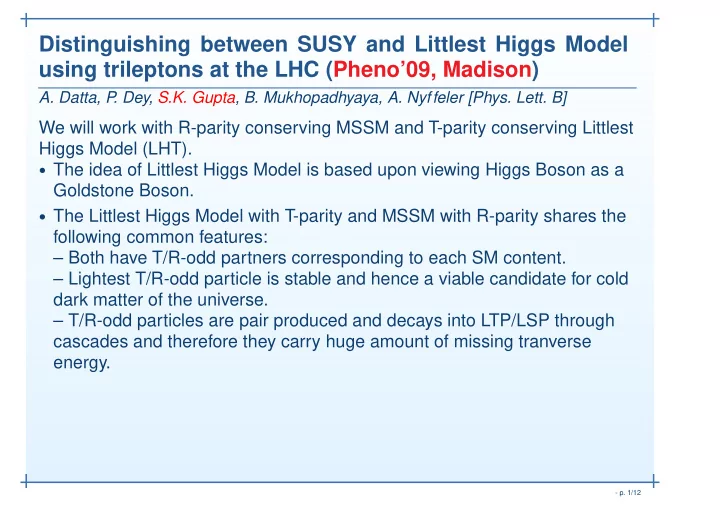
Distinguishing between SUSY and Littlest Higgs Model using trileptons at the LHC (Pheno’09, Madison)

  • A. Datta, P

. Dey, S.K. Gupta, B. Mukhopadhyaya, A. Nyffeler [Phys. Lett. B]

We will work with R-parity conserving MSSM and T-parity conserving Littlest Higgs Model (LHT).

  • The idea of Littlest Higgs Model is based upon viewing Higgs Boson as a

Goldstone Boson.

  • The Littlest Higgs Model with T-parity and MSSM with R-parity shares the

following common features: – Both have T/R-odd partners corresponding to each SM content. – Lightest T/R-odd particle is stable and hence a viable candidate for cold dark matter of the universe. – T/R-odd particles are pair produced and decays into LTP/LSP through cascades and therefore they carry huge amount of missing tranverse energy.

slide-2
SLIDE 2
  • p. 2/12

LHT differs with MSSM in the following:

– (T-odd) partners of Standard Model particles have the same spin unlike SUSY where the (R-odd) superpartners of the Standard Model differ by a spin 1/2. "Bosonic SUSY" – Absence of T-odd partner of gluon and presence of extra (T-odd and

  • even) tops.
slide-3
SLIDE 3
  • p. 3/12

Sources of trileptons in LHT and SUSY

q′ q q′ q q′ q W ± q′

H

qH ZH W ±

H

ZH W ±

H

ZH W ±

H

(a) (b) q′ q q′ q q′ q W ± ˜ q′ ˜ q

  • χ0

2

  • χ±

1

  • χ0

2

  • χ±

1

  • χ0

2

  • χ±

1

followed by W ±

H → AHW ± → AHl′±νl′,

ZH → AHZ → AHl±l∓, e χ±

1 → νl′e

l′± → e χ0

1l′±νl′,

e χ0

2 → l±e

l∓ → e χ0

1l±l∓.

slide-4
SLIDE 4
  • p. 4/12

Assumptions

  • Assume the mass spectra of LHT and MSSM to be identical (not all states

can be matched !)

  • Assume that we have some information on these masses from the first

phase of LHC.

  • Assume that gluino is heavy → no QCD-enhanced SUSY events ⇒

Hadronically quiet trilepton event rates could distinguish between the two models (at least in some region of the parameter space)

slide-5
SLIDE 5
  • p. 5/12

Matching SUSY spectrum with LHT

LHT spectrum can be essentially determined by 3 parameters: (f, κq, κl)

  • (

l, q) masses equated to (lH, qH) masses

  • (AH, W ±

H , ZH) masses aligned to (

χ0

1,

χ±

1 ,

χ0

2) setting:

  • Bino mass M1 set equal to mAH
  • M2 = mZH and µ = 1.5 TeV → pair (

χ±

1 ,

χ0

2) is Wino dominated

→ SUSY scenario 1 (SS1)

  • µ = mZH and M2 = 1.5 TeV → pair (

χ±

1 ,

χ0

2) is Higgsino dominated

→ SUSY scenario 2 (SS2)

  • Physical chargino and neutralino states obtained by diagonalization of

respective mass matrices

  • M3 = 5 TeV to decouple gluinos
  • Trilinear couplings set to zero (except At)
  • Lighter CP-even Higgs mass set to mH = 120 GeV
  • tan β = 10, mA = 850 GeV
slide-6
SLIDE 6
  • p. 6/12

LHT versus SUSY spectrum

Masses and scale f in GeV:

LHT SUSY

f mAH mZH mdH muH mlH mνH

Case

m e χ0 1 m e χ0 2 m e χ± 1 κl = κq = 1 500 66.2 316.7 707.1 685.7 707.1 685.7

SS1

65.9 314.9 314.9

SS2

63.7 314.9 318.1 1000 150.2 648.3 1414.2 1403.5 1414.2 1403.5

SS1

149.8 645.0 645.0

SS2

148.9 645.0 646.2 κl = 0.4, κq = 1 500 66.2 316.7 707.1 685.7 282.8 274.2

SS1

65.9 314.9 314.9

SS2

63.7 314.9 318.1 1000 150.2 648.3 1414.2 1403.5 565.7 561.4

SS1

149.8 645.0 645.0

SS2

148.9 645.6 646.0

SS1: M2 < µ, SS2: µ < M2

slide-7
SLIDE 7
  • p. 7/12

Production cross-sections

Pair production cross-sections at the LHC of W ±

H ZH (LHT) and

χ±

1

χ0

2

(SUSY) SS1: M2 < µ; SS2: µ < M2

0.1 1 10 100 1000 10000 400 600 800 1000 1200 1400

Cross−section (fb) f (GeV)

LHT SS1 SS2

0.1 1 10 100 1000 10000 400 600 800 1000 1200 1400

Cross−section (fb) f (GeV)

SS1

SS2

LHT

κq = 1 κq = 1.5

slide-8
SLIDE 8
  • p. 8/12

Branching fractions versus κl: LHT and SUSY

f = 500 GeV and κq = 1; SS1: M2 < µ & SS2: µ < M2

κ

LHT

ν ν e H e H H H H H

0.2 0.4 0.6 0.8 1 0.4 0.5 0.6 0.7 0.8 0.9 1

Branching Fraction

l

Z −> Z −> h A Z −> e e

κ

SS1

χ χ 2

~ ~

1 χ χ

~ ~

2 1 τ 1 τ χ2

~ ~

eL χ2

~ ~

χ0 ντν

~

τ χ0

~

νeνe

~ _

2

~

2 _

0.2 0.4 0.6 0.8 0.4 0.5 0.6 0.7 0.9

l

1

0.8 1

−> h

−> Z

−>

−> −> −> e

Branching Fraction

κ

SS2

χ χ1 2

∼ ∼

χ2 χ1

∼ ∼0

0.2 0.4 0.6 0.8 1 0.4 0.5 0.6 0.7 0.8 0.9 1

Branching Fraction

l

−> h −> Z

κ

LHT

Η Η Η νeΗ Η νe Η

0.2 0.4 0.6 0.8 1 0.4 0.5 0.6 0.7 0.8 0.9 1

Branching Fraction

l

W −> W A W −> e W −> e

χ+ 1 −> χ1 0 W+ χ+ 1 −> ν ~τ τ+ χ+ 1 −> ν ~e e+ χ+ 1 −> eL ~ + νe χ+ 1 −> τ ~ + 1 ντ ~ ~ ~ ~ ~ ~

SS1

κ

0.2 0.4 0.6 0.8 1 0.4 0.5 0.6 0.7 0.8 0.9 1

Branching Fraction

l

κ

SS2

+

χ

1 −> Other modes χ1

∼+

χ

∼ +

1

0.2 0.4 0.6 0.8 1 0.4 0.5 0.6 0.7 0.8 0.9 1

Branching Fraction

−> W

l

slide-9
SLIDE 9
  • p. 9/12

Event selection

Basic Cuts No jet with pT j > 30 GeV and |ηj| < 2.7, pTl > 25 GeV, |ηl| < 2.5 and ∆Rll > 0.2 ET / > 30 GeV Selection Cuts ET / > 100 GeV ml+l− > 20 GeV |ml+l− − mZ| > 15 GeV |mT (lET / ) − mW | > 15 GeV

slide-10
SLIDE 10
  • p. 10/12

3l + ET /

event rates after cuts

Number of trilepton events after cuts with integrated luminosity 300 fb−1, κl = 0.4 SS1: M2 < µ; SS2: µ < M2

1 10 100 1000 10000 100000 400 600 800 1000 1200 1400

Number of Events f (GeV)

SS1 LHT SS2 SM

1 10 100 1000 10000 100000 400 600 800 1000 1200 1400

Number of Events f (GeV)

LHT SS2 SS1 SM

κq = 1 κq = 1.5

slide-11
SLIDE 11
  • p. 11/12

Trileptons at the LHC: cuts and their efficiency

f = 500 GeV, κq = 1, κl = 0.4 Integrated luminosity 300 fb−1

Cuts LHT SS1 SS2 Background

No jet with pT j > 30 GeV and |ηj| < 2.7, pT l > 25 GeV, |ηl| < 2.5 and ∆Rll > 0.2 9292.7 1641.4 68.1 20232.5 and ET / > 30 GeV ET / > 100 GeV 7281.2 1187.6 49.6 1599.9 ml±l∓ > 20 GeV 7085.4 1137.5 48.1 1596.5 |ml±l∓ − mZ| > 15 GeV 4543.9 659.8 18.2 467.1 |mT (lET / ) − mW | > 15 GeV 4246.3 606.5 17.0 263.9

slide-12
SLIDE 12
  • p. 12/12

Summary

  • LHT trilepton events can be distinguished, at least at the 6σ level, from

either SUSY scenario (SS1 and SS2) even for matching mass spectra for κl < .5.

  • For higher values of κl, with higher heavy mirror lepton / slepton masses,

the trilepton rates in LHT and SUSY are too low compared to SM background.

  • Though a LHT-SUSY discrimination is possible for an integrated

luminosity of 30 fb−1, the information on the mass spectrum might not be sufficient at that stage of the LHC.