DISPOSITIONS HON. MARTIN J. TANGEMAN KATY GRAHAM - - PDF document

dispositions
SMART_READER_LITE
LIVE PREVIEW

DISPOSITIONS HON. MARTIN J. TANGEMAN KATY GRAHAM - - PDF document

11/6/2018 DISPOSITIONS HON. MARTIN J. TANGEMAN KATY GRAHAM Dispositions: How We Deliver the Goods Appellate Justices Institute October 24, 2018 The disposition constitutes the rendition of the judgment of appeal, and is the


slide-1
SLIDE 1

11/6/2018 1

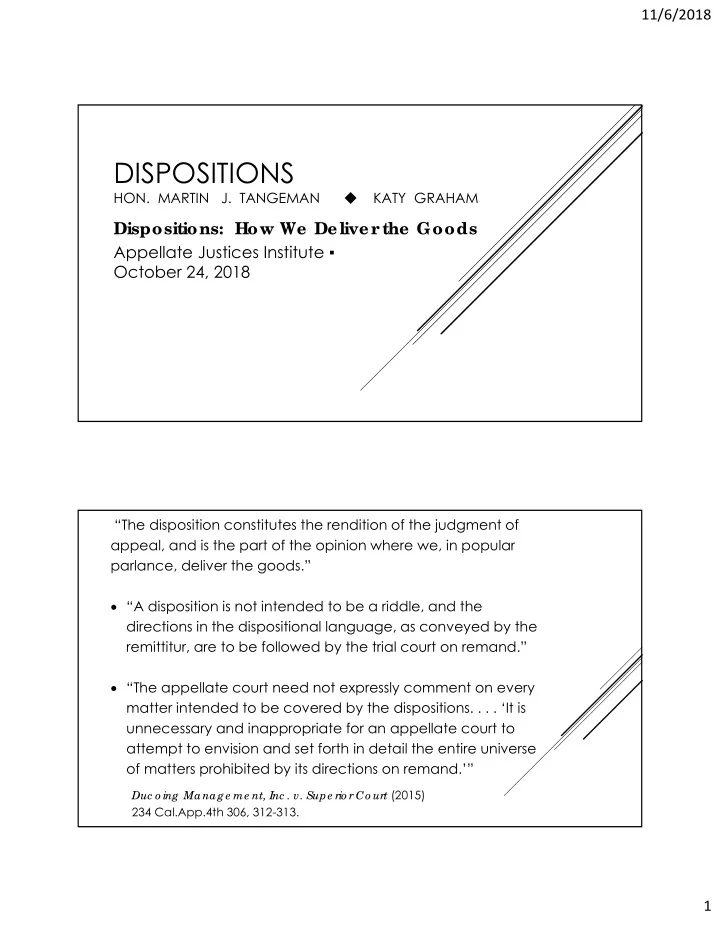
DISPOSITIONS

  • HON. MARTIN J. TANGEMAN ◆

KATY GRAHAM

Dispositions: How We Deliver the Goods Appellate Justices Institute ▪ October 24, 2018

“The disposition constitutes the rendition of the judgment of appeal, and is the part of the opinion where we, in popular parlance, deliver the goods.”  “A disposition is not intended to be a riddle, and the directions in the dispositional language, as conveyed by the remittitur, are to be followed by the trial court on remand.”  “The appellate court need not expressly comment on every matter intended to be covered by the dispositions. . . . ‘It is unnecessary and inappropriate for an appellate court to attempt to envision and set forth in detail the entire universe

  • f matters prohibited by its directions on remand.’”

Duc o ing Manag e me nt, I nc . v. Supe rio r Co urt (2015) 234 Cal.App.4th 306, 312-313.

slide-2
SLIDE 2

11/6/2018 2

POSSIBLE DISPOSITIONS

Affirm Reverse Unqualified Reversal Partial Reversal Reversal With Directions Modify Dismiss

. . . or combination?

USE PRECISE DISPOSITIONAL LANGUAGE

Minimize Time and Expense After Remand

Avoid Confusion in Trial Court Avoid Successive Appeals

slide-3
SLIDE 3

11/6/2018 3

CORRECTING THE DISPOSITION

A petition for rehearing or review is the vehicle for correcting a troublesome disposition

(Duc o ing Manag e me nt, I

nc . v. Supe rio r Co urt

(2015) 234 Cal.App.4th 306, 314.)

CAUTION: GOV. CODE, § 68081

“Before [an appellate court] renders a decision in a proceeding

  • ther than a summary denial of a petition for an extraordinary writ,

based upon an issue which was not proposed or briefed by any party to the proceeding, the court shall afford the parties an

  • pportunity to present their views on the matter through

supplemental briefing. If the court fails to afford that opportunity, a rehearing shall be ordered upon timely petition of any party.” (Gov. Code, § 68081.)

And, note due process concerns where relief not timely requested

slide-4
SLIDE 4

11/6/2018 4

IN 2015-2016 . . .

Of the cases disposed of by written opinion, 8,269 were

affirmed, 1,038 were reversed, and 278 were dismissed.

Of those cases affirmed by the Courts of Appeal, 6,759

received full affirmance, while 1,510 received affirmance with modification.

POSSIBLE DISPOSITIONS - CRIMINAL

Penal Code section 1260: The court may reverse, affirm, or modify a judgment or order appealed from, or reduce the degree of the offense or attempted offense or the punishment imposed, and may set aside, affirm, or modify any or all of the proceedings subsequent to, or dependent upon, such judgment or

  • rder, and may, if proper, order a new trial
slide-5
SLIDE 5

11/6/2018 5

TRIAL COURT JURISDICTION ON REMAND

The disposition defines the scope of jurisdiction in trial court to

which the matter is returned.

Grise t v. F air Po litic al Prac tic e s Co m. (2001) 25 Cal.4th 688, 701.

SCOPE

A reversal with directions empowers the trial court to act only in accordance with the directions. (Hampto n v. Supe rio r Co urt o f

L

  • s Ang e le s (1952) 38 Cal.2d 652.)
  • “Any material variance . . . is unauthorized and void.” (Butle r
  • v. Supe rio r Co urt (2002) 104 Cal.App.4th 979, 982.)
  • “A failure to follow appellate directions can be challenged

by . . . prohibition or . . . mandate.” (I

b id.)

slide-6
SLIDE 6

11/6/2018 6

WHAT HAPPENS IN THE TRIAL COURT?

Generally . . .

Affirmance

 Housekeeping

Reversal

 New trial – unless COA directs otherwise or double jeopardy

Modification

 Trial court enters judgment as modified

Dismissal

 By COA or trial court?

AFFIRMANCE

Affirmance ends litigation Trial court has no jurisdiction to reopen or retry

  • case. (Grise t v. F

air Po litic al Prac tic e s Co m. (2001) 25

Cal.4th 688, 701.)

slide-7
SLIDE 7

11/6/2018 7

REVERSAL

WITH OR WITHOUT DIRECTIONS

New Trial Unless Disposition Directs Otherwise

LAW OF THE CASE

Law of the case applies in a new trial.

Puritan L e asing Co . v. Supe rio r Co urt (1977) 76 Cal.App.3d 140, 146 Pe o ple v. Barrig an (2004) 32 Cal.4th 236, 246

Trial court interprets opinion to determine law of the case.

Barrig an, supra, at p. 247

Law of the case does not apply to determinations of questions of fact based on new or different evidence in a new trial following reversal on appeal

I

  • d. at p. 246

But double jeopardy applies if reversal based on insufficiency of evidence

slide-8
SLIDE 8

11/6/2018 8

SCOPE

“Reversed for further proceedings consistent with this

  • pinion.”

Does the COA intend for trial court to conduct a new

hearing/trial? (Reversal)

Does it intend for trial court to enter judgment/order in

favor of appellant? (Reversal Directing Final Disposition)

Does it intend for trial court to exercise discretion or find

facts? (Reversal Directing Limited Remand)

CRIMINAL

REVERSAL

Judgment against defendant reversed results in a

new trial, unless COA directs otherwise. (Pen. Code, § 1262.)

Double Jeopardy?

Retrial within 60 days, or trial court dismisses the

  • case. (I

d., § 1382, subd. (a).)

slide-9
SLIDE 9

11/6/2018 9

CRIMINAL

DOUBLE JEOPARDY

Bars retrial after reversal for insufficiency of evidence (Burks v. Unite d State s (1978) 437 U.S. 1, 14-15.)

Includes conduct enhancements (Pe o ple v. Se e l

(2004) 34 Cal.4th 535)

Not recidivism enhancements (Pe o ple v.

Barrag an (2004) 32 Cal.4th 236, 259.)

Does not bar retrial after reversal for trial error

(Pe o ple v. He rnande z (2003) 30 Cal.4th 1, 10.)

Because disposition does not reflect guilt or innocence

Ex: Prejudicial instructional error Prejudicial evidentiary error Improper admission of evidence Erroneous dismissal of single juror Invalid guilty plea (DJ attaches only to valid plea)

slide-10
SLIDE 10

11/6/2018 10

CRIMINAL

REVERSAL DIRECTING FINAL DISPOSITION

COA may “direct[] final disposition of the action in defendant’s favor” (Pen. Code, § 1262) . . . if so, it must direct that the defendant be discharged, fines refunded, etc. see § 1262; Go nzale s v. Califo rnia (1977) 68 Cal.App.3d 621

SCOPE

Example: COA reverses an order granting a motion for new trial . . . does the COA intend the trial court to have jurisdiction to hear a new motion for new trial on other grounds? (Pe o ple v. T

aylo r (1993) 19 Cal.App.4th 836, 842.)

If so, reversal w/o directions If not, an option: Reverse with directions to deny the motion for new trial and enter judgment against respondent.

slide-11
SLIDE 11

11/6/2018 11

CRIMINAL

DIRECTIONS FOR LIMITED REMAND

For Exercise of Discretion For Fact Finding

EXAMPLE

Correcting a Sentencing Error

When to modify and when to remand for resentencing?

 If correction requires exercise of discretion . . . Reverse with

directions for limited remand

 If correction requires no exercise of discretion . . . Modify

Ex:

 Failure to impose mandatory enhancement  Imposition of an improper enhancement  Failure to stay a 654 term

slide-12
SLIDE 12

11/6/2018 12

Upon remand for resentencing after the reversal

  • f one or more subordinate counts of a felony

conviction, the trial court has jurisdiction to modify every aspect of the defendant’s sentence on the counts that were affirmed, including the term imposed as the principal term

Pe o ple v. Burb ine (2003) 106 Cal.App.4th 1250, 1259.

CRIMINAL

REVERSAL DIRECTING LIMITED REMAND COMMON SCENARIOS

  • 1. Batso n/Whe e le r
slide-13
SLIDE 13

11/6/2018 13

EXAMPLE

DISPOSITION The judgment is reversed and the case remanded for further proceedings

  • n defendant’s Batso n/Whe e le rmotion as directed in this opinion. If the

court finds that, due to the passage of time or any other reason, it cannot adequately address the issues at this stage or make a reliable determination, or if it determines that the prosecutor exercised her peremptory challenges improperly, it should set the case for a new trial. If it finds the prosecutor exercised her peremptory challenges in a permissible fashion, it should reinstate the judgment. (Pe o ple v. Plac e nc ia (Feb. 9, 2009, No. C056595) ___Cal.App.4th___ [2009

  • Cal. App. Unpub. LEXIS 1044, at *19].)
  • 2. Motion to Suppress
slide-14
SLIDE 14

11/6/2018 14

EXAMPLE

DISPOSITION Our prior opinion in this cause filed on June 6, 2002, is vacated. The judgment is reversed and remanded to the superior court with directions to conduct a hearing on appellant's motion to suppress filed November 28, 2000. If the court grants the motion to suppress, it shall vacate the judgment and afford appellant an opportunity to withdraw his plea. If the superior court denies the motion to suppress, it shall reinstate the

  • judgment. (See Pe o ple v. T
  • rre s (1992) 6 Cal.App.4th 1324, 1335.)

(Pe o ple v. L azalde (2004) 120 Cal.App.4th 858, 866.)

  • 3. Retrospective Competency Hearing
slide-15
SLIDE 15

11/6/2018 15

EXAMPLE

DISPOSITION The judgment is reversed. The case is remanded to the trial court with instructions to hold a retrospective competency hearing, to be calendared forthwith. Counsel shall be appointed to represent defendant at such hearing. In the event defendant is found to have been competent to stand trial, the judgment shall be reinstated. In the event defendant is found to have been incompetent to stand trial, defendant shall receive a new trial. (Pe o ple v. Ro b inso n (2007) 151 Cal.App.4th 606, 619.)

  • 4. Pitc he ss Motion
slide-16
SLIDE 16

11/6/2018 16

EXAMPLE

DISPOSITION The judgment is reversed with directions. On remand, the trial court must conduct an in camera inspection of the requested personnel records for relevance. If the trial court's inspection on remand reveals no relevant information, the trial court must reinstate the judgment of conviction. If the inspection reveals relevant information, the trial court must order disclosure, allow defendant an opportunity to demonstrate prejudice, and order a new trial if there is a reasonable probability the outcome would have been different had the information been disclosed. (Pe o ple v. Jo hnso n (2004) 118 Cal.App.4th 292, 306-307.)

  • 5. Marsde n Motion
slide-17
SLIDE 17

11/6/2018 17

EXAMPLE

  • III. Disposition

The judgment is reversed with directions to the trial court to make further inquiry into Reed’s claim of ineffective assistance of counsel. If, after further inquiry, the court determines good cause exists for appointment of new counsel to fully investigate and present defendant’s motion for new trial, the court shall appoint new counsel for that purpose and conduct further proceedings as necessary. If,

  • n the other hand, the court determines after further inquiry that

good cause does not exist for appointment of new counsel to fully investigate and present defendant’s new trial motion, the court shall rule on the motion as presented by Reed. If the court denies the motion for new trial, the court shall reinstate the judgment. (Pe o ple v. Re e d (2010) 183 Cal.App.4th 1137, 1149-1150.)

CONSIDER DEADLINES ON REMAND

If there is a concern about the case languishing . . .

Criminal – consider a deadline for hearing on remand -

defendant has state constitutional right to timely hearing

  • n remand, but must show prejudice.
slide-18
SLIDE 18

11/6/2018 18

MODIFICATION CRIMINAL COMMON SCENARIOS

  • 1. Correcting Sentence
slide-19
SLIDE 19

11/6/2018 19

CRIMINAL MODIFICATION CORRECTING SENTENCE

If correction requires no exercise of discretion . . . Modify

(Failure to impose mandatory enhancement, imposition of an improper enhancement, failure to stay a section 654 term)

But remand if trial court would have any discretion.

(Pe o ple v. Humphre y (1997) 58 Cal.App.4th 809, 813.)

Reason: A prison term is “made up of interdependent components. The invalidity of some of those components necessarily infects the entire sentence.” (Pe o ple v. Savala (1983) 147 Cal.App.3d 63, 69.)

EXAMPLE

The judgment is modified; execution of the sentence imposed in count two (assault by means of force likely to produce great bodily injury) is stayed pending the finality of this judgment and service of the sentence in count one (Pen. Code, § 654); the stay is to become permanent upon completion of the term imposed in count one. The prison term of 12 years remains the same. The trial court is directed to correct the abstract of judgment as indicated above and to forward a corrected certified copy to the Department of Corrections; the department will modify its records

  • accordingly. As modified, the judgment is affirmed.

(Pe o ple v. F

lo we rs (1982) 132 Cal.App.3d 584, 593.)

slide-20
SLIDE 20

11/6/2018 20

EXAMPLE

  • IV. DISPOSITION

The matter is remanded to the trial court for the purpose of imposing sentence on the gang enhancement allegation attached to count

  • 2. In addition, the trial court is directed to stay the sentence for count

1 under section 654 and to amend the abstract of judgment accordingly, and to reduce defendant's sentence for the gang enhancement as to count 4 to one year. In all other respects, the judgment is affirmed. (Pe o ple v. Williams (2009) 170 Cal.App.4th 587, 647.)

  • 2. Reducing to Lesser Degree or Lesser

Offense

slide-21
SLIDE 21

11/6/2018 21

CRIMINAL

AUTHORITY TO REDUCE

A court may grant a new trial when the verdict or finding is contrary to law or evidence, “but if the evidence shows the defendant to be not guilty of the degree of the crime of which he was convicted, but guilty of a lesser degree thereof, or of a lesser crime included therein, the court may modify the verdict, finding or judgment accordingly without granting or ordering a new trial, and this power shall extend to any court to which the cause may be appealed.” (Pen. Code, § 1181,

  • subd. (6).)

The court may reverse, affirm, or modify a judgment or order appealed from,

  • r reduce the degree of the offense or attempted offense or the punishment

imposed . . . .

(Pen. Code, § 1260.)

EXAMPLE

DISPOSITION The judgment of the trial court is modified by reducing it to murder of the second degree and as so modified is affirmed. The cause is remanded to that court with directions to pronounce judgment upon defendant sentencing him to be imprisoned in a state prison for the term prescribed by law for murder of the second degree.

Pe o ple v. Ho lt (1944) 25 Cal.2d 59, 93.

slide-22
SLIDE 22

11/6/2018 22

CRIMINAL

LIMITATION ON REDUCED CONVICTION(S)

The COA may not modify judgment after conviction on a single greater conviction to reflect multiple convictions for lesser offenses.

Choose the lesser with the longest term to effectuate apparent intent to convict of most serious offense possible.

Pe o ple v. Navarro (2007) 40 Cal.4th 668, 674.

While an appellate court has the power to modify the sentence (§ 1260) we exercise this power sparingly for . . . the trial court’s articulated discretion is, generally speaking, controlling.

Pe o ple v. Humphre y (1997) 58 Cal.App.4th 809, 813.

CRIMINAL

LIMITATION – TRIAL COURT DISCRETION

slide-23
SLIDE 23

11/6/2018 23

HYBRID DISPOSITIONS CRIMINAL

CONDITIONAL REVERSAL/MODIFICATION

 Reversal for failure to instruct on lesser included offense

Consider giving prosecution option on remand to

(1) retry greater offense with proper instructions, or (2) accept modification reducing to lesser offense

(Pe o ple v. E dwards (1985) 39 Cal.3d 107, 110.)

slide-24
SLIDE 24

11/6/2018 24

CRIMINAL EXAMPLE

Disposition: The judgment is reversed with directions as follows: If the People do not bring defendant to trial within 60 days after the filing of the remittitur in the trial court pursuant to Penal Code section 1382, subdivision 2, the trial court shall proceed as if the remittitur constituted a modification of the judgment to reflect a conviction of involuntary manslaughter (Pen. Code, § 192) and unlawful use of heroin (Health & Saf. Code, § 11550) and shall resentence defendant accordingly. (Pe o ple v. E dwards (1985) 39 Cal.3d 107, 110.)

DISMISSAL

Criminal - Dismissal if “irregular in any substantial

particular, but not otherwise.” (Pen. Code, § 1248.)

slide-25
SLIDE 25

11/6/2018 25

COMPLETE DISPOSITION

Scope of Remand? Directions? Rulings on Outstanding

Motions/Requests?