Discovering Black Holes and Gravitational Waves: Algorithms and - - PowerPoint PPT Presentation

discovering black holes and gravitational waves
SMART_READER_LITE
LIVE PREVIEW

Discovering Black Holes and Gravitational Waves: Algorithms and - - PowerPoint PPT Presentation

Discovering Black Holes and Gravitational Waves: Algorithms and Simulation Scott Field Department of Mathematics U. Mass Dartmouth 1 1 ICERM Public Lecture 2019 Outline Gravitational wave science (highlights) What are


slide-1
SLIDE 1

1

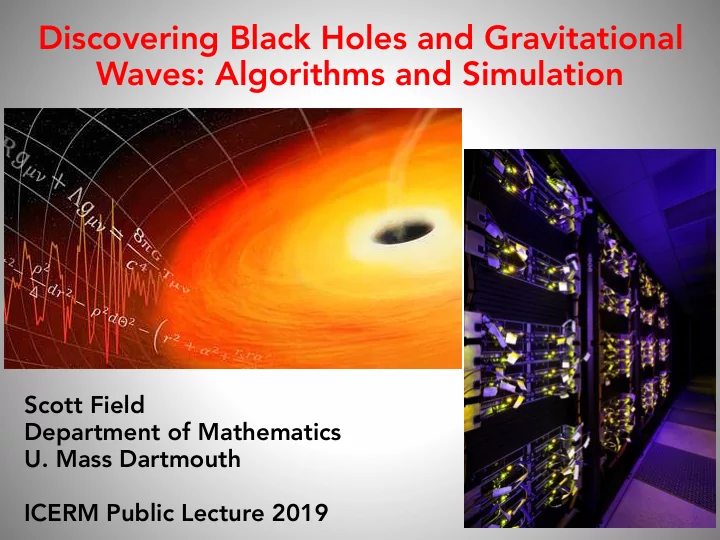
Discovering Black Holes and Gravitational Waves: Algorithms and Simulation

Scott Field Department of Mathematics

  • U. Mass Dartmouth

ICERM Public Lecture 2019

1
slide-2
SLIDE 2

2

  • Gravitational wave science (highlights)
  • What are gravitational waves?
  • Mathematical framework & intuition
  • How to detect gravitational waves?
  • Simulation of black holes and GWs
  • Computers & algorithms
  • Ongoing work and challenges

Outline

slide-3
SLIDE 3

3

Common Acronyms

  • GW = Gravitational Wave
  • LIGO = Laser Interferometer Gravitational-Wave

Observatory

  • GR = General Relativity
slide-4
SLIDE 4

4

References

  • 1. Phys. Rev. Lett. 116, 061102 (2016)
  • 2. Numerous figures pulled from the LIGO open science website
  • 3. https://www.utdallas.edu/news/2015/2/26-31432_New-Insight-Found-in-Black-Hole-

Collisions_story-sidebar.html

  • 4. Holst, Sarbach, Tiglio, Vallisneri, “The emergence of gravitational wave science: 100

years of development of mathematical theory, detectors, numerical algorithms, and data analysis tools”

  • 5. Ed Seidel’s APS April talk, 2018
  • 6. Sarbach, Tiglio “Continuum and Discrete Initial-Boundary-Value Problems and Einstein's

Field Equations”

  • 7. Cervantes-Cota, Galindo-Uribarri, and Smoot, “A Brief History of Gravitational Waves”
  • 8. Sormani, et al “The Mathematics of Gravitational Waves”, AMS Notices
  • 9. Yvonne Choquet-Bruhat, “Beginnings of Cauchy problem”
slide-5
SLIDE 5

Gravitational wave science (highlights)

What: Two black holes Where: Another galaxy Earth distorted by GWs emitted from black holes = GW detectors

slide-6
SLIDE 6

6

A 100 Year Research Problem

Gravitational wave science (highlights)

1915: General relativity is born 2005: First simulation of black holes and their

emitted gravity waves (Frans Pretorius)

2015: Gravitational waves

  • bserved by LIGO!

Gravitational wave science (highlights)

1950s - 1960s: Existence of solutions (Yvonne Choquet-Bruhat) 1957: Framework showing GWs can be measured (Felix Pirani)

slide-7
SLIDE 7
  • On September 14, 2015 GWs passed through Earth
  • Scientific paper: Phys. Rev. Lett. 116, 061102
  • Strain = GW signal measured by the LIGO detectors

Gravitational wave science (highlights)

First Observation of GWs

slide-8
SLIDE 8

8

Computer simulations are required to analyze the data. Simulations are hard…

  • Weeks of running on

a supercomputer

  • Advanced algorithms
  • Advanced

mathematical tools

Gravitational wave science (highlights)

slide-9
SLIDE 9

Gravitational wave science (highlights)

Gravitational Waves Go Mainstream

slide-10
SLIDE 10

10 Gravitational wave science (highlights)

slide-11
SLIDE 11

11

Kip’s 2016 visit (before his prize)

Physics of Interstellar @ UMassD

Gravitational wave science (highlights)

Kip

PhD students, Zach & Tiffany

CSCVR directors, Sigal & Gaurav

Bob Fisher, Richard Price

slide-12
SLIDE 12

What are gravitational waves?

Black Hole Census

Black holes discovered through GW observations

Gravitational wave science (highlights)

slide-13
SLIDE 13
  • The observation of

gravitational waves was an unprecedented experimental feat…

Gravitational wave science (highlights)

  • … that required

mathematical & computational breakthroughs

slide-14
SLIDE 14

14

Engines of GW Science

  • 1. Astrophysical system to generate waves
  • Two black holes orbiting one another
  • 2. Mathematical framework for computing the

expected gravitational wave signal

  • 3. Detectors to observe the signal
  • 4. Algorithms and computers to solve equations
  • 5. Data analysis tools to compare theory and
  • bservation

Gravitational wave science (highlights)

slide-15
SLIDE 15

15

What is the mathematical theory that describes them?

What are gravitational waves?

slide-16
SLIDE 16

16

What is Gravity? Newton’s Answer

  • Gravity is a force between two objects
  • No gravitational waves! Waves need a medium

(e.g. water) to be “waiving in”

What are gravitational waves?

1687

slide-17
SLIDE 17

Einstein’s General Relativity

  • Gravity is not a force in the

usual sense of “push” or “pull”

  • Mass causes space-time around

it to bend or warp

  • Path of objects (light included)

is affected by this warped space-time

  • The gravitational “force” is a

manifestation of the bending of space and time

What are gravitational waves?

1915

slide-18
SLIDE 18

Example: Light Moving In Curved Space

What are gravitational waves?

  • A black hole appears on an academic quad…
slide-19
SLIDE 19

What are gravitational waves?

  • Credit: Andy Bohn, et al.; SXS Collaboration
slide-20
SLIDE 20
  • Secretly a partial differential equation (derivatives lurking in R; Ricci curvature)
  • Solution to this equation describes the geometry of space and time
  • Gravitational lensing of an academic quad by a black hole
  • The distance from ICERM to Fenway Park changes when a GW passes by
  • ICERM employees age more quickly than Hemenway’s empoylees
slide-21
SLIDE 21

21

MESSY AND UNINFORMATIVE!!!!

What are gravitational waves?

When solution has spherical symmetry…

slide-22
SLIDE 22

Mathematical Structure of Equations

  • System of coupled, nonlinear partial differential

equations

  • When written with first order derivatives of time and

space, there are 52 equations with hundreds of terms!

  • Paper-and-pencil solutions only known for simple

cases; computers are needed Does Einstein’s equation of general relativity allow for gravitational waves?

What are gravitational waves?

slide-23
SLIDE 23

Existence of GWs was debated until the late 1950s


  • 1. Existence of solutions? (Not obvious)
  • 2. Equations are too hard to solve, so how

can we say anything concrete about the possibility of gravitational waves?

What are gravitational waves?

Theoretical Justification for Gravitational Waves?

slide-24
SLIDE 24

Under what conditions can we solve Einstein’s equation of general relativity? Why this matters: If solutions don’t exist, it doesn’t make sense to ask a carry out computer simulations

What are gravitational waves?

Issue 1: Existence of Solutions

slide-25
SLIDE 25

Q: Solve for x

What are gravitational waves?

Interlude: When Can We Solve an Equation?

12 + 2x − 8 = 7x + 5 − 5x

slide-26
SLIDE 26

Q: Solve for x A: Not all equations can be solved…

What are gravitational waves?

Interlude: When Can We Solve an Equation?

12 + 2x − 8 = 7x + 5 − 5x 4 + 2x = 5 + 2x 4 = 5

slide-27
SLIDE 27
  • (1930’s) Mathematical tools

developed by Kurt Friedrichs, Hans Lewy, and Sergei Sobolev

  • (1947) A graduate student, Yvonne

Choquet-Bruhat (YCB), begins using these new tools to show the equations can be solved

  • (1952) YCB shows Einstein equations

have solutions under restricted conditions

  • (1969) YCB + Robert Geroch extend

the results to general conditions

What are gravitational waves?

Roadmap to Solvability

slide-28
SLIDE 28

Do the Einstein equations admit solutions that can be interpreted as gravitational waves? Why this matters: Why spend billions of dollars building gravitational wave detectors if they don’t exist?

  • (1916) Einstein finds approximate solutions that

are waves; but he dismisses them as unphysical…

What are gravitational waves?

Issue 2: gravitational waves?

slide-29
SLIDE 29

Q: You have a square bedroom thats 49 square feet. Whats the length of the wall?

What are gravitational waves?

Interlude: When Can We Trust a Solution?

slide-30
SLIDE 30

Q: You have a square bedroom thats 49 square feet. Whats the length of the wall? A: X = wall’s length Mathematically, the wall could be 7 feet or -7 feet. Physically, only 7 feet makes sense. Not all solutions can be trusted…

What are gravitational waves?

Interlude: When Can We Trust a Solution?

x2 = 49

slide-31
SLIDE 31

(1934) The Einstein and Rosen paper

What are gravitational waves?

Roadmap to Waves: Part I

(Preprint) 1934: “Do gravitational waves exist?”

  • (Preprint) “… I arrive at the

interesting result that GWs do not exist”

slide-32
SLIDE 32

(1934) The Einstein and Rosen paper

What are gravitational waves?

Roadmap to Waves: Part I

(Preprint) 1934: “Do gravitational waves exist?” (“Revised” paper) 1934: “On gravitational waves”

  • (Preprint) “… I arrive at the

interesting result that GWs do not exist”

  • (Revision) “…The second part of the

article was altered by me…as we had misinterpreted the results… I want to thank my colleague Professor Roberston….”

slide-33
SLIDE 33
  • (1957) The Chapel Hill conference
  • “Proof by discussion”: Pirani derived an equation that

could be used to measure gravitational waves. A thought experiment by Feynman and Bondi showed the waves could generate heat, and were therefore physical.

What are gravitational waves?

Roadmap to Waves: Part II

Felix Pirani

Richard Feynman, Hermann Bondi, Joseph Weber

slide-34
SLIDE 34

Thanks to the hard work of many researchers from 1915 to the mid-1960s we now know

What are gravitational waves?

  • 1. It makes sense to solve Einstein’s equations
  • f general relativity under general

conditions

  • 2. Gravitational waves are one particularly

import feature of the solutions Lets see what these waves look like…

slide-35
SLIDE 35

What are gravitational waves?

Generation and propagation of gravitational waves

slide-36
SLIDE 36

36

How to observe gravitational waves?

General relativity predicts their

  • existence. How to test the prediction?
slide-37
SLIDE 37

The most promising sources of gravitational waves are those that move dense objects at high accelerations. Examples are supernovae and collisions of compact

  • bjects like neutron stars

and black holes.

What are gravitational waves?

Strong sources of gravitational waves

How to observe gravitational waves?

slide-38
SLIDE 38

How to observe gravitational waves?

Real-world example

* Not seen with an optical (traditional) telescope

  • Fig. by Kimberly Matsuda, Mathematics undergrad
slide-39
SLIDE 39

How to observe gravitational waves?

Real-world example

  • Use the gravitational wave

signal to answer scientific questions

  • Properties of the black hole

system (e.g. masses)

  • Is Einstein’s theory of

relativity correct?

  • Number of space dimensions
  • Speed of gravity waves
  • Populations of black holes
  • Fig. by Kimberly Matsuda, Mathematics undergrad
slide-40
SLIDE 40

How to observe gravitational waves?

Detectors on Earth

slide-41
SLIDE 41

How to observe gravitational waves?

How the detector works

slide-42
SLIDE 42

How to observe gravitational waves?

Gravitational waves are entering the detector = GW detector Overhead view of detector

slide-43
SLIDE 43

How to observe gravitational waves?

Measuring small changes

  • No GWS: distance between mirrors is 4 kilometers
  • GW causes small, time-dependent changes ∆L ≈ 10−18km
  • Smaller than the size of a

proton

  • Gravitational wave detection

requires complicated data analysis algorithms

slide-44
SLIDE 44
  • Signal is weak, buried in

detector noise

  • Precise computer models are

used to generate thousands / millions of “template” signals from likely sources

  • Comparison to templates

allow for detection and parameter estimation

  • Computational modeling is

absolutely essential in the discovery process!

How to observe gravitational waves?

Role of Computational Models

slide-45
SLIDE 45

45

Solving Einstein’s equation on a computer

(A brief history of computational relativity)

slide-46
SLIDE 46
  • Use algorithms, mathematical tools, and

computational resources to find solutions of general relativity equations

  • We specify the problem’s setup: masses of

the black holes, spins of the black holes, etc.

  • Computer simulations solve the equations

for this configuration to get various outputs like the gravitational wave signal

Brief history of computational relativity

What is computational relativity?

slide-47
SLIDE 47

Input to the computer: black holes mass & spins

Brief history of computational relativity

Two body problem (setup)

slide-48
SLIDE 48
  • “These are just differential equations,

and people solve those all the time. Throw them on a computer. Just do it!”

  • Weather simulations
  • Airplane simulations
  • Rocket re-entry simulations

Brief history of computational relativity

Just differential equations…

slide-49
SLIDE 49
  • (1957) Origins of computational relativity
  • Bryce DeWitt spends time at Lawrence Livermore National Lab

working on fluid simulations. He and Charles Misner suggest the following: “First we assume that you have a computing machine better than anything we have now, and many programmers and a lot of money, and you want to look at a nice pretty solution of the Einstein equations….” (2005) First stable simulation of two black holes

  • Strongly hyperbolic formulations with constraint damping
  • 2nd order finite difference (still predominate use)

49

It took 50 years!

Brief history of computational relativity

slide-50
SLIDE 50
  • First attempt carried out by Hahn and Lindquist
  • Hahn, a student of Peter Lax, had access to the

IBM 7090 supercomputer

  • 1 MegaFLOPs
  • Cost 3 million
  • 51x51 mesh points
  • Crashes in 50 steps
  • 4 minutes/step

50

High-performance computing in 1964

Brief history of computational relativity

slide-51
SLIDE 51
  • (1982) Peter Lax’s report on supercomputing in the US: Why

are there no supercomputers available to US academics

  • Simulations done in Germany or classified project
  • Larry Smarr, who works in computational relativity, is using

supercomputers through a friend at Livermore Lab.

  • Larry writes the first unsolicited NSF proposal “A center for

Scientific & Engineering Supercomputing” to be funded

  • The first supercomputing center network is born
  • Cornell, NCSA, Pittsburgh, San Diego, Princeton
  • Many of the first simulations are computational relativity

51

An unsolicited proposal — 1983

Brief history of computational relativity

slide-52
SLIDE 52

52

Progress, but somethings wrong

Brief history of computational relativity

  • (early 1990s) Despite new supercomputing centers

(thanks to Larry) and decades of research effort, no one can evolve a binary black hole system

  • Algorithms or formulations are unstable — codes crash
  • (1993) LIGO is funded to detect gravitational waves; but

we don’t know what they look like!

  • (Late 1990s) NSF funds the Binary Black Hole Grand

Challenge to support new mathematical, numerical, and HPC techniques to solve the problem

slide-53
SLIDE 53

53

Grand Challenge: Why does the code “blow up”?

Brief history of computational relativity

  • Yvonne Choquet-Bruhat proved that solutions exist
  • Whats the right way to instruct a computer to find

them?

  • There are many wrong ways, which lead to

uncontrolled errors; the computer stops working

  • This “blue screen of death” 


is a familiar situation for 
 anyone who has used a
 computer

slide-54
SLIDE 54

54

Grand Challenge Collaborations

Brief history of computational relativity

slide-55
SLIDE 55

55

The 2005 Breakthrough

Brief history of computational relativity

  • Frans Pretorius' talk at the Banff mathematical

research institute

  • First stable simulations of binary black holes;

first numerical gravitational waves

  • Key reasons it worked:
  • Constraint damping; originally proposed by 


mathematician Heinz-Otto Kriess

  • Adaptive mesh refinement
  • Removed the black hole singularity from 


the grid

  • Numerical dissipation
  • Today: many research groups have their own 


codes

slide-56
SLIDE 56

56

Spectral Einstein Code (SpEC)

Brief history of computational relativity

  • SpEC uses a multi-domain grid
  • High-order basis functions
  • Parallelization by domain
slide-57
SLIDE 57

57 Brief history of computational relativity

  • Typical simulation
  • 100 cores; 2 - 4 weeks
  • Runs on Blue Waters, Stampede, Comet, etc…
slide-58
SLIDE 58

58

Key contributions to gravitational wave science

Brief history of computational relativity

  • Two-body binary black hole problem
  • 8D parameter space (each hole has mass and spin)
  • Simulations are used to…
  • Building high-fidelity gravitational wave models
  • Compare directly to observed GW datasets
  • Need a good model for answering science questions
  • Final mass and spin of the merged black holes
slide-59
SLIDE 59

59

Ongoing Work* and Future Directions

* Biased towards U. Mass Dartmouth

slide-60
SLIDE 60
  • Over the next decade, gravitational-

wave detectors will be observing more events, with higher signal-to- noise ratios, and longer durations

  • Heavy demands will be placed on

simulation codes, models, and data analysis efforts

60

Urgent need for solutions

Ongoing work & challenges

slide-61
SLIDE 61

61

Multi-disciplinary Approach

Ongoing work & challenges

  • Research groups…
  • Gravity theory
  • Computational astrophysics
  • Numerical analysis
  • Data science
  • PhD students…
  • Yun Hao, Rahul Kashyap, Caroline Mallary, Ed McClain, Alec Yonika, Gustavo

Reynoso, Vishal Tiwari

  • Masters students …
  • Joel Baer, Gabriel Casabona, Connor Kenyon, Nishad Muhammed, Nur Rifat,

Feroz Shaik

  • Undergraduate students…
  • Dwyer Deighan, Chris Gilbert, Kim Matsuda, Owen Tower
slide-62
SLIDE 62

62

White dwarf mergers and explosions

Ongoing work & challenges

Rahul Kashyap

Robert Fisher Gabriel Casaba

slide-63
SLIDE 63
  • Using GPUs and playstation to accelerate

simulations of perturbations of rotating black holes

63

Novel HPC solutions

Ongoing work & challenges

Alec Yonika

Gaurav Khanna

slide-64
SLIDE 64

64

Fast computational models

Ongoing work & challenges

  • Recall a single computational relativity simulations takes 2 - 4 weeks. Can

we use these in real-time data analysis studies?

  • Yes! Train a fast-to-evaluate model directly from the numerical data
  • Evaluation of model is fast (<< 1 second) and as accurate as

the numerical gravitational wave model

Nur Rifat

Feroz Sheik

slide-65
SLIDE 65

65

Additional Projects

Ongoing work & challenges

  • Classifying gravitational waves with 


convolutional neural networks

  • Accurate models for gravitational


wave propagation

  • Discontinuous Galerkin methods


for extreme mass ratio 
 binary black holes and 
 relativistic hydrodynamics Kim Dwyer Owen Ed Aakash

slide-66
SLIDE 66

66

Final thoughts

  • The computation of gravitational waves has a rich

history, deeply interconnected with (applied) mathematics and high-performance computing

  • Recent set of gravitational wave detections has

underscored the need for fast, accurate numerical computations

  • Meeting observational demands will rely heavily on the

efficient usage HPC resources & improved numerical methods

  • ICERM will host a semester long program addressing

some of these issues in 2020 (Fall)

slide-67
SLIDE 67

67

SpECTRE: A new code

Ongoing work & challenges

  • Total amount of time spent executing each task summed across all

processors in a given time interval. The vertical axis shows the combined processor utilization (from 0% to 100%) and the horizontal axis shows the wall time.

  • Black: Charm++ RTS
  • white: idle cores
  • The additional colors show SpECTRE tasks.
slide-68
SLIDE 68

68

Fast computational models

Ongoing work & challenges

  • Recall a single computational relativity simulations takes 2 - 4 weeks.

Can we use these in real-time data analysis studies?

  • Yes! Train a fast-to-evaluate model directly from the numerical data

Parameter sampler N parameters {ʌ_i}_{i=1}^N SpEC Solver Training Data {h(t;ʌ_i}_{i=1}^N No

F u t u r e W

  • r

k

Bad parameter values h_{Sur}(t;ʌ) Accurate surrogate? Yes Decompose Data Approximate (decomposed) Data h_S (t)

Build Surrogate

Waveform Alignment

slide-69
SLIDE 69

69

SpECTRE: A new code

Ongoing work & challenges

Issues

  • Moore’s law is dead
  • Next-generation systems will have millions of cores
  • Cores idle during communication (waiting for data)
  • Load balancing & synchronization with current codes

Proposed solution

  • Discontinuous Galerkin method
  • Task-based parallelism (using the Charm++ library)
slide-70
SLIDE 70

70

SpECTRE: A new code

Ongoing work & challenges

  • Strong scaling on Blue Waters; fixed grid size
  • Problem: Orszag-Tang vortex test case
slide-71
SLIDE 71
  • When matter fields are included (stars), simulations are often neither

accurate nor efficient enough to meet observational needs

  • Essentially no use of modern techniques like discontinuous Galerkin

methods, finite element, reduced basis, …

  • Star detonation is a multi-scale, multi-physics process. Needed for

even qualitatively correct results

  • Simulations are too slow for direct use in, say, Bayesian parameter

estimation studies

  • Long duration GW signals are inaccessible to current codes
  • Building accurate computational models to enable high-precision science
  • Future space-based detectors will lead to new opportunities and

challenges

71 Ongoing work & challenges

Challenges and Opportunities

Ongoing work & challenges