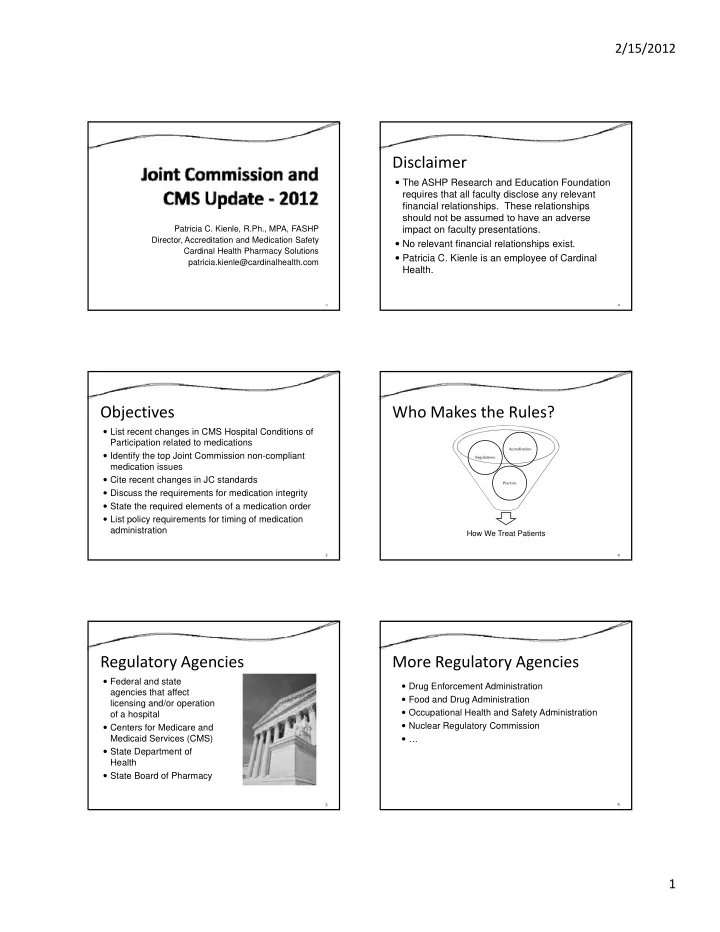
Disclaimer The ASHP Research and Education Foundation requires that - - PDF document

disclaimer
SMART_READER_LITE
LIVE PREVIEW

Disclaimer The ASHP Research and Education Foundation requires that - - PDF document

2/15/2012 Disclaimer The ASHP Research and Education Foundation requires that all faculty disclose any relevant financial relationships. These relationships should not be assumed to have an adverse should not be assumed to have an adverse


slide-1
SLIDE 1

2/15/2012 1

Patricia C. Kienle, R.Ph., MPA, FASHP Director, Accreditation and Medication Safety Cardinal Health Pharmacy Solutions patricia.kienle@cardinalhealth.com

1

Disclaimer

 The ASHP Research and Education Foundation requires that all faculty disclose any relevant financial relationships. These relationships should not be assumed to have an adverse should not be assumed to have an adverse impact on faculty presentations.  No relevant financial relationships exist.  Patricia C. Kienle is an employee of Cardinal Health.

2

Objectives

 List recent changes in CMS Hospital Conditions of Participation related to medications  Identify the top Joint Commission non-compliant medication issues medication issues  Cite recent changes in JC standards  Discuss the requirements for medication integrity  State the required elements of a medication order  List policy requirements for timing of medication administration

3

Who Makes the Rules?

Regulations Accreditation 4

How We Treat Patients

Practice

Regulatory Agencies

 Federal and state agencies that affect licensing and/or operation

  • f a hospital
  • f a hospital

 Centers for Medicare and Medicaid Services (CMS)  State Department of Health  State Board of Pharmacy

5

 Drug Enforcement Administration  Food and Drug Administration  Occupational Health and Safety Administration

More Regulatory Agencies

Occupational Health and Safety Administration  Nuclear Regulatory Commission  …

6

slide-2
SLIDE 2

2/15/2012 2

 The Joint Commission  American Osteopathic Association

 Healthcare Facilities Accreditation Program

Accreditation Organizations

 DNV Healthcare

 National Integrated Accreditation for Healthcare

Organizations

7

 United States Pharmacopeia  ASHP – Best Practices

Standards of Practice

8

CMS Conditions of Participation

 Basis for regulatory requirements and accreditation standards  Pharmaceutical Services  Pharmaceutical Services, and

 Medical Records  Nursing Services  Nuclear Medicine

9

 Condition of Participation

 Tag number

 Interpretive Guidelines

Parts of the CoPs

 Survey Procedures

10

 Meet needs of the patients  Drug storage  Responsible pharmacist

§482.25 Pharmaceutical Services

 Adequate number of personnel  Accurate records of scheduled drugs  Controlled and distribution meets applicable standards of practice, law, and regulation  Compounding only under pharmacist supervision and consistent with laws

Policies 02-02-P, 02-05-P, 22-01-P, RX15-03, RX15-04

11

 All drugs and biologicals kept in a secure area, and locked when appropriate  Controlled substances locked within a secure area O l th i d l h t l k d

… Pharmaceutical Services …

 Only authorized personnel have access to locked areas  Outdated, mislabeled, or otherwise unusable drugs and biologicals not available for patient use

Policies 09-02-H, 09-03-P, 18-09-H, 20-01-H, RX15-05

12

slide-3
SLIDE 3

2/15/2012 3

 Only authorized personnel remove drugs and biologicals from a storage area  Automatic stop order policy E ADR d i tibiliti t d t

… Pharmaceutical Services

 Errors, ADRs, and incompatibilities reported to attending physician and hospital committee  Abuses and losses of controlled substances reported to DOP and CEO  Drug information available to professional staff  Formulary system

Policies 05-01-P, 08-02-H, 10-05-H, 20-01-H, RX14-01, RX15-01

13

 Medical Record Services

 §482.24(c)(1)  Orders

P t l

Other Medication‐Related CoPs

 Protocols

 Nursing Services

 §482.23(c)  Administration of medications

 Nuclear Medicine Services

 §482.53(b)  In-house preparation of radio pharmaceuticals

Policies 10-02-H, 13-01-H, RX08-02

14

 Orders and protocols

 Required elements  Authentication of multi-page orders

Ti i f di ti d i i t ti

Recent CoP Changes

 Timing of medication administration

 Change in the “30 minute” rule

Policies 10-02-H, 13-09-H

15

TJC Top Non‐Compliant Issues

Rank Standard Non- Compliant 1 RC 01 01 01 The hospital 65% 1 RC.01.01.01 The hospital maintains complete and accurate medical records for each patient 65% 6 MM.03.01.01 The hospital safely stores medications 33% 10 MM.04.01.01 Medication orders are clear and accurate 28%

16

2011 Joint Commission Changes

 MM.02.01.01 Selecting Medications  Prelabeling of syringes

17

Policies 08-02-H, 11-05-P, 11-09-H

Key Areas for Compliance

 Selection

 Pediatric issues

 Storage Integrity of meds

Store Select  Integrity of meds

 Orders

 Protocols

 Dispensing

 Labeling syringes

 Administration

 Timing

18

Order Monitor Administer Dispense

slide-4
SLIDE 4

2/15/2012 4

 MM.02.01.01: The hospital selects and procures medications  EP 2: The hospital develops criteria for selecting

di ti hi h t i i i l d th

Selection of Medications

medications, which, at a minimum, include the following:

 … Population(s) served (for example, pediatrics,

geriatrics) …

 Also added pediatric focus to two PC standards

 Pain management and risks for falls

Policies 08-02-H, 08-03-H, 22-20-P

19

 Security  Safety  Integrity of medications

Storage of Medications

Policies 09-01-P, 09-02-H, 13-03-H, RX15-05

20

Security – Controlled Substances

 Lock all controlled substances  Include C-V I l d d l  Include procedural areas and clinics  No unauthorized access

21

 Lock all meds unless hospital policy permits

  • therwise

 Define who is authorized to access medications A t t d d l t t t

Security – All Medications

 Automated and manual systems must meet same standards  Flush solutions

Policies 09-01-P, RX15-05

22

Are these secure?

23

Integrity of Medications

 In date  Correct temperature

 Use manufacturer’s

information information

24

Policies 09-01-P, 09-02-H, 09-03-P, 09-04-H

slide-5
SLIDE 5

2/15/2012 5

 CMS CoP §482.41 – Temperature Control

 The hospital must ensure that …pharmaceuticals are

stored properly and in accordance with manufacturer’s recommendations

Use Manufacturer’s Storage Info

with…manufacturer s recommendations…

 MM.03.01.01 – Safe Storage

 EP 1 - The hospital stores medications according to

the manufacturers’ recommendations or, in the absence of such recommendations, according to a pharmacist’s instructions

 Problematic drugs

25

Policies 09-02-H, 09-04-H, 09-06-H

Manufacturers’ Information

 Storage temperature

 Room temperature  Moving refrigerated

items to room items to room temperature

 Moving room

temperature items to warmers

26

Policies 09-01-P, 09-02-H, 09-04-H, 09-06-H

 Refrigerator to room temperature

 Succinylcholine, insulin, lorazepam

 Room temperature to refrigerator

Manufacturers’ Information

 Magnesium citrate, barium

 Room temperature to warmer

 Irrigation solutions  IV contrast

 Point-of-Care ial/bag systems

 BUD of bag outside of overwrap

Policies 09-01-P, 09-02-H, 09-04-H, 09-06-H

27 28

 Name of patient  Age and weight of patient, when applicable  Date and time of the order

Orders – Required Elements

 Drug name  Exact strength or concentration, when applicable  Dose, frequency, and route  Quantity and/or duration, when applicable  Specific instructions for use, when applicable  Name of prescriber

Policies 10-01-H, 10-02-H, 10-09-H

29

Orders

 Must be unambiguous

 Legible  Complete

D t d d ti d

 Dated and timed

 Applies on any type of order

 Handwritten  Preprinted  Electronic

 Protocols

 Detailed information in CoP

30

Policies 10-01-H, 10-02-H, 10-09-H

slide-6
SLIDE 6

2/15/2012 6

Is this a clear, unambiguous order?

31

 Develop with prescriber(s)

 Consistency of practice  Unique name of protocol

A id h i d li i if ibl

Medication Protocols

 Avoid therapeutic duplication if possible  Orders require objective parameters

 Taper  Titrate  Therapeutic duplication

 CMS views this as a medical decision, not one of convenience or non-LIP judgement

Policies 10-01-H, 10-02-H, 10-09-H

32

 NPSG.03.04.01: Labeling medications

 Deals with labeling during procedures

 MM.05.01.09: Medications are labeled

Prelabeling Syringes

 Communication between The Joint Commission and the American Society of Anesthesiologists

 The Joint Commission no longer prohibits pre-labeling

syringes

Policies 11-05-P, 11-09-H, 22-05-H

33

Is this safe?

34

Policy 11-09-H

 Change in the “30 minute rule”  November 2011 change in CMS Interpretive Guidelines and Survey Procedures Ch d t d b ASHP ISMP d J i t

Medication Administration Timing

 Change advocated by ASHP, ISMP, and Joint Commission  Hospital needs to define policy and medications that are time-critical and must be given within 30 minutes

  • f the scheduled time

Policies 13-01-H, 13-09-H

35

 Establish standard times  Develop written policy that includes

 Meds not eligible for standard dosing times

Policy Elements

 Meds eligible for standard dosing times  Time-critical scheduled medications  Action for medications outside of scheduled dosing

times and windows

Policies 13-01-H, 13-09-H

36

slide-7
SLIDE 7

2/15/2012 7

 Hospital policy needs to define  Suggestions

 Stats

Not Eligible for Standard Times

 First time or loading doses  One-time doses  Time sequenced doses  Investigational drugs  PRNs

Policies 13-01-H, 13-09-H

37

Meds Eligible for Standard Times

 Hospital policy needs to define  Suggestions

 Meds ordered on a repeated cycle of frequency

 Policy needs to specify those medications that are time-critical

38

Antibiotics Pain medications Anticoagulants Orders for a specific time Anticonvulsants Orders that must be separated Immunosuppressive agents Meds ordered more frequently than every 4 hours Insulin

Policies 13-01-H, 13-09-H

CMS Requirements for Timing

Type of Order Maximum Allowance Outside of Scheduled Time Time-critical 30 minutes Scheduled more frequently 1 hour

39

Scheduled more frequently than daily but no more frequently than every 4 hours 1 hour Scheduled for daily, weekly,

  • r monthly

2 hours

Policies 13-01-H, 13-09-H

First and Subsequent Dose Timing

40

Policy 13-09-H

Infection Prevention

41

Policies 21-03-P, 21-03-H, 21-05-P, 21-05-H, 21-07-P

Safe Injection Practices

 Multiple dose vials

 Use single use vials as much as possible  Use for one patient only  Preservatives are not effective against viruses and

fungi

 Never use infusion supplies for more than one patient

 Syringes, needles, and cannulas are used for a single

patient for a single procedure

42

Policies 21-05-P, 21-05-H, 21-06-H

slide-8
SLIDE 8

2/15/2012 8

 While the use of aseptic technique when preparing and administering injectable medications is applicable to all healthcare settings, including pharmacy areas, these FAQs are not intended to

Exemption for Pharmacy

reflect the standards and recommended practices for handling medication vials and related products in pharmacy settings—these should be determined in accordance with the state boards of pharmacy, the United States Pharmacopeia (USP), the Drug Enforcement Agency (DEA), and the Food and Drug Administration (FDA).

43

National Guidelines

 CDC: Safe Injection Practices to Prevent Transmission

  • f Infections to Patients

 CDC: Prevention Checklist for Outpatient Settings – Minimum Expectations for Safe Care Minimum Expectations for Safe Care  APIC: Safe Injection, Infusion, and Medication Vial Practices in Health Care  USP: Compounding Sterile Preparations

44

 Read the medication sections of the CMS Conditions

  • f Participation

 Know your state regulations St t b d f h

Action Steps

 State board of pharmacy  State department of health

 Review hospital policies and medical staff bylaws and rules & regulations  Ensure your policies, procedures, and practices are current

45

Resources

 CMS Hospital Conditions of Participation, Rev 75, http://cms.hhs.gov/manuals/Downloads/som107ap_a _hospitals.pdf  Comprehensive Accreditation Manual for Hospitals  Comprehensive Accreditation Manual for Hospitals, Joint Commission  Joint Commission Perspectives  Assuring Continuous Compliance with Joint Commission Standards: A Pharmacy Guide, 8th edition , ASHP

46

Resources

 ISMP Timely Administration of Scheduled Medications, www.ismp.org/Tools/guidelines/acutecare/tasm.pdf  USP <797> June 2008 update  USP <797>, June 2008 update  APIC: Safe injection, infusion, and medication vial practices in health care, available at www.apic.org/Content/NavigationMenu/PracticeGuid ance/PositionStatements/AJIC_Safe_Injection0310.p df

47

CHS Medication Management Compliance

Jerry Reed, M.S., R.Ph., FASCP Director of Pharmacy Operations Community Health Systems

48

slide-9
SLIDE 9

2/15/2012 9

Objectives

 Summarize CHS 2011 TJC Medication Management survey results  Review additional non‐compliant issues in CHS facilities related to Medication Management

49

2011 Medication Management Survey Findings

 MM.03.01.01 EP 2‐3, 6‐8  MM.04.01.01 EP 1, 6‐8, 10, 13  MM.05.01.01 EP 1 – 3, 8  MM.05.01.09 EP 1, 4, 10  MM.05.01.11 EP 4  MM.05.01.13 EP 1  MM.08.01.01 EP 5  NPSG 03.04.01 EP 1‐3, 6

50

2011 Medication Management Survey Findings

Standard Subject TJC ‐2009 TJC ‐ 2010 TJC ‐ 2011 CHS ‐ 2011 MM.03.01.01 Storage 33% 34% 34% 22% Top MM Standards Scored Non-Compliant by Year

51

Policies 09-02-H, RX15-05 MM.03.01.01 Storage 33% 34% 34% 22% MM.04.01.01 Orders 30% 28% 25% 36% MM.05.01.01 RPh Review 14% 16% 14% 26% MM.01.01.03 HRHA 7% 6% 7% 0% MM.05.01.07 Prep 6% 5% 6% 0% MM.05.01.09 Labeling 6% 5% 5% 9%

MM.03 Storage

 Unauthorized personnel with access to drugs  Crash carts storage  Terminated employees remain in ADCs  Medications prepared without a BUD  Unsecured carts and kits with meds  Proper temperature storage

52

Policies 09-01-H, 09-02-H, 09-04-H, 12-01-H, 12-02-H, 22-09-P

MM.03 Storage

 Policies addressing safe storage

53

Policies 09-01-P, 09-02-H, 09-03-P, RX15-05,

MM.03 Storage

 Unsecured drugs  Unlocked med room  Unsecured prescription pads

54

Policies 09-02-H, RX15-10

slide-10
SLIDE 10

2/15/2012 10

MM.03 Storage

 MDV expiration dates

55

Policy 21-06-H

MM.03 Storage

 Disposal of CS waste without a witness  Expired medications  Patient’s own medications

56

Policies 09-01-P, 09-02-H, 09-03-P, 13-03-H

MM.04 Medication Orders

 Policy for LASA drugs  Telephone and verbal orders  Medication protocols or order sets Medication protocols or order sets  Resume orders  Therapeutic duplications  Titration orders  No evidence of order review by pharmacist

57

Policies 08-12-H, 10-02-H, 10-03-H, 10-05-H

MM.05 Preparing and Dispensing

 Order review by a pharmacist  Multiple drugs ordered for pain  Room number used as a patient identifier on drug p g storage bins

58

Policies 10-02-H, 11-05-P, 11-09-H, 22-05-P

MM.05 Preparing and Dispensing – Patient Care Areas

 Labeling

59

Policies 10-02-H, 11-05-P, 11-09-H, 22-05-P

MM.05 Preparing and Dispensing – Procedural Areas

60

Policies 11-09-H, 22-03-P

slide-11
SLIDE 11

2/15/2012 11

MM.05 Preparing and Dispensing – Procedural Areas

61

Policy 11-09-H Policy 11-09-H

MM.08 Medication Management System Evaluation

 Collect and analyze data  Identify data over time to identify risk points  Review current literature for new technologies and  Review current literature for new technologies and best practices  Medication Reconciliation processes  Identify opportunities as priorities  Evaluate changes to confirm improvements  Annual report

62

Policy 04-02-H

Additional Medication Management Opportunities

 Drugs in Gift Shops  Chemicals stored in patient care areas  Thermometer calibration  Pill crushers and tablet splitters  Compounding products  Drug Recalls  USP Chapter <797> Survey Results  USP Chapter <795> Standards  EPA RCRA‐compliant Pharmaceutical Waste Program  Implementation of new policies

63

Policies 09-01-P, 11-07-P, 13-03-H

Additional Medication Management Opportunities

 Pill Crushers and Tablet Splitters  Compounding Products

64

Policy 11-07-P

Drug Recall System

 MM.05.01.17  Recall terms

 Class I, II, or III recall  FDA Enforcement Report  Market withdrawal

M d ll

 Mandatory recall  Medical device safety alert  Phantom recall  Voluntary recall  Withdrawal

 RASMAS (Risk and Safety Management Alert System)

 Web‐based notification service  Pilot sites

65

Policy 18-07-P

USP Chapter <797> Survey

 23 Questions  2 944 total responses (128 facilities)  2,944 total responses (128 facilities)  330 non‐compliant responses (11.2%)

66

Policy Section 22, Sterile Products

slide-12
SLIDE 12

2/15/2012 12 USP Chapter <797> Survey – The Good News

 ACDs are recalibrated at least once daily. (100%)  All CSPs (non‐immediate use) are prepared in ISO 5. (99%)  Spare glovebox arm sleeves on hand. (99%)  C t i f hi h i k di ( %)  Competencies for high‐risk compounding. (99%)  All CSPs prepared by a technician are checked by a second

  • person. (98%)

 Hoods are certified every 6 months. (98%)  Glovebox sleeves are changed at least once annually. (97%)  Hoods are never turned off unless being serviced. (96%)  Anterooms adjacent to cleanrooms are ISO 7. (95%)

67

Policy Section 22, Sterile Products

USP Chapter <797> Survey – The Other News

 Gloved fingertip sampling (59%)  Surface sampling for viable organisms (62%)  CSP quality control program developed and includes a  CSP quality control program developed and includes a sampling plan (73%)  Temperature, humidity, and pressure differential monitoring (75%)  Nursing personnel complete competencies for “Immediate Use” compounding (80%)  Pre‐filters are changed monthly (81%)

68

Policy Section 22, Sterile Products

USP Chapter <795> Standards

 Non‐sterile compounding  Update official in May, 2012  3 Types

 Simple – reconstitution or adding a component to a product as

instructed by the manufacturer instructed by the manufacturer

 Moderate – calculations required or compounding when stability

references are not available

 Complex – specialized training or equipment necessary

 Competencies  Dedicated compounding area  Recipes and master formulation approval, including Beyond‐Use‐Dating  Record keeping

69

Policy 11-07-P

Pharmaceutical Waste – Statistics for U.S. Hospitals

Compliance Rates Hazardous Drugs Identified

70

Hazardous Drug Identification Method Policy 18-10-H

Pharmaceutical Waste

71

Policy 18-10-H

New Policies Implemented

 Acute Care CS policies  Ambulatory Surgery Centers Ambulatory Surgery Centers  Physician Practice and Clinic Policies  Long Term Care

72

slide-13
SLIDE 13

2/15/2012 13

Implementation of Electronic Clinical Surveillance Initiative – Sentri7 & Quantifi Sentri7 & Quantifi

73

Trent Beach, Pharm.D., M.B.A., M.H.A., FASHP Director of Clinical Pharmacy Services Community Health System

Sentri7 & Quantifi

Sentri7

  • Supports real‐time clinical decisions
  • Gathers and displays patient specific

information based on predefined criteria

  • Optimizes time to identify assessment

and intervention opportunities and intervention opportunities

Quantifi

  • Supports intervention documentation
  • Integrates with Sentri7 allowing partial

auto‐population of data.

  • Provides information needed to

demonstrate productivity

74

  • Logic designed to identify specific patients
  • A standardized set of rules will be provided
  • Customized rules may be created to meet

facility needs

Rules

Sentri7 & Quantifi

  • Will be centrally coordinated for

standardization across the system

  • Associated with hard and soft dollar savings

where appropriate

Intervention Types

75

Sentri7 & Quantifi

Implementation Timeline

Pilots (4) January 23 – April 6 Remediation Wave 1 & 2 (7) February 6 – April 13 Phase I (40) May 7 Phase II (40) & February 20 – April 27 May 7 – September 7 September 17 – January 11, 2013 Phase III (40) January 28 – May 31

76

Sentri7 & Quantifi

Training & Go Live Support

  • Live Online Training from P1S Team
  • Comprehensive Training Manual
  • Video Tutorial

User Training

  • Assigned P1S Online Support

Go Live Support

  • PRN Training from P1S Support Team
  • CHS Super Users

Ongoing Support

77

Sentri7 & Quantifi

Results

Strong performance anticipated/expected

  • Usage will be gathered and

analyzed

  • Feedback will be provided
  • Results will be reported through

divisional leadership

  • Our success depends on all of us

78

slide-14
SLIDE 14

2/15/2012 14

79

Update on Current CHS Initiatives and Strategies Initiatives and Strategies

80

Bob Fink, Pharm.D., M.B.A., FASHP, BCNSP, BCPS Chief Pharmacy Executive Community Health System