Disability and Bias in Interviewing & Hiring Definition In the - - PowerPoint PPT Presentation

disability and bias in interviewing hiring
SMART_READER_LITE
LIVE PREVIEW

Disability and Bias in Interviewing & Hiring Definition In the - - PowerPoint PPT Presentation

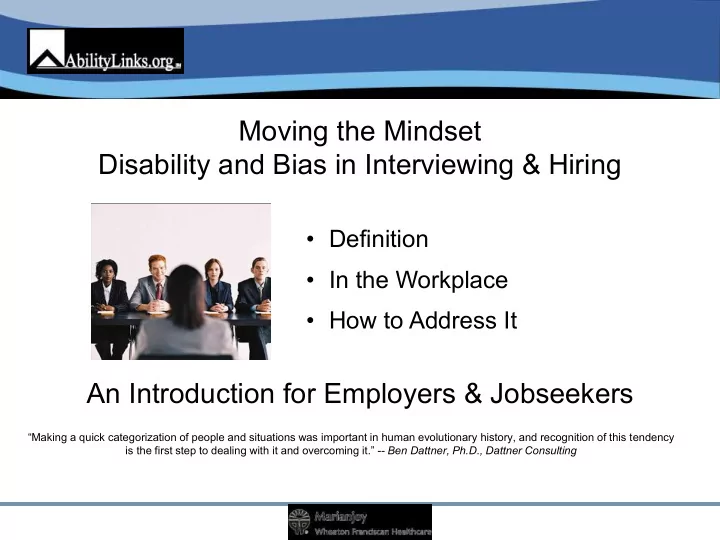
Moving the Mindset Disability and Bias in Interviewing & Hiring Definition In the Workplace How to Address It An Introduction for Employers & Jobseekers Making a quick categorization of people and situations was important


slide-1
SLIDE 1

Moving the Mindset Disability and Bias in Interviewing & Hiring An Introduction for Employers & Jobseekers

  • Definition
  • In the Workplace
  • How to Address It

“Making a quick categorization of people and situations was important in human evolutionary history, and recognition of this tendency is the first step to dealing with it and overcoming it.” -- Ben Dattner, Ph.D., Dattner Consulting

slide-2
SLIDE 2
  • Workplace Bias
  • EEOC and DOJ

Examples

  • Interviewing, Hiring

Process

  • Metrics,

Management, Culture

slide-3
SLIDE 3
slide-4
SLIDE 4

Mark Williams

  • Low Vision Disability
  • AbilityLinks
  • Family Resource Center on Disabilities
  • Chicagoland Business Leadership Network
  • Disability Employment Initiative
  • Cohen Institute for Mental Health Education
  • Professional Assistant Center for Education
  • Access Living
slide-5
SLIDE 5

https://www.projectimplicit.net

Age Disability Skin Tone Weight Religion Sexuality Race Gender

slide-6
SLIDE 6
slide-7
SLIDE 7

The Unstructured Approach Employer

  • Asks 5 candidates to be interviewed individually by

associates and partners Interviewers

  • Use free-flowing discussion of topics of interest to the

interviewer, such as which school the person studies at and where they play golf Employer

  • Asks interviewers to rank candidates based on how

well they “fit” the firm’s image

slide-8
SLIDE 8

The Unstructured Approach Advantages Disadvantages

  • Determines requisite communication and

social skills

  • Subjective
  • Helps identify compatibility with other

employees

  • Subject to stereotyping
  • May be modified as needed, or on the fly
  • Negative answers may be given

more weight

  • Can help foster decision making between

equally qualified candidates

  • Lacks evidence of validity
slide-9
SLIDE 9
slide-10
SLIDE 10

Overlooking more qualified candidates? Hiring for the position, or the culture? Is cultural fit at the expense of innovation?

slide-11
SLIDE 11

How do your policies affect the hiring process?

slide-12
SLIDE 12

EEOC v Maxim Healthcare Staffing (March 2014)

  • A health care staffing service refused to hire a candidate because of

their HIV status

  • The assignment involved sitting with patients at a medical facility
  • A health exam showed the HIV-positive status but said he was

cleared to work

  • "Once again, an employer involved in the health care field has

impermissibly allowed fear and bias to enter into the hiring process," said EEOC Philadelphia Regional Attorney Debra M. Lawrence

slide-13
SLIDE 13

DOJ Settlement Florida State University Police Department (June 2014) Florida State University Police Department

  • Asked about disability and other medical

conditions through an online application form Department of Justice

  • Found the department in violation of the ADA,

which does not permit employers to inquire whether an applicant is an individual with a disability or as to the nature of such disability before making a conditional offer of employment

slide-14
SLIDE 14

ˈ

"Bias." Merriam-Webster.com. Merriam-Webster, n.d. Web. 18 June 2014. <http://www.merriam-webster.com/dictionary/bias>

1bi·as noun \ˈbī-əs\

: a tendency to believe that some people, ideas, etc., are better than others that usually results in treating some people unfairly

slide-15
SLIDE 15

Bias Affects

  • Who gets hired
  • How employees are evaluated,

promoted and compensated

  • Productivity, morale, and attrition
  • Claims of discrimination
  • Employees’ access to workplace

resources, and opportunities

slide-16
SLIDE 16

Implicit Bias Can Be: • Unconscious.

  • Favorable or Unfavorable
  • Involuntary
  • Distinct
  • Emotive
  • Unaligned
  • Pervasive
  • Malleable

1b im·plic·it adjective \im-ˈpli-sət\

: involved in the nature or essence of something though not revealed, expressed, or developed

slide-17
SLIDE 17
slide-18
SLIDE 18

Common Interview Biases

  • Stereotyping
  • Performance v. Qualifications
  • Inconsistent Questioning
  • All The Same
  • First Impressions
  • Impatience
  • Over-Selling
  • People Like Me
  • Personal References
  • Arbitrary expectations
  • Order-Based Preferences
  • Intuition
  • Attractiveness
slide-19
SLIDE 19

https://www.projectimplicit.net

Age Disability Skin Tone Weight Religion Sexuality Race Gender

slide-20
SLIDE 20
slide-21
SLIDE 21

Strategies to Reduce Bias

  • Identifying bias free behavior
  • Multiple Interviewers
  • Training
  • Blind Review
  • Diverse Interviewers
  • Experience
slide-22
SLIDE 22

OFCCP Strategies

  • Interview:Hire Comparisons
  • Assessments of Effectiveness
  • Internal Audits
  • Voluntary Self-Disclosure
  • Documentation of Outreach And Recruitment
slide-23
SLIDE 23

Essential Function Creating written communications to strengthen relations with specific customers Structured Questions What types of written communication did you create in your last position? Benchmark Answers a) I was not responsible for written communications b) I created memos occasionally to other staff c) I wrote brochures and advertising copy d) I handled the stewardship of customer accounts, which included daily correspondence with customers

slide-24
SLIDE 24

Developing a Structured Interview

  • Competencies to be assessed in the interview
  • Main and probe questions (behavioral and situational)
  • Rating scale
  • Pilot test, interviewer guide, documentation of the

development process

  • Consensus rating form

Conducting a Structured Interview

  • A comfortable, accessible atmosphere
  • Comprehensive notetaking
  • Consistent interview length for all candidates;

consistent order of questions Evaluating a Structured Interview

  • Immediately after each interview
  • Rating each answer against benchmark answers for

that question

  • Determine consensus

Office of Personnel Management, Assessment & Selection, Structured Interviews

slide-25
SLIDE 25
slide-26
SLIDE 26
slide-27
SLIDE 27

Metrics

  • Hiring and promotion rates
  • Career path movement
  • Compensation among different employee

groups

  • Statistical analyses of performance

appraisals to identify patterns of potentially biased performance evaluations

Marathon Oil 2012 Corporate Social Responsibility Report

slide-28
SLIDE 28

1cul·ture noun \ˈkəl-chər\

: the beliefs, customs, arts, etc., of a particular society, group, place, or time : a particular society that has its own beliefs, ways of life, art, etc. : a way of thinking, behaving, or working that exists in a place or organization (such as a business)

"Culture." Merriam-Webster.com. Merriam- Webster, n.d. Web. 18 June 2014. <http://www.merriam- webster.com/dictionary/culture>

slide-29
SLIDE 29

Conclusion

http://www.dol.gov/odep/pdf/BusinessStrat egiesThatWork.pdf www.abilitylinks.org

slide-30
SLIDE 30

Questions?