
SLIDE 1
7/21/2016 1
Teaching Functional Skills to Individuals with Autism and other Developmental Disabilities
- Dr. Barry D. Morgenstern
Institute of Professional Practice
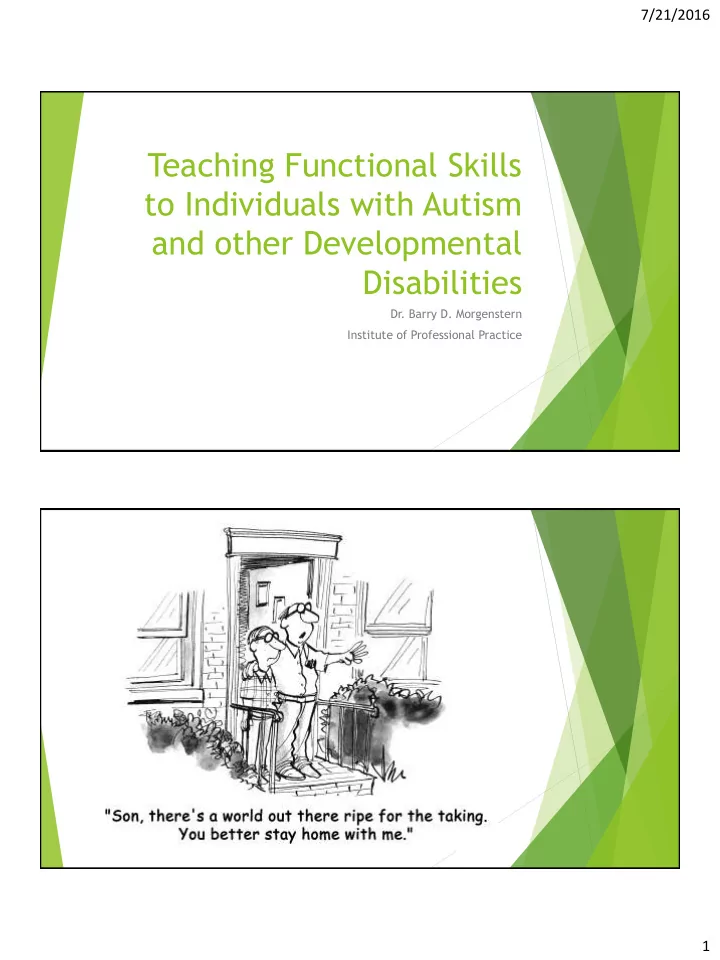
Disabilities Dr. Barry D. Morgenstern Institute of Professional - - PDF document
7/21/2016 Teaching Functional Skills to Individuals with Autism and other Developmental Disabilities Dr. Barry D. Morgenstern Institute of Professional Practice 1 7/21/2016 A smart person learns from his own mistakes, but a wise person
7/21/2016 1
Institute of Professional Practice
7/21/2016 2
7/21/2016 3
7/21/2016 4
Why Focus on Functional Skills?
7/21/2016 5
What do adults have to help the child do that they would not have to help a typically developing child of the same age do? What do adults have to avoid doing with the child that they would not have to avoid doing with a typically developing child of the same age?
7/21/2016 6
Activities of Daily Living (ADLs) There is a high rate of failure to teach functional skills to children with autism
7/21/2016 7
Evidence for the High Rate of Failure
Green, Gilchrist, Burton, and Cox (2000) found: 50% of the children with Asperger’s Syndrome were not independent in basic self care like tooth brushing
Schools are focused on academics and there is often little time scheduled for other skills.
7/21/2016 8
There are often fundamental misunderstandings about what it takes to be successful
7/21/2016 9
Can the person learn from rules?
If the child can learn from rules classroom based instruction can be very useful
7/21/2016 10
The Basic Teaching Procedures
Basics of Teaching Functional Skills
(1) Prompting- Help the person engage in the behavior (2) Fading- Systematically remove the prompts over time (3) Reinforcement- Provide reinforcement contingent on improvements (4) Chaining- Combine the specific behaviors into useful functional skills (5) Schedules- In some situations, schedules can greatly facilitate the
development of functional skills
(6) Rules- In some situations, learning basic rules will greatly facilitate the
development of functional skills
7/21/2016 11
Prompting
Verbal Prompts
7/21/2016 12
Gestural Prompts Modeling Prompts
7/21/2016 13
Video Models Physical Prompts
7/21/2016 14
Should you work on imitation first?
If the child doesn’t have imitation skills many things will be very difficult to
prompts to be successful. If the child could simply imitate the action the task could be learned at a much faster rate.
In some cases, imitation can be acquired quickly. In these cases it is usually helpful to work on this skill before many commonly taught functional skills.
If it appears that imitation will take a long time to develop, it is probably worth starting to teach functional skills while imitation skills are developed.
Picture Prompts
7/21/2016 15
Picture-Object Matching is a Critical Skill for Using Pictures as Prompts
7/21/2016 16
Fading
7/21/2016 17
7/21/2016 18
Which Type of Fading Strategy to Use?
Research does not clearly suggest which fading strategy is best under all
Most-to-Least Prompting
This prompting procedure is most likely to prevent errors during instruction. Therefore it is often recommended for learners who engage in problem behavior contingent on making errors.
7/21/2016 19
Least-to-Most Procedures
This procedures minimizes the need for physical prompts. Therefore it can be very helpful for learners who are resistant to physical prompts.
This procedure gives the learner more of an opportunity to try things first. So it is helpful for skills that require thinking or creative behavior (e.g., problem solving, social situations).
Graduated Guidance
This procedure is often helpful for learners without strong imitation skills where physically molding the movement is likely to be needed.
7/21/2016 20
Time Delay
This procedure is often very helpful when the end result of the task is highly
reinforcer.
7/21/2016 21
Flexible Prompt Fading
Several studies have shown that combinations of different prompt fading methods and allowing the instructor to use judgement when fading prompts can be highly effective. One example of these combinations is flexible prompt fading. Soluaga, Leaf, Taubman, McEachin, and Leaf (2008) – A Comparison of flexible prompt fading and time delay for 5 children with autism. Research in Autism Spectrum Disorders, 2, 753-765. Described in more detail in: A Work in Progress EDS: Ron Leaf and John McEachin
Reinforcement
7/21/2016 22
Poor Reinforcement- Most Common Reason for Failure
7/21/2016 23
Most behaviors are not performed in isolation
Very rarely is a behavior performed in isolation. Most functional skills are performed in a sequence or a “behavior chain.”
What is a behavior chain?
Adapted from Cooper, Heron, and Heward (2007) A behavior chain involves performing a series of discrete responses that must be performed in a specific order. Each behavior in the chain serves as the cue for the next response and the reinforcer for the previous response. The first response in the chain and the last response in the chain only serve one purpose.
7/21/2016 24
How do you teach a behavior chain?
Break the skill down into a series of teachable steps called a task analysis.
Behavior Chain Vs. Task Analysis- What’s the difference?
Behavior Chain- Is a technical term that implies that each step is a discriminative stimulus for the next step and a conditioned reinforcer for the previous step.
Task Analysis- A complex skill is broken down into a series of teachable steps.
7/21/2016 25
Example of a Task Analysis
Tie Shoes
(1) Pick up both laces between thumb and pointer fingers (2) Cross both laces and make and X (3) Make a loop (4) Pull other lace around the loop (5) Push through with pointer finger (6) Grasp both loops between thumb and pointer fingers (7) Pull through
Different Chaining Procedures
Forward Chaining- The learner only receives instructions at the start of the task analysis. As each part is mastered, more steps are added.
Backward Chaining- Initially the learner only receives instructions in the last step in the task analysis. When that is mastered more steps are added from the back of the behavior chain.
Total Task Training- The learner receives instruction on every step of the task analysis every session.
7/21/2016 26
Research on chaining does not show any procedure to be consistently more effective in all situations.
Deciding on a Chaining Procedure
Although research doesn’t clearly show one chaining procedure to be more effective than others, there are some logical reasons to choose one or another under different circumstances.
7/21/2016 27
Total Task Chaining
Probably best for relatively simple tasks
Can already perform the tasks in the chain, but needs to learn the order
Has a strong imitative repertoire
Forward Chaining
For long and complex tasks
For learners with more severe disabilities
7/21/2016 28
Backward Chaining
For long and complex tasks
For learners with more severe disabilities
If the end of the task is highly reinforcing to the learner
7/21/2016 29
What could possibly go wrong?
(1)
You prompt the learner to engage in a response
(2)
Over successive trials the natural stimuli start to acquire control over the response
(3)
The control is transferred from the prompt to the natural stimuli.
(4)
You put all the behaviors that you taught together into a behavior chain.
(5)
Provide reinforcement for success Sure it might be time consuming and require patience. But it is so simple. What could possibly go wrong?
7/21/2016 30
Shaping Game
(1)
There is only 1 person teaching and 1 person learning.
(2)
The learner goes out of the room, while the rest of the group decides on the
(3)
No one is allowed to talk during the session.
(4)
The teacher can teach only by providing reinforcement (clapping) as the learner makes closer approximations to the target.
(5)
Everyone in the room claps when the learner is successful.
Shaping Game Lessons
Although it is done rarely, shaping can work in the absence of any prompting, fading, chaining, error correction, or punishment procedures. Usually other procedures are added, but it is not always essential.
The differential reinforcement of successive approximations is what produces improvement.
7/21/2016 31
Key Point!
It is very common for prompting, fading, and reinforcement to be unsuccessful in practice. To use shaping the teacher must reinforce successive approximations towards the terminal behavior. This is the key to improvement.
What if the task changes?
7/21/2016 32
Consider Using Activity Schedules
Involves giving the child supplemental stimuli in pictures, words, or on an electronic device like an IPAD
It has the limitation that the child can become dependent on the supplemental stimuli? But don’t you use a calendar?
Can be extremely helpful when: the tasks are long and complicated if the order the tasks change if different tasks need to be performed at different times if the tasks change frequently
Specific Skills at Different Ages
7/21/2016 33
Common Skills for Young Children Toilet Training
7/21/2016 34
Nothing frustrates parents more than toilet training
The secret reason that toilet training is so difficult for so many families and teachers:
7/21/2016 35
They don’t follow the instructions! Why don’t people read the instructions carefully?
7/21/2016 36
Toilet Training Instructions
A lot of research has gone into toilet training. The procedures are very effective if used properly. The problem is that people tend to underestimate the difficulty of the task. Many of the manuals have hundreds of pages of instructions on how to do it. It is about as interesting as it sounds!
Realize that toilet training will be a project. It can often be done very quickly- even as short as a couple of days- but you will NOT have a normal life during that time.
7/21/2016 37
How do you pick up your pants?
Behavior analysts often fail to give parents adequate warning as to the difficulties they will face during toilet training.
7/21/2016 38
Individual Needs
The same toilet training procedure is not appropriate for all individuals.
Individuals who are severely disabled or older will likely need more intense
procedures.
Some individuals who have a lot of problem behavior around toileting will need that problem treated first.
Sometimes for young children it is appropriate to partially train.
Boys- Sit or Stand?
7/21/2016 39
Common mistake: Not mastering wiping at a young age Using Public Restrooms
7/21/2016 40
Suggested Book- Toilet Training Success What to do when accidents happen?
7/21/2016 41
Ritualistic Problems with Bowel Training Trip Training vs. Intensive Toilet Training
Trip Training- Teach the child to use the toilet independently when the adult reminds the child to go to the toilet
Intensive Toilet Training- Teach the complete toileting routine including self- initiating for the toilet
7/21/2016 42
Trip Training
Advantages
Does not require disruption of the child’s regular schedule
Much easier for parents and teachers to implement
Typically developing children often do not self-initiate initially
Disadvantages
Child does not learn to self-initiate and will have to learn that at another time
Typically takes much longer than intensive training
Intensive Training
Advantages
Often much faster than trip training
Child learns to self initiate as part
It is likely that some people with severe impairments may not be able to learn with other methods
Disadvantages
It is usually necessary to temporarily discontinue other programming during the training
It can be very stressful / emotional for parents and teacher
Requires staff / parents to dedicate a lot of time to sitting in the bathroom. Sometimes several days up to 10-days.
7/21/2016 43
Feeding is a critical skill area Problems with Eating Very Limited Foods
7/21/2016 44
Health Implications Independent Feeding is Critical for Independence
7/21/2016 45
Feeding Problems Limit Social Opportunities Common Mistake- Chasing the Child to Eat
7/21/2016 46
Common Mistake- Making special meals after refusal
Common Mistake: Not getting assistance from a qualified BCBA
7/21/2016 47
Dressing Dressing Can Be Surprisingly Difficult
Dressing involves difficult discrimination (front / back) (inside out) Dressing involves difficult fine motor skills (buttons, zippers) Dressing commonly involves sensitivity to different materials
7/21/2016 48
Common Skills for the Middle Years Problems with teaching Cooking
7/21/2016 49
Is the food safe to eat? Will the person eat what was cooked?
7/21/2016 50
Teaching Kids to Tie Shoes
There is a lot of superstitious behaviors around teaching kids to tie shoes
Don’t teach bunny ears! It is easier, but leads to problems of having to untie
the knots it creates
Mastery can be difficult to define – shoot for both speed and quality
Teaching Tooth brushing
It is very hard to measure the quality of tooth brushing. One easy way to dramatically help with this problem is to use an electric tooth brush.
7/21/2016 51
Teaching Older Children and Adults How much independence should you give the person?
7/21/2016 52
Stranger Danger What happens to skills that aren’t practiced frequently?
7/21/2016 53
Avoiding Stranger Danger Involves Very Subtle Social Skills Shopping
7/21/2016 54
The Importance of Teaching Pre- Requisite Skills Street Crossing
7/21/2016 55
Problems with defining mastery But does anyone walk where you live?
7/21/2016 56
Using Public Transportation How do you check if they are doing everything correctly?
7/21/2016 57
A lot of things can happen Employment Sites
7/21/2016 58
Encourage Variety What is good enough?
7/21/2016 59
Setting the Criteria
For any behavior change it is possible to set expectations too low and not get the benefits that you should get. But it also always possible to set the expectations too high which will also lead to negative effects. It is critical that team members discuss what is good enough and plan accordingly.
Thanks to Dr. Alan Barnard for this tip.
The Importance of the Details
7/21/2016 60
If this skill is mastered why doesn’t he do it at home? General Case Programming
7/21/2016 61
How to Select the Examples
Specifying the set of stimulus situations the skill will be used after training
Defining the range of relevant stimulus variation across these situations
Defining the range of response variation across this set of stimulus situations
Selecting and sequencing teaching examples that sample the range of stimulus variation and response demands
Research Based Example- Vending Machines- Sprague and Horner 1984
7/21/2016 62
Research Based Example- Bus Tables- Horner et. al (1986)
Teach Self-Management
7/21/2016 63
Self-Management starts with Self-Awareness
Fading Adult Supervision
7/21/2016 64
What happens when no one is looking? Use Natural Contingencies
7/21/2016 65
How to Create a Natural Contingency? Flexibility and Routines
7/21/2016 66
Is it working? If not, why not?
7/21/2016 67
Before you do anything the 3 most common problems- The Yes, BUT check
When you are first starting an intervention, a few minutes of planning can make a huge difference. Thanks to Dr. Alan Barnard for this tip.
Yes, it is a good idea BUT the plan is not sufficient to meet the objective.
7/21/2016 68
Examples of Insufficient to Meet the Objective
Not teaching prerequisite skills
Not having enough examples
Not providing sufficient training to staff or parents
Not having an effective form of reinforcement
Not having an effective way to prompt and fade
Yes, it is a good idea BUT the plan will cause other negatives to happen.
7/21/2016 69
Examples of Plans Causing Other Negatives
You teach the person to shop independently and they go to the store and buy nothing but candy and soda
You teach the person to handle stranger danger and now they are afraid of new staff people
You teach the person to do tasks independently and now they refuse even on tasks where they need assistance which leads to serious problem behaviors
Yes, it is a good idea but there are obstacles that will prevent us from implementing.
7/21/2016 70
Examples of Not Overcoming Obstacles before starting a plan
Are the materials prepared?
Did the staff get the necessary training?
Do you have a place to practice?
Troubleshooting- What to do when things go wrong. Ask the 5 Questions…
7/21/2016 71
Question 1-Does the person understand the expectations? Question 2- Is the motivation system working?
7/21/2016 72
Question 3- Is the effort or risk too big? Question 4- Are the contingencies upside down?
7/21/2016 73
Question 5- Is the error correction procedure effective? Summary
Functional Skills are critical and often overlooked part of effective programming
It is important to learn the basics of how to teach based on the principles of applied behavior analysis
Even if you know the basic principles, learning the “tricks” for individual skill areas is very helpful
Use General Case Programming
Try to get the behavior under the control of a natural contingency
Ask the 3 yes, but questions before starting your intervention
If things are not going well, use the 5 troubleshooting questions
7/21/2016 74
Thanks! Feel free to email me with questions or comments.
barrymorgenstern@gmail.com