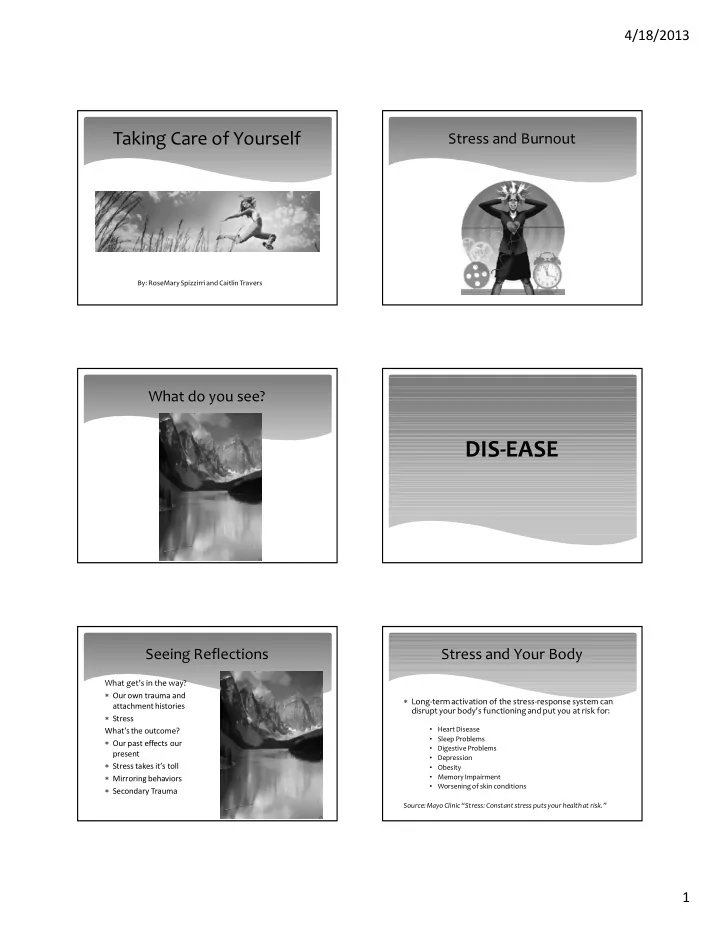
DIS-EASE Our own trauma and Longterm activation of the - - PDF document

dis ease
SMART_READER_LITE
LIVE PREVIEW

DIS-EASE Our own trauma and Longterm activation of the - - PDF document

4/18/2013 Whats the outcome? disrupt your bodys functioning and put you at risk for: Stress and Your Body Stress and Burnout Seeing Reflections 1 present attachment histories What gets in the way? What do you see? By:


slide-1
SLIDE 1

4/18/2013 1

Taking Care of Yourself

By: RoseMarySpizzirri and Caitlin Travers

What do you see?

What get’s in the way? Our own trauma and attachment histories Stress What’s the outcome? Our past effects our present Stress takes it’s toll Mirroring behaviors Secondary Trauma

Seeing Reflections Stress and Burnout

DIS-EASE

Stress and Your Body

Long­term activation of the stress­response system can disrupt your body’s functioning and put you at risk for:

  • Heart Disease
  • Sleep Problems
  • Digestive Problems
  • Depression
  • Obesity
  • Memory Impairment
  • Worsening of skin conditions

Source: Mayo Clinic “Stress: Constant stress puts your health at risk.”

slide-2
SLIDE 2

4/18/2013 2

What can you do?

Practice Self­Care!

Why Self­Care?

SUPPORT is a key of SPACE… and can also be the most difficult to do!

“Self­care is more than bubble baths and good books.”

http://www.christieinge.com/

  • 1. Physical
  • 2. Emotional
  • 3. Spiritual
  • 4. Intellectual
  • 5. Social
  • 6. Relational
  • 7. Safety and Security

Types of Self­Care

Source: “Balanced Living Through Self­Care” by Carol Williams­Nickelson, PsyD

Physical Self­Care

Taking care of your Body!

Exercise – get active! Nutrition – eat well! See a doctor

Breathing

Emotional Self­Care

Nurtrition Take care of your Feelings

Identify Accept Express

slide-3
SLIDE 3

4/18/2013 3 Spiritual Self­Care

Exploring and expressing your beliefs and values What feels right for YOU

Religion Spirituality Nature

Intellectual Self­Care

Critical Thinking Interest in Ideas Creativity

Social Self­Care

Nurturing relationships

  • utside of your

immediate family

Relational Self­Care

Strengthening relationships with significant

  • thers, kids,

parents, and family

Safety & Security Self­Care

Being proactive to ensure personal safety

Stretching Progressive Muscle Relaxation Mindfulness Types of Meditation

Let’s practice relaxation!

slide-4
SLIDE 4

4/18/2013 4

Practice physical activity with them! Progressive Muscle Relaxation Brain Gym activities

Teaching self care to your kids….

Self­Care Plans

What can you commit to doing for YOU?

Q & A

Blogs Christine Inge: http://www.christieinge.com/ Christine Moers: http://www.welcometomybrain.net/ Lindsay Crapo: http://homeasoftplacetofall.blogspot.com/ Videos: TED Talk on Mindfulness: http://www.ted.com/talks/andy_puddicombe_all_it_takes_is_10_mindfu l_minutes.html IGetRealTV: http://www.youtube.com/user/igetrealtv?feature=watch Relaxation Exercise: https://www.youtube.com/watch?v=aaTDNYjk­Gw

Resources for Home

Carol Williams­Nickelson, P. (2006). Balanced Living Through Self Care. In J. Worell, & C. D. Goodheart, Handbook of Girls' and Women's Psychological Health (pp. 183­191). New York, NY: Oxford University Press. http://www.youtube.com/watch?v=Xx5Z2l2o514

References

slide-5
SLIDE 5