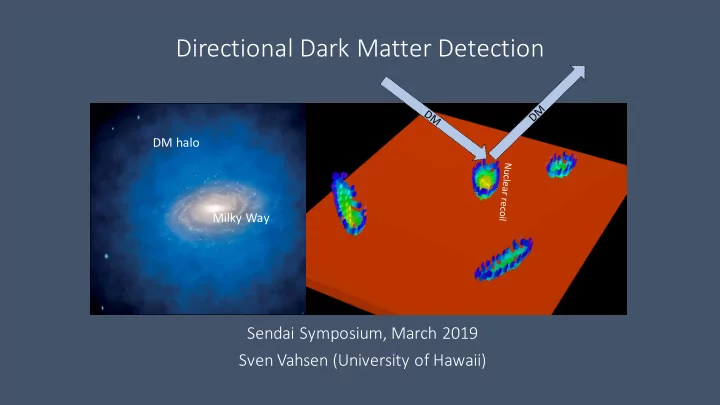
Directional Dark Matter Detection DM halo Milky Way Sendai - - PowerPoint PPT Presentation

directional dark matter detection
SMART_READER_LITE
LIVE PREVIEW

Directional Dark Matter Detection DM halo Milky Way Sendai - - PowerPoint PPT Presentation

Directional Dark Matter Detection DM halo Milky Way Sendai Symposium, March 2019 Sven Vahsen (University of Hawaii) Outline Challenges in direct detection of DM Motivation for directional detectors Technological approaches

slide-1
SLIDE 1

Directional Dark Matter Detection

DM halo Milky Way

Sendai Symposium, March 2019 Sven Vahsen (University of Hawaii)

slide-2
SLIDE 2

Outline

  • Challenges in direct detection of DM
  • Motivation for directional detectors
  • Technological approaches
  • CYGNUS

Jan 8th, 2019 Sendai Symposium 2

slide-3
SLIDE 3

Do we live in a WIMP halo?

  • Dark Matter exists
  • Overwhelming evidence at

distance scales from Milky Way to visible universe

  • All gravitational
  • WIMPs are one hypothesis
  • Direct Detection seeks to answer
  • Does the local Milky Way DM halo

contain WIMP-like particles?

  • What are their properties?
  • What is their local density and

velocity distribution ?

Jan 8th, 2019 Sendai Symposium

WIMP halo? Milky Way

3

slide-4
SLIDE 4

Challenges

  • Huge detectors
  • Stringent requirements on
  • Shielding
  • Radiopurity
  • Background rejection

Jan 8th, 2019 Sendai Symposium

LUX detector 368 kg LXe Water shield

4

slide-5
SLIDE 5

SI, elastic, WIMP/nucleon Scattering: Experimental Status

  • Best limits now

< 0.1 zB

  • Noble liquid

experiments most sensitive at m~50 GeV/c2

  • Solid targets leading

around m~5 GeV/c2

  • Controversial signals

suggesting m~10 GeV

Jan 8th, 2019 Sendai Symposium

  • C. O’hare

5

slide-6
SLIDE 6

SD, elastic, WIMP/nucleon Scattering: Experimental Status

  • Bubble chambers with

fluorine targets are taking the lead

  • Excellent gamma

rejection at low energies

Jan 8th, 2019 Sendai Symposium

Clark @ UCLA DM ‘18

6

slide-7
SLIDE 7

Recent Limits: Low mass

  • Ionization-only analyses

from noble liquid experiments

  • Dedicated, often,

ionization-based experiments, including gas targets

  • Often
  • lack of particle ID at

lowest (keV) energies

  • Uncertainty about low-

energy sensitivity

Jan 8th, 2019 Sendai Symposium

arxiv: 1802.06994 Darkside-50 ionization (S2) only analysis Analysis threshold: 0.6 keVnr

7

slide-8
SLIDE 8

Summary of Status and Challenges

  • G2 experiments will probe cross-sections within factor 10-100 of the

neutrino floor for m > 1 GeV/c2

  • Challenges to further progress in this mass range
  • Irreducible neutrino background
  • Lack of particle ID in ionization-only experiments for E ~< 10 keV
  • Lingering controversial signals from DAMA / lack of clear discovery signal
  • Calibrations at lowest recoil energies
  • Ever stricter requirements on radio purity and background rejection

Jan 8th, 2019 Sendai Symposium 8

slide-9
SLIDE 9

Motivation for Directional Detectors

Jan 8th, 2019 Sendai Symposium 9

slide-10
SLIDE 10

Non-directional WIMP search

  • Observable: excess count rate over

predicted BG in signal region

  • Requires ultra-clean detectors &

precise understanding of remaining backgrounds

  • Single-scattering neutrons produce

identical events to WIMPs

Jan 8th, 2019 Sendai Symposium

Xenon100

10

slide-11
SLIDE 11

The WIMP Wind

  • ~220 km / s
  • blows from CYGNUS
  • provides two additional WIMP signatures…

Jan 8th, 2019 Sendai Symposium 11

slide-12
SLIDE 12

Annual Rate Modulation

  • due to motion of earth around sun
  • %-level effect
  • requires thousands of signal events, and %-level control of BGs and gain

Jan 8th, 2019 Sendai Symposium 12

slide-13
SLIDE 13

Diurnal (Daily) Directional Oscillation

Jan 8th, 2019 Sendai Symposium

  • scillation of the mean recoil direction, due to rotation of earth
  • rder 1 effect
  • scillation period = sidereal day ≠ solar day
  • no known background with this signature

WIMP wind ~42o

13

slide-14
SLIDE 14

The Galactic Dipole

  • The diurnal directional
  • scillation is equivalent to a

dipole in galactic coordinates

  • Recoils Point away from

constellation CYGNUS

  • Need ~10 3D vector events to

reject isotropy.

Jan 8th, 2019 Sendai Symposium

Physics Reports 627 (2016)

CYGNUS

Galactic dipole: - strongest predicted direct detection signature

  • can unambiguously demonstrate cosmological origin of signal

14

slide-15
SLIDE 15

Penetrating the neutrino floor

  • Directionality significantly enhances

the DM sensitivity below neutrino floor

  • 3D again “best”
  • But note:
  • True Figure of Merit:

sensitivity / unit cost

  • A realistic detector has strongly

energy-dependent directionality. This was not considered in past studies.

Jan 8th, 2019 Sendai Symposium

Readout strategies for directional dark matter detection beyond the neutrino background Ciaran A. J. O'Hare, Anne M. Green, Julien Billard, Enectali Figueroa-Feliciano, Louis E. Strigari

Ciaran A. J. O'Hare

15

slide-16
SLIDE 16

Technological Approaches

Jan 8th, 2019 Sendai Symposium 16

slide-17
SLIDE 17

Achieving Directionality

  • Detectors that reconstruct the

recoil trajectory

  • Gas-based TPCs
  • Nuclear Emulsions
  • Crystal defect spectroscopy
  • DNA strand detector
  • Planar targets (graphene)
  • Detectors that indirectly determine

the recoil direction

  • Anisotropic scintillators
  • Columnar recombination
  • Carbon nanotubes
  • Event-by-event recoil tracking in

condensed matter is hard, but not impossible

Jan 8th, 2019 Sendai Symposium

Physics Reports 662 (2016) See next two talks

17

slide-18
SLIDE 18

Prototypes and Experiments

Name Technology Directionality Status NEWAGE Gas TPC, strip readout 3d Running underground DRIFT Gas TPC, NID, wire readout 1.5d Running underground MIMAC Gas TPC, strip readout 3d Ran underground, scaling up DMTPC Gas TPC, optical readout 2d Ran underground, scaled up, stopped D3 / Hawaii readout R&D Gas TPC, pixel readout 3d Prototypes evaluated, ran above- ground New Mexico readout R&D Gas TPC, NID, optical readout 2d Prototypes evaluated LEMON, ORANGE, INITIUM, CYGNO Gas TPCs, CMOS + PMT

  • ptical readout

3d Prototypes evaluated, funded to scale up NEWSdm Nuclear Emulsions 2d Prototyping / going underground PTOLEMY Graphene 2d Prototyping / going underground

Jan 8th, 2019 Sendai Symposium

All directional that have set limits use <=1m3 gas TPCs NEWAGE: best limit using directionality DRIFT: best limit with a directional detector (list is probably not comprehensive!)

18

slide-19
SLIDE 19

CYGNUS

slide-20
SLIDE 20

The CYGNUS Proto-Collaboration

  • Recently, many of the groups

working on directional dark matter detection formed CYNUS

  • 45 signed members from the US,

UK, Japan, Italy, Spain, China, Australia

  • Steering group:
  • Neil Spooner (Sheffield, UK)
  • Sven Vahsen (Hawaii, USA)
  • Kentaro Miuchi (Kobe, Japan)
  • Elisabetta Baracchini (GSSI/INFN, Italy)
  • Elisabetta Barberio (Melbourne,

Australia)

Jan 8th, 2019 Sendai Symposium

The dark matter wind is expected to come from the constellation Cygnus.

20

slide-21
SLIDE 21

The main idea

  • Direct DM detection w/ Gas

based TPCs

  • Measure spatial ionization

distribution resulting from nuclear recoils

  • Advantages:
  • Axial Directionality
  • Head/tail
  • Background rejection
  • Particle ID
  • 3D fiducialization
  • Technologically challenging,

but now achievable via multiple technologies

Jan 8th, 2019 Sendai Symposium

20 keVee electron 20 keVee He-recoil 10 x longer than recoil! Initial ionization distribution charge cloud after 25 cm drift in gas TPC DM 𝛅

21

slide-22
SLIDE 22

CYGNUS vision and long-term goal

> 1000 m3 directional nuclear recoil detector capable of

  • Setting competitive DM limits
  • Observing galactic dipole

ó diurnal oscillation in lab

  • Detecting solar neutrinos
  • Efficiently penetrating the

ν floor

  • Measuring DM particle

properties and physics

  • Measuring Geoneutrinos
  • WIMP astronomy

Jan 8th, 2019 Sendai Symposium

CYGNUS

A review of the discovery reach of directional Dark Matter detection Physics Reports 627 (2016)

Galactic dipole: - strongest predicted direct detection signature

  • unambiguous proof of cosmological origin

exposure

22

slide-23
SLIDE 23

CYGNUS: Experimental Approach

  • Gas Time Projection Chamber
  • Gas mixture: SF6:4He, p~1 atm
  • Possibility of switching between higher

density (search mode) gas and lower density gas mixtures for (improved) directional confirmation of WIMP signal

  • Reduced diffusion via negative Ion

drift (SF6 gas)

  • Redundant 3D fiducialization
  • SF6 minority carriers
  • charge cloud profile
  • Helium target
  • Improved sensitivity to low mass WIMP
  • Longer recoil tracks, extending directionality

to lower energies

  • Multiple readout plane options have been

successfully demonstrated

Jan 8th, 2019 Sendai Symposium

WIMP

E E

recoil (track) ionization SF6:4He gas gas vessel neutron + gamma shielding central cathode

23

slide-24
SLIDE 24

3D Fiducialization I: Minority Carriers

Jan 8th, 2019 Sendai Symposium

CS2-CF4-O2 All BG removed!

Discovery of Multiple, Ionization-Created Anions in Gas Mixtures Containing CS2 and O2 Daniel P . Snowden-Ifft http://arxiv.org/abs/1308.0354

  • Game changer for directional WIMP search via gas TPC
  • Utilizes timing - works with any charge readout (1D,2D,3D)
  • First discovered in CS2
  • Now also demonstrated in pure SF6 & CF4 + SF6 mixtures
  • Incredibly lucky: SF6 is also non-toxic, non-flammable, not corrosive,

has gain, thermal diffusion, and is a good SD target (!)

24

slide-25
SLIDE 25

3D Fiducialization II: Charge Cloud Reconstruction

  • Measuring charge-profile

(not width) of track, enables accurate measurement of transverse diffusion, which depends on drift length à obtain absolute position in drift direction

P.Lewis (U. Hawaii)

  • Requires high resolution readout of charge density à only 2D, 3D
  • However, should work with any gas
  • Published version utilized “chopped” alphas, but has since been

extended by grad student to also work with recoil events (unpublished)

Jan 8th, 2019 Sendai Symposium 25

slide-26
SLIDE 26

2D electron rejection (experiment)

  • On right: 2D optical readout in 100 torr CF4
  • F versus electron recoils
  • 𝜏 = 0.35 mm readout resolution, incl. diffusion
  • Using range-energy signature, electron event rejection factor < 3.9 x

10-5 around 10 keVee

  • It’s a limit – all available electron events rejected!
  • Extrapolating to CYGNUS
  • 20 torr SF6 + 740 torr Helium: 50% longer tracks
  • 50 cm of thermal drift (𝜏 = 0.55 mm): 50% higher

àexpected same discrimination in CYGNUS

  • Should improve with 3D charge cloud tomography, i.e., going

beyond range-energy signature.

  • Follow-up experimental work with 3D readout needed.
  • Both directionality and BG rejection are strongly gas density
  • dependent. Can operate in search mode (higher density) and

confirmation mode (lower density)

Jan 8th, 2019 Sendai Symposium GEM-based TPC with CCD imaging for directional dark matter detection N.S. Phan, et. al., Astroparticle Physics, 84 (2016) 26

slide-27
SLIDE 27 1 2 3 4 5 z [cm] 2 4 6 8 10 12 14 16 ]
  • charge [e

6 − 4 − 2 − 2 4 6 x [cm] 1 2 3 4 5 z [cm] 2 4 6 8 10 12 14 ]

  • charge [e

Six types of TPC charge readouts

Jan 8th, 2019 Sendai Symposium

Worse performance Lower cost Better performance Higher cost Best compromise? Simulation study to find out

6 − 4 − 2 − 2 4 6 x [cm] 6 − 4 − 2 − 2 4 6 y [cm] 1 2 3 4 5 z [cm] 6 − 4 − 2 − 2 4 6 x [cm] 6 − 4 − 2 − 2 4 6 y [cm] 1 2 3 4 5 z [cm]

6 − 4 − 2 − 2 4 6 x [cm] 6 − 4 − 2 − 2 4 6 y [cm]

3 − 2 − 1 − 1 2 3 x [cm] 6 − 5 − 4 − 3 − 2 − 1 − 0 1 y [cm] 1 2 3 4 5 z [cm] 3 − 2 − 1 − 1 2 3 x [cm] 6 − 5 − 4 − 3 − 2 − 1 − 0 1 y [cm] 1 2 3 4 5 z [cm] 3 − 2 − 1 − 1 2 3 x [cm] 6 − 5 − 4 − 3 − 2 − 1 − 0 1 y [cm] 1 2 3 4 5 z [cm] 3 − 2 − 1 − 1 2 3 x [cm] 6 − 5 − 4 − 3 − 2 − 1 − 0 1 y [cm] 1 2 3 4 5 z [cm]

1D GEM 1.5 D: wires 3D pads 2D optical 3D strips 3D pixels 20 keV electron after 25 cm of drift

27

slide-28
SLIDE 28

Input Parameters: Diffusion, gain, etc

Jan 8th, 2019 Sendai Symposium 28

slide-29
SLIDE 29

Input Parameters: Readouts

Jan 8th, 2019 Sendai Symposium 29

slide-30
SLIDE 30

Results: Detection efficiency

Jan 8th, 2019 Sendai Symposium

Ok, but NID gain on low side CCD and planar suffers from this

30

F He

slide-31
SLIDE 31

Results: Axial Vector Angular resolution

Jan 8th, 2019 Sendai Symposium

F He

  • Lower is better
  • Detector is pressure/diffusion limited
  • F: bad
  • He: better
  • Pixels close to optimal
  • Strips not bad

31

slide-32
SLIDE 32

Results: Head/tail recognition efficiency

Jan 8th, 2019 Sendai Symposium

  • Higher is better
  • Detector is diffusion/pressure limited
  • especially for F
  • He: better
  • nly pixels, strip, and CCD do OK

F He

32

slide-33
SLIDE 33

Results: 3D Electron Rejection Factors

Jan 8th, 2019 Sendai Symposium

  • Nice!
  • Gets somewhat worse after

diffusion

  • Algorithm can be improved

F He

33

slide-34
SLIDE 34

Final Result: Sensitivity per Unit Cost

Jan 8th, 2019 Sendai Symposium

Conclusion/recommendation: build a 1000 m3 detector with strip readout for $35M

34

slide-35
SLIDE 35

10-1 100 101 102 103 104 10-47 10-46 10-45 10-44 10-43 10-42 10-41 10-40 10-39 10-38 10-37 10-36 10-35 10-34

CYGNUS SD Sensitivity

  • Assumptions
  • 3 years of running time
  • 3 keVr F threshold
  • 1 keVr He threshold
  • Directional mode:

20 torr SF6 740 torr 4-He

  • Search mode:

200 torr SF6 740 torr 4-He

  • Should see solar 𝜉 events
  • Discoveries can be

investigated in directional mode

Jan 8th, 2019 Sendai Symposium

preliminary

Ciaran O’Hare CYGNUS 1000: 10m x 10m x 10m CYGNUS 100k: ~2 x DUNE target volume

35

slide-36
SLIDE 36

10-1 100 101 102 103 104 10-51 10-50 10-49 10-48 10-47 10-46 10-45 10-44 10-43 10-42 10-41 10-40 10-39 10-38 10-37 10-36

CYGNUS SI Sensitivity

Jan 8th, 2019 Sendai Symposium

preliminary

Ciaran O’Hare

  • Assumptions
  • 3 years of running time
  • 3 keVr F threshold
  • 1 keVr He threshold
  • Directional mode:

20 torr SF6 740 torr 4-He

  • Search mode:

200 torr SF6 740 torr 4-He

  • Should see solar 𝜉 events
  • Discoveries can be

investigated in directional mode

36

slide-37
SLIDE 37

Sendai Symposium 37

slide-38
SLIDE 38

Summary

  • Many novel ideas for achieving directionality have been proposed and studied
  • Much of the worldwide directional detection community merged into CYGNUS
  • Work on strawman design of CYGNUS 1000 gas-TPC detector nearly complete
  • Competitive SI and SD sensitivity. Extends to low WIMP masses thanks to He
  • CYGNUS 1000 would be the first step towards a large-scale, distributed recoil
  • bservatory, capable of
  • unambiguously demonstrating the cosmological origin of a putative WIMP signal
  • effectively penetrating the neutrino floor
  • eventually, WIMP astronomy
  • Please join: Directional Detection Workshop in Roma (Italy) at Sapienza
  • n June 24-25-26th 2019.

Jan 8th, 2019 Sendai Symposium 38