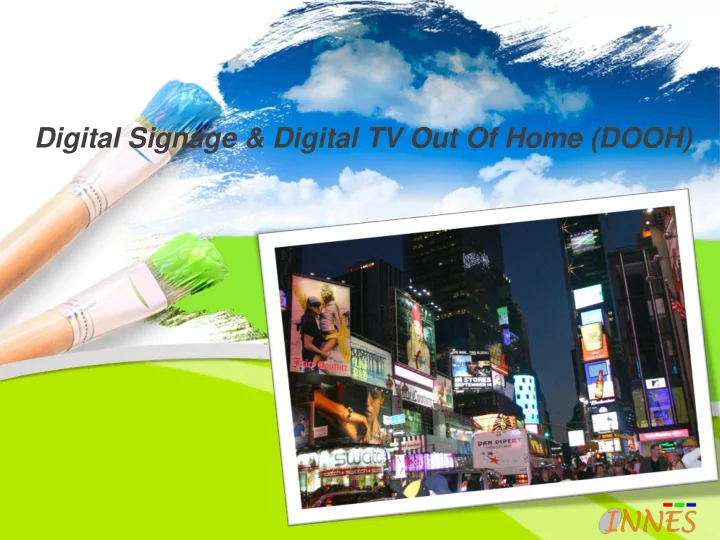
Digital Signage & Digital TV Out Of Home (DOOH) 1.Digital - - PowerPoint PPT Presentation
Digital Signage & Digital TV Out Of Home (DOOH) 1.Digital Signage : Market and use case 2.About Innes 3.Technologies and Standards Market access Broadcast 3 large segments Institutional Mass Market 3 main sectors : Point of wait,
1.Digital Signage : Market and use case 2.About Innes 3.Technologies and Standards
Market access
4
Broadcast Institutional Mass Market
3 main sectors :
- Point of wait,
- Point of sale,
- Point of transit,
3 large segments
5
Point of Wait: Corporate, Education, Hospitality, Healthcare, Banking
The primary contact for point-of-wait projects is
- ften the system integrator or value-added
resellers that bring together the different skills to meet the needs of the customer.
6
Point of Sale : BRANDING TV, ADS
External communication projects where the goal is a recognized ROI are generally controlled by advertising agencies or screen network operators.
7
POINT OF TRANSIT: TRANSPORT, INFORMATION FOR TRAVELLER
The “transportation” projects are often supported by the system integrator in connection with the public service delegator transport operator. The main difficulties of the sector is the need to conform to many standards (EN50155, …). Unlike the previously described sectors, the equipment onboard, such as media players or display must endure a high temperature range (for instance -25°C/+70°C) and to be anti- vibration.
About Innes
- Main player in the digital signage in France
- 75 % point of wait (corporate, museography)
- 20 % point of sale
- 5 % point of transit
- Creation of the company in 2005
- Strong R&D (multimedia, linux/windows, TI omap, Intel Atom, …)
- AV Hardware manufacturer and Software author
- Sales activity begins in 2013 Europe
Innes : Manufacturer of Richmedia players and encoders
10
Mono – user
Player (Playzilla) Composer + Scheduler (Screen Composer)
Solution 1 : Peer to peer usage
Solution 2 : Server use (many people use the system)
Linux X86
X11/ Wayland / Android
Intel 9xx Intel Poulsbo Nvidia
Linux ARM/Cortex A8
X11/ Wayland / Android
Davinci ARM9 + DSP C64 OMAP CortexA8 + DSP …
Kronos API (OpenGL, Open VG, OpenMAX, …) Direct X
X86 Windows Rich Media Engine AV Framework + Web Framework (Gecko, Webkit, …) User Application
SMIL+, JavaScript , CSS3, HTML5, XPATH, XSPF, XMP, iCal, Device API… WS-*
SOAP DPWS WS-Management Popai Play-log
Player language proposal
Examples: Vidéo + subtitles, html5 + scripts, images, … Contents + Resources Composition Spatial Temporal CSS3 + script SMIL + script + iCalendar/wallclock
- The power of a declarative language (easy for authoring
software)
- The power of a style language like CSS3 (layout, animation,…)
- The power of a script language known for a large public (web
designer) and a collection of APIs (device, canvas, webgl,…)
- Synchronized Multimedia Integration Language
- XML language
- Open specification
- Temporal synchronization
- Sequences
- Exclusive time containers
- Events
- Supported by leading digital signage systems: Advantech, IAdea, Innes, Scala,
Spinetix, Stinova, …
- Ideal candidate for interoperability
http://www.w3.org/AudioVideo/ http://www.a-smil.org/
SMIL W3C
CSS3 W3C
- Region
- Place: top, left, width, height
- Css Regions (http://labs.adobe.com/technologies/cssregions/)
- Shape: border-radius, clip, …
- Background: background-color, opacity, …
- Media behaviour: object-fit (fill, contain, cover), object-position
- Transitions
- transition-property
- transition-duration
- Audio volume
- Media queries
- Media features
- @media all and (orientation: portrait){…}
- @media all and (aspect-ratio : 16/9){…}
- *:-moz-system-metric(touch-enabled){…}
- Media types
- @media tv {…}
SMIL + CSS3 Example
<smil> <head> <style type="text/css"> [region="mainRegion"]{ transition-duration:1000ms; transition-property:opacity;
- pacity:0;
left:0px;left:0px;width:1920px;height:1080px; … } [region="mainRegion"]:smil-active{
- pacity:1;
} </style> <body repeatCount=“indefinite”> <video region="mainRegion" src="video1.mp4" duration="media"/> <video region="mainRegion" src="video2.mp4" duration="media"/> </body> </smil>
SMIL Medias elements and interractivity
- SMIL Medias elements must have a close semantic HTML5
- Notion of inheritance -> suitable control (play/stop, next page, etc.)
- New elements in SMIL:
- iframe (browsing context, seamless, …)
- book (paged media)
- vector vs animation ?
- svg ?
iCalendar/ xCal
- Have notions that are not presents in wallclack
- Events with begin and end: can be notified even if device was off at
the beginning
- Exceptions
- Alarms : 10 minutes before end, …
- Interoperability with existing calendars softwares
- Use of calendar API (html5)
Example:
BEGIN:VCALENDAR BEGIN:VEVENT DTSTAMP:20120531T102355Z UID:507f6235-694f-42fb-a10c-0a4a38ac027e LAST-MODIFIED:20120531T102355Z CREATED:20120531T102355Z DTSTART:20120519T080000 DTEND:20120519T120000 RRULE:FREQ=WEEKLY;INTERVAL=1;BYDAY=MO,TU,TH,FR EXDATE;VALUE=DATE:20120615 END:VEVENT END:VCALENDAR
SMIL + iCalendar
<smil> <head> <style type="text/css" src="style.css"/> <link type="text/calendar" href="calendar.ics"/> </head> <body> <par repeatCount="indefinite"> <video region="mainRegion" src="video.mp4" duration="media" begin="UID507f6235_694f_42fb_a10c_0a4a38ac027e.begin" end=“UID507f6235_694f_42fb_a10c_0a4a38ac027e.end"/> </par> </body> </smil>
SMIL + scripts
- Issues:
- Everything can’t be done by declarative : clients have very different
needs
- Introduction of scripts
Example: <smil> <head> <script type="text/javascript"> … function loadFunction(event){…} </script> </head> <body onload="loadFunction(event)" repeatCount="indefinite"> <script type="text/javascript">…</script> <video region="mainRegion" src="video.mp4" duration="media"/> </body> </smil>
State Chart, Data Model
Issues :
- SMIL States are poor (data model, …)
- Need to have declarative State Chart to animate interactivity
Proposal :
- SCXML W3C
Device API
- Battery status
- Media Capture (camera, microphone)
- Messaging (SMS, MMS, emails)
- Sensor API
- Calendar (iCalendar, ISO-8601)
- Permissions for Device API Access
- Systems info and events (CPU, network, etc.)
- Touch Events
- ….
Player - Monitor : AV Signal Transport, Monitoring and commands
- Proprietary protocol like Samsung MDC
RS232, Ethernet
- VESA Monitor Command Control Set (MCCS) and DDC/CI
I2C on DVI, VGA, HDMI, Display Port, HDBaseT
- Signal transport TCP/IP oriented (SMPTE 2022 FEC)
AV encoder Player HDMI AV decoder Monitor HDMI IP
AV MpegTS AAC/H264, Monitor status and command ?
MCCS DDC MCCS DDC
- Content Standards
- Screen-Media Formats
- RFI Working Template
- POPAI Digital Signage Device RS-232 Standards
- POPAI Digital Signage Playlog Standards V 1.1
- Digital Control Commands
- Industry Standards of Digital Signage Terms
- Work-in-Progress: Server-Player API Standard
POPAI Digital Signage Standards committee has released a reference system and a glossary on common terminologies that are available for download from POPAI site
- r following hypertext.
Popai Digital Signage
Server-Player API Standard
- Object Media downloader
- Player language downloader
- Software downloader
Some tracks :
- REST HTTP,
- HTTP cache API like Manifest HTML5,
- XACML (Access control): example: no download during the day for
files bigger than 1Mio,
- SOAP,
- FUMO FOTA (Firmware Over the Air) (Open Mobile Alliance, )
Unambiguously object media definition
- POPAI Screen-Media Formats
http://popai.com/docs/DS/ScreenFormat%20Standards%20Draft%20rev097.pdf
- RFC4281: The Codecs Parameter for "Bucket" Media Types
What are the formats that can be played by the player ?
Playlog
“Popai Playlog is a collection of record or information created from the digital signage system reflecting the content played, the system performance and other
- data. (Synonyms: billing log, performance log, audit log, proof-of-play report)”
Player Management in a Telecommunications Management Network (TMN) model
Two candidates :
- SNMP (set, get, trap primitives commands)
- WS-Management (object model)
Pro of the second solution : WS-Management is available with Microsoft PowerShell architecture Use HTTP/HTTPS Easy to integrated with a DPWS (Device Profile for Web Service) stack