
SLIDE 1
Social Communication Difficulties & ASD
Pany Hudson MBBS BSc FRCPCH MSc Consultant Neurodevelopmental Paediatrician
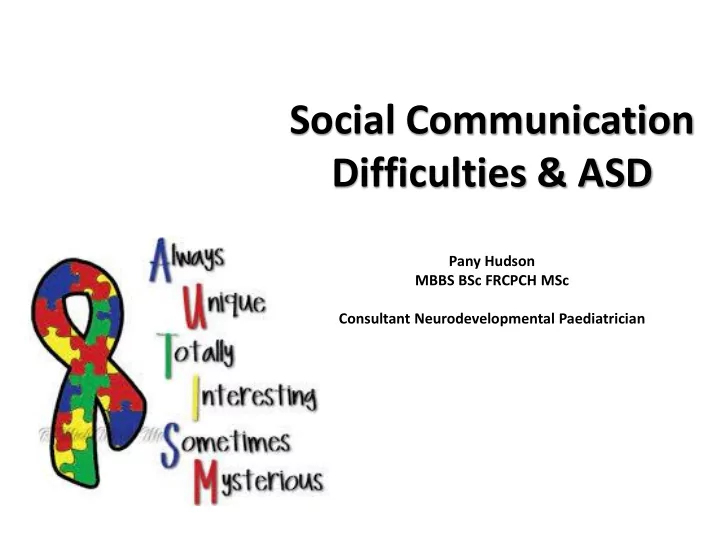
Difficulties & ASD Pany Hudson MBBS BSc FRCPCH MSc Consultant - - PowerPoint PPT Presentation
Social Communication Difficulties & ASD Pany Hudson MBBS BSc FRCPCH MSc Consultant Neurodevelopmental Paediatrician History Identification of Autism started in 1938 with Asperger & Kanner Many, many theories and many different
Pany Hudson MBBS BSc FRCPCH MSc Consultant Neurodevelopmental Paediatrician
Qualitative differences and impairments
communication
patterns of behaviour, interests and mannerisms New classification acknowledges the wide variation, rather than distinct categories and identifies 1 category of ASD with 2 domains of impairment (Social affect & repetitive, restricted behaviour) and includes sensory differences Different children affected in different areas to different degrees The symptoms may be prominent at different times when social demands exceed their capacity to cope
Plan)- previously known as Statement of Educational Needs.
commonly, not always.
mean that there will not an EHCP!
– The ASD Team for under 8 years old is based out of St George’s Hospital and the Early Years Centre (in conjunction with Garrett Park ASD Advisory Service). – The over 8 years old is through CAMHS. – The diagnostic pathway in the under 8 year olds in Wandsworth aims to be specific and sensitive and in accordance to the NICE guidelines.
1%
Early Years- Language Delay &/or behaviour Diagnosis Behaviour/Anxiety/ Support
Diagnosis Behaviour/Anxiety/ Support
Diagnosis of ASD & language disorder Good progress with visual timetables, social skills Support in school ASD parenting course Contact Family due to move to the USA
3 years 6 months boy Significant developmental delay Sensory difficulties Significant language delay (situational understanding)
Diagnosis of ASD Likely to develop intellectual disability Got into the correct provision in another borough Making progress with additional specialist support
Complex background of NF1 and prematurity Rigidity and inflexibility Need for sameness Socially aware Cognitively very able; amazing attention to detail
Anxiety at transition to Reception- unable to cope Reduced eating & pica Not sleeping Started on sertraline- did not tolerate it Started on propranolol- good effect but still very unsettled in school Had to be taken out of school and eventually given an ASD base place Early days but better
7 ½ year old Private setting doing exceptionally well academically No concerns around behaviour at school, but huge concerns at home Maths teacher only made a specific comment around rigidity…
Seen by adviser and SLT- no real concerns at school. At home cognitive rigidity, high levels of anxiety Also apparent in one to one sessions
Referred to Evelina Hospital and CAMHS On sertraline and doing a bit better Huge input from the family Mother diagnosed with a type of cancer…
Early Years- Language Delay &/or behaviour Behaviour/Anxiety/ Support
Professional has initial concerns around a child social communication and interaction and any other features suggestive of Autistic Spectrum Disorder. Completes EHA to provide evidence and outline concerns (except GP who fill in a referral form/letter) Either to MACNP only, or only developmental paediatrics or both
Single Point of Access
MACNP Does the EHA suggest there is an clear need for MDA? What additional support would be appropriate at this point? Which team should they be allocated to? Early Years Adviser Team: observe the child in the setting and informal info gathering GPAS: 3 targeted observations, 1 meeting with parents to fill in the SRS screening questionnaire and evidence-gathering
5-8 years old 0-5 years old
Additional universal early years, or SEN school-based support EYC: Community SALT, Enhanced children’s center School: in-class input. No GPAS. Referrals to Other services, eg OT, feeding clinic Clinical Psychology at the EYC or cognitive assessment
Post-diagnosis support: Contact; parental training (e.g. CATS or Cygnet), information on DLA & National Autistic Society Post-diagnosis support:
Multi-Disciplinary Assessment
Multi-Disciplinary Assessment
Current ASD Pathway 0-8 years old
Average to diagnosis 6 months
ASD diagnos is ASD diagnos is Specialist SALT Observation & Assessment for evidence gathering
Average to diagnosis 14 months
Developmental Pediatrician: assessment to understand developmental levels, consider comorbidities and differential diagnoses; 18 weeks from referral Specialist SALT Observation & Assessment for evidence gathering
development?
diagnosis? Rett’s, Klefner Lindau
another diagnosis, eg ADHD, anxiety?
difficulties?
People with autism have some very valuable skills which can be applied in the workplace. They might have very good attention to detail, or be really good at sticking to routines and timetables. Therefore, are likely to be very punctual and
always be something. Job seeker, NAS website
Professional has initial concerns around a child social communication and interaction and any other features suggestive of Autistic Spectrum Disorder. Completes EHA to provide evidence and outline concerns (except GP who fill in a referral form/letter) Either to MACNP only, or only developmental paediatrics or both
Single Point of Access
MACNP Does the EHA suggest there is an clear need for MDA? What additional support would be appropriate at this point? Which team should they be allocated to? Early Years Adviser Team: observe the child in the setting and informal info gathering GPAS: 3 targeted observations, 1 meeting with parents to fill in the SRS screening questionnaire and evidence-gathering
5-8 years old 0-5 years old
Additional universal early years, or SEN school-based support EYC: Community SALT, Enhanced children’s center School: in-class input. No GPAS. Referrals to Other services, eg OT, feeding clinic Clinical Psychology at the EYC or cognitive assessment
Post-diagnosis support: Contact; parental training (e.g. CATS or Cygnet), information on DLA & National Autistic Society Post-diagnosis support:
Multi-Disciplinary Assessment
Multi-Disciplinary Assessment
Current ASD Pathway 0-8 years old
Average to diagnosis 6 months
ASD diagnos is ASD diagnos is Specialist SALT Observation & Assessment for evidence gathering
Average to diagnosis 14 months
Developmental Pediatrician: assessment to understand developmental levels, consider comorbidities and differential diagnoses; 18 weeks from referral Specialist SALT Observation & Assessment for evidence gathering
Diagnosis