Dick Hubbard / Saclay for the ANTARES collaboration time - - PowerPoint PPT Presentation

dick hubbard saclay for the antares collaboration time
SMART_READER_LITE
LIVE PREVIEW

Dick Hubbard / Saclay for the ANTARES collaboration time - - PowerPoint PPT Presentation

oscillations in ANTARES Dick Hubbard / Saclay for the ANTARES collaboration time calibration LED beacon Antares site 40 km off Toulon in Mediterranean Sea Antares detector Effective area 0.1 km 2 , 10 strings, 900 PMTs Sky coverage


slide-1
SLIDE 1

time calibration LED beacon Optical modules
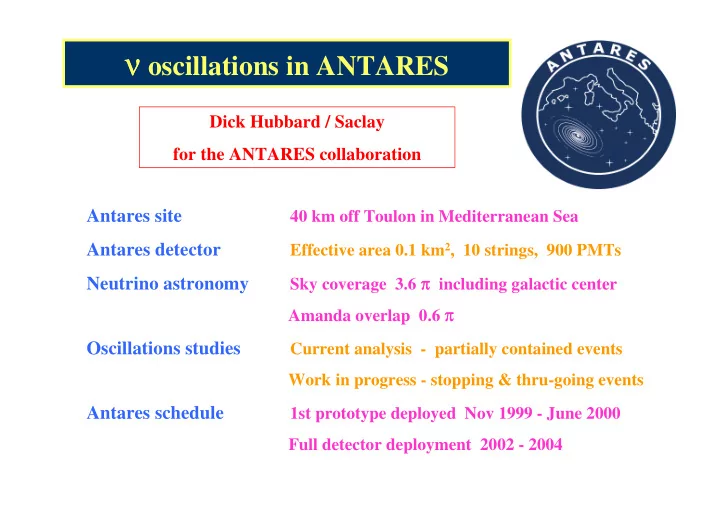
ν ν oscillations in ANTARES

Dick Hubbard / Saclay for the ANTARES collaboration

Antares site

40 km off Toulon in Mediterranean Sea

Antares detector

Effective area 0.1 km2, 10 strings, 900 PMTs

Neutrino astronomy

Sky coverage 3.6 π π including galactic center Amanda overlap 0.6 π π

Oscillations studies

Current analysis - partially contained events Work in progress - stopping & thru-going events

Antares schedule

1st prototype deployed Nov 1999 - June 2000 Full detector deployment 2002 - 2004

slide-2
SLIDE 2

ANTARES collaboration

University of Oxford University of Sheffield CPPM, Marseille (IN2P3) DSM/DAPNIA, Saclay (CEA) IReS, Strasbourg

  • Univ. of H.-A., Mulhouse

C.O.M. Marseille IFREMER, Marseille/Brest IGRAP (INSU), Provence University and INFN, Bari University and INFN, Bologna University and INFN, Catania INFN - LNS, Catania University I and INFN, Rome University and INFN, Genova IFIC, Valencia NIKHEF, Amsterdam ITEP, Moscow

slide-3
SLIDE 3

ANTARES scientific program

Low Energy Medium Energy High Energy

ν ν oscillations

Observation of first

  • scillation minimum

Neutralino search

χ χ χ χ →

→ ν +

ν + X

center of earth, sun, galaxy

GRB cannonballs ν ν from (extra-)

galactic sources SN remnants, AGN, GRB, ...

slide-4
SLIDE 4

~300 m ~60 m

float

Acoustic beacon

time calibration LED beacon electronic container Optical modules hydrophone

~100 m

shore station electro-optic submarine cable ~ 40 Km 2400 m Junction box anchor

0.1 km2 effective area, 10 strings, 900 PMTs Deployment starts in 2002

ANTARES detector

slide-5
SLIDE 5

Water optical properties

Optical background: ~ 60 kHz on 10” PMT mainly 40K + bioluminescence bursts

⇒ ⇒ < 5% dead time / PMT

Water transparency:

  • Blue light 470 nm

λ λabs ~ 55 m λ λscat eff ~ 300 m

  • UV light 370 nm

λ λabs ~ 25 m λ λscat eff ~ 120 m

λ λscat eff = λ λscat

1 - < cos θ

θ >

slide-6
SLIDE 6

Ο Οscillations analyses

Current analysis Contained events and leaving muons

10 string detector : generate ν ’s with Eν = 4 - 300 GeV Atmospheric neutrino flux from Bartol : statistical errors only Large hadronic showers rejected by quality cuts

Work in progress

Hadronic showers for partially-contained events Shower energy precision ~ factor 2 at 1 σ Minimum error ~ ± 10 GeV ⇒ poor for Super-K parameters Analysis of stopping and through-going muons Generate neutrinos with Eν = 4 GeV - 100 TeV Two analyses using visible E/L or zenith-angle distribution

ν flux normalization from data : fitted as 3rd parameter

slide-7
SLIDE 7

ν ν oscillations : partially-contained events

Bartol atmospheric ν ν flux 4 years, 90% C.L. 720 single-string events 2100 multi-string events Statistical errors only

exclusion E / cos θ E / cos θ E / cos θ

Oscillations analysis : ratio with and without oscillations

slide-8
SLIDE 8

ν ν oscillations : all events

Zenith angle distribution Multi-string events - no containment cuts E/L distribution - partially-contained only Single- and multi-string events E/L distribution - no containment cuts Single- and multi-string events

90% C.L exclusion after 3 years 4063 events per year including ..294 partially-contained single-string ..428 partially-contained multi-string 3341 thru-going + stopping multi-string

Atmospheric ν ν flux = 3rd parameter

Systematic errors ± ± 5% bin-to-bin

slide-9
SLIDE 9

Comparative precision

Sensitivity for 3 years data

Assuming Super-K parameters from Neutrino-2000 conference 90 % C.L. for Antares, Opera and Super-K 68 % C.L. for Minos

sin2 2θ θ ∆ ∆m2 (eV2) 10-2 10-3

slide-10
SLIDE 10

Sources of systematic errors

Background sources

Electron- and tau-neutrino backgrounds negligible Atmospheric single- and multi-muon backgrounds small

Detector acceptance and calibration

Relative timing and relative positions should be O.K. Calibrate efficiencies for single-string and multi-string events ?

Atmospheric neutrino flux

Flux normalization fit as 3rd parameter in oscillations analysis Flux shape uncertainties influence mainly sin2 2θ determination

slide-11
SLIDE 11

Three low-energy ν

ν studies for Antares Eν

ν < 1 TeV

Neutrino oscillations

  • guaranteed physics result

Dark matter

  • only if favorable DM parameters

Cannonballs

  • possible early astrophysics result

Oscillations parameters : work in progress ∆m2 precision improved throughout Super-K allowed region

for sin2 2θ = 1 exclusion zone covers ∆m2 = 3×10⁻⁴ - 0.6 eV2 for ∆m2 = 3.5×10⁻³ eV2 exclusion zone covers sin2 2θ > 0.25

Systematic errors important

Flux shape and differential efficiency mainly affect sin2 2θ

Conclusions