
SLIDE 1
Di Gretton Jessie Favell Kathleen Paice Kay Warren Sue Hayes
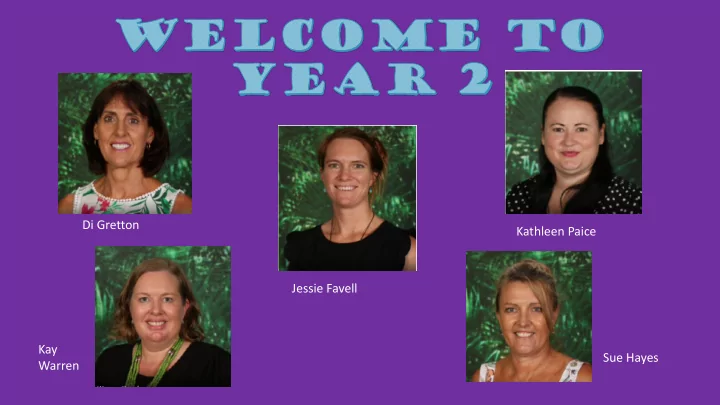
Di Gretton Kathleen Paice Jessie Favell Kay Sue Hayes Warren - - PowerPoint PPT Presentation
Di Gretton Kathleen Paice Jessie Favell Kay Sue Hayes Warren Reading Comprehension Numeracy Computational Student fluency and engagement problem solving Wellbeing Learning Critical Thinking Progressions Reading Feedback Student
Di Gretton Jessie Favell Kathleen Paice Kay Warren Sue Hayes
Reading Comprehension Numeracy Computational fluency and problem solving Wellbeing Student engagement
Differentiation Critical Thinking
Which character do I prefer? In this unit we are going to explore and compare characters in stories and write about which character they prefer.
During this unit students will:
sentences
profiles
choices for long verbs
Reading groups are conducted each week
with a focus on:
variety of ways including…
It is not restricted to the subject of English, but is utilised in all areas of the curriculum.
2 main focus areas:
the students knowledge
Working towards instant recall of Facts
Begins with Warm-up and then focussed activities Based on year level knowledge, children’s ability and focus teaching. Includes problem solving and investigations. Can be whole class, mixed ability or ability based groups. Focus around mental strategies where students are explicitly taught through the a consistent approach
We incorporate critical thinking into all curriculum areas. In essence, this requires our students to be an active learner, rather than a passive recipient of information. They need to use their ability to reason, question and
to understand what we are asking them to do
Examples: Problems
Balloon cars Comparing
I have packed my bag for a holiday.
Inside it I have a towel, flashlight and raincoat packed.
Where might I be going? Why do you think that?
The purpose of giving students feedback in the learning process is to improve their capabilities. This is done in many ways. * Learning Progressions * Giving assessment back * Student conferences * Buddy feedback * Groups * Self reflection * On the spot
Is s the proces ess, s, where we as as a sc a school, l, ac accomm mmoda date te the di differ eren ences ces be between en lear arners rs so so t that at al all Year ar 2 st stude dents s hav ave the be best st poss ssible ble chan ance ce of lear arning ing.
We look at Students
knowledge
From this we put students into groups both mixed and like ability, gather resources, adjust tasks and lessons, set the needed pace, have individual learning goals and put support program in place.
We promote positive student engagement across the college with:
school expectations
target
Teaching is a partnership between home and school.
Please see your classroom teacher if there is something you are unsure of or need further clarification about. We are more than happy to assist. Our emails are on the Year 2 newsletter or our door is always open.
.13th Feb History Incursion
19th March Community Day ‘Bullying No Way’ 23rd March Parent Teacher interviews start
Week 7/8 Swimming