SLIDE 1
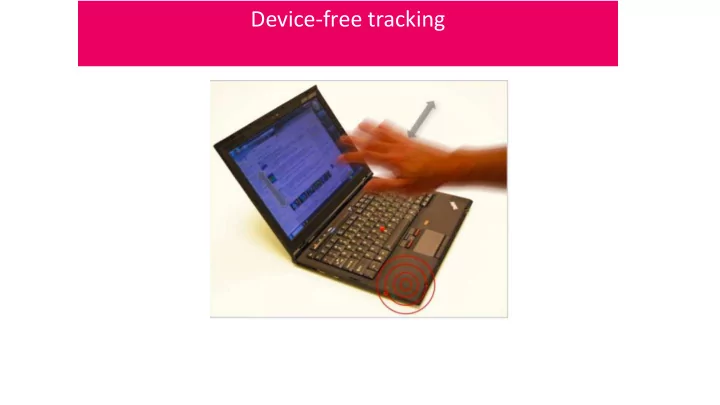
Device-free tracking
SLIDE 2
Doppler radar effect Limitations of Doppler Algorithms to get better resolution
SLIDE 3 SoundWave
- Transmit 18-20 kHz signals from laptop speaker
- Capture reflections on the laptop microphone at 48 kHz
sampling rate
- Perform a 4800 point FFT over a sliding window
SLIDE 4
Doppler radar effect Limitations of Doppler Algorithms to get better resolution
SLIDE 5
DFT (Discrete Fourier Transform)
SLIDE 6 DFT properties
Sampling frequency = fs (i.e., fs samples per second) Slowest frequency (!"
# radians per step) = N samples per rotation
= (N/ fs) seconds per rotation Therefore, the slowest frequency = (fs /N) Hz Higher frequencies are integer multiple of (fs /N) Hz 0, fs
# , 2fs # , 3fs # , 4fs # , … ,
SLIDE 7 The resolution and the highest frequency
fs
$ Resolution = minimum observable frequency difference =
2 m = 0 3 4 1
Frequency Magnitude/ Phase of zm
What if the actual frequency falls in between two frequency bins?
SLIDE 8
FingerIO: Using Active Sonar for Fine Grained Finger Tracking
Rajalakshmi Nandakumar, Vikram Iyer Shyam Gollakota, Desney Tan
SLIDE 9
Can we achieve finger tracking for near device interaction with no finger instrumentation and no line of sight?
SLIDE 10
Application 1: Make anything an input surface
SLIDE 11
Application 2: Move beyond tiny screens
SLIDE 12
Application 3: Interaction with occlusions
SLIDE 13
- Track a finger with no instrumentation
and no line of sight
- Introduce algorithms and techniques for
active sonar without custom hardware
- Achieve 0.8 —1.2 cm accuracy on a
Galaxy S4 and smartwatch prototype
FingerIO
SLIDE 14
1) Transform mobile devices into active sonar systems 2) Achieve sub-centimeter level tracking accuracy
Challenges
SLIDE 15
Key Idea: Transform the Device into Active Sonar
Sound waves transmitted by the phone speaker reflect off of the finger
SLIDE 16 Mic 2 Mic 1
Key Idea: Transform the Device into Active Sonar
Echo from finger is recorded by 2 microphones
SLIDE 17
Key Idea: Transform the Device into Active Sonar
Time for the echo to arrive back at the phone changes as the finger moves
SLIDE 18 Accuracy Depends on Time Measurement
Sampling at 48kHz, 1 sample → 0.7cm
t1 t2
Mic 2 Mic 1
SLIDE 19
1) Transform mobile devices into active sonar systems 2) Achieve sub-centimeter tracking accuracy
Challenges
SLIDE 20
How can we measure arrival time?
Transmit chirp signals and use autocorrelation to determine arrival times Chirp Correlation Profile
SLIDE 21
First Order Solution: Correlation
We use the closest moving echo to achieve finger tracking
t1 t2
Correlation Profile
SLIDE 22
Correlation in Practice
How to get the exact arrival time of the echoes? Estimate echo arrival with 2-3 sample error → tracking accuracy of 3 cm
SLIDE 23 Inspiration from WiFi Networks
- Transmitters and receivers do not share
a common, synchronized clock
- Receivers need to determine the start of
a message to successfully decode
SLIDE 24
WiFi’s Solution: OFDM
Timing Errors Create FFT Phase Offsets
FFT Phase
Compute inverse FFT to generate N sample OFDM symbol Append the first S samples to create a cyclic suffix à Creates a periodic signal We leverage this phase to get exact echo arrival time
SLIDE 25 Putting it All Together
- 1. Transmit 18-20 kHz OFDM symbols
every 5.92 ms
- 2. Use correlation to get a coarse timing
estimate within 2-3 samples
- 3. Correct error using phase properties of
OFDM to achieve < 1 cm accuracy
5.92 ms
t
SLIDE 26
Evaluation
SLIDE 27
How accurate is FingerIO?
Random user drawings 10 Users 3 Repetitions 30 Total measurements 0.8 cm accuracy 50 x 100 cm2 around phone
FingerIO Phone Reference Phone
SLIDE 28 How accurate is FingerIO?
1 8 6 4 2
SLIDE 29 Smartwatch Tracking Accuracy
10 Participants 3 Drawings 30 Total measurements 1.2 cm accuracy 25 x 50 cm2 on one side
40m m 40m m
Mic 1 Mic 2 Speaker
SLIDE 30 Addressing unintended motion
10 users 1 min random motion 10 min of motion 0 false detection (watch) 2 false detection (phone)
5 cm
Start-Stop Gesture
SLIDE 31
- Track a finger with no instrumentation
and no line of sight
- Introduce algorithms and techniques for
active sonar without custom hardware
- Enable exciting new directions for finger
tracking research
Conclusion