Development Strategy for Tritium( 3 H) Extraction Removal from Liquid - - PDF document

development strategy for tritium 3 h extraction removal
SMART_READER_LITE
LIVE PREVIEW

Development Strategy for Tritium( 3 H) Extraction Removal from Liquid - - PDF document

Transactions of the Korean Nuclear Society Virtual Spring Meeting July 9-10, 2020 Development Strategy for Tritium( 3 H) Extraction Removal from Liquid Radioactive Waste of Nuclear Power Plants JeongHee Lee, Yongmin Park, Gibeom Park, Sang-woo


slide-1
SLIDE 1

Development Strategy for Tritium(3H) Extraction∙Removal from Liquid Radioactive Waste

  • f Nuclear Power Plants

JeongHee Lee, Yongmin Park, Gibeom Park, Sang-woo Noh, Seung-il Kim, Duk-won Kang* R&D center, Elim-Global Co. Ltd., 767, Sinsu-ro, Suji-gu, Yongin-si, Gyeonggi.do, Republic of Korea

*Corresponding author: dukwon.kang@elim-global.com

  • 1. Introduction

Among the nuclides released into the environment with nuclear power plant (NPP) operations, the tritium (half- life: 12.3, 18.6 keV, 3H), which is a beta emitter, is the most interesting nuclide among researchers. The biological half-life of HTO ingested in the human body is about 9.7 days, and most of it is discharged out of the

  • body. Many radiochemistry researchers have been

researching to remove 3H from the contaminated water because it has a genetic effect when it is replaced with hydrogen when absorbed into the body. However, 3H is present in various forms such as H2O, D2O, HT and HTO in water and has physical and chemical properties similar to water, making it difficult to develop 3H separation and removal technologies. [1-2]. Among the technologies developed to date, commercialized technologies include LPCE (Liquid Phase Catalytic Exchange) technology used in domestic heavy water reactors NPP (Wolsung) and CECE (Combined Electrolysis Exchange) technology used in Fukushima accident site in Japan. Both of these technologies separate 3H by electrolysis method and cryogenic catalyst exchange method and require very expensive facility and have also a very small treatment capacity less than 100 kg/hr. For this reason, there is a limit to the processing capacity to treat 3H from a large amount of contaminated water. The Fukushima NPP accident in Japan has generated more than 1.2 million tons of contaminated water so far, which forces the Japenese government to seriously consider ocean discharge due to a lack of storage capacity. In Korea, as

3H is detected from urine samples of residents around

Wolseong NPP, which operates heavy water reactors, concerns about 3H and social interest in removal technology are rapidly increasing. This research paper focuses on the development of high-capacity / high-efficiency 3H removal technology to increase the treatment capacity, which is a limitation of the commercially available 3H removal technology. In this works, we will introduce an approach strategy for the development of more advanced 3H removal technology through a review of the technologies that have been developed to date, and evaluate the detailed characteristics of each technology through empirical experiments on technologies with high potential. 1.1 Objectives The technology to be developed is a new concept of hybrid type 3H removal technology. We plan to develop a technology of 100 L / hr that is cheaper than the current commercialized system construction cost, can improve the removal efficiency for 3H by 80%, and can increase the processing capacity.

  • 2. Method and Results

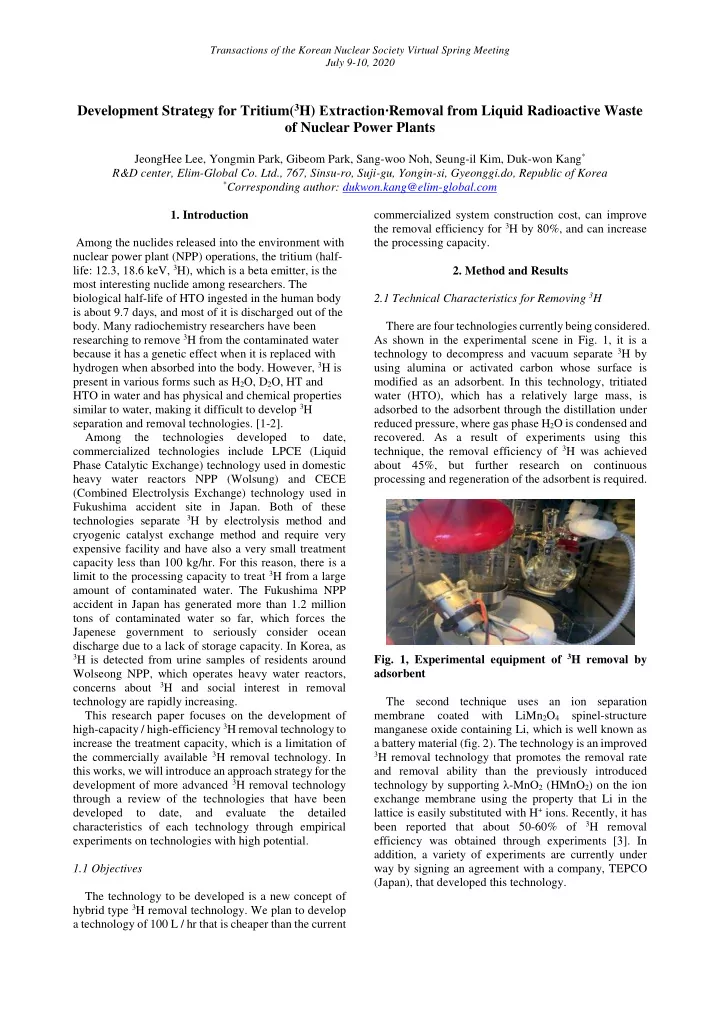
2.1 Technical Characteristics for Removing 3H There are four technologies currently being considered. As shown in the experimental scene in Fig. 1, it is a technology to decompress and vacuum separate 3H by using alumina or activated carbon whose surface is modified as an adsorbent. In this technology, tritiated water (HTO), which has a relatively large mass, is adsorbed to the adsorbent through the distillation under reduced pressure, where gas phase H2O is condensed and

  • recovered. As a result of experiments using this

technique, the removal efficiency of 3H was achieved about 45%, but further research on continuous processing and regeneration of the adsorbent is required.

  • Fig. 1, Experimental equipment of 3H removal by

adsorbent The second technique uses an ion separation membrane coated with LiMn2O4 spinel-structure manganese oxide containing Li, which is well known as a battery material (fig. 2). The technology is an improved

3H removal technology that promotes the removal rate

and removal ability than the previously introduced technology by supporting λ-MnO2 (HMnO2) on the ion exchange membrane using the property that Li in the lattice is easily substituted with H+ ions. Recently, it has been reported that about 50-60% of 3H removal efficiency was obtained through experiments [3]. In addition, a variety of experiments are currently under way by signing an agreement with a company, TEPCO (Japan), that developed this technology.

Transactions of the Korean Nuclear Society Virtual Spring Meeting July 9-10, 2020

slide-2
SLIDE 2
  • Fig. 2, Schematic diagram of 3H removal using λ-

MnO2(HMnO2), reproduced for permission [3] In the third technology, after the 3H ions are replaced with Al ions while undergoing a two-step ion exchange process in which Al-supported resin is used,

3H

undergoes desorption and concentration processes from the resin, and finally adsorbed, enriched and stored in zeolite (fig. 3). This technology has been studied largely by DOE in the United States. Since the resin recycling process is possible, it can be configured as a continuous processing process, and the removal efficiency is known to be about 70-80%. In addition, a pre-treatment process is essential to pre-remove various interfering ions or

  • rganic substances contained in contaminated water.
  • Fig. 3, 3H removal process via technology of ion

exchange resin The fourth technique separates

3H through an

inorganic graphene oxide separation membrane and a zeolite molecular sieve membrane (fig. 4). Since this technology includes multiple layers of separation membranes, there is a space constraint that requires a huge area when making a large-capacity system. Therefore, research is currently being conducted to reduce the installation space by increasing the contact

  • efficiency. This technology is also actively being

researched around the United States' DEO, and is one of the technologies that has the advantage of being capable

  • f large-capacity processing.
  • Fig. 4, 3H removal process via membrane technology

2.2 Strategy Currently, basic experiments and device configuration for each of the aforementioned technologies are in

  • progress. As shown in fig. 5, additional pre-treatment

process removing ions, particulates and suspended solids

  • f the new concept will be introduced to increase the

removal efficiency. We plan to develop a hybrid composite process that selects and combines the most probable technologies among the four technologies mentioned above. The treatment of separated and concentrated HTO will be reviewed with the possibility

  • f cement solidification and recycling possible

depending on the purity of separation.

  • Fig. 5, Conceptual diagram of 3H removal technology
  • 3. Summary

Researchers from all countries with NPP have been constantly researching to develop the technologies to separate and remove the tritiated water (HTO) from contaminated water. However, the development of large- capacity treatment technology for the separation and removal of tritiated water requires a lot of time and effort, as tritiated water has similar properties to light water, both physically and chemically. Our research institute has been continuously discussing with related researchers who have various experience for developing the 3H removal technology. To conduct research based

  • n technologies that are likely to remove 3H, four

domestic universities in similar fields were selected and then, it plans to perform step by step from laboratory- scale research to semi-pilot level research. Through this independent study, we intend to develop a process capable of regeneration of 3H adsorbents and continuous

Transactions of the Korean Nuclear Society Virtual Spring Meeting July 9-10, 2020

slide-3
SLIDE 3

processing. In addition, after developing and manufacturing a hybrid-type complex

3H removal

system that combines advantages for each technology, performance tests will be conducted. As it is still in the early stages of research, this paper briefly describes the introduction and promotion strategies of the technologies to be approached. The progress of each development stage will be introduced annually through this journal. . REFERENCES

[1] Davidson, R. B., et al, Commissioning and first operating experience at Darlington Tritium Removal Facility, Fusion Technology, Vol.14, No.2P2A, p.472-479, 1988. [2] Vasaru, Gheorghe, Tritium isotope separation, CRC press, 1993. [3] Koyanaka., et al, Tritium separation from heavy water using a membrane containing deuterated manganese dioxide, Journal

  • f Radioanalytical and Nuclear Chemistry, Vol.322, No.3,

p.1889-1895, 2019. Transactions of the Korean Nuclear Society Virtual Spring Meeting July 9-10, 2020