SLIDE 1
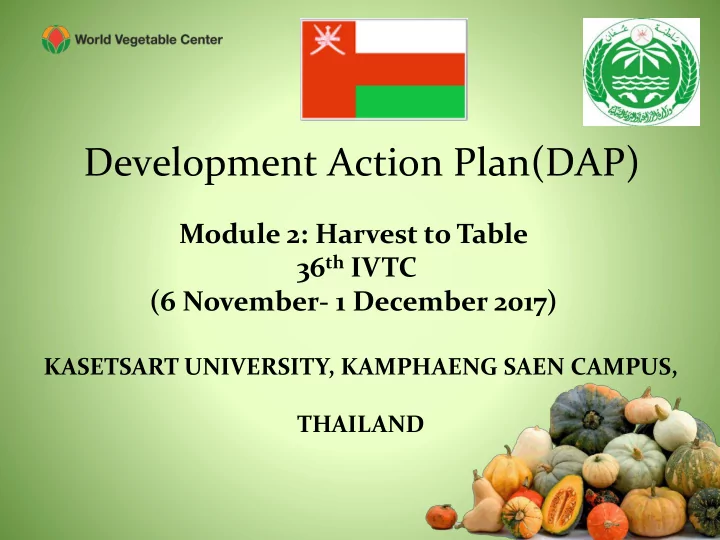
Development Action Plan(DAP)
Module 2: Harvest to Table 36th IVTC (6 November- 1 December 2017)
KASETSART UNIVERSITY, KAMPHAENG SAEN CAMPUS, THAILAND
SLIDE 2
Introduction Name: Basim Bashir Bait Abaidoun. Vegetable researcher. Directorate General of Agriculture & Livestock Research. (Department of Agricultural and Animal Research). Agriculture research station – Salalah(south of Oman). BSc Plant Science (Sultan Qaboos University) – Oman. MSc Organic Farming System (Newcastle University) – UK. Education background
SLIDE 3
Main Responsibilities Evaluate and screening of new verities of vegetable crops under Salalah condition. Introduce of new technologies for high yield production (hydroponic system). Contribute to the development of research programs to increase the productivity of vegetable crops under climatic conditions. Cooperate with agricultural extension department to solve farmers' problems.
SLIDE 4
Sultanate of Oman
SLIDE 5
His majesty sultan qaboos
SLIDE 6
Country in Southwest Asia. Capital: Muscat. Population: 4.345 million according to 2014 estimates. Total area of about 309,500 sq. km. ➢ Mountains: 16%. ➢ Deserts: 81%. ➢ Coastal plains: 3%. The average annual rainfall : 100 mm. ➢ Dhofar region (south of Oman) where there is monsoon rainfall (200-250 mm) during kharif (July- September) period. Official Language: Arabic language. Religion: Islam. Weather: Hot and humid in summer and moderate in winter.
SLIDE 7 Geographical Regions of Oman
Oman has more than 2.3 million hectares of arable land .The total cultivated area is about 73,670 hectares (MoA, 2009) of which 60% is located in the coastal areas (MAF, 2009a).
crops Area (ha) Fruit Crops Perennial f Field Crops Vegetables
6185.71
Total 73671
Area of different groups of crops in Oman (MAF, 2009)
SLIDE 8
Directorate General of Agriculture & Livestock Research(Oman) Established in March 2006
SLIDE 9 Organization and Structure
3 .Soil Research Center
- Soil Research Lab
- Bio-saline Research Lab
- Irrigation Research Lab
- 2. Plant Protection Research
Center
- Plant Pathology Research Lab
- Entomology Research Lab
- Biological Control Research Lab
- Toxicology Research Lab
- Honey bee Research Lab
- 1. Plant Production Research
Center
- Fruit Research Lab
- Vegetable Research Lab
- Field crops Research Lab
- Seed and Plant Genetic Resources
Research Lab
- 6. The Veterinary Health Research
Center
- Virology Lab
- Bacteriology Lab
- Parasitological Diseases Lab
- Biochemistry and Toxicology Lab
- Pathology Lab
Status
- 5. Livestock Production Research
Center
- Goats and Sheep Research Lab
- Poultry Research Lab
- Cows Research Lab
- Artificial Insemination Research Lab
- Livestock Feeding Research Lab
- 4. Date palm Research Center
- Date palm Production and Genetic
Resources Research Lab
- Tissue culture and Biotechnology
Research Lab
- Date palm Horticulture Research Lab
- Food Processing Research Lab
Includes 126 Omani Researchers and about 460 personnel in the administrative section.
SLIDE 10
Three topics in module 2 that I found most useful.
➢Packaging: package design , materials. ➢Cooling: room cooling, forced air cooling, hydro cooling.
and ice cooling.
➢Rooftop organic gardening.
SLIDE 11
pesticides residue in fruits & vegetables
Action plan topic
SLIDE 12 Pesticides are chemical compounds that are used to
kill pests, including insects, rodents, fungi and unwanted plants (weeds).In the
hands pesticides are potentially toxic to other organisms, including humans.
SLIDE 13
Problem: High residue levels of pesticides
found in some fruits and vegetables in Oman.
Objective of this study
▪ Reduce the use of pesticides. ▪ Awareness from extensive use of pesticides. ▪ Determination of vegetables and fruits with residues of pesticides and their sources of entry.
SLIDE 14
Inputs:
Budget. Stuff. Farmers. Experts people. Construction. Materials.
SLIDE 15 Activities:
Determine the target locations.
- Border gates, airports, sea ports, farms, central markets
fruits and vegetables shops. Training of the agricultural extension agents. Develop of training materials (Pesticide Residue Test Kit). Farmers training in Optimal use of pesticides (how and when). Workshops. Field work. Duration: At least 1 year.
SLIDE 16 Cost ($) Details 320,000 Contract Worker 200,000 Travel & Transportation 120,000 Materials 1000000 Construction 40,000 Modifications& repair 1,680,000 Total
Budget
SLIDE 17
Benefits / outcomes
Awareness about the extensive use of pesticides. Change of control methods for pests & diseases. Actual use of knowledge about nutrition and health. Ensure that agricultural products containing a high percentage of pesticides are not entered.
Impact
Improve health. Increase income. Improve social status.
SLIDE 18
Solutions:
Establishment of controlled collecting centers for fruit and vegetables. Establish of packing and packaging houses. Establish of toxicology laboratories.
SLIDE 19
Challenges
Budget. Most of the farmers are foreigners.
SLIDE 20
THANK YOU