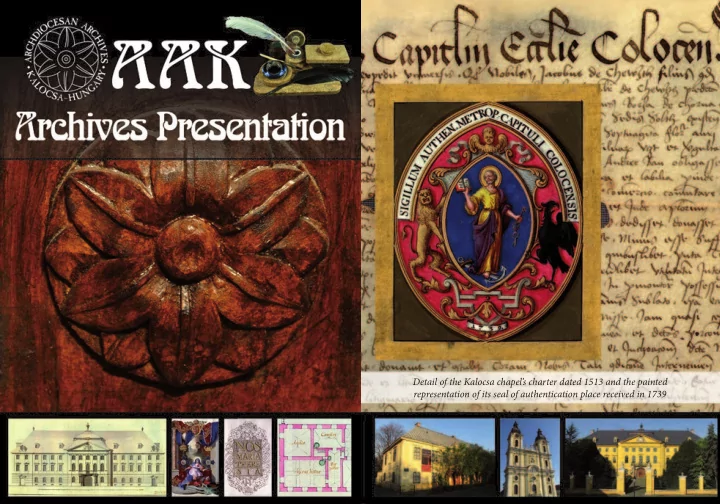
Detail of the Kalocsa chapels charter dated 1513 and the painted - - PowerPoint PPT Presentation

detail of the kalocsa chapel s charter dated 1513 and the
SMART_READER_LITE
LIVE PREVIEW

Detail of the Kalocsa chapels charter dated 1513 and the painted - - PowerPoint PPT Presentation

Detail of the Kalocsa chapels charter dated 1513 and the painted representation of its seal of authentication place received in 1739 Contents 1.) Brief presentation of the archbishopric ..............................................3 1.1.)


slide-1
SLIDE 1

Detail of the Kalocsa chapel’s charter dated 1513 and the painted representation of its seal of authentication place received in 1739

slide-2
SLIDE 2

Contents

1.) Brief presentation of the archbishopric ..............................................3 1.1.) Changes in the use of designations: From Kalocsa-Bács to Kalocsa-Kecskemét .....................................................................................3 1.2.) Territorial changes: From Bács-Bodrog county to Bács-Kiskun county ...........................................................................................................5 1.3.) Tie Archiepiscopal province .....................................................................5 1.4.) Tie Roman Catholic Archdiocese - in the light of the fjgures..............7 2.) Tie nature and structure of the archives ..........................................10

  • AAK. I. Archives of the Archbishopric of Kalocsa .......................................10
  • AAK. II. Archives of the Chapter of the Archbishopric of Kalocsa

............11

  • AAK. III. Archiepiscopal Economic Archives of Kalocsa

............................12

  • AAK. IV. Archives of the Deans’ Departments .............................................13
  • AAK. V. Archives of Parishes

...........................................................................14

  • AAK. VI. Other institutions

.............................................................................14

  • AAK. VII. Successions ......................................................................................15
  • AAK. VIII. Collections .....................................................................................15

3.) Research options, source types .........................................................16 3.1.) Records .......................................................................................................17 3.2.) School records and documents ...............................................................18 3.3.) Documents relating to records (exceptions, registry patches) ...........20 3.4.) Litigation deeds (the Holy See, manor court) .......................................20 3.5.) Economic deeds from the feudal era (lists of pays, urbariums, maps, robot) ..............................................................................................22 3.6.) Protocols of ecclesiastic visits ..................................................................24 3.7.) Documents of places of authentication (nobiliary diplomas, estate cases, testaments) ...........................................................................24 3.8.) Population censuses, genealogical records, electoral lists ...................27 3.9.) Documents of associations and bodies ..................................................28 4.) Usage of the archives, services ..........................................................29 4.1.) Traditional, local services ........................................................................29 4.2.) Matricula-Historia-online (Genealogy research and local history on the Internet) ............................................................................30

slide-3
SLIDE 3

3 4.3.) KFL-online (AAK-online) (other fjles of the archives available via the Internet) ........................................................................................31 4.4.) E-research service – results .....................................................................33 4.5.) Database of records of Kalocsa and its quarters on the Internet ........34 4.6.) Extra-curricular school programs ..........................................................35 4.7.) Publications ...............................................................................................37 4.8.) Prizes and honors .....................................................................................40

1.) Brief presentation of the archbishopric

Our archdiocese located between the rivers Danube and Tisza was founded by King Saint Stephen and in the last millennium has become Hungary’s second prestigious church place after Esztergom. Despite the considerable age of the Archdiocese, almost the complete collection of the archives is the remains of the last three centuries. The reason for this is that the Turkish occupation caused significant breakage and important changes in the life of the Archdiocese. After the perish of Mohács, the whole area of the diocese was occupied by the Turkish soon, the operation of the Roman Catholic church organisation was suspended during the Ottoman

  • ccupation and most of our previous written and object remains were
  • destroyed. The 18th century brought mainly restart and reorganisation in

the depopulated countryside both to the diocese and Kalocsa, the seat of the Archdiocese. 1.1.) Changes in the use of designations: From Kalocsa-Bács to Kalocsa-Kecskemét Our diocese was mentioned in the sources as the Archbishopric of Kalo- csa-Bács for nine centuries. The name Bács was used in the Modern Age

  • referring to the double-seat operation of the medieval diocese - despite the

fact that after the Turkish neither cathedral, no chapter worked or no church governance took place. The address of the Archbishop of Kalocsa-Bács was used until 1968, the time of establishing the independent bishopric of Subo-

  • tica. Interestingly, the diocese called simply Kalocsa Diocese in the popular

language wore this short name for less than 25 years because based on the Bull of Pope John Paul II beginning as “Gens Hungarorum” , the Archdiocese

  • f Kalocsa-Kecskemét was born as a part of the national modification of

boundaries of the bishoprics. Kalocsa was the stable, unchanged element of the three name versions all over the time and in the last three centuries this city was the seat and residence of the archbishops that is why the simplifying name became general by which the archbishop and the archbishopric were both called “Kalocsa” briefly.

Archives of the Archdiocese of Kalocsa (AAK) - archives presentation booklet

(based on the Hungarian second, enlarged edition: A Kalocsai Főegyházmegyei Levéltár (KFL) - levéltárismertető füzet. Szerk.: Lakatos Andor, Kalocsa, 2016.) Edited by: Lakatos Andor English translation: Tóth Noémi Ilona Kalocsai Főegyházmegyei Gyűjtemények kiadványai 12. Publisher: Kalocsai Főegyházmegyei Levéltár Kalocsa, Hungary, 2018 ISBN 978-963-89957-7-3 ISSN 1587-3730 Kalocsai Főegyházmegyei Levéltár (KFL) Archives of the Archdiocese of Kalocsa (AAK) H-6300 Kalocsa, Szentháromság tér 1. Tel.: +36 78 467 363, +36 30 602 2191 archivum@asztrik.hu http://archivum.asztrik.hu

slide-4
SLIDE 4

5 4 1.2.) Territorial changes: From Bács-Bodrog county to Bács-Kiskun county The area of the diocese covered Bács-Bodrog county, the southern areas

  • f Pest County and a part of the Kiskunság in the 18th-19th centuries. The

natural boundaries are Tisza River from the East, the Danube River from the west and south, the borderline started at Solt from the Danube and was sloping toward the South-east to Tisza where it arrived under Szeged town. In the 20th century the territory of the diocese changed substantially several times. After the Trianon treaty, as a consequence of the changes of country borders, the Archdiocese Kalocsa-Bács nearly three quarters of its territory and population. Hardly more than one third of the parishes and ministries and nearly half of ministrations remained in Hungary. The Holy See established the Apostolic Administration of Bács with the headquarters

  • f Subotica from around a hundred parishes on the 10th February 1923.

For Kalocsa, the loss of territory became final - except for the short period between 1941-1944 - however, Rome declared the Apostolic Administration to be an independent diocese much later, only in 1968. The next important territorial change came in 1993 in the life of the archdiocese when the Kalo- csa-Kecskemét Archdiocese was born. Since then, the area of the diocese has been mainly the same as the territory of Bács-Kiskun County. As a result of reorganisation in 1993 the increase was important, both the surface area and the population of the diocese after Trianon have grown more than double. The organization structure of the Archdiocese was divided into three archdeaconries, such as: Cathedral, Bács and Tisza Archdeaconries the area distribution of which changed as a consequence of the events described. In 1979 the name of the Tisza Archdeaconry was changed to Bodrogi and in 1993 in conjunction with the territorial growth, the fourth, the Kiskunság Archdeaconry was born. 1.3.) The Archiepiscopal province Our Archiepiscopal is the head of an archiepiscopal province (metropo- lis, province), and, therefore its significance goes beyond the borders of the

  • diocese. The courts of the Metropolitan archbishops were the appeal forums

in the cases of the dioceses belonging to their province (so-called suffra- ganeus), they could hold synods, gave advice to their fellow archbishops in many cases before their decisions that had important economic and legal

Kalocsa

Solt Baja

Zombor

Szabadka Szeged

Kecskemét

Kiskunhalas Hajós Kecel Topolya

Óbecse Zenta

Bács

Újvidék

Titel Kúla Palánka Apatin Jánoshalma Bácsalmás Kiskunmajsa Kiskunfélegyháza

River Danube (Duna) River Tisza Kalocsa 1923-1992 Kalocsa-Bács till 1923 Kalocsa-Kecskemét from 1993 Bács-Bodrog county Bács-Kiskun county

Changes in the area of the archdiocese

Belgrade Budapest Vienna Zagreb

Hungary Serbia

slide-5
SLIDE 5

7 6

  • consequences. The responsibilities of the exarchas changed a lot over time,

in this context, in short, the wide powers in the medieval age (direct involve- ment in the election of the bishops, decisions in cases of dispute between bishops, organising new dioceses) reduced gradually in modern times and despite the appeal right of the court of the Holy See, the advisory role, the honorary priority remained. At the same time, the area of the archiepiscopal provinces and the number of overseen dioceses reduced substantially. The territory of the province of the Archbishopric of Kalocsa spread from Croatia to Transsylvania at the end of the 18th century and it was composed of the dioceses of Senj-Modruš, Bosna-Zagreb, Syrmia, Younes, Oradea, and Transylvania. In 1853 the organisation of the the Zagreb Archbishopric province meant an important change because together with Zagreb the dioceses of Zengg-Modrus and Bosna-Syrmia segregated from the province. After 1920 Csanád Diocese, remained the only suffraganeus

  • f the archbishopric province the name of which changed to Szeged-Csanád

in 1982. Since 1993 the Archdiocese of Kalocsa-Kecskemét together with Pécs and Szeged-Csanád bishopric have constituted one an Archbishopric province. 1.4.) The Roman Catholic Archdiocese - in the light of the figures On the population of the archbishopric, the number of the clergy:

1821 1875 1905 1927 1975 1997

population (thousand people) 440 705 927 244 160 588 proportion of Catholics (%) 65 66 67 82 83 75 number of clergy (people) 182 187 221 161 139 124 Language usage of the pastors at the parishes: 1830 1881 1927 1942 Hungarian 39 47 41 105 German 23 20 2 20 South Slav 7 2

  • 3

Mixed 30 43 20 72

  • Hungarian with other languages

8 39 19 65

  • German with other languages

9 33 13 47

  • South Slav with other languages

13 31 15 42

  • Slovak with other languages

2 1

  • 1

total number of parishes 99 112 63 200 Territory of the Kalocsa archbishopric at the end of the 18th century

slide-6
SLIDE 6

9 8 Religious distribution of the population (%): Roman Catholic Orthodox Lutheran Calvinist Hebrew 1881 65,5 16,8 9,3 5,6 2,8 1927 82 2 7,7 5,8 2,5 2001 66 0.05 3,1 11 0,03 On the estates of the Archdiocese: 1885 1925 1935 Archdiocese (acres) 87.433 65.509 59.242 Chapter (acres) 24.025 19.239 16.426 On the Roman Catholic educational institutions of the Archdiocese: 1881 1927 2000 school children 75.898 17.620 1.083 primary/Elementary School 135 52 4 teacher/lecturer 520 386 111 State civil school 5 4

  • Teacher training institute (male)

1 1

  • Teacher training institute (female)

1 1

  • Teacher training college
  • 1
  • Training institute for

kindergarten teachers

  • 1
  • kindergarten
  • 11

3 Students’ hostel

  • 2

By viewing the maps and tables it can be seen that the operation of the archbishoprics affected a significant area and several of the inhabitants of

  • Hungary. The diocese’s history is far from being only religious history: (a)

properties, schools, foundations, historic buildings; the scientist, politi- cian, patron priests, prelates and environment the worshippers unified into companies building their environment; the heroes and victims of the serious historical changes, the recipients or the defendants of trials may be evidence for us to show that the centuries of the Archdiocese have tightly integrated into the history of Hungary and they have become integral parts thereof. The sources available to us reflect the variety of the previous list and the historical wealth well. Blazon of Archbishop Császka György (fjre enamel, 1891)

slide-7
SLIDE 7

11 10

2.) The nature and structure of the archives

Our Institution is the historical archives of the Archdiocese of Kalocsa- Kecskemét, which has been operated as a private archives available to the public since 1995 pursuant to the valid law on archives. (Related regulations: the Code of the Church §2 of canon 491 and Act no. LXVI of year 1995) The AAK guards and takes care of the historical documents and deeds of the

  • archbishopric. It receives the archives of central direction and supervisory
  • rgans of the church, the educational, health and social institutions of the

diocese and, of the diocese-level religious associations and bodies operating in the area of the Archdiocese. The structure of the archives follows the rules of the offices creating the documents, the stock exceeding 1300 document metres (hereinafter: dm) can be divided into 8 main parts (fond groups marked by Roman numerals, that is to say into minor archives) which are the following:

  • AAK. I. Archives of the Archbishopric of Kalocsa

(scope of years: 1699-1992, size: 635.45 dm) includes the deeds and documents of the organs grouped around the headquarters of the archbish-

  • pric, called “aula” in former times (that is: the court of the archbishopric),

such organs cover the Office of the Archbishopric (church direction), the Archbishopric High Holy See (court) and the Educational Supervision of the Archdiocese (school cases), the documents and deeds of which constitute half of the whole stock of the archives. Most of the materials in the Archives of the Archbishopric are composed the deeds and documents of the Office of the Archbishopric (scope of years: 1699-1992, size: 518.12 dm), where series of documents relating to the church direction, parishes and people (personal) deeds were differentiated as well. The copies of registers and manuscript volumes (records, register books, indexes) collected since 1826 compose a part separated from formal aspect. Among the deeds, documents of the Archbishopric Holy See of Kalocsa being the court organ of the diocese (scope of years: 1733-1992, size: 59.27 dm) there are mainly the deeds of proceedings of the holy see (e.g. marital bonds and divorce proceedings, proceedings of declaring deceased, discip- linary cases). The prestige and jurisdiction of the court was increased by the fact that the Archbishopric Holy See of Kalocsa was also a forum of appeal

  • n the area of the prevailing archbishopric province thus, litigations from a

large part of the country were heard here. The Educational Supervision of the Archdiocese of Kalocsa (scope of years: 1858-1952, size: 58.06 dm) was the central educational authority of the diocese, which started its operation as an independent office in the second half of the 19th century. The cases of the Roman Catholic elementary and secondary schools of the diocese were managed here, religious education, teacher training and teacher associations were organised here. In addition to the he general and theoretical documents, the cases were grouped separately by each school, by leaving series of deeds and documents by each institution that can be studied well for the posterity interested in the history of each school.

  • AAK. II. Archives of the Chapter of the Archbishopric of Kalocsa

(scope of years: 1734-1988, size: 53.31 dm) was the consulting body of the archbishops that was established during the operation of the Chapter of the Archbishopric of Kalocsa reorganised in 1738. The members of the body

  • f high esteem, the canons played and important part of the official work
  • f the headquarters of the archbishopric, the direction of the church. The

Cabinet of the authentication-place archives

slide-8
SLIDE 8

13 12 chapter was legally independent and treated its finances separately from the

  • archbishopric. Its far-reaching scope of activities (place of authentication,

caring foundations, etc.) decreased by the 20th century as a consequence of historical changes and after the 2nd Council of the Vatican, the new church laws also reduced its authority and tasks considerably. The main parts of the archives are made up of the private deeds of the chapter and the economic documents of foundations and place of authentication.

  • AAK. III. Archiepiscopal Economic Archives of Kalocsa

The documents, deeds were generated during the operation and direc- tion of the archiepiscopal lands of up to one hundred thousand acres, its scope of years spreads from the 18th century up to 1945 and its size is approx- imately 300 dm. The stores of the archives have been located in the house of the historian-canon István Katona since 1986, the documents were stored in estate buildings before. The main groups of the documents are: documents

  • f the General Estate Direction (Prefecture, Economic Seat, Animal Direc-

tion, Economic Departments), Legal deeds (Collection of Estate Ownership Law, Squire’s Court, Law Office), Organs of the Financial Direction (Audit Office, Head Cashier’s Office, Assistant Accounting Offices), Organs of Technical Direction (Forest Office, Engineering Office, Documents of the Title Deeds).

  • AAK. IV. Archives of the Deans’ Departments

Includes the documents, deeds accumulated during the activities of

  • deans. Such materials can be found mainly in parishes currently, often

dispersedly because the dean’s position was not connected to any special parish but any of the parsons could fulfil such tasks. The unification, collec- tion of the documents of the departments advance in parallel with the settlement of the archives of the parishes. So far the documents, deeds of

  • nly three quarters: Géderlak, Homokmégy and Kalocsa have been brought

to our archives, in a relatively small quantity. We have experienced sadly in the recent years that only a minor part of the documents and records

  • f the deans remained at the deans’ parishes, therefore, the operation of

each quarter can be reconstructed only fragmentally, in specific periods. The correspondence with the deans of the Archiepiscopal Archives (Acta congregationis, Districtualia, Relationes, Themata theologica) can supple- ment the missing parts to some extent. Store entrance of the main archives Volumes of the records and indices of the Holy See

slide-9
SLIDE 9

15 14

  • AAK. V. Archives of Parishes

Covers the historically valuable documents generated in the parishes of the Archdiocese of Kalocsa-Kecskemét. Most of these deeds, documents can be found at the parishes of the diocese nowadays, too, and data and indices provided in the 1950’s-1960’s are available on them. Based on the indices, we should consider the stock of documents from 131 parishes in a size of 225 dm, from the period between the 18th century to the end of the 20th century. We started their settlement, description, sometimes their delivery, if needed, at the start of the 2000’s and we could finish that work with around twenty parishes within three or four years. We took photos on the most important manuscripts of the parishes between 2010 and 2015 in order to help with the research and usage of individual sources (registers, and other censuses, records) that are available with difficulties otherwise.

  • AAK. VI. Other institutions

Mean documents, deeds generated somewhere else which have arrived to our archives as time passes. Currently the material of 11 fonds of a size of approximately 40 dm belongs here from the period between 1766 and 1980. As examples, the documents, deeds of the High Grammar School of the Archbishopric (operated first by Piarists then by Jesuits), the Saint Augustine Society (school literary and scientific debating society), the Mission Centre Pál Mátyás or the Elderly Priests’ Home of Kalocsa from the second part of the 20th century could be mentioned. The documents, deeds listed above arrived to our archives as a consequence of the termination, nationalisation

  • r moving of the institutions.
  • AAK. VII. Successions

The collection of personal successions became regular starting only from the second half of the 20th century and we have had a considerable quantity of documents only from Lajos Haynald cardinal-archbishop from the 19th century. (In former times, the personal documents were destroyed during the succession procedure and they aimed at preserving only official documents).

  • AAK. VIII. Collections

We guard unique archived documents that need individual storage and treatment because of their character and size, which are taken from series of documents and which are registered at piece-level. The charter store includes (30 charters from the period before the Mohács battle of 1526), a map store, a plan store, microfilm store, furthermore, a collection of stamps, posters, picture postcards and photos. We have aimed at digitising our collections for a long time in order to achieve better manageability and search and we have a considerable stock of pictures. Typewriter from the end of the 19th century Signature and seal

  • f Katona István

historian-canon (1806)

slide-10
SLIDE 10

17 16

3.) Research options, source types

The topics of various research activities are really variable, however, it can be stated that mainly the researchers of church history, local history and family history can find useful information from the former Bács-Bodrog county area and the current Bács-Kiskun county (the area between the rivers Danube and Tisza). Most of our researchers have been genealogists lately and in addition, we have been contacted in the topics of local history (the history of localities, parishes, schools and other institutions) first of all. The filing organisation of our archives can be considered ideal from the aspects of family and local history research: The important theory behind the grouping and placing of documents and deeds that we applied in Kalocsa, was the establishment of document series by each locality. The documents, deeds relating to each parish had been collected in separate series of documents and this “area principle” had also been used with the documents of records, holy see and schools as well. Such document groups provide research with a reliable base and can be handed over fast, without the need to browse the thick volumes of files and indices for deed numbers before. In addition to the names of localities, other personal and objective document series have been set up, with the exception of the stock of the Archbishopric Economic Archives where the filed documents of the various

  • ffices remained in time and number order and they can be researched by

using auxiliary books (files and indices). Here you can read about our types of resources that are important from the aspects of family and local history research. 3.1.) Records The records are the favourite resources of our genealogists. Our archives

  • f Kalocsa possess a really rich stock of records, which are mainly dupli-

cates from the time after 1826 and a minor part is composed of original records (most of the original records can be found at the parishes). This stock is supplemented by the collection of microfilms and digital copies. We can state that the picture digitisation of researchable content has been completed, therefore, the research has taken place via the Internet and has become very intense. Kalocsa region on the map of Ruttkay Mihály from 1763 Our archives’ regular researcher, Dr. Bárth János while working

slide-11
SLIDE 11

19 18 Regarding the types of records, three main groups can be differentiated: birth (baptising), marriage and decease (burial) records. The abbreviations

  • f the Hungarian terminology used in our archives include the baptising

(K), marriage (E) and decease (M) records respectively. There is also a minor stock of church records documenting other events of religious life with similarly useful and usable data content, such us confirmation records

  • r religious-conversion records (converted-people abandoning their belief)

and the logs of fiancés. At certain parishes, there are army (camp priest) records held separately. There are also indices prepared later for the baptis- ing, marriage and decease records, which are sometimes separate volumes. The quantity and quality of data of the indices are not the same, they some- times include only names and page numbers, in other cases they provide the abridged content of the records. The notes in the records constitute excellent sources for geneal-

  • gy research but they also have valuable information on social, locality,

demographic and ethnographic research as well (e.g. statistical, analysing examination of population, immigration-migration, jobs, average age, child mortality, lethal illnesses, differences featuring communities, connections between relatives, naming habits, exceptional events, accidents, etc. data). Owing to the fact that several ethnic communities and several religions were present in the localities of our diocese, the records are excellently suitable to examine the characteristics of such groups and how they lived together. 3.2.) School records and documents In the 18th century, the noun books of secondary schools included only the name, incidentally the address or the nationality of the students by each

  • class. The noun books of the Archbishopric Secondary Grammar School of

Kalocsa that we preserve in our archives start from 1766 and they include study results from the start of the 1800’s as well. The volumes of the 19th century are more and more informative because they include the basic iden- tification of the students (name, job, address of parent or guardian), and information on paying tuition fee or receiving scholarship. The maturity records kept starting from the middle of the century included the whole school career of each student (which class and where they attended). The educational supervision documents of our archives include rich material from the second half of the 19th century in connection with the teachers of catholic schools (applications, filling positions, etc.), and the

  • peration circumstances of each school.

Title page of the register of Zsablya (1827)

slide-12
SLIDE 12

20 Similarly, the school see of the parishes give a glimpse on the operation details of each school, from the cases of the teachers and the maintenance staff up to the maintenance. In the archives of the parishes sometimes the materials of pedagogic discussions, teachers’ conferences also turn up which were often held in each dean quarter, by representing several localities and institutions and they also kept minutes on the meetings. 3.3.) Documents relating to records (exceptions, registry patches) From the middle of the 19th century it became regular that the parson contacted the headquarters of the diocese for asking permits, authorisa-

  • tions. The system and of exceptions (so-called dispensatios) and the legal

background of their application emerged, in several cases similar actions were needed (e.g. consanguinity, mixed marriage and in the case of failing

  • r amalgamating the three-time announcement) and they managed more

strictly and administered more carefully the name changes, the legalisation

  • f children and the corrections in the records than in the 18th century. All the

above resulted in a lot of documents in the archives of the diocese the essen- tials of which were recorded in the “notes” rubric of the records but if we look up the relative background correspondence and the parson’s request for permissions as well then we can find many additional pieces of information

  • there. The requests of various exceptions and permits were reasoned care-

fully by presenting the circumstances in details. The background of requests and decisions can be clarified and we can find even elaborated genealogies when consanguinity relations are shown. 3.4.) Litigation deeds (the Holy See, manor court) When it is about litigation deeds mainly the Holy See’s court files of the diocesan archives should be thought of. From the aspect of genealogy research, the marriage litigations are the most important , the bond liti- gations declaring marriages as non-happened in the sense of sanctity, the divorce litigations allowing the married parties to live apart and deeds allow- ing the engagement to be broken off. It was after the First World War that the large number of litigations on declaring people legally dead appeared, which declared the disappearance, death of non-returned soldiers generally based

  • n witness statements, the recollections of fellow-soldiers. The widows of

persons declared dead, disappeared became free and could get married

  • again. The mentioned litigations were initiated at the concerned people’s

Title page of Maria Tieresa’s charter (Vienna, 1779)

slide-13
SLIDE 13

22 parish and they were heard by the regionally competent diocesan (bishopric) holy see and the competent archbishopric holy see was the forum of appeal. The importance of the litigations at the holy see is increased by the fact that in lack of civil recording and marriages it was the holy see court that was competent in all cases of the Roman Catholic population until the end of the 19th century. The similar litigations include rich resources of information, the statements, witness statements often provide life-like supplementations

  • f the weekdays or war events.

Owing to the fact that important lands belonged to the archbishopric and the chapel in the feudal era, this fact meant also court responsibilities of the manor’s court in relation to the villeins living on the lands. The manor’s court appeared as a part of the estate organisation operating the land and this court had to hear lots of kinds of cases such as horse theft at markets up to knifing at balls, confirmation of important sale-purchase transactions. 3.5.) Economic deeds from the feudal era (lists of pays, urbariums, maps, robot) The economic organisation operating the large estates of the church (archbishopric-chapter estates, property governance) was usually composed

  • f civil employees. In in addition to overseers and bailiffs working in each

economic quarter-area and the central office managers (prefects, land gover- nors, chief auditors) the need for legal and technical expertise appeared as well in the form of law and engineering offices already in the 19th century. In the feudal era execution staff (seneschals) also belonged to the rights of landlords (e.g. Manor court). The officers working within the framework of the estate appeared in the written materials of the offices and the lists of pays. It is more important than the above that the population of large estates could be concerned or mentioned in many other cases in the feudal era. Among the deeds of estates ensuring rights, for example, the lists of families settled in an organised way can be found. The tax-payers were taken down regularly in separate records (urbariums). The memories of Maria Theresa’s socage regulations and the surveys, maps relating to them can also be found. In certain times, robot was documented in such a careful way that the similar services of each person can be followed up to a daily level. The economic materials might have been generated in large quanti- ties but their survival was only incidental, unfortunately. Similar resources Decoration of Maria Tieresa’s charter, including the painted representation of the pectoral (Crux Tolosana) donated (Vienna, 1779)

slide-14
SLIDE 14

25 24 may have been scrapped or devastated easily. In spite of the fact that such activities belonged to the headquarters of the diocese, the estate governance

  • perated separate from the headquarters of the archbishop, in other build-

ings and their deeds did not make part of the archiepiscopal archives. The

  • fficer staff of the real estate was not mentioned in the year-books of the

diocese either, information can be found there only on the position-holders

  • f church governance and school directorate (priests, teachers).

3.6.) Protocols of ecclesiastic visits The protocols of ecclesiastic visits written in Latin language (visitatio canonica) of the feudal ere provide detailed pictures in several time sections

  • n the life of each parish: the circumstances of pastoral duties, the church,

the contributors (parson, chaplain, choirmaster-teacher, etc.), the revenues and the installations of the parish. The canonical visits took place always

  • n the order and on behalf of the archbishop but from the 19th century, the

shorter documents of dean’s visits appeared as well. 3.7.) Documents of places of authentication (nobiliary diplomas, estate cases, testaments) Before 1873 in Hungary, the so-called places of authentication replaced the institution of the public notary, which guarded documents of public authenticity (ensuring rights) and which acted in such cases. Although the activity did not have basically church nature and could affect the whole population independently of the religion, several church institutions worked in the realisation, for example, the Chapter of the Cathedral of Kalocsa had the authority of place of authentication which was assigned by the ruler in

  • 1739. The nobiliary proofs, crested notepapers, testaments, the conveyance

letters of property and the documents of various procedures guarded in the archives of places of authentication are the popular resources of genealogy research. Title page of a visitation volume from 1767 Tie signature of the young and the old queen Maria Tieresa 1741 1779

slide-15
SLIDE 15

27 26 3.8.) Population censuses, genealogical records, electoral lists Starting from the second half-end of the 18th century, population censuses took place in each parish (often upon the initiative of the ruler or the state), which usually surveyed the community by each family or household. The result of population census (status animarum) could appear in central, dio- cesan archives but the similar material in the archives of parishes is usually more detailed on the spot. It happens that several time layers can be found (in independent booklets, volumes in general) but the depth and quality of data provision can be variable. In the second half of the 19th century similar Floor plan of the archives in the western wing of the Archbishop’s Palace (Tialher József, 1799) Blazon of the Bajsai Vojnits family in Maria Tieresa’s charter (1741)

slide-16
SLIDE 16

29 28 censuses disappeared but family books appeared that were more impor- tant from the aspect of the pastor where the parsons made efforts to follow the life events of each family (births, deaths, moves, emigration, migration, etc). Again at the parishes, starting from the second half of the 19th century there are records on paying and collecting the church tax and lists of names set up for various elections (catholic autonomy movement, congregational representatives) but such records do not usually include much information but the names and addresses. 3.9.) Documents of associations and bodies The activities of various religious associations and societies became lively at the end of the 19th century and in the first half of the 20th century. There are often similar protocols, membership registers in the archives of

  • parishes. Reading circles, beads associations, altar societies, bachelor soci-

eties, Franciscan third order, pilgrims societies – the lists of associations and societies can be increased and the forums of the official management of parishes can be mentioned here such as the school court or later, in the 20th century the body of the representatives of the congregation. Owing to the fact that in the mentioned period, the everyday life of people was defined mainly by local communities, such resources can be important from the aspect of genealogy research as well.

4.) Usage of the archives, services

4.1.) Traditional, local services Research in the resources of our archives is possible in the traditional way, in the research room of our institution, on the second floor of the Arch- bishop’s Palace but our clients often contact us via correspondence, remotely. Several services supplement our research and client services (providing information, copying, data search, creation of authenticated copies, extracts, sales of publications, etc.), on which detailed information is available on our homepage. Research involves administration in each case, when research is done personally, the visitor’s ticket is to be filled in and in the case of research via the Internet, online registration is requested. According to our research regulations, the general research limit year is 1956 in the material of our archives that is to say, basically documents older than that can be searched. A further limitation is valid to sources that include personal information (e.g. registers, litigation deeds of the holy see, etc.), where the research limit can be up to 100 years. Archives stores – fascicles of old eras and current archiving boxes Façade plan of the Archbishop’s Palace (Kronovetter Antal, 1776)

slide-17
SLIDE 17

31 30 Before the research in the archives, it is advised to collect information from our printed auxiliary materials and our website. The time and date

  • f personal research to be done in Kalocsa are worth agreeing in advance

which is necessary for regulating our turnover (because of the small size of

  • ur institution and research room). On a yearly average, there are 150 visits

in Kalocsa, in addition, we provide research-data mining between 30 and 40 times and we reply briefly between 400 and 500 times to our researchers’ questions (usually in e-mail messages). 4.2.) Matricula-Historia-online (Genealogy research and local history

  • n the Internet)

We have been digitising our archdiocese’s manuscripts, volumes, regis- ters and local history resources since 2009 and our online research service, the Matricula-Historia-online, has worked since December 2010, by using which the sources mentioned can be browsed independently of the opening hours over the Internet, even from home. In the past years we processed the materials of 240 parishes and parsonages, we realised collection on the spot in 110 parishes and we took 1.1 million digitised photos on approximately 50 Research room in the archives – detail thousand documents. The level of processing is almost 100% in the parishes founded before 1945 in Kalocsa-Bács and Kalocsa-Kecskemét counties. The contents of registers in a broader sense (together with indices, registers of the confirmed, converted and engaged, supplemented with the documents of exceptions and corrections) fulfil the extensive needs of genealogists, and the explored local history sources of the parishes (records

  • f visitations, school boards, congregations, associations, communities,

censuses, historia domus) focus on local communities which are also suitable to localise families, by providing important background and supplementary information for the names. 4.3.) KFL-online (AAK-online) (other files of the archives available via the Internet) In 2012, our KFL-online (AAK online) service was started within the framework of which we started digitising other central stocks, records and archiving auxiliary materials of the archives. Up to 160 thousand photos

slide-18
SLIDE 18

33 32 were taken within a few years by the aid of which the following documents and deeds became searchable on our website:

  • from the Archiepiscopal Archives (KFL I) records of the Consistorium

(Holy See) and the files of the Archbishopric Office, court records and files

  • f the Holy See and files of litigations on declaring people deceased in the

1st World War

  • from the Archiepiscopal Chapter Archives (KFL II) protocols, docu-

ments of the Archiepiscopal Chapter and the Archives of Authentic places

  • from the Economic Archives (KFL III) collection of deeds of land

rights, collection of terriers, protocols of overseers and manor courts, indi- ces of Estate Directorate and the Lawyer’s Office

  • from among the Other institutions (KFL VI) name books and maturity

examination logs of the Archbishopric Grammar School of Kalocsa, from their Piarist and Jesuit eras

  • from among the Collections (KFL VIII) the material of diplomas,

thesaurus of maps, plans, seals Title page of the baptism register of Akasztó (1777) 4.4.) E-research service – results For our 7-year-old Internet service we have accepted more than 2200 e-researcher registrations (this means 1 new registration per workday in a year with 300 workdays on the average). The number of research events was 81 thousand (31 researchers worked every day on the average in the electronic system), and during the various research events they browsed more than 15 million pictures (there were between 6 and 9 thousand turns of pages and viewing pictures on a daily average). The number of research topic selections was 283 thousand (110 per day) on our homepage, if we had had to serve this turnover on the spot, this would have involved moving at least 1 ton of documents every day... We ensured registration opportunities for two weeks (HUF 2 500), for three months (HUF 5 000) and for 1 year (HUF 15 000) (with 30, 100 and 400 downloadable pictures, respectively). The “self-indexing” , thematic placement of digital pictures organised per locality with the Matricula-Historia-online proved to be simple but operating well, and fulfilled the purposes of research at basic level. The stock of pictures in KFL-online organised in a grouping by fonds and condition-lists of the insti- tution, under the appropriate archive marks, in the future, we would like to connect this stock with the texts describing the documents on our website. Cover of consistorial (Holy See) register (1845)

slide-19
SLIDE 19

35 34 The opportunity of e-research is suitable to transform, increase the researcher’s population to a large extent (e.g. “Searching ages” , the strength- ening of the proportion of 30-50-year-old people, higher number of foreign researchers), and to rocket-increase the researcher turnover (sky-rocket- ing increase in the number of research cases and “turning the pages”). The “non-stop” nature of the online service plays an important part in all the above because our e-researchers evidently often work “after the closing” , in the evening hours or at weekends. 4.5.) Database of records of Kalocsa and its quarters on the Internet In the case of Kalocsa and its quarters our objective was to make a full-text database of records available, including both texts and images. The number

  • f records processed from the period between 1700 and 1910 (registry

records) is around 165 thousand and the interesting point about the content is that the material covers the whole population, by including the records

  • f the Roman Catholic, Jewish and civil population. The affected area is a

town and its direct surroundings (registry places of Kalocsa, Homokmégy, Szakmár), the database was compiled for more than one and a half decades and it worked in several types of software environment. Address of the database: http://kalocsa.asztrik.hu The Internet database is suitable for summarising, maintaining, correc- ting the information, for entering further data and it is able to receive the researchers’ comments, supplementations (web2), which creates new oppor- tunities in our life (by involving in remote peers, external data processing staff and aggregating research resources). The publication on the Internet took place with the contribution of Arcanum Adatbázis Kft and the support

  • f the Hungarian National Cultural Fund in the autumn of 2013. The usage
  • f the database is free of charge, the average number of researchers’ regis-

tration is around 100 every year. 4.6.) Extra-curricular school programs Our institution gained funds with the aim of implementing out-of-school programmes in 2011 (SROP-3 2 11/10-1-2010-0185). Under the project, in the 2011-2012 school-year the primary and secondary school students

  • f five partner institutions participated in skill and competence develop-

ing programmes which included special monthly lessons (Genealogy) and thematic days in the collections (The history of writing, From codices to digital libraries, Masterpieces of goldsmiths), by aiming at popularising information with personal experiences. In addition to the staff members of the archives, the staff of the library and the museum also participated in the

  • implementation. During one school-year we had totally 41 programmes (31

thematic days, 10 special lessons), and based on the figures of attendance sheets, totally 1061 students and 48 accompanying teachers participated. By the end of school-year 2011-2012, the five-year maintenance period

  • f the programme started. Under the title “The history of writing” we hold

thematic days for school groups three or four times in each semester. In the lessons, the students can learn about the historical role played by writing, the variety of writing tools and writing carriers and the special features of the written forms. After the practical writing test, the students can examine and interpret old texts. The lessons are usually closed with a local knowledge walk in the expositions and collections of the Archbishopric Treasury and the Archdiocesan Library.

slide-20
SLIDE 20

37 36 „ Writing experiment” – usage of old writing tools in practice, archives workshop event. Document survey – direct meeting with historical resources, the memories of old eras 4.7.) Publications The main publications that appeared by the co-operation of the archives:

  • Lakatos Andor: A Kalocsai Főszékeskáptalan Levéltára

(Repertórium). Kalocsa, 1998. (Kalocsai Múzeumi Értekezések 4.) Page 174

  • 1848/49 és ami utána következett Válogatott dokumentumok

a Kalocsai Érseki Levéltár 1848-1851 közötti anyagából (Forráskiadvány). Edited by.: Lakatos Andor, Sarnyai Csaba Máté. Kalocsa, 2001. (A Kalocsai Főegyházmegyei Gyűjtemények kiadványai 1.) Page 246

  • A Kalocsai Érseki Levéltár. (Archiepiscopal Archives of Kalocsa)

Levéltárismertető. Edited by: Lakatos Adél, Lakatos Andor, Szabó

  • Attila. Kalocsa, 2002. (A Kalocsai Főegyházmegyei Gyűjtemények

kiadványai 2.) Page 341

  • A Kalocsa-Bácsi Főegyházmegye történeti sematizmusa 1777-1923.

Edited by: Lakatos Andor. Kalocsa, 2002. (A Kalocsai Főegyházmegyei Gyűjtemények kiadványai 3.) Page 486

  • Patachich Ádám érsek emléke. Zajezdai báró Patachich Ádám,

kalocsai érsek (1776-1784) halálának 220-ik évfordulója alkalmából rendezett konferencia és kiállítás emlékkönyve. -Kalocsa, 2004 november 17 Edited by: Lakatos Adél. Kalocsa, 2005. [2006] A Kalocsai Főegyházmegyei Gyűjtemények kiadványai 4, Page 126

  • A Kalocsai Főegyházmegyei Levéltár térképtára 1749-1945. (DVD

publication) KFL-Arcanum Adatbázis Kft. 2009. It includes the description and scanned images of around 826 description items and 1500 maps.

  • A Kalocsai Érsekség 100 esztendeje (1909-2009). Publisher: Kalocsa-

Kecskeméti Főegyházmegye, 2009. Page 552, In it: Lakatos Andor: A változások évszázada – fejezetek a Kalocsai Főegyházmegye 20 századi történetéből 1909-1999 (statistics, events, chronology)

  • A Kalocsai Főegyházmegyei Levéltár (KFL) - levéltárismertető.

Edited by: Lakatos Andor. Published on the occasion of receiving the Year’s Archive Prize, Kalocsa, 2013. (A Kalocsai Főegyházmegyei Gyűjtemények kiadványai 6.) Page 36

slide-21
SLIDE 21

39 38

  • Patachich Ádám érsek 1784-es hagyatéki leltára (source publication).

Edited by: Lakatos Adél. Kalocsa, 2013. (A Kalocsai Főegyházmegyei Gyűjtemények kiadványai 7.) Page 122

  • Tóth Tamás: A Kalocsa-Bácsi Főegyházmegye megújulása Patachich

Gábor és Patachich Ádám érsekek idején (1733-1784). Budapest- Kalocsa, 2014. (A Kalocsai Főegyházmegyei Gyűjtemények kiadványai 8.) Page 494

  • Mária-enciklopédia, Kalocsa, 1950. Source publication and
  • repertory. Edited by: Lakatos Andor. Kalocsa, 2015-2016. (A Kalocsai

Főegyházmegyei Gyűjtemények kiadványai 11.) Page 455

  • A kalocsai érseki uradalom erdőinek kezelési utasítása a 18. század

végén. Source publication. Instructio respectu manipulationis sylvarum inn dominio archiepiscopali Colocensi. Edited by: Lakatos

  • Andor. Kalocsa, 2017. (A Kalocsai Főegyházmegyei Gyűjtemények

kiadványai 14.) Page 181 Publications of the archives Publications of the archives

slide-22
SLIDE 22

4.8.) Prizes and honors PRIZE OF THE YEAR’S RESEARCH PLACE – 2011 (AZ ÉV KUTATÓHELYE DÍJ – 2011) Donator: Hungarian Genealogy Research Association (Magyar Családtörténet-kutató Egyesület, MACSE) Honoree: Archives of the Archdiocese of Kalocsa (Kalocsai Főegyházmegyei Levéltár, KFL) Reasoning: for the expert and devoted work done for genealogic research. Fast and expert research service, success of the project for digitising and publishing the resources on the Internet. PAULER GYULA PRIZE – 2012 (PAULER GYULA DÍJ – 2012) Donator: Ministry for Human Resources (Emberi Erőforrások Minisztériuma, EMMI) Honoree: Lakatos Andor Director of the Archives (KFL) Nature of the award: state honor that can be donated to archivists that have shown

  • utstanding performance for a long time and

that contribute to the development of their expert area by their activities and initiatives. PRIZE OF THE YEAR’S ARCHIVE – 2013 (AZ ÉV LEVÉLTÁRA DÍJ – 2013) Donator: Association of Hungarian Archivists (Magyar Levéltárosok Egyesülete, MLE) Honoree: Archives of the Archdiocese of Kalocsa (Kalocsai Főegyházmegyei Levéltár, KFL) Nature of the prize: serves the honoring of archiving institutions that deploy outstanding professional activities, the prize is handed

  • ver during the autumn events of the Open Archives (Nyitott Levéltárak)

programme series. KALOCSA TOWN – FOR SCIENTIFIC WORK – TÓTH MIKE PRIZE – 2015 (KALOCSA VÁROS TUDOMÁNYOS MUNKÁÉRT – TÓTH MIKE DÍJ – 2015) Donator: Municipality of Kalocsa Town (Kalocsa Város Önkormányzata) Honoree: Lakatos Andor Director of the Archives (KFL) Nature of the prize: For the research of the history of Kalocsa town and scientific work. PRIZE OF THE YEAR’S ARCHIVE PUBLICATION – 2015 (AZ ÉV LEVÉLTÁRI KIADVÁNYA DÍJ – 2015) Donator: Association of Hungarian Archivists (Magyar Levéltárosok Egyesülete, MLE) Honoree: Archives of the Archdiocese of Kalocsa (Kalocsai Főegyházmegyei Levéltár, KFL) Nature of the prize: First prize of the category Monog- raphies and studies for the book written by Tóth Tamás Entitled: A Kalocsa-Bácsi Főegyházmegye 18 századi megújulása. HUNGARIAN GOLD CROSS OF MERIT – civil section – 2016 (MAGYAR ARANY ÉRDEMKERESZT polgári tagozat – 2016) Donator: Áder János president of the republic, for the proposal of Balog Zoltán minister of human resources Honoree: Lakatos Andor Director of the Archives (KFL) Nature of the prize: state honor for recognizing high- quality professional work, exemplary activity. PRIZE OF THE YEAR’S ARCHIVE PUBLICATION – 2017 (AZ ÉV LEVÉLTÁRI KIADVÁNYA DÍJ – 2017) Donator: Association of Hungarian Archivists (Magyar Levéltárosok Egyesülete, MLE) Honoree: Archives of the Archdiocese of Kalocsa (Kalocsai Főegyházmegyei Levéltár, KFL) Nature of the prize: First prize of the category Source publications for the book edited by Lakatos Andor Entitled: A kalocsai érseki uradalom erdőinek kezelési utasítása a 18. század végén. 40