SLIDE 1 Demystifying the job market: From PhD to Professor
@jayvanbavel new york university
SLIDE 2
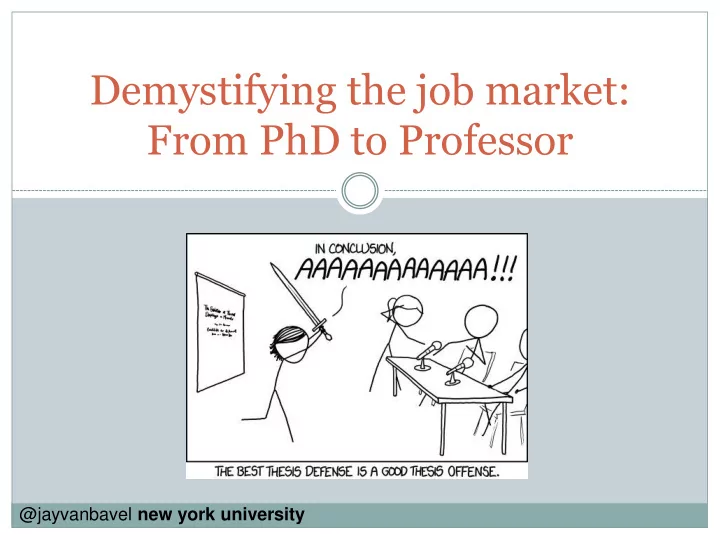
The stuff of nightmares!
SLIDE 3 Overview
Section I: Job Search
Postdocs
Academic Jobs
Section II: Application materials
Research statement
Teaching statement
CV
Cover letter
Section III: Interviewing
Preparation
In vivo
Section IV: Negotiations
Preparing a budget
Justification
Negotiation
SLIDE 4 Overview
Section I: Job Search
Postdocs Academic Jobs
SLIDE 5
GOAL
Find a good job that makes you happy and fulfilled
SLIDE 6
After graduation
SLIDE 7
To post doc or not to post doc
SLIDE 8
To post doc or not to post doc
Hone your skills or acquire a new skill Build your contacts and collaborators, Let your papers come out Write up data Navigate the job market
SLIDE 9 The difference between good and bad post docs
The hierarchy of post docs:
1.
Self-funded (SSHRC, NRSA)
2.
Grant-funded
3.
Teaching funded (or worse, adjunct)
4.
Pro bono
How do you set one up?
Talk to your advisor Network Be assertive! Plan early
SLIDE 10
The job market: The problem
In a typical year in the United States, nearly 400 new
students enter into social psychology doctoral- training programs (APA, 2003).
In a typical year in the United States, about 25
assistant professor positions in social psychology PhD programs are advertised.
About 5 to 10% of new social psychology PhD
students follow their trainers’ career paths (Ferguson, 2005).
SLIDE 11 Downward mobility
High competition makes
academia downwardly mobile
Undergraduate Graduate Faculty Tenure
SLIDE 12 The job market: Some solutions
Consider alternative institutions:
Research 1 Universities(108) – UofA, UofT, OSU, NYU Research 2 Universities (99) Research 3 Universities (90) Masters Colleges and Universities (727) Baccalaureate Colleges (809) Associates Colleges (~2000)
SLIDE 13
SLIDE 14
The job market: Some solutions
Find your sweet spot Talk to your advisor
Psychology Job Wiki: psychjobsearch.wikidot.com
SLIDE 15 The job market: Some solutions
Consider alternative fields:
Business Schools (e.g., Marketing or Organizational Behavior) Political Science Public Policy Schools Social Work Programs Communication Education Sociology Medical Schools Neuroscience Psychology is a mass exporter (ie hub discipline)
SLIDE 16 Prepare yourself!
There are great post docs in these fields (esp.
Business)
Start thinking about this early, if possible
Attend conferences Read these journals (and publish in them, if possible) Get the right experiences (e.g., teaching)
Find the right fit for yourself, and tailor your
application
SLIDE 17
Dream job vs. starter job Go somewhere where you can be successful (e.g.,
large subject pool, course reductions, etc)
The job market: Some solutions
SLIDE 18
The Job market: Some solutions
Be willing to move for
your first job
SLIDE 19 The Job market: Some solutions
Consider great jobs in other countries:
USA: psychjobsearch.wikidot.com Canada:
https://www.academicwork.ca/en_search_results.asp?keyw=psych
- logy&lang=E&Search.x=0&Search.y=0
UK: www.jobs.ac.uk NL: www.academictransfer.com AUS: http://www.psychoneuroxy.com/announcements,a.html EASP: http://www.easp.eu/job-offers/ Euro:
http://wiki.mgto.org/doku.php/management_and_psychology_aca demic_job_search_websites#europe
SLIDE 20
The Job market: Some solutions
Do some soul searching about your priorities
SLIDE 21 Overview
Section I: Job Search
Postdocs Academic Jobs
Section II: Application materials
Research statement Teaching statement CV Cover letter
SLIDE 22
GOAL
Have materials that 4-5 very busy people want to
read
Stand out sufficiently from your peers to earn an
interview
SLIDE 23
Plan your year
Create a scholar for yourself
SLIDE 24
Research statement
Be coherant (try to find a common theme)
SLIDE 25
Research statement
Be coherant (try to find a common theme) Talk about your main lines of research Include paragraphs on future directions Highlight your unique strengths (don’t focus on what you
have in common with other applicants, like coursework, focus on what makes you distinctive)
Feel free to talk about special aspects of your approach
(e.g., stats/methods, social neuro, open science)
Looks good at glance & deep read
BOTTOM LINE: Who cares?
SLIDE 26
Analyze the value of your research
SLIDE 27
What will readers learn about that they did not know
(or could not have known) before?
Why is that knowledge important for the field? How are the claims made in the article justified by
the methods used?
Analyze the value of your reasearch
SLIDE 28
Ask yourself: Who cares?
1)
Highlight theoretical contribution
2) Highlight practical contribution
SLIDE 29 Teaching statement
Teaching philosophy
Start abstract Make it concrete
Teaching experience
Quality > quantity Be specific in terms of practices Report teaching evaluations
Courses you can teach
Align to job ad Service courses are ideal
SLIDE 30 CV
Appointments and Education Awards Research
Statement Publications (in print, under review, in prep) Presentations (colloquia, symposia, conference talks, posters)
Teaching
Classes (with evaluations) Teaching assistant work Mentoring (esp. stats and undergrad awards)
Service
Field, university, department
SLIDE 31 Cover letter
Create a template letter Highlight research, teaching and other strengths
(methods, service, awards, etc.)
Mention aspects of fit (tailor letter to each school)
Resources that are unique for your research Personal connection to the place (school or city) Faculty you are excited about as colleagues/collaborators Alignment with features in job ad
SLIDE 32 Reference letters
Get at least three from your mentors/collaborators
Ask them at least a month in advance Email them all your materials (invite feedback) Send them one-paragraph summaries of your (a) research, (b)
teaching and (c) service strengths plus (d) your relationship to them
Set up a meeting in person Ask them if they can write a good letter Ask them what they need from you to make their life easier Coordinate with them to highlight issues on your behalf
SLIDE 33 Internet presence
Create a website
Include a research/teaching statement A link to your CV A professional picture
Social media is a double edged sword
Keep it professional Delete your political diatribes (until you have tenure) Think twice about blogging
SLIDE 34 The Job market: Some solutions
Apply multiple years
Apply selectively in your first year, then broader each year
Network aggressively (give lots of GREAT talks)
You want them to think, “Oh, Jay applied” when they go
through the 100-200 applications.
Get materials from successful colleagues Treat writing your materials like writing a paper
Get advisor to edit Pass around with other students on the job market
SLIDE 35
The Job market: Some solutions
Do good work: People will read it!
SLIDE 36 Overview
Section I: Job Search
Postdocs Academic Jobs
Section II: Application materials
Research statement Teaching statement CV Cover letter
Section III: Interviewing
Preparation In vivo
SLIDE 37
GOAL
Create impression that you will be a successful and
pleasant colleague
SLIDE 38
Practice your job talk extensively and get tons of
feedback
Ask your contact for format for talk(s) Buy a slick outfit that makes you feel good Get your meeting schedule Prepare for interviews by reading ~10 abstracts from
each person you will meet Pro-tip: Start preparing before you get an interview
Preparation
SLIDE 39 Be normal: people want an engaging colleague they
can hang out with for 10-30 years, not a jerk or a name-dropper
Dress nice, act your age, be a decent human being Turn your talks to common interests (research at R1) Have a vision for the future of your career (teaching, grants) Come prepared with questions (be assertive and engaged) Ask about their research (but don’t be naïve)
Secret: most faculty aren’t prepared for these and just want to pass the 30 minutes without awkward silence
Meetings
SLIDE 40
Standard is 50 minute talk Make elegant slides, with clear narrative Include necessary details (e.g., error bars, effect
sizes, citations, etc)
Outline future directions (be concrete, if possible) Be non-defensive and receptive to suggestions Prepare for obvious questions Act like a faculty member, not a student (don’t keep
talking about your dissertation)
(I move acknowledgments to the end)
Job Talk
SLIDE 41
Some schools have teaching or chalk talks Don’t get trashed at the dinner (you are still on the
interview)
Feel free to ask about personal issues (e.g., where do
most faculty live, what is departmental culture, etc).
Save questions about salary and personal resources
for AFTER you get an offer
Follow-up with people after you get home (but don’t
be annoying)
All of these tips apply for phone interviews
Miscellaneous
SLIDE 42 Overview
Section I: Job Search
Postdocs
Academic Jobs
Section II: Application materials
Research statement
Teaching statement
CV
Cover letter
Section III: Interviewing
Preparation
In vivo
Section IV: Negotiations
Preparing a budget
Justification
Negotiation
SLIDE 43
GOAL
Create a win-win situation where you obtain the
resources you need to get tenure and the chair gets to successfully recruit their top candidate
SLIDE 44 Negotiations
Read a few articles on negotiation!
Make the chair/dean like you (learn their needs)
Find out what is reasonable to request (ask around)
Ask for everything you need (but justify every item)
Negotiate everything:
Salary (+summer salary) Research costs (equipment and staff) Course releases (+course preps) Miscellaneous (housing, spouse, deferral, deadline, etc)
Talk to a mentor when you get an offer!
SLIDE 45
SLIDE 46 Psychology Faculty Salaries
5 10 15 20 25
SLIDE 47
Other non-linear distributions
SLIDE 48
Other non-linear distributions
Brilliant versus weaker students Brilliant versus weaker colleagues Teaching two versus eight courses per year Start-ups range from $1,500 to $1,500,000 no grad students versus free phd students No testing rooms to a MRI scanner in the basement No travel versus paid trips around the world Obscurity versus giant soapbox
SLIDE 49
Other reading
http://web.uvic.ca/~dslind/sites/default/files/Goals
%20for%20Academiabound%20psych%20grad%20s tudents_0.pdf