Delegation with Updatable Unambiguous Proofs and PPAD-Hardness - - PowerPoint PPT Presentation

β–Ά
delegation
SMART_READER_LITE
LIVE PREVIEW

Delegation with Updatable Unambiguous Proofs and PPAD-Hardness - - PowerPoint PPT Presentation

Delegation with Updatable Unambiguous Proofs and PPAD-Hardness Lisa Yang MIT Based on joint work with Yael Tauman Kalai and Omer Paneth time computation = ? Delegation () = y Proof checks in time

slide-1
SLIDE 1

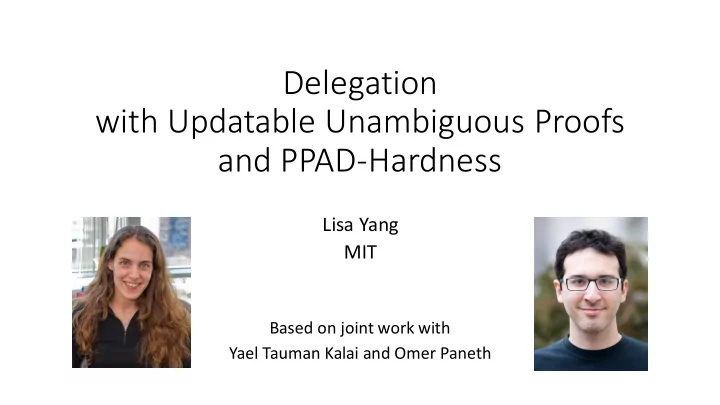
Delegation with Updatable Unambiguous Proofs and PPAD-Hardness

Lisa Yang MIT

Based on joint work with Yael Tauman Kalai and Omer Paneth

slide-2
SLIDE 2

Delegation

𝑁(𝑦) = y Proof Ξ  Can verifying be faster than computing? time π‘ˆ computation 𝑁 𝑦 = ? π‘Š checks Ξ  in time β‰ͺ π‘ˆ

slide-3
SLIDE 3

Publicly Verifiable Delegation

𝑁(𝑦) = y Proof Ξ 

𝐷𝑆𝑇

slide-4
SLIDE 4

Prior Work: Publicly Verifiable Delegation

Strong assumptions

  • Random Oracle Model

[Micali94]

  • Knowledge assumptions
  • Indistinguishability Obfuscation
  • Multilinear maps

[Paneth-Rothblum17]

Delegation for bounded-depth circuits via Fiat-Shamir

  • Optimal security of LWE

[Canetti-Chen-Holmgren-Lombardi-Rothblum-Rothblum-Wichs19]

  • Sub-exponential LWE

[Kalai-Zhang20]

Delegation for polynomial-time computations

  • Bilinear groups

[Kalai-Paneth-Y19] [Groth10, Lipma12, Gennaro-Gentry-Parno-Raykova12, Bitansky- Canetti-Chiesa-Tromer12, Bitansky-Chiesa-Ishai-Ostrovsky-Paneth13…] [Bitansky-Sanjam-Lin-Pass-Telang14,Canetti-Holmgren-Jain- Vaikuntanathan14,Koppula-Lewko-Waters14, Canetti- Holmgren16, Chen-Chow-Chung-Lai16]

slide-5
SLIDE 5

π·π‘ˆ … 𝐷𝑀𝑗+1 𝐷𝑀𝑗 𝐷0

Updatable Proofs [Valiant08]

Consider a long computation 𝐷0 β†’ π·π‘ˆ carried

  • ut over 𝐢 iterations

Updatable Proofs: update Π𝑗 into Π𝑗+1 Want the proof update to take time ~ computation performed Want proofs to remain succinct

[Bitansky-Canetti-Chiesa-Tromer13] using SNARKs

(based on strong assumptions)

Π𝑗 Π𝑗+1

slide-6
SLIDE 6

Unambiguous Proofs

𝑁(𝑦) = y Proofs Ξ  β‰  Ξ β€²

𝐷𝑆𝑇 Unambiguous Proofs: π‘„βˆ—(𝐷𝑆𝑇) cannot output Ξ  β‰  Ξ β€² for the same statement 𝑁 𝑦 = 𝑧 (except with negligible probability over 𝐷𝑆𝑇)

[Reingold-Rothblum-Rothblum]

slide-7
SLIDE 7

Our Results: Delegation

Delegation with updatable and unambiguous proofs based on the decisional bilinear group assumption:

For a bilinear group 𝐻 of order π‘ž = 2Θ(πœ†) and 𝛽 = 𝑃(log πœ†) given for random 𝑕 ∈ 𝐻 and 𝑑 ∈ β„€π‘ž it is hard to distinguish whether 𝑒 = 𝑑2𝛽+1 or 𝑒 is an independent random element in β„€π‘ž.

[Kalai-Paneth-Y19]

slide-8
SLIDE 8

Our Results: PPAD-Hardness

PPAD-Hardness based on:

  • 1. The quasi-polynomial hardness of KPY’s bilinear group assumption
  • 2. Any hard language 𝑀 decidable in super-polynomial time (and

polynomial space)

  • For example, the hardness of SAT for sub-exponential size circuits

(non-uniform ETH) suffices

[Choudhuri-Hubacek-Kamath-Pietrzak-Rosen-Rothblum19]

slide-9
SLIDE 9

Related Work: PPAD-Hardness

Strong assumptions

  • Indistinguishability Obfuscation
  • Functional Encryption assumptions [Garg-Pandey-Srinivasan16, Komargodski-Segev17]

Fiat-Shamir interactive protocol for a particular language

  • Security of Fiat-Shamir/Optimal security of LWE
  • Sub-exponential LWE

Polynomial Local Search (PLS) Hardness

[Abbot-Kane-Valiant04, Bitanski-Paneth-Rosen15, Hubacek-Yogev17] [Choudhuri-Hubacek-Kamath-Pietrzak-Rosen- Rothblum19, Ephraim-Freitag-Komargodski-Pass19] [Lombardi-Vaikuntanathan20, Kalai-Zhang20, Jawale-Khurana20] [Bitansky-Gerichter20]

slide-10
SLIDE 10
  • 1. Delegation with Updatable Proofs
  • Use recursive proof composition
  • Without strong assumptions!

Local extraction [Kalai-Paneth-Y19]

slide-11
SLIDE 11

𝐷𝑀𝐢 … 𝐷𝑀2 𝐷𝑀1 𝐷0 𝐷𝑀𝐢 Verify Π𝐢 … 𝐷𝑀2 Verify Ξ 2 𝐷𝑀1 Verify Ξ 1 𝐷0 Ξ β€² Ξ 1 Π𝐢 Ξ 2 … 𝑁𝑓𝑠𝑕𝑓 π·π‘€π‘—βˆ’1, Π𝑗, 𝐷𝑀𝑗 π‘—βˆˆ[𝐢] replaces this with 𝐷0, Ξ β€², 𝐷𝑀𝐢

  • 1. Delegation with Updatable Proofs

Ξ  contains 𝐢 proofs Π𝑗:π·π‘€π‘—βˆ’1 β†’ 𝐷𝑀𝑗

Ξ β€² β‰ͺ Ξ 1 + β‹―+ |Π𝐢|

nondeterministic Ξ : 𝐷0 β†’ 𝐷𝑀 Update Ξ : Append proof for computation performed Proof grows!! Local extraction suffices!

slide-12
SLIDE 12

Ξ  = ?

π‘Ÿ1 𝑏1 π‘Ÿπ‘™ 𝑏𝑙 𝐷𝑆𝑇 encoded computation tableau

𝑁 𝑦 = 𝑧

𝑧 𝑦

π‘ˆ π‘Š checks Ξ  using Zero-Test

[Paneth-Rothblum17]

Homomorphic encryption

KPY Delegation

𝑏 = 𝐺(π‘Ÿ)

slide-13
SLIDE 13
  • 2. Delegation with Unambiguous Proofs
  • Observation: need to use encryption with unambiguity property
  • Unambiguity of Ciphertexts: any π‘„βˆ—(𝐷𝑆𝑇) cannot generate two

different ciphertexts that encrypt the same message

  • KPY Encryption:
  • 𝑑𝑙 = 𝑑 ← 𝔾
  • 𝑑 = 𝑕𝑆 ∈ 𝔾[𝑦]
  • π‘„βˆ— ↛ 𝑑 = 𝑕𝑆,𝑑′ = 𝑕𝑆′ such that 𝑆 𝑑 = 𝑆′ 𝑑 = 𝑛
  • Unambiguous Proofs: suffices to ensure unambiguity of answers

𝑆 𝑑 = 𝑛

slide-14
SLIDE 14
  • 2. Unambiguity of Answers
  • [Kalai-Raz-Rothblum14] for π‘Ÿ ∈ 0,1 β„“ answers are unambiguous
  • Need unambiguous answers for π‘Ÿ ∈ 𝔾ℓ
  • Observation: If 𝑄 evaluates a multilinear polynomial then can

show unambiguity of answers for every π‘Ÿ ∈ 𝔾ℓ

  • Idea: Ask 𝑄 to send a β€œproof of multilinearity” for his

evaluated ciphertexts

𝑧 𝑦

π‘ˆ

Notion of local multilinearity!

𝑏 = 𝐺(π‘Ÿ)

slide-15
SLIDE 15

Proof of Local Multilinearity

  • 𝑄 homomorphically evaluates 𝐺(π‘Ÿ1 … π‘Ÿβ„“)
  • First attempt: ask 𝑄 for the restriction of 𝐺 in each coordinate

Evaluate encryptions of (𝐡𝑗, 𝐢𝑗) such that 𝐺 Τ¦ π‘Ÿ = 𝐡𝑗 β‹… π‘Ÿπ‘— + 𝐢𝑗 π‘Š checks consistency using the Zero-Test

  • Problem: π‘„βˆ— can compute (𝐡𝑗, 𝐢𝑗) using πΉπ‘œπ‘‘(π‘Ÿπ‘—)
  • Idea: encrypt Τ¦

π‘Ÿ again without 𝑗'th coordinate Ask 𝑄 for 𝐡𝑗

β€²,𝐢𝑗 β€²

  • Test that 𝐡𝑗, 𝐢𝑗 = 𝐡𝑗

β€²,𝐢𝑗 β€²

β€œProof of Equality” 𝑄 evaluated same function on both encryptions

slide-16
SLIDE 16

Delegation with Updatable Unambiguous Proofs

Not done yet… To show unambiguity of entire proof:

  • Unambiguity of other ciphertexts in KPY proof
  • Unambiguity of ciphertexts we added ☺

Equality and Multilinearity proofs

  • Show unambiguity preserved in recursive proof composition

Updatable proofs

slide-17
SLIDE 17

Summary

  • Our Results:
  • Delegation with updatable and unambiguous proofs based on

the KPY bilinear group assumption

  • PPAD-Hardness based on the quasi-polynomial hardness of the

KPY bilinear group assumption (and any hard language)

  • Power of local proofs:
  • recursive proof composition (updatable proofs)
  • proof of multilinearity (unambiguous proofs)

Standard assumptions!

slide-18
SLIDE 18

Thank you!

lisayang@mit.edu