Delaying Surgery After Acute MI A 63-year-old man suffers an acute - - PDF document

delaying surgery after acute mi
SMART_READER_LITE
LIVE PREVIEW

Delaying Surgery After Acute MI A 63-year-old man suffers an acute - - PDF document

Updates and Controversies in Perioperative Medicine How long should we delay surgery after: Updates and Controversies in Acute myocardial infarction? Perioperative Medicine Drug-eluting stent implantation? Ischemic stroke? Which


slide-1
SLIDE 1

1 Updates and Controversies in Perioperative Medicine

Hugo Quinny Cheng, MD

Division of Hospital Medicine University of California, San Francisco

Updates and Controversies in Perioperative Medicine

How long should we delay surgery after:

  • Acute myocardial infarction?
  • Drug-eluting stent implantation?
  • Ischemic stroke?

Which patients need bridging anticoagulaion? Postoperative anemia:

  • How much evaluation is needed?
  • When should patients be transfused?

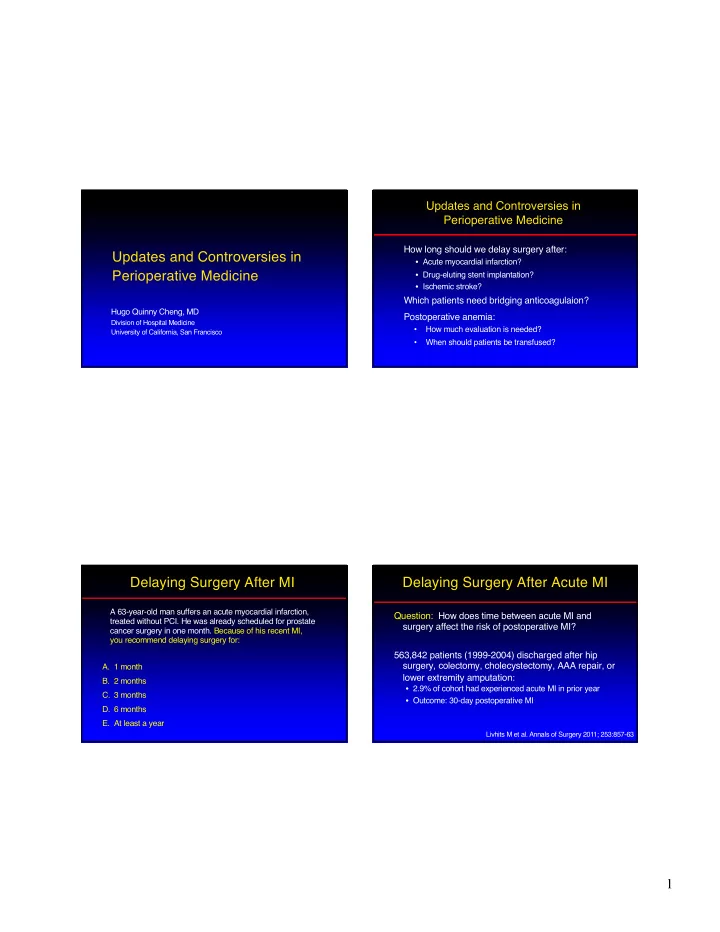
Delaying Surgery After MI

A 63-year-old man suffers an acute myocardial infarction, treated without PCI. He was already scheduled for prostate cancer surgery in one month. Because of his recent MI, you recommend delaying surgery for:

  • A. 1 month
  • B. 2 months
  • C. 3 months
  • D. 6 months
  • E. At least a year

Delaying Surgery After Acute MI

Question: How does time between acute MI and surgery affect the risk of postoperative MI? 563,842 patients (1999-2004) discharged after hip surgery, colectomy, cholecystectomy, AAA repair, or lower extremity amputation:

  • 2.9% of cohort had experienced acute MI in prior year
  • Outcome: 30-day postoperative MI

Livhits M et al. Annals of Surgery 2011; 253:857-63

slide-2
SLIDE 2

2 Delaying Surgery after Acute MI

0% 5% 10% 15% 20% 25% 30% 35%

< 30 31-60 61-90 91-180 181-365

30-Day Postop MI

Time (days) Between Acute MI & Surgery

How Long to Wait after MI?

Conclusions:

  • Surgery within one year of acute MI associated with high

risk of postoperative MI

  • Risk falls over time; most of the reduction within 2 months
  • Trend is similar when only elective surgery considered

Caveats:

  • Nonrandomized, observational study

ACC/AHA Guidelines:

  • Delay elective surgery for at least 2 months after MI

Surgery After Drug Eluting Stent

A 75-y.o. man sustains an unstable cervical spine

  • fracture. He had a drug-eluting stent placed 3

months ago for stable angina. The spine surgeon wants to operate, but putting him in a halo vest is a less desirable alternative approach. What do you recommend?

  • 1. Operate now; 3 months is fine
  • 2. Wait 6 months after DES placed
  • 3. Wait 12 months after DES placed

Effect of Stent Type & Time After Implantation

Time of surgery after PCI didn’t matter after first 6 months

20% 15% 10% 5%

60 120 180 240 300 360 6 months Time between PCI & Surgery Complications Bare Metal Drug Eluting

Hawn MT et al. JAMA. doi:10.1001/jama.2013.278787

slide-3
SLIDE 3

3 ACC/AHA Guidelines for PCI

  • Indications for PCI are same as for nonsurgical patients
  • Avoid PCI if antiplatelet drugs will need to be held prematurely
  • Delay elective surgery after elective PCI at least:

Bare metal stent: 30 days Drug eluting stent: 6 months (optimal) 3 months (if harm in delay)

  • Continue or restart antiplatelet agents (especially ASA) as

soon as hemostasis permits

Delaying Surgery After Stroke

A 63-year-old man suffers an acute stroke that is managed without thrombolysis. Brain MRI incidentally detects a large

  • meningioma. The neurosurgeon wants to resect the tumor in

2 weeks. Because of his stroke, you recommend delaying surgery for:

  • A. 1 month
  • B. 3 months
  • C. 6 months
  • D. 9 months
  • E. At least a year

Delaying Surgery After Stroke

Question: How does time between stroke and surgery affect the risk of cardiovascular complications? Danish cohort study of all adults undergoing elective noncardiac surgery from 2005-2011:

  • 7137 patients had prior stroke (1.5% of total cohort)
  • Outcome: 30-d postop Major Adverse Cardiac Events

(MACE): cardiovascular death, nonfatal MI, ischemic stroke

  • Looked at effect of time since stroke on MACE rate

Jorgenson ME et al. JAMA 2014; 312:269-277

Delaying Surgery After Stroke

0% 5% 10% 15% 20% < 3 months 3-6 months 6-12 months > 12 months

CV Death Ischemic Stroke Acute MI

MACE Incidence

Time Between Acute Stroke & Surgery

slide-4
SLIDE 4

4 How Long to Wait after CVA?

Conclusions:

  • Surgery after CVA associated with high CV risk
  • Risk falls over 9 months, biggest drop after first 3 months

Caveats:

  • Nonrandomized, observational study

My take-away:

  • Delay elective surgery for at least 3 months (up to 9

months) if possible

Managing Perioperative Anticoagulation

Two patients on warfarin therapy are scheduled for elective hip

  • arthroplasty. You’re asked whether they should receive

perioperative bridging anticoagulation (with enoxaparin):

  • One patient has atrial fibrillation due to hypertension
  • The other patient has a St. Jude mechanical AVR
  • Neither has any other relevant comorbidity
  • 1. Bridge for AVR only
  • 2. Bridge for AF only
  • 3. Bridge for both
  • 4. Bridge for neither

Benefits & Harm of Bridging Perioperative Anticoagulation

Benefit from thromboembolism averted by bridging Harm from postoperative bleeding caused by bridging

BRIDGE Trial

Patients:

  • 1884 patients on warfarin for atrial fib or flutter
  • CHADS-2 score > 1
  • Excluded patients with mechanical valve or stroke within

12 weeks and cardiac & neurologic surgery

Intervention:

  • Randomized to bridging with LMWH or placebo

Outcome:

  • 30-day risk of arterial thromboembolism & bleeding

Douketis JD et al. NEJM, 2015; 373:823-33

slide-5
SLIDE 5

5 BRIDGE Trial

Bridged No Bridge Embolic Event 0.3% 0.4%

Non-inferior

Major Bleeding 3.2% 1.3% NNH = 53 Minor Bleeding 21% 12% NNH = 12

Douketis JD et al. NEJM, 2015; 373:823-33

BRIDGE Trial for Atrial Fibrillation

Conclusions:

  • Bridging did not reduce risk of embolism
  • Bridging increases bleeding risk

Caveats:

  • Few patients with high CHADS-2 score (mean = 2.3)

My take-away:

  • Don’t bridge majority of atrial fibrillation
  • Carefully consider bridging if stroke risk is very high

(CHADS-2 score 5 or 6, rheumatic atrial fibrillation)

What About Mechanical Valves?

0% 1% 2% 3% 4% 5% 6% 7%

Without Anticoagulation With Warfarin Atrial Fibrillation Mechanical Valve Thromboembolic Risk (annual)

Cannegieter, et al. Circulation, 1994 Ansell J. Chest. 2004;126:204S-233S.

Effect of Mechanical Valve Location & Design on Thromboembolic Risk

Valve Location:

Aortic RR = 1.0 Mitral RR = 1.8

Valve Design:

Caged Ball RR = 1.0 Tilting Disk RR = 0.7 Bi-leaflet RR = 0.6

Cannegieter, et al. Circulation, 1994

slide-6
SLIDE 6

6

Perioperative Anticoagulation:

2012 ACCP Guidelines (9th Edition)

Atrial Fib. Mechanical Valve Recommendation

CHADS2 = 5-6; recent CVA; rheumatic AF Any MVR; older (caged- ball or tilting disc) AVR; recent CVA Bridge with heparin CHADS2 = 3-4 Bileaflet AVR plus other stroke risk factor(s) ??? CHADS2 = 0-2 Bileaflet AVR without AF or

  • ther stroke risk factor

No heparin bridge

Perioperative Anticoagulation:

My Approach after BRIDGE Trial

Atrial Fib. Mechanical Valve Recommendation

CHADS2 = 5-6; recent CVA; rheumatic AF Any MVR; older (caged- ball or tilting disc) AVR; recent CVA

Consider bridging

CHADS2 = 3-4 Bileaflet AVR plus other stroke risk factor(s)

No bridge

CHADS2 = 0-2 Bileaflet AVR without AF or

  • ther stroke risk factor

What About Venous Clots?

Time Since Venous Thromboembolic Event Risk of Recurrent VTE

What About Venous Clots?

Retrospective cohort study

  • 1178 patients on warfarin for DVT or PE
  • Outcome: 30-day recurrent clotting & significant bleeding

Bridged No Bridge Hazard Ratio Recurrent VTE

0% 0.2% ns

Bleeding

2.7% 0.2% 17 (4-75)

Clark NP et al. JAMA Int Med, 2015; 175:1163

slide-7
SLIDE 7

7 How About Venous Clots?

Conclusions:

  • Recurrent VTE is rare & bridging didn’t affect risk
  • Bridging increases bleeding

Caveats:

  • Nonrandomized study, so selection bias
  • Few patients were considered high-risk for recurrence

My practice:

  • Bridge or place temporary IVC filter only in high-risk group

Clark NP et al. JAMA Int Med, 2015; 175:1163

Venous Clots: 2012 ACCP Guideline

Risk of Recurrent VTE Recommendation

High Risk: VTE < 3 months ago; Severe thrombophilia

Bridge

Medium Risk: VTE 3-12 months ago; recurrent VTE; VTE with cancer other thrombophilia

Case-by-case decision

Low: Single VTE > 12 months ago

No bridge Risk of Recurrent VTE Recommendation

High Risk: VTE < 3 months ago; Severe thrombophilia

Consider bridging

  • r IVC filter

Medium Risk: VTE 3-12 months ago; recurrent VTE; VTE with cancer other thrombophilia

No bridge

Low: Single VTE > 12 months ago

Venous Clots: My Approach Postoperative Anemia

You visit a 79-year-old woman on postoperative day #1 after hip fracture repair. You notice her hemoglobin dropped from 11.6 g/dL before surgery to 8.5 g/dL today. The operative note reports an EBL (estimated blood loss) of 300 mL. Which of the following actions is most likely to be useful?

  • 1. Labs to rule out coagulopathy
  • 2. Labs to rule out hemolysis
  • 3. CT to rule out retroperitoneal

hematoma

  • 4. No work-up; the EBL is wrong
slide-8
SLIDE 8

8 Estimated & Actual Blood Loss

Estimated Blood Loss (EBL):

  • Based on suctioned blood and weight of sponges
  • Poor repeatability and inter-observer variability

Actual Blood Loss (ABL):

  • Calculated value based on patient’s estimated blood

volume and change in hemoglobin level ABL = Estimated Blood Volume x Δ Hct (Initial Hct + Final Hct)/2

EBL versus ABL

Procedure Estimated Blood Loss Actual Blood Loss Total Hip Arthoplasty 362 mL 1383 mL Total Knee Arthroplasty 159 1067 Posterior Spinal Fusion 975 1606 Retropubic Prostatectomy 1300 1794

Table courtesy Barbara Slawski, MD (Medical College of Wisconsin)

Postoperative Anemia

You visit a 79-year-old woman on postoperative day #1 after hip fracture repair. You notice her hemoglobin dropped from 11.6 g/dL before surgery to 8.5 g/dL today. She has no complaints other than moderate hip pain. Vital signs stable. When should she receive red blood cell transfusion?

  • 1. Now
  • 2. Now, if she has CV disease
  • 3. Wait until hemoglobin < 8 g/dL
  • 4. Wait until hemoglobin < 7 g/dL

FOCUS* Trial

(*Functional Outcomes in Cardiovascular Patients Undergoing Surgical Hip Fracture Repair)

Patients: 2016 patients undergoing hip fracture repair.

  • Mean age = 82
  • 63% with CV disease (CAD (40%); CVA (24%); CHF(17%))

Treatment: Randomized to 2 transfusion triggers:

  • 1. Hemoglobin < 10 g/dL
  • 2. Symptoms of anemia (chest pain, CHF, hypotension or

tachycardia unresponsive to fluids) or at physician discretion for Hgb < 8 g/dL

Carson JL et al. NEJM, 2011; 365

slide-9
SLIDE 9

9 FOCUS Trial Results

Median PRBC Units Transfused

(IQR)

Total Units Transfused 10 g/dL Trigger

2 (1,2) 1866

Symptomatic Trigger (or 8 g/dL)

0 (0,1) 652

Carson JL et al. NEJM, 2011; 365

FOCUS Trial Results

In-hospital mortality 60-day mortality 60-day mortality or disability 3-year mortality 10 g/dL Trigger

2.0% 7.6% 35% 46%

Symptom Triggered

1.4% 6.5% 35% 45%

Carson JL et al. NEJM, 2011; 365 Carson JL et al. Lancet, 2015; 386

AABB Transfusion Guidelines

The society formerly known as the American Association

  • f Blood Banks:

“For patients undergoing orthopedic surgery or cardiac surgery and those with preexisting cardiovascular disease, the AABB recommends RBC transfusion threshold of 8 g/dL hemoglobin.” Strong recommendation; moderate evidence

  • JAMA. doi:10.1001/jama.2016.9185

Conclusions

  • Recent MI & stroke predicts postoperative cardiac events,

especially within first 2 (for MI) or 3 (for stroke) months

  • Wait 6 months after DES implantation before going for

elective surgery (3 months if surgery is time-sensitive)

  • Bridging anticoagulation not indicated for most patients

with atrial fibrillation, mechanical valves, or VTE.

  • Possible exceptions CHADS2 = 5-6, MVR, acute VTE
  • They call it an “estimated” blood loss for a reason
  • Transfuse after surgery for hemoglobin < 8 g/dL
slide-10
SLIDE 10

10

Thank You

quinny.cheng@ucsf.edu