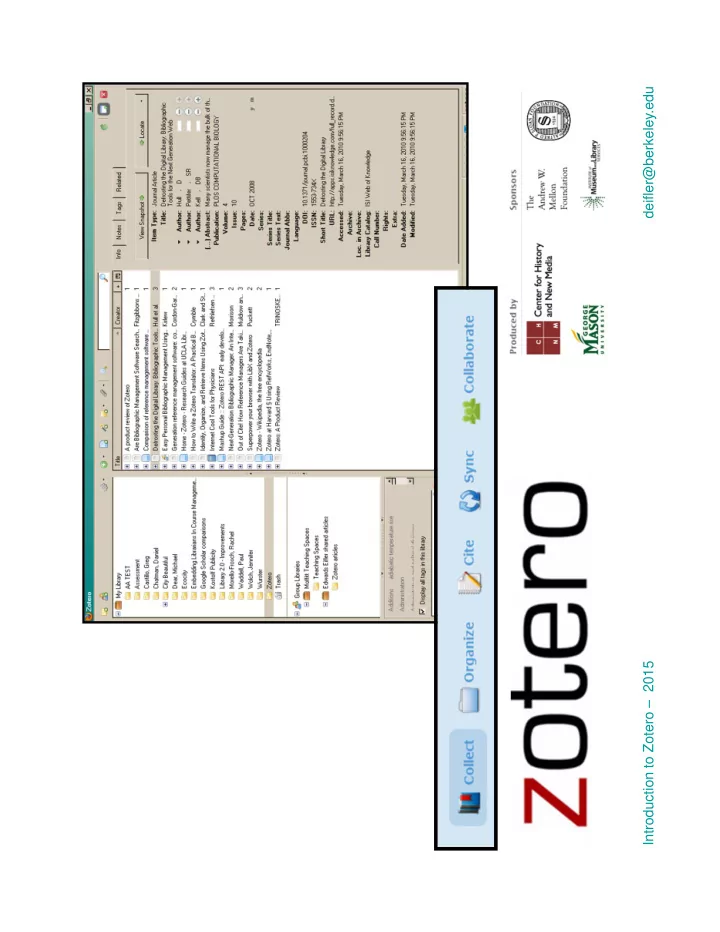
SLIDE 1
Introduction to Zotero – 2015 deifler@berkeley.edu
SLIDE 2 Introduction to Zotero – 2015 deifler@berkeley.edu
Citation Management
http://refworks.com/ (online only) http://www.mendeley.com/ (local and online) www.zotero.org/ (chrome, firefox, safari)
- Available to UC Berkeley users “free
for life” (paid by UCB)
- Entirely web-based, so it can be
used on all operating systems, at any computer
- Format bibliographies in Word
- Allows for citation sharing for
collaborative projects
- Data entry “cludgy”
- Does not synch to local computer
- Owned by ISI Reuters Thompsen
- Free to users; for-profit with
indeterminate funding model
- Allows for mass import of PDFs
- Can highlight and annotate PDFs from
within the program
- Makes recommendations based on
cloud-sourcing
- Good collaborative citation sharing
- Poor with new media (video, interviews,
email, etc) formats
- Data entry easy
- Owned by Elsevier
- Free and open source to all
- Syncs with online server to allow
collaboration and backup
- Easy data entry
- Designed for new media (email,
websites, blog posts, maps, etc.)
- Easy to add notes, attach .pdf’s,
and take “snapshots” of web pages for posterity
- Drag and drop citations.
- Easy collaboration
- Open source, supported by IMLS
Spend your time writing, not managing citations.
SLIDE 3 Introduction to Zotero – 2015 deifler@berkeley.edu
Citation Management Made Easy
software eases task of collecting, managing and publishing bibliographies.
(blogs, emails, YouTube, etc.)
- As with all citation managers,
you must check the quality of imported citations…
GIGO = garbage in, garbage out
SLIDE 4 Introduction to Zotero – 2015 deifler@berkeley.edu
Zotero History
- Open and extensible – (General
Public License)
- October, 2006: initial release
- February, 2010: Version 2.0
(server storage and sharing)
Everywhere” with connectors for Chrome and Safari
- April, 2012: Zotero 3.0 for
Firefox AND Standalone
- April, 2013: Zotero 4.0
- June, 2015: Zotero 4.0.27
SLIDE 5
Introduction to Zotero – 2015 deifler@berkeley.edu
UC Berkeley and Harvard Guides
http://guides.lib.berkeley.edu/subject-guide/188-Zotero?p=15929 http://guides.library.harvard.edu/zotero/advanced/
SLIDE 6 Introduction to Zotero – 2015 deifler@berkeley.edu
Installing Zotero http://www.zotero.org/download/
browser OR Standalone for Safari, Chrome or Firefox with connector
editions (e.g. standalone AND embedded Firefox editions)
downloading citations. (Firefox embedded is always “open” in browser window.)
SLIDE 7 Introduction to Zotero – 2015 deifler@berkeley.edu
Opening Zotero
(Firefox, Chrome, Safari)
version, make sure “connectors” have downloaded as well
browser or Standalone version
SLIDE 8
Introduction to Zotero – 2015 deifler@berkeley.edu
Version 4.0 Interface
SLIDE 9
Introduction to Zotero – 2015 deifler@berkeley.edu
What do all those icons mean?
Add new collection (folder) Actions (Preferences) Add new item (33 types) Item by identifier (ISBN, DOI) Add note (standalone or child) Add attachment (snapshot, link, copy) Advanced search Synch with Zotero server Full screen mode Close Zotero (window only) Create a new group (sharing) Lookup (Uce-Links, Google Scholar)
SLIDE 10 Introduction to Zotero – 2015 deifler@berkeley.edu
Adding Items: OskiCat
allows downloading of multiple citations
downloads single monographic citation
- Article icon does the same
for articles
SLIDE 11
Introduction to Zotero – 2015 deifler@berkeley.edu
Adding Items: Melvyl and Amazon
SLIDE 12
Introduction to Zotero – 2015 deifler@berkeley.edu
Adding Items: ProQuest or Google Scholar
SLIDE 13
Introduction to Zotero – 2015 deifler@berkeley.edu
Adding Items: New York Times or YouTube
SLIDE 14 Introduction to Zotero – 2015 deifler@berkeley.edu
Snapshots of web pages
- Search on “green roof”
- Drag and drop article into
appropriate Zotero folder: url and snapshot automatically added
timestamp and actual html of the page… it’s permanent
SLIDE 15
Introduction to Zotero – 2015 deifler@berkeley.edu
Adding Items Manually: 33 formats
SLIDE 16 Introduction to Zotero – 2015 deifler@berkeley.edu
Metadata: Notes and Tags
- Standalone and Child Notes
- Manually add tag
- Some tags added by catalog
subject headings
- Drag item onto tag
- Search tags
SLIDE 17 Introduction to Zotero – 2015 deifler@berkeley.edu
Adding Attachments
- Attach Snapshot of Current
Page allows capturing .html of existing web page.
- Link to Current Page captures
url, but not .html.
- Link to URI (url or uniform
resource name)
- Attach Stored Copy of file for
reading when offline; can delete the original stored copy.
- Link to File saves Zotero server
space but requires access to hard drive where file exists.
- In some databases (e.g. Google
Scholar) you can drag and drop link to .pdf which will attach a stored copy.
SLIDE 18 Introduction to Zotero – 2015 deifler@berkeley.edu
Sorting and Searching for Items
- Sort items in center panel
- Searching basic and
advanced
attached documents, etc.
- Save search for future use
SLIDE 19 Introduction to Zotero – 2015 deifler@berkeley.edu
Outputting a Bibliography 1: Drag ‘n Drop
- Actions Preferences Export
select default output style
- Drag and drop selected items into
any text-based program
- Set new output style when citing
SLIDE 20 Introduction to Zotero – 2015 deifler@berkeley.edu
Bibliography 2: Create from collection
- Highlight desired folder
- Right click and select “Create
Bibliography from Collection”
- Select citation style and output
mode and method (e.g. “copy bibliography to clipboard”)
SLIDE 21 Introduction to Zotero – 2015 deifler@berkeley.edu
Outputting a Bibliography 3: Word Plug-in
- Get word processor plug-in from
actions preferences cite Word Processors install Microsoft Word add-in
- Use icons in Word’s Add-Ins
toolbar to insert citation after selecting citation style
- You can change the style later via
the “set document preferences” icon
SLIDE 22 Introduction to Zotero – 2015 deifler@berkeley.edu
7800 Citation Styles
- Click on “gear” action icon
- Select preferences
- Select “Cite” tab; “Styles”
- Click on “Get additional styles”
- “Install” style you want.
SLIDE 23 Introduction to Zotero – 2015 deifler@berkeley.edu
Retrieving Metadata from PDFs
- Drag and drop PDF into Zotero folder
- Right click on PDF icon
- “Retrieve metadata for PDF” creates an item and puts PDF into it. (first
time you’ll need to add a small add-in)
SLIDE 24 Introduction to Zotero – 2015 deifler@berkeley.edu
Synching with Server and Home
- Synching and sharing requires you
register with Zotero for an account
- Actions Preferences Sync
User name Password
- Reset tab: avoid using this
SLIDE 25 Introduction to Zotero – 2015 deifler@berkeley.edu
Collaborate with Group Libraries
- Must log-in to Zotero.org with
name and password
- Add members, determine privacy,
transfer ownership, determine editing rights, etc.
SLIDE 26 Introduction to Zotero – 2015 deifler@berkeley.edu
Additional Storage Fees
- Unlimited citation information
- First 300 Mb of attachments
Free
- 2 GB - $20/year
- 6 GB - $60/year
- Unlimited - $120/year
- No cost for collaborators
- Instructions for using free storage
- n 3rd party cloud servers in UCB
and Harvard guides
SLIDE 27 Introduction to Zotero – 2015 deifler@berkeley.edu
Some Extras
- For capitalization problems, right click title and choose from Transform Text
menu.
- De-duplication at bottom of collections, or right-click and “Merge Items”
SLIDE 28 Introduction to Zotero – 2015 deifler@berkeley.edu
Search UC-eLinks for full text
- Click on the Action (gear) icon
- Choose Preferences
- Under the “Advanced Tab” in the
OpenURL section, copy the following into the "Resolver" box: http://ucelinks.cdlib.org:8888/sfx_local
http://www.zotero.org/support/locate
- Right arrow above item’s “Locate” tab
will now search UC e-links from “library lookup”
SLIDE 29 Introduction to Zotero – 2015 deifler@berkeley.edu
Creating a Collection Timeline
CreateTimeline
citation data
SLIDE 30 Introduction to Zotero – 2015 deifler@berkeley.edu
Transferring Citations into Zotero
- Export using RIS preferred
- From RefWorks/Endnote
export as either “Bibliographic software” or “BibteX”
- Best to import folder-by-folder
and drag each group of imported items into a new folder in Zotero.
- Check to make sure essential
data came over.
- Princeton guide to importing
and exporting at:
http://libguides.princeton.edu/content.php?pid=30227&sid=230429
SLIDE 31 Introduction to Zotero – 2015 deifler@berkeley.edu
Issues/concerns
- As with any citation manager, you need to review citations for accuracy. It’s
easy to edit citations in Zotero.
- May be more accurate to download citations individually from book or
article icon than as a group via the group folder.
- Remember to use the Zotero Forums first to answer questions
https://forums.zotero.org/categories/
SLIDE 32 Introduction to Zotero – 2015 deifler@berkeley.edu
Zotero Mobile Apps – ZotPad for annotating PDFs; Paper Machines plugin
Zandy is well on its way to being the first full-featured mobile Zotero application for Android devices. Users can currently edit and view their Zotero libraries, add new items, and work offline. Future releases promise even more functionality.
- Scanner for Zotero lets you
add books to your Zotero library from anywhere, with no need to have Zotero installed anywhere. Simply scan a book’s ISBN barcode with your Android phone, and the software will add the book to your Zotero library directly on our servers.
- BibUp allows iPhone users to
add books to their Zotero libraries much like Scanner for Zotero, and it also provides the additional functionality of photographing specific pages to be collected, on which BibUp will even perform OCR.
transfer of Zotero-based PDFs to and from mobile readers like Android devices and the iPad. It builds on the success of the
- riginal ZotFile extension,
which significantly enhances Zotero’s built-in PDF management by automating the attachment of PDFs to Zotero items, and the renaming of those files according to user- configurable rules.
SLIDE 33
Introduction to Zotero – 2015 deifler@berkeley.edu
Creating Communities of Practice