Definitions for Distinct and Complete Integer Partitions Multiset A - - PDF document

definitions for distinct and complete integer partitions
SMART_READER_LITE
LIVE PREVIEW

Definitions for Distinct and Complete Integer Partitions Multiset A - - PDF document

Definitions for Distinct and Complete Integer Partitions Multiset A multiset is a collection of elements (like a set) which can occur with multiplicity (unlike a set). Integer Partition An integer partition of a positive integer n is a


slide-1
SLIDE 1

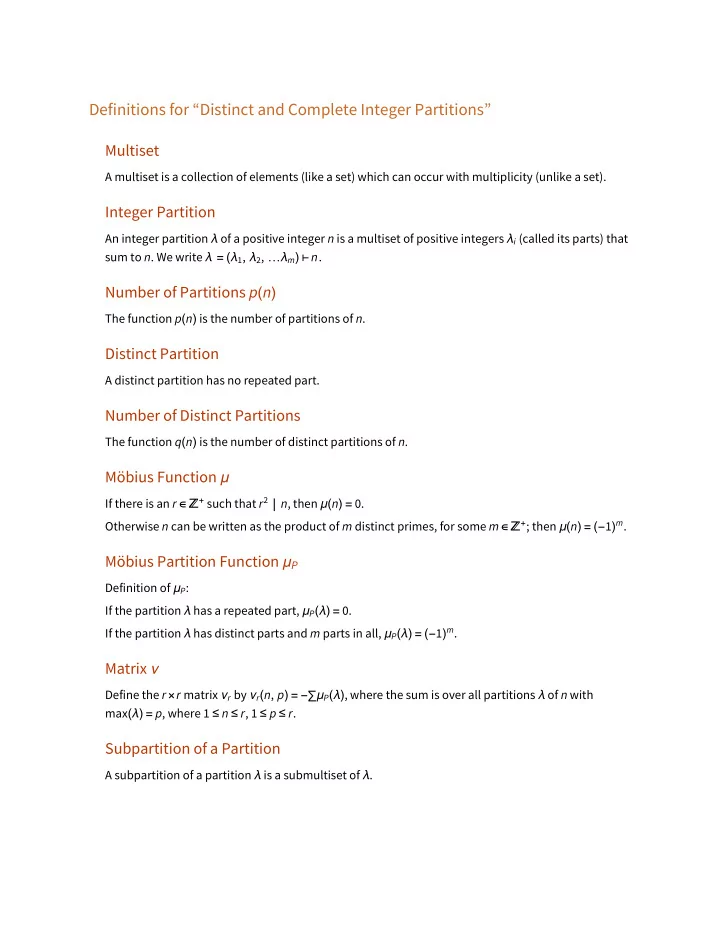
Definitions for “Distinct and Complete Integer Partitions”

Multiset

A multiset is a collection of elements (like a set) which can occur with multiplicity (unlike a set).

Integer Partition

An integer partition λ of a positive integer n is a multiset of positive integers λi (called its parts) that sum to n. We write λ = (λ1, λ2, …λm) ⊢ n.

Number of Partitions p(n)

The function p(n) is the number of partitions of n.

Distinct Partition

A distinct partition has no repeated part.

Number of Distinct Partitions

The function q(n) is the number of distinct partitions of n.

Möbius Function μ

If there is an r ∈ ℤ+ such that r2 n, then μ(n) = 0. Otherwise n can be written as the product of m distinct primes, for some m ∈ ℤ+; then μ(n) = (-1)m.

Möbius Partition Function μP

Definition of μP: If the partition λ has a repeated part, μP(λ) = 0. If the partition λ has distinct parts and m parts in all, μP(λ) = (-1)m.

Matrix ν

Define the r×r matrix νr by νr(n, p) = -∑μP(λ), where the sum is over all partitions λ of n with max(λ) = p, where 1 ≤ n ≤ r, 1 ≤ p ≤ r.

Subpartition of a Partition

A subpartition of a partition λ is a submultiset of λ.

slide-2
SLIDE 2

Subsum of a Partition

A subsum is the sum of a subpartition.

Complete Partition

A partition λ ⊢ n is complete if its subpartitions have all possible subsums 1, 2, 3, …, n.

k-Step Partition

A partition λ = (λ1, λ2, …, λm) to be k-step iff λm ≤ k and for each j, 0 ≤ j ≤ m, we have the inequality λj ≤ k + λj+1 + λj+2 + … + λm. From Park’s condition, a 1-step partition is complete.

Matrix of Number of k-step Partitions

Define l(n, k) to be the number of k-step partitions of n.

Matrix γ

Define the matrix γr by γ(i, j) = l(i - j, j - 1), where i ≤ i ≤ r, i ≤ j ≤ r. That is, the columns of γ are the number of k-step partitions shied down to form a lower-triangular matrix.

Involution β

Let  be the set of distinct partitions and  be the set of complete partitions. Define β :  →  as follows. Let d = (d1, d2, d3, …, dm) ∈  and c = (c1, c2, c3, …) ∈ .

  • 1. If m is even, then β(d, c) = (d1 + d2, d3, …, dm), (d2, c1, c2, c3, …)).
  • 2. If m is odd, then β(d, c) = ((d1 - c1, c1, d2, d3, …, dm), (c2, c3, …)).

Strict Composition

A strict composition of n is a finite sequence of positive integers with sum n.

Matrix σ

Define the r×r matrix σr by σ(n, m) = -∑(-1)# (s), where 1 ≤ n ≤ r, 1 ≤ m ≤ r. The sum is over all strict compositions c of n with maximum part m and # (s) is the number of parts of s.

Matrix α

Let α be the lower-triangular matrix of all 1’s.

2 Summary of Definitions.nb

slide-3
SLIDE 3

Matrix χ

Define the lower-triangular n×n matrix χ by χ(n, k) =  μ  n

k

if k n 0 otherwise where 1 ≤ k ≤ n.

Summary of Definitions.nb 3