Defense Acquisition University Provides a global learning - - PDF document

defense acquisition university
SMART_READER_LITE
LIVE PREVIEW

Defense Acquisition University Provides a global learning - - PDF document

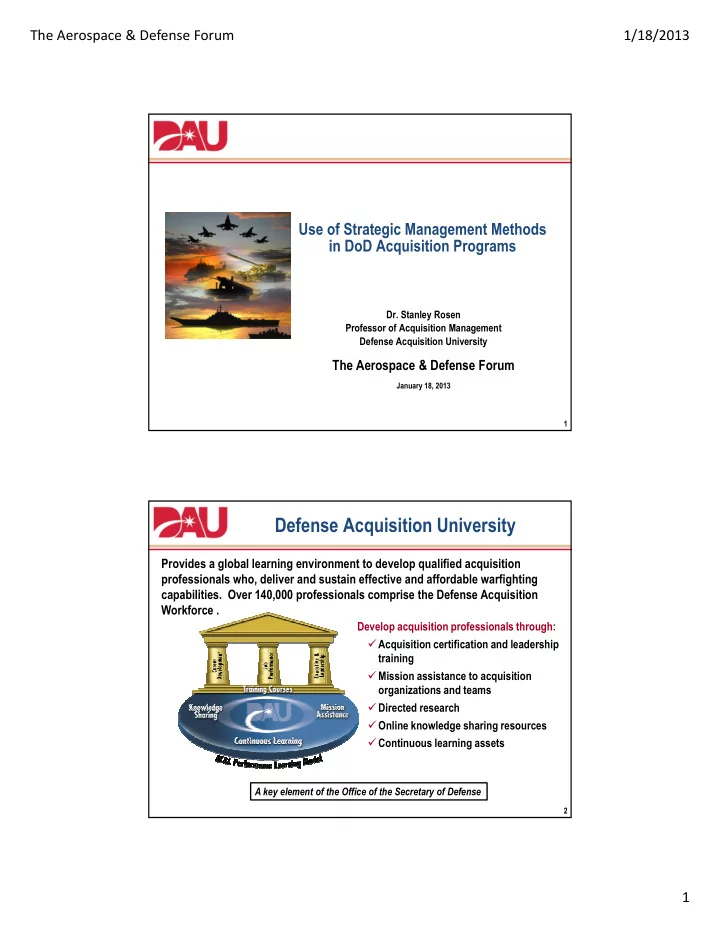
The Aerospace & Defense Forum 1/18/2013 Use of Strategic Management Methods in DoD Acquisition Programs Dr. Stanley Rosen P Professor of Acquisition Management f f A i iti M t Defense Acquisition University The Aerospace &


slide-1
SLIDE 1

The Aerospace & Defense Forum 1/18/2013 1

Use of Strategic Management Methods in DoD Acquisition Programs

  • Dr. Stanley Rosen

P f f A i iti M t

1

Professor of Acquisition Management Defense Acquisition University

The Aerospace & Defense Forum

January 18, 2013

Defense Acquisition University

Provides a global learning environment to develop qualified acquisition professionals who, deliver and sustain effective and affordable warfighting

  • capabilities. Over 140,000 professionals comprise the Defense Acquisition

W kf Workforce .

Develop acquisition professionals through: Acquisition certification and leadership training Mission assistance to acquisition

  • rganizations and teams

Directed research

2

Online knowledge sharing resources Continuous learning assets

A key element of the Office of the Secretary of Defense

slide-2
SLIDE 2

The Aerospace & Defense Forum 1/18/2013 2

Methodology Methodology Findings Findings Background Background Research Objective Research Objective

DAU Is Conducting Research to Determine DAU Is Conducting Research to Determine How Strategic Planning and Management How Strategic Planning and Management

Conclusions and Next Steps Conclusions and Next Steps

How Strategic Planning and Management How Strategic Planning and Management (SP&M) Most Effectively Supports Defense (SP&M) Most Effectively Supports Defense System Acquisition Program Success System Acquisition Program Success

3

DAU Research Has Identified How SP&M Practices are Being Used in Defense System Acquisition

  • How widely?
  • How well?
  • To what effect?
  • Best practices?

Definition: “Strategic Planning and Management helps organizations achieve more successful acquisition outcomes. The first part of the process is centered on strategic planning where managers jointly formulate their strategy. The second component, strategic management, addresses implementation of the strategic plan

4

implementation of the strategic plan. Strategic Planning and Management has the following key characteristics:

  • Positions the organization through strategy and capability planning.
  • Responds to real time strategic issues.
  • Tackles systematic management of resistance during strategic

Implementation.”

slide-3
SLIDE 3

The Aerospace & Defense Forum 1/18/2013 3

Implications for A&D Forum Members

  • Understand the strategic nature of major

defense acquisition programs defense acquisition programs

  • Understand the strategic challenges facing DoD

program managers and acquisition workforce

  • Understand the processes and tools DoD

program leaders use for strategic planning and management

5

management

  • Align company and program strategies and

actions with customer success criteria and management culture/methods

Methodology Methodology Findings Findings Background Background Research Objective Research Objective

Strategic Planning and Management is an Strategic Planning and Management is an Important Aspect of Public Sector and Important Aspect of Public Sector and

Conclusions and Next Steps Conclusions and Next Steps

Important Aspect of Public Sector and Important Aspect of Public Sector and Defense Acquisition Activity Defense Acquisition Activity

6

slide-4
SLIDE 4

The Aerospace & Defense Forum 1/18/2013 4

Strategic Planning Benefits Public Sector Organizations

  • Strategic planning offers many benefits to public sector
  • rganizations, including

– Promotion of strategic thinking, acting and learning g g, g g – Improved decision making – Enhanced organizational effectiveness, responsiveness and resilience – Improved organizational legitimacy – Direct benefit for the people involved

  • “Evidence indicates that when strategic planning is seen as

a practice that is improved by reason-based advice, it is

  • ne of the very useful ways in which imperfect people can

7

  • ne of the very useful ways in which imperfect people can

cope pretty well with …’insoluble’ problems.” » Bryson, Univ of Minnesota, Dec 2010, Public Administration Review

Strategic Management is a Proven Tool for Effective Government

Successful linkage of strategic visioning, long-range planning, budgeting and i l t ti h b d t t d implementation has been demonstrated

  • Promotes organizational and technological innovation

Large government agencies can use strategic management processes to powerful, positive, transforming effect

8

» Bryson, Univ of Minnesota, 2005, International Public Management Journal » Review of Preparing for the Future: Strategic Planning in the U.S. Air Force, Barzely and Campbell, 2003

slide-5
SLIDE 5

The Aerospace & Defense Forum 1/18/2013 5

Public Sector Strategic Planning and Management is Evolving

  • Strategic planning has become ubiquitous

in the public sector over the past 25 years

  • Evolving recognition that transition is

needed from strategic planning to the broader process of strategic management

– Effective strategy implementation – Ongoing rather than episodic – Focus on achieving strategic goals and

  • bjectives rather than on measurement

9

j – Performance monitoring informs strategy

» Poister, Georgia State Univ, Dec 2010 Public Administration Review

Situation

  • The Department of Defense is

responsible for effectively using t d ll t fi ld taxpayer dollars to field systems which enhance national security.

  • The Department is constantly

striving to find ways to improve performance.

10

– Budget reductions are prompting “doing more with no more”(at best) – Lessons learned from best practices are being emphasized (“Better Buying Power initiatives”)

slide-6
SLIDE 6

The Aerospace & Defense Forum 1/18/2013 6

Acquisition Programs are a Major Part of the Defense Department’s Budget

11

Acquisition Programs impact the entire DoD budget

Defense Systems Acquisition is a Strategic Activity

  • All system acquisitions

– Support organizational (and – Support organizational (and national) strategies – Have long-term implications – Help create the future

  • Major acquisitions

– Are key to organizational (and national) success

12

national) success – Employ significant resources – Command top-level oversight

We must apply the best strategic management tools and processes

slide-7
SLIDE 7

The Aerospace & Defense Forum 1/18/2013 7

Strategic Planning and Management is Key to Program Acquisition Success

  • Management challenges

– Program success Program success – Organizational success

  • Defense acquisition

programs and

  • rganizations must

succeed in a dynamic environment

13

– Requirements – Priorities – Resources – Challenges

Methodology Methodology Findings Findings Background Background Research Objective Research Objective

DAU Surveyed a Broad Cross DAU Surveyed a Broad Cross-

  • Section of

Section of Defense System Acquisition Executives Defense System Acquisition Executives

Conclusions and Next Steps Conclusions and Next Steps

y q y q

14

slide-8
SLIDE 8

The Aerospace & Defense Forum 1/18/2013 8

Survey Respondents are Well Qualified

How many total years have you used Strategic Planning and/or Strategic Management methodologies? How many years have you worked in acquisition management?

This group was eliminated from the survey data

15

Respondents come from a wide range of Army, Navy, Air Force and other Defense Department programs and acquisition organizations

  • 393 responded
  • 345 have SP&M experience

Respondents have Both Government and Non-Government Experience

Where is your experience in Strategic Planning and Management? Where is your experience in Strategic Planning and Management?

16

Surprisingly many DoD acquisition executives have private sector experience

slide-9
SLIDE 9

The Aerospace & Defense Forum 1/18/2013 9

Methodology Methodology Findings Findings Background Background Research Objective Research Objective

DAU Identified Key Aspects of Strategic DAU Identified Key Aspects of Strategic Planning and Management in the Defense Planning and Management in the Defense

Conclusions and Next Steps Conclusions and Next Steps

Planning and Management in the Defense Planning and Management in the Defense Acquisition Community Acquisition Community

17

Respondents Suggested Ways in Which Defense Acquisition SP&M Differs from Other Sectors

  • Clearly different
  • Not so clearly different

Are there SP&M considerations you think are unique in a Defense System Acquisition context? – Responsible to taxpayers – Purpose is national security, not profit- or market-driven

  • Sometimes performance must be

achieved at all costs

– Life-or-death implications, including nuclear – Influence of national politics – Unique federal regulations, – Often wide gap in understanding between top- and working-levels, coupled with micro- management and multi-level approvals – Must comply with specific guidance from

  • thers

– Often big dollars, long timelines, complex programs – Leadership shortcomings and inexperience – Uncertain contradictory and frequently

18

q g , policies and processes

  • Requirements
  • Budgeting and funding
  • Acquisition/procurement
  • Personnel management and

drawdown

Uncertain, contradictory and frequently changing

  • Funding
  • Policies
  • Priorities
  • Requirements
  • Threats

Success metrics and constraints provide unique SP&M challenges

slide-10
SLIDE 10

The Aerospace & Defense Forum 1/18/2013 10

Most Respondents’ Organizations Have a Strategic Plan

Does your organization have a strategic plan?

19

Strategic planning is widely practiced in the Defense Acquisition Community

SP&M is Used for Both Organizational and Program Improvement

How have you used your organization's strategic plan? How have you used Strategic Planning and/or Strategic Management methodologies in defense acquisition?

20

slide-11
SLIDE 11

The Aerospace & Defense Forum 1/18/2013 11

Respondents Value SP&M in Improving Program Outcomes

Overall, how would you rate Strategic Planning and Management methodologies in improving program Management methodologies in improving program management outcomes?

21

About a quarter of the respondents highly value SP&M (Likert 6 or 7)

Specific Benefits/Outcomes Associated with SP&M in Defense Systems Acquisition

22

slide-12
SLIDE 12

The Aerospace & Defense Forum 1/18/2013 12

Specific Benefits/Outcomes Associated with SP&M in Defense Systems Acquisition

  • More efficient execution of funds (+)
  • Improved personnel morale
  • Conserve resources by industry and
  • Reduces waste, lack of focus and

duplication of effort

  • Gives vector in highly distributed orgs

23

Conserve resources by industry and government working together

  • Team effectiveness
  • Helps solidify the resources toward a

common goal and priority taskings (+)

  • Better link to future requirements for POM

and resource planning

  • More knowledgeable workforce
  • Portrays the organization’s strategic

contributions to national defense Gives vector in highly distributed orgs

  • Increased focus on the important vice the

urgent

  • Direct, measurable bottom line results
  • Collaboration and coordination with other

PMA’s

  • Leadership
  • Provides a good roadmap
  • Prepares agencies during BRACs

Major Factors That Facilitate Effective Implementation of Strategic Plans

  • Leadership

– Vision – Follow through

  • Stakeholder/participant involvement

– Education – Buy-in

In your experience, what factors facilitate effective implementation of strategic plans?

Follow through – Commitment – Resources – Involvement/interest/ – Buy-in – Understanding – Communication – Implementation – Attitude

  • Not just a “check the box” effort
  • PM’s should take a long-term approach, not day-to-day

churn

y – Cooperation – Alignment – Open to change – Participation at all levels – Buy-in by middle management that help execute the plan’s implementation

  • Common understanding of the vision,

mission, strategic intent and strategy, based on clear, unifying goals and

  • bjectives

24

  • Management playing a part in the development of strategic

planning so that they will understand their roles, their employees’ roles and the importance of execution

  • Pressure from above to use the tools available to

effectively implement these processes

j

  • Communication

– Documented requirements – Priorities/issues/plans – Listen to everyone’s ideas – Leadership articulation of employees’ contribution – Clear format

These results aren’t too surprising, but are essential to keep in mind

slide-13
SLIDE 13

The Aerospace & Defense Forum 1/18/2013 13

Other Factors That Facilitate Effective Implementation of Strategic Plans

  • Proper training

– Knowledgeable workforce – Provide leadership classes

  • Effective teamwork
  • Cultural change

– Frequent use

In your experience, what factors facilitate effective implementation of strategic plans?

  • A full-time facilitator/in-house expert
  • Continuity

– Having a living document – Persistency, don’t change half way through – Transition into sustainment – Through leadership changes – Consistent direction

  • Good governance structure (objective
  • wners, quarterly reviews)
  • Appropriate, stable resources

– Time to commit to planning and implementation q – Constant monitoring and follow up

  • Attitude

– Open mindedness – Willingness to face the brutal facts

  • Perspective

– Understanding the value streams of the

  • rganization’s products and services

– Understanding global impacts, political climate and funding

  • Establishing executable processes upfront
  • Having a plan above you to lash up to

25

Time to commit to planning and implementation – Funding – Taking the time to do a good job (“When done properly, strategic plans can be very effective, but most managers/leaders get impatient”)

  • Direct impact to participants, with

incentives g p y p

  • Integration with other project management

disciplines

  • Direct measurable impact to the
  • rganization

– Making your customer successful

These results highlight best strategic management practices

Survey Results Indicate the Usefulness

  • f a Range of SP&M Tools -1
  • Most Useful (and how they are commonly used)

– Action plans

  • Establish priorities

Establish priorities

  • Clarify expectations

– Root cause analyses

  • Establish priorities
  • Lower cost

– Mission/strategy mapping

  • Align organization

– Brainstorming – Program analysis/assessment

  • Establish priorities

– Needs assessment

26

  • Establish priorities

– SWOT analyses

  • Establish priorities

– Stakeholder interviews

  • Clarify expectations

– Vision statements

  • Clarify expectations
  • Align organization

Ratings from Not Useful (1) to Very Useful (7)

slide-14
SLIDE 14

The Aerospace & Defense Forum 1/18/2013 14

Survey Results Indicate the Usefulness of a Range of SP&M Tools - 2

  • Least useful

– Company proprietary software – Force Field Analysis – Environmental scans(?)

  • But “Review of Regulatory

Environment” and “Review of Industry Trends” were more widely used

  • Other

– Scenario planning

27

– Balanced Scorecard – Process consultants – Industry experts/Futurists

The most useful tools were highly rated (Likert 6 & 7) by over 50% of respondents

Survey Results Indicate the Usefulness

  • f a Range of SP&M Tools - 3
  • Business intelligence
  • Winsight/Project

Other useful tools/approaches/processes mentioned ( + means multiple mention) [No particular order]

Business intelligence

  • Dashboards
  • Well-prepared offsites
  • Discovery-Driven Plan/Discovery-

Driven Growth

  • Army Strategic Management System

(++)

  • PoPs
  • Systems2Win, including LEAN and Six

Winsight/Project

  • QuickScore (Spyder Strategies)
  • CMMI
  • Quality Function Deployment
  • Design of Experiments
  • Bottom-to-top communication
  • Logistics elements review and

development

  • Hoshin planning (+)

28

y g Sigma tools (+++)

  • Continuous Process Improvement (+)
  • Objective risk-based threat/issue

assessments

  • Analysis of Alternatives tool (PMT 350)

(+)

  • 7 or 9 Step SDCA
  • X-matrix

Hoshin planning ( )

  • Risk Analysis
  • Issue- or Action Item-based program

management software

  • Project Management tools, practices

and processes

  • Contract negotiation consultants (+)
slide-15
SLIDE 15

The Aerospace & Defense Forum 1/18/2013 15

Survey Results Indicate the Usefulness

  • f a Range of SP&M Tools - 4
  • 8 Step Problem Solving

Other useful tools/approaches/processes mentioned ( + means multiple mention) [No particular order]

  • Business Case Analysis
  • 8-Step Problem Solving
  • DMAIC
  • Campaign Planning Process
  • POAM
  • Assumption/strategic risk analysis

(integrated with other project management disciplines)

  • Objectively assess value-added of

various DoD acquisition processes

  • Business Case Analysis
  • Theory of Constraints (+)
  • IDEFO
  • Current Reality Trees/Maps
  • Future Reality Trees/Maps
  • Injection Maps
  • Competencey-based

toolsets/planning processes (e.g. Lominger)

29

  • Organizational climate survey
  • OSPs
  • Pre-Requisite Trees
  • Conflict Diagrams
  • Root-Cause analysis (+)
  • Voice-of-the-Customer feedback

processes (e.g. Lominger)

Roadblocks to Effective SP&M -1

Ratings from Minor (1) to Major (7)

  • Biggest roadblocks

– Lack of time – Lack of management commitment – Lack of follow-up

L i b t till t bl

30

  • Less pressing but still notable

– Lack of expertise – Lack of funds – Lack of training – Ineffective tools

slide-16
SLIDE 16

The Aerospace & Defense Forum 1/18/2013 16

Roadblocks to Effective SP&M -2

  • Ineffective metrics
  • Senior leadership (PEO/PM) disagreement

about strategy

  • Use of inappropriate models (e.g. aircraft in

space acquisition)

  • Jaded members of the organization

Other roadblocks mentioned

gy

  • Lack of stakeholder /employee buy-in (+++)
  • Lack of business and organizational

management background and experience

  • Lack of senior level vision to require

strategic planning (+)

  • Getting commitment from assigned

personnel

  • Lack of personnel trained in acquisition

disciplines

  • Poor communication (+)

g (regarding strategic plans)

  • Unrealistic timelines
  • Working outside of “requirements”
  • Mid-management reluctance to change (not

“real work”)

  • Personnel commitment degradation due to

Congressional attitudes; low morale

  • Too many inefficient legacy processes
  • Unforeseen external drivers that derail

plans

31

  • Poor communication (+)
  • Lack of cohesive vision
  • Command attitude (crisis management,

don’t make waves, not invented here) (+)

  • Culture of “zero mistakes”
  • Management distraction
  • Unpredictable/erratic Congressional

budgetary direction

  • Contracting timelines

plans

  • Inability to match time, expertise and funds
  • Inadequate internal controls
  • Overwhelming burden of oversight &

reporting

  • Difficulty in tracking strategic improvement
  • Competition among orgs to “be the

solution”

  • Constant reorganization (Navy)

Usefulness of Selected Resources in the Successful Application of SP&M

Ratings from Not Useful (1) to

  • Most useful

– Internal staff – My own research – Funding

  • Somewhat useful

Very Useful (7)

32

– Communities of practice – Tool experts

  • Less useful

– External process consultants – External meeting facilitators Even for less-valued resources, 20% found them very useful (Likert 6 or 7)

slide-17
SLIDE 17

The Aerospace & Defense Forum 1/18/2013 17

Do you plan to use SP&M tools in the future?

33

The Defense acquisition community will continue to practice strategic planning and management

Are resources set aside for SP&M in the future?

34

Over two thirds of the community either have no resources committed or are unaware of resources committed to SP&M

slide-18
SLIDE 18

The Aerospace & Defense Forum 1/18/2013 18

With regard to Strategic Planning and Management, are you interested in:

35

There is significant interest in additional education and training on these topics.

Methodology Methodology Findings Findings Background Background Research Objective Research Objective

These Results Point to Significant These Results Point to Significant Opportunities to Strengthen Defense Opportunities to Strengthen Defense

Conclusions and Next Steps Conclusions and Next Steps

Opportunities to Strengthen Defense Opportunities to Strengthen Defense System Acquisition Management System Acquisition Management

36

slide-19
SLIDE 19

The Aerospace & Defense Forum 1/18/2013 19

Conclusions

  • SP&M is seen as valuable to Dept of Defense

system acquisition programs and organizations

  • High value activities, tools, processes and

practices have been identified

  • Roadblocks to effective SP&M can be

addressed

  • Leaders must understand the importance of

h i l

37

their role

  • Tool use and process training is needed

– Especially for senior leaders

  • Implementation assistance can be very useful

Case: USAF Space and Missile Systems Center

  • Strategic management led from office of the Commander (SMC/CC)

– Implementation leadership from SMC/XP (Strategic Plans and Programs) – All program and functional areas involved All program and functional areas involved

  • Clear mission and vision statements, which are widely

communicated

– Mission: Deliver resilient and affordable space capabilities for the nation – Vision: Be the most respected acquirer and sustainer of space systems

  • Goals clearly stated, championed and managed

– Projects regularly tracked Updated as appropriate (not just annually)

38

– Updated as appropriate (not just annually)

  • Result: Improved acquisition outcomes widely recognized, enabled

by

– Improved governance – Improved key internal processes – Better workforce management – Effective strategic communications

slide-20
SLIDE 20

The Aerospace & Defense Forum 1/18/2013 20

Implications for A&D Forum Members

  • Understand the strategic nature of major

defense acquisition programs defense acquisition programs

  • Understand the strategic challenges facing DoD

program managers and acquisition workforce

  • Understand the processes and tools DoD

program leaders use for strategic planning and management

39

management

  • Align company and program strategies and

actions with customer success criteria and management culture/methods

  • BACKUP

40

slide-21
SLIDE 21

The Aerospace & Defense Forum 1/18/2013 21

Abstract

  • The Department of Defense is responsible for effectively using taxpayer dollars to

field systems which enhance national security System Program Offices are field systems which enhance national security. System Program Offices are constantly striving to find ways to improve performance, and are in the middle of a major reset in their management processes. Effective strategic planning has been proven to improve program office effectiveness and is conducive to successful program management outcomes. However, many program offices do not effectively use strategic planning methods and many program managers are not sufficiently

41

trained in strategic planning and management skills. This presentation presents results of recent original research to determine how strategic planning most effectively supports successful defense acquisition program management. Imperatives and impediments will be identified.

SP&M Considerations Unique to [that Characterize] Defense Acquisition

  • Funding uncertainties
  • Strategic efforts directed towards budgeting

process and acquisition regulations

  • Unique political/legal/moral issues
  • Churn from Congress/budgets (+++++)
  • Safety issues

p q g

  • Lack of a profit motive (++++++++)
  • Constant policy changes (“acquisition

reform”)

  • Keep Soldiers, Sailors, Marines, Airmen at

the forefront when making decisions

  • Lack of leadership understanding of

financial management

  • Bad assumption that funds will always be

available

  • Not looking for market placement

Safety issues

  • Environmental issues
  • FAR/DFARS/Service FAR requirements (+)
  • Personnel drawdown
  • The needs of the military
  • How and what funding is used
  • How requirements are established
  • Certification requirements must be enforced
  • Little room for adequate deliberation in

reacting to directives

42

  • Not looking for market placement
  • Strict federal regulations
  • Increasing micro-management from

services and DoD

  • Many levels of review
  • Changing priorities in multi-year programs

(shipbuilding) (threats)(political ideologies)(++)

  • Leadership in DC has little idea of what we

do on a day to day basis reacting to directives

  • Need to use program’s technology insertion

roadmap

  • Flexibility is essential within DoD, although

the budgeting/planning process and budget volatility doesn’t allow much flexibility

  • Sometimes performance must be achieved

at all costs

  • Not market driven
slide-22
SLIDE 22

The Aerospace & Defense Forum 1/18/2013 22

SP&M Considerations Unique to [that Characterize] Defense Acquisition - 2

  • Don’t adequately measure and manage our

logistics interfaces

  • Driven by national security needs
  • Diversification of systems
  • Multiple/conflicting/changing

requirements (++) y y

  • Regulatory constraints (+++++)
  • Personnel policies
  • Procurement policies (+)
  • Budgetary environment/POM cycle (++)
  • Vision and external environment often

specified

  • Effective tools badly needed in current

fiscal situation

  • Impossible to develop viable plans that we

h ibilit f b t t th q ( )

  • Classified systems
  • Threat-based scenarios
  • Competing priorities with other programs
  • Management of nuclear force
  • Funding decreases while mission needs

stay the same or increase

  • Documentation requirements
  • PM not free to chose what to focus on
  • Strategic planning depends on ability to

43

have responsibility for, but not the associated authority or control of funding

  • Cumbersome bureaucracy
  • May need to support outdated technologies
  • Must respond to threat environment
  • DoD rules not always consistent with

commercial best practice

  • Reliance on other organizations to set

requirements, set strategic direction and control funding analyze user gaps, recommend solutions and influence the user/department in supporting and funding these solutions

  • SP is first to be cut
  • SP reduced to a check mark

consideration

  • Outside interference with long-term

plans

  • Very low production rates

SP&M Considerations Unique to [that Characterize] Defense Acquisition - 3

  • Congressional budget cycle that requires all

money be spent

  • JCIDS
  • Inability to manage the organization as

industry does creates internal system waste, overhead and unnecessary burden to d f d

  • Complex, long-term defense acquisition

process (+)

  • High dollars
  • Flexible environment
  • Policy /investment decisions based on

qualitative responses to political or financial climates, not quantitative evaluation

  • Unique budgeting process
  • Keeping combat readiness in the view of all

employees manage and fund

  • Political climate
  • War/ provide the warfighter appropriate

solutions to protect our national interests (+++)

  • Doing market research up front to

determine the real need for the product or service

  • Lack of movement of civilian leadership

prohibits growth/ no external experience

44

employees

  • Political implications and budgetary/legal

limitations can limit options being considered

  • Inexperienced DoD members interfacing

with more experienced industry peers

  • Budget cycles have too much influence on

leadership in the planning process

  • Lack of ability to bank on the funding being

provided in a timely fashion

  • Many dependencies
  • High level of complexity
  • Roadmaps extending to 25 years out

increase sustainment and life cycle costs

  • Usage of taxpayer dollars
slide-23
SLIDE 23

The Aerospace & Defense Forum 1/18/2013 23

Factors That Facilitate Effective Implementation of Strategic Plans

  • Leadership vision/follow through

/commitment/resources/involvement/interest/ buyin/understanding/communication/implement ation

  • Open mindedness
  • Application of appropriate resources (+)
  • Having a living document (++)

(++++++++++++++++++++++++++++++++++++++ +++++++++++++++++++++)

  • Common understanding of the mission
  • Clear, unifying goals and objectives (+++++)
  • Stakeholder/participant

involvement/education/buy-in/cooperation /open to change (+++++++++++++)

  • Workforce cooperation/alignment/

commitment/clear, shared vision (++++++)

  • Clear format

Having a living document (++)

  • Having a plan above you to lash up to
  • Time to commit to planning and

implementation

  • Transition into sustainment
  • PM’s should take a long-term approach, not

day-to-day churn

  • A full-time facilitator/in-house expert (+)
  • Proper training
  • Effective team

45

Clear format

  • Persistency , don’t change half way through(++)
  • Communication of priorities/issues/plans

(+++++++)

  • Leadership articulation of employees’

contribution

  • Not just a “check the box” effort
  • Good governance structure (objective owners,

quarterly reviews) (+)

  • Documented requirements
  • Continuity through leadership changes (+)
  • Listen to everyones’ ideas
  • Knowledgeable workforce
  • Teamwork
  • Long-term stable funding (++)
  • Consistent direction
  • Frequent use

Factors That Facilitate Effective Implementation of Strategic Plans -2

  • Cultural change
  • Constant monitoring and follow up (+)
  • Direct measurable impact to the
  • Management playing a part in the

development of strategic planning so that they will understand their roles, their l ’ l d h i f Direct measurable impact to the

  • rganization
  • Direct impact to participants with incentives
  • Making your customer successful
  • Understanding the value streams of the
  • rganization’s products and services
  • Understanding global impacts, political

climate and funding

  • Understanding intent of strategy
  • Establishing executable processes upfront

employees’ roles and the importance of execution

  • Pressure from above to use the tools

available to effectively implement these processes

  • Buy-in by middle management that help

execute the plan’s implementation

  • Face the brutal facts
  • Integration with other project management

disciplines

46

  • Provide leadership classes
  • Taking the time to do a good job (“When

done properly, strategic plans can be very effective, but most managers/leaders get impatient”)

  • Participation at all levels
  • Metrics
  • Strategic plan should flow to action plans,
  • bjective/goal deployment, metrics,
slide-24
SLIDE 24

The Aerospace & Defense Forum 1/18/2013 24

Key SP&M Principles Apply to Defense Acquisition Management

  • Ownership by the leadership
  • Organizational buy-in

Organizational buy in

  • Long term vision
  • Clarity of mission and values
  • Self awareness
  • Environmental awareness
  • Competitive assessments

Understand scenarios

47

  • Understand scenarios
  • Develop alternative strategies backward and forward
  • Establish and use criteria to select strategic course
  • Effectively measure and manage implementation

Application of SP&M Principles to Defense Systems Acquisition

  • Ownership by the leadership

– Support from Congress, POTUS, OSD, service leaders, etc is essential

  • Organizational buy-in

g y

– Implementers (program office, contractor community, OT&E, etc) must “own” the approach

  • Long term vision

– Clarity regarding the program’s contribution and how it will change conditions

  • Clarity of mission and values

– Essential throughout the acquisition community: Why do we exist

  • Self awareness

– Internal strengths and weaknesses of the acquisition community. Not all organizations are identical

  • Environmental awareness

– Understanding of factors that promote the program and threaten it’s success

  • Competitive assessments

48

p

– Threats drive requirements and competitors threaten program continuity (dynamic)

  • Understand scenarios

– Prepare for changing circumstances

  • Develop alternative strategies backward and forward

– Acquisition strategy alternatives

  • Establish and use criteria to select strategic course

– Define baseline acquisition strategy

  • Effectively measure and manage implementation

– Acquisition metrics and assignment tracking