Defending Patents in IPR Proceedings Leveraging Motions to Amend and - - PowerPoint PPT Presentation

defending patents in ipr proceedings
SMART_READER_LITE
LIVE PREVIEW

Defending Patents in IPR Proceedings Leveraging Motions to Amend and - - PowerPoint PPT Presentation

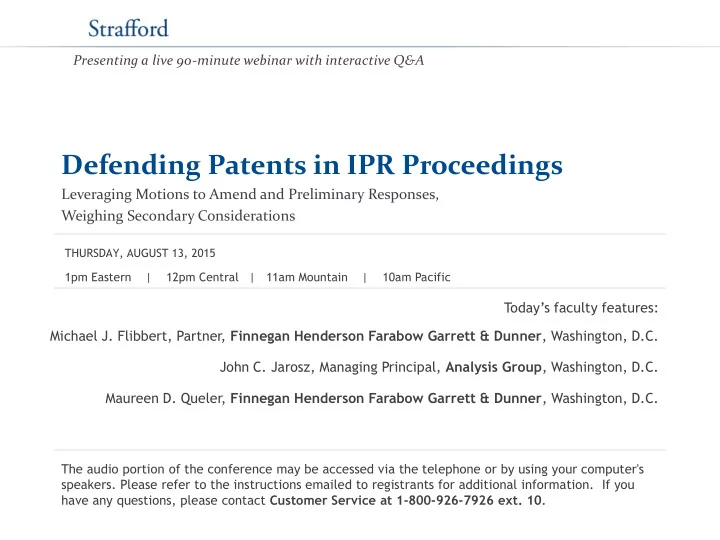
Presenting a live 90-minute webinar with interactive Q&A Defending Patents in IPR Proceedings Leveraging Motions to Amend and Preliminary Responses, Weighing Secondary Considerations THURSDAY, AUGUST 13, 2015 1pm Eastern | 12pm


slide-1
SLIDE 1

The audio portion of the conference may be accessed via the telephone or by using your computer's

  • speakers. Please refer to the instructions emailed to registrants for additional information. If you

have any questions, please contact Customer Service at 1-800-926-7926 ext. 10.

Defending Patents in IPR Proceedings

Leveraging Motions to Amend and Preliminary Responses, Weighing Secondary Considerations

Today’s faculty features:

1pm Eastern | 12pm Central | 11am Mountain | 10am Pacific THURSDAY, AUGUST 13, 2015

Presenting a live 90-minute webinar with interactive Q&A Michael J. Flibbert, Partner, Finnegan Henderson Farabow Garrett & Dunner, Washington, D.C. John C. Jarosz, Managing Principal, Analysis Group, Washington, D.C. Maureen D. Queler, Finnegan Henderson Farabow Garrett & Dunner, Washington, D.C.

slide-2
SLIDE 2

Tips for Optimal Quality

Sound Quality If you are listening via your computer speakers, please note that the quality

  • f your sound will vary depending on the speed and quality of your internet

connection. If the sound quality is not satisfactory, you may listen via the phone: dial 1-866-819-0113 and enter your PIN when prompted. Otherwise, please send us a chat or e-mail sound@straffordpub.com immediately so we can address the problem. If you dialed in and have any difficulties during the call, press *0 for assistance. Viewing Quality To maximize your screen, press the F11 key on your keyboard. To exit full screen, press the F11 key again.

FOR LIVE EVENT ONLY

slide-3
SLIDE 3

Continuing Education Credits

In order for us to process your continuing education credit, you must confirm your participation in this webinar by completing and submitting the Attendance Affirmation/Evaluation after the webinar. A link to the Attendance Affirmation/Evaluation will be in the thank you email that you will receive immediately following the program. For additional information about CLE credit processing call us at 1-800-926-7926

  • ext. 35.

FOR LIVE EVENT ONLY

slide-4
SLIDE 4

Finnegan, Henderson, Farabow, Garrett & Dunner, LLP

Strafford Webinar

August 13, 2015

Michael J. Flibbert michael.flibbert@finnegan.com

Defending Patents in IPR Proceedings

slide-5
SLIDE 5

5

5

Petition Filed PO Preliminary Response Decision

  • n

Petition PO Response & Motion to Amend Claims Petitioner Reply to PO Response & Opposition to Amendment PO Reply to Opposition to Amendment Oral Hearing Final Written Decision 3 months no more than 3 months 3 months 3 months 1 month Hearing Set

No more than 12 months

IPR Overview

PO Discovery Period Petitioner Discovery Period PO Discovery Period Observations & Motions to Exclude

slide-6
SLIDE 6

6

6

IPR Statistics- Technology Breakdown FY 2015

928 64% 343 23% 68 5% 113 8% 4 0%

Electrical/Computer Mechanical/Business Method Chemical Bio/Pharma Design

slide-7
SLIDE 7

7

7

IPR Statistics- Institution Rate

*http://www.uspto.gov/sites/default/files/documents/aia_statistics_04-30-2015.pdf

Joined 7% Denied 25% Instituted 68%

slide-8
SLIDE 8

8

8

IPR Statistics- Outcome

*http://www.aiablog.com/claim-and-case-disposition/

slide-9
SLIDE 9

9

9

IPR Statistics- Substitute Claim Outcome

*http://www.aiablog.com/claim-and-case-disposition/

slide-10
SLIDE 10

10

10

Patent Owner Preliminary Response

Petition Filed PO Preliminary Response 3 months

  • 37 C.F.R. § 42.107
  • Respond to proposed grounds of

unpatentability in Petition

  • No new testimony beyond that of record except as

authorized by Board

  • No deposition of Petitioner’s expert at this stage
  • Can file other non-testimonial evidence (e.g., prosecution

declarations, declarations from EP opposition, literature)

  • Can request motion for additional discovery relating to

real party-in-interest

slide-11
SLIDE 11

11

11

Patent Owner Preliminary Response

* http://www.uspto.gov/sites/default/files/documents/2015-06-30%20PTAB.pdf

  • Response optional: “patent owner may file a preliminary

response”

slide-12
SLIDE 12

12

12

Patent Owner Preliminary Response

  • Reasons to file:

– Statutory time bar: 35 U.S.C. §315(b)

  • Time bar applies even if complaint was before enactment of AIA (IPR2014-

00008)

  • Time applies even if there is a subsequent amendment in reexamination –

statute refers to the patent, not the claims (IPR2013-00315)

  • Time bar includes counterclaims for infringement (IPR2013-00258)
  • Time bar does not apply if the complaint is dismissed without prejudice

(IPR2013-00312; also IPR2012-00004)

  • Time bar does apply if complaint is dismissed WITH prejudice (IPR2013-00168)

– Narrow grounds instituted

  • Redundancy
  • Improper anticipation grounds
slide-13
SLIDE 13

13

13

Patent Owner Preliminary Response

  • Reasons to file:

– Incorrect or omitted claim construction

  • Symantec Corp. v. RPost Communications Ltd., IPR2014-00357,

Paper 14 at 10, 14 (PTAB July 15, 2014) (claims not anticipated because proposed construction was overly broad)

– Missing claim elements in proposed obviousness or anticipation grounds

  • 35 U.S.C. § 312(a)(3)- requires an IPR petition to identify with

particularity the grounds on which the challenge is based, and the evidence supporting those grounds

slide-14
SLIDE 14

14

14

Patent Owner Preliminary Response

  • Reasons to file:

– Failure to address reasonable expectation of success

  • BioGatekeeper, Inc. v. Kyoto Univ., IPR2014-01286, Paper 12 at

6-8 (PTAB Feb. 11, 2015) (denying institution because the petition failed to establish that one of ordinary skill would have had a reasonable expectation of success in achieving the claimed combination)

– Failure to name all real parties-in-interest – Failure to address prosecution history evidence of unexpected results or other secondary considerations of nonobviousness

slide-15
SLIDE 15

15

15

Patent Owner Preliminary Response

  • Reasons to file:

– Conclusory / unsupported expert declaration

  • Kinetic Techs., Inc. v. Skywork Solutions, Inc., IPR 2014-00529,

Paper 8 at 15 (PTAB Sept. 23, 2014) (“Merely repeating an argument from the Petition in the declaration . . . does not give that argument enhanced probative value.”).

  • TRW Automotive US LLC v. Magna Elecs., Inc., IPR2014-00258,

Paper 18 at 10-11 (PTAB Aug. 27, 2014) (finding Petitioner’s

  • bvious-to-try rationale unsupported and giving little weight to the

expert declaration because it simply repeated TRW’s conclusory statements verbatim)

– Reliance on non-prior art

slide-16
SLIDE 16

16

16

Patent Owner Preliminary Response

  • Reasons to file:

– Reliance on non-prior art

  • The petitioner has the burden to establish that a reference is a

printed publication under 35 U.S.C. § 311(b). Cisco Sys., Inc. v. Constellation Techs. L.L.C., IPR2014-01085, Paper 11 at 9 (PTAB Jan. 9, 2015)

  • LG Elecs., Inc. v. Advanced Micro Devices, Inc., IPR2015-00329,

Paper 13 at 13 (PTAB July 10, 2015) (holding that date printed on face of reference did not establish that it was published on that date)

  • Because institution decisions must be based on information in the

petition, deficiencies cannot be remedied later. Actavis, Inc. v. Research Corp. Techs., Inc., IPR2014-01126, Paper 22 at 13 (PTAB Jan. 9, 2015) (citing 35 U.S.C. § 314(a))

slide-17
SLIDE 17

17

17

Patent Owner Preliminary Response

  • Reasons to file:

– The Board’s discretion to deny “follow-on” petitions

  • Conopco, Inc. dba Unilever v. The Proctor & Gamble Co.,

IPR2014-00628, Paper 23 at 4-6 (March 20, 2013)

  • Allowing petitioners to strategically unveil the best prior art and

arguments in serial petitions would tax Board resources and force patent owners to defend multiple attacks

– No right of appeal of institution decisions

  • 35 U.S.C. §319 - A party dissatisfied with a final written decision

may appeal

  • St. Jude Medical, Cardiology Division, Inc. v. Volcano

Corporation, 749 F.3d 1373 (Fed. Cir. 2014)

slide-18
SLIDE 18

18

18

Patent Owner Preliminary Response

  • Reasons to consider not filing:

– High institution rate (~68%) – No expert support allowed in Patent Owner preliminary response – Claim construction not final in institution decision – Gives petitioner 5+month lead on your arguments – Depose Petitioner’s expert without revealing theory of case

slide-19
SLIDE 19

19

19

Experts

  • Consider testifying and consulting experts
  • Deposition testimony is key

– Good witness is key due to role of depositions

  • Retain experts early (even if not filing patent owner

preliminary response)

– Technical experts and commercial success experts – Identify and engage technical expert early to vet arguments for preliminary response – Confer with in-house scientists to identify expert candidates

slide-20
SLIDE 20

20

20

Institution Decision

  • Timing of institution is panel-dependent
  • Scheduling order will issue with Institution Decision
  • 10 days from Institution - file objections to evidence in

Petition (e.g., hearsay, authentication)

PO Preliminary Response Decision

  • n

Petition no more than 3 months

  • 37 C.F.R. § 42.108 and 35 U.S.C. § 314
  • Institution is discretionary
  • Standard: “reasonable likelihood”
slide-21
SLIDE 21

21

21

Patent Owner Response

  • Respond to grounds of unpatentability in institution

decision with arguments, technical literature, and expert declarations

  • Provide claim construction positions if disagree with

PTAB

  • Strengthen evidence of unexpected results with expert

declarations

  • Establish commercial success and long-felt need with

expert declarations

  • Antedate prior art if possible
slide-22
SLIDE 22

22

22

Secondary Considerations

  • Obviousness is resolved based on factual determinations

including: (1) the scope and content of the prior art; (2) any differences between the claimed subject matter and the prior art; (3) the level of skill in the art; and (4) where in evidence, so-called secondary considerations. See, e.g. IPR 2013-00004, Final Decision at 14 (citing Graham v. John Deere Co., 383 U.S. 1, 17-18 (1966)).

Applied by PTAB in IPRs and CBMs:

slide-23
SLIDE 23

23

23

Commercial Success

  • “Commercial success involves establishing success in the

marketplace of a product encompassed by the claims and a nexus between the commercial product and the claimed invention.” (IPR2012-00006, Final Decision at 34; IPR2013-00097, Final Decision at 45)

What is commercial success?

slide-24
SLIDE 24

24

24

Commercial Success

  • “Commercial success is relevant because the law presumes

an idea would successfully have been brought to market sooner, in response to market forces, had the idea been

  • bvious to persons skilled in the art.”

Merck & Co., Inc. v. Teva Pharmaceuticals USA, Inc., 395 F.3d 1364, 1376–77 (Fed. Cir. 2005)

Theory:

slide-25
SLIDE 25

25

25

Legal Elements of Commercial Success

  • Commercial Success: patented product or process

has a substantial share of a definable market. See In re Huang, 100 F.3d 135, 140 (Fed. Cir. 1996). Nexus: a legally and factually sufficient connection between the success and the patented invention. Demaco Corp. v. F. Von Langsdorff Licensing Ltd., 851 F.2d 1387 (Fed. Cir. 1988). To date, the Board has rejected commercial success arguments in almost every case in which the issue was raised

slide-26
SLIDE 26

26

26

Burden of Proof at PTAB

  • Original Claims:
  • In an IPR, the Petitioner has the burden to prove a

proposition of unpatentability by a preponderance of the

  • evidence. 35 U.S.C. § 316(e)

Motion to Amend:

  • For a motion to amend, the Patent Owner has the burden

to show entitlement to the relief requested. 37 C.F.R. § 42.20(c)

slide-27
SLIDE 27

27

27

PTAB Timing

  • Patent Owners:
  • Argue commercial success in Preliminary Response?
  • No expert declarations allowed
  • Gives petitioner head start on attack
  • Patent Owner Response: only 3 months or less to

respond after institution

  • Start early: Consider commercial success soon after

receiving petition (before institution)

  • What experts needed?
  • What analysis needed to show market share and nexus?
  • Discovery needed? (own documents? public documents?

discovery from petitioner?)

slide-28
SLIDE 28

28

28

Termination

  • Termination of IPR proceedings

– 37 C.F.R. § 42.74(a) – The Board is not a party to settlement and may independently determine any question of patentability – Board considers whether issues have been fully briefed (IPR 2013-00016)

  • Appeal

– If party does not make, use, or sell the patented invention there may be no standing to appeal inter partes reexamination decision (Consumer Watchdog v. Wisconsin Alumni Research Found., 753 F.3d 1258 (Fed. Cir. 2014))

slide-29
SLIDE 29

29

29

Appeal

  • Standard of Review:

– Factual findings are reviewed under the substantial evidence standard of review – Legal conclusions are reviewed de novo – If you are successful at PTAB: focus on the facts and substantial evidence supporting the Board’s final decision – If you are unsuccessful at the PTAB: focus on the harmful legal error in the Board’s final decision

  • Affirmance rate

– Historically reverses less than 15% of cases originating from the PTO – Rule 36 judgment is likely (from Feb 2015 – June 2015, eight out of ten affirmances of IPRs/CBMs were Rule 36 judgments)

slide-30
SLIDE 30

30

30

Speaker Information

Mike Flibbert is a partner is Finnegan’s Washington, DC

  • ffice and chairs the firm’s chemical practice group. He

represents clients in patent disputes before federal district courts and the Federal Circuit and also serves as lead counsel in IPR and other contested proceedings before the Patent Trial and Appeal Board of the U.S. Patent and Trademark Office. He lectures frequently in the United States and abroad on patent law topics, including the America Invents Act (AIA).

slide-31
SLIDE 31

31

31

Disclaimer

These materials have been prepared solely for educational and entertainment purposes to contribute to the understanding of U.S. intellectual property law. These materials reflect only the personal views of the authors and are not individualized legal advice. It is understood that each case is fact specific, and that the appropriate solution in any case will

  • vary. Therefore, these materials may or may not be relevant to any

particular situation. Thus, the authors, Finnegan, Henderson, Farabow, Garrett & Dunner, LLP (including Finnegan Europe LLP, and Fei Han Foreign Legal Affairs Law Firm) cannot be bound either philosophically or as representatives of their various present and future clients to the comments expressed in these materials. The presentation of these materials does not establish any form of attorney-client relationship with these authors. While every attempt was made to ensure that these materials are accurate, errors or omissions may be contained therein, for which any liability is disclaimed.

slide-32
SLIDE 32

Commercial Success at the PTAB

Strafford CLE Webinar

August 13, 2015 John C. Jarosz jjarosz@analysisgroup.com

slide-33
SLIDE 33

33

STRAFFORD CLE WEBINAR SERIES – JOHN JAROSZ ■ AUGUST 13, 2015

Commercial Success – Economic Considerations

1) Is the product that embodies the patented invention a marketplace success? 2) Is the success of the product due to the patent (causal nexus)?

slide-34
SLIDE 34

34

STRAFFORD CLE WEBINAR SERIES – JOHN JAROSZ ■ AUGUST 13, 2015

1) Product Success

a) Absolute Performance b) Relative Performance

slide-35
SLIDE 35

35

STRAFFORD CLE WEBINAR SERIES – JOHN JAROSZ ■ AUGUST 13, 2015

a) Absolute Performance

  • Shipments
  • Revenues
  • Prices
  • Costs
  • Profits
slide-36
SLIDE 36

36

STRAFFORD CLE WEBINAR SERIES – JOHN JAROSZ ■ AUGUST 13, 2015

b) Relative Performance

  • Definition of market/competition

a)Product b)Geographic

  • Significance of market share

a)Over time b)Versus Benchmark

slide-37
SLIDE 37

37

STRAFFORD CLE WEBINAR SERIES – JOHN JAROSZ ■ AUGUST 13, 2015

a) Absolute Performance

slide-38
SLIDE 38

38

STRAFFORD CLE WEBINAR SERIES – JOHN JAROSZ ■ AUGUST 13, 2015

a) Absolute Performance

Refill Percentages

slide-39
SLIDE 39

39

STRAFFORD CLE WEBINAR SERIES – JOHN JAROSZ ■ AUGUST 13, 2015

b) Relative Performance

Product 1 Product 2 Product 3

slide-40
SLIDE 40

40

STRAFFORD CLE WEBINAR SERIES – JOHN JAROSZ ■ AUGUST 13, 2015

b) Relative Performance

Brand Product 1 Generic Product Brand Product 2

slide-41
SLIDE 41

41

STRAFFORD CLE WEBINAR SERIES – JOHN JAROSZ ■ AUGUST 13, 2015

b) Relative Performance

Shipments Product 1 Product 2 Product 3 Product 4 Product 5 Product 6

slide-42
SLIDE 42

42

STRAFFORD CLE WEBINAR SERIES – JOHN JAROSZ ■ AUGUST 13, 2015

2) Causal Nexus

a) Features/Advantages of Patent b) Importance of Patented Features/Advantages c) Importance of Non-Patented Features/Advantages

slide-43
SLIDE 43

43

STRAFFORD CLE WEBINAR SERIES – JOHN JAROSZ ■ AUGUST 13, 2015

a) Features/Advantages of Patent

  • Patent Claims
  • Prior Art
  • Technical Opinion
slide-44
SLIDE 44

44

STRAFFORD CLE WEBINAR SERIES – JOHN JAROSZ ■ AUGUST 13, 2015

b) Importance of Patented Features/Advantages

  • Internal Marketing Materials
  • External Promotional Materials
  • Industry Praise
  • Company Testimony/Declarations
  • Customer Testimony/Declarations
  • Revealed Preferences
  • Party Actions
  • Licenses
  • Copying
  • Consumer Studies/Surveys
  • Contemporaneous
  • Made for Litigation
slide-45
SLIDE 45

45

STRAFFORD CLE WEBINAR SERIES – JOHN JAROSZ ■ AUGUST 13, 2015

b) Importance of Patented Features/Advantages

slide-46
SLIDE 46

46

STRAFFORD CLE WEBINAR SERIES – JOHN JAROSZ ■ AUGUST 13, 2015

b) Importance of Patented Features/Advantages

slide-47
SLIDE 47

47

STRAFFORD CLE WEBINAR SERIES – JOHN JAROSZ ■ AUGUST 13, 2015

b) Importance of Patented Features/Advantages

slide-48
SLIDE 48

48

STRAFFORD CLE WEBINAR SERIES – JOHN JAROSZ ■ AUGUST 13, 2015

c) Importance of Non-Patented Features/Advantages

  • Product Features
  • Non-Product Features
  • Price
  • Promotion
  • Brand Name
  • Custom
slide-49
SLIDE 49

49

STRAFFORD CLE WEBINAR SERIES – JOHN JAROSZ ■ AUGUST 13, 2015

c) Importance of Non-Patented Features/Advantages

slide-50
SLIDE 50

50

STRAFFORD CLE WEBINAR SERIES – JOHN JAROSZ ■ AUGUST 13, 2015

slide-51
SLIDE 51

51

STRAFFORD CLE WEBINAR SERIES – JOHN JAROSZ ■ AUGUST 13, 2015

PTAB Final Written Decisions

September 2012 – April 2015

  • 80: Discussion of commercial success
  • 78: Inadequate proof of commercial success
  • 2: Adequate proof of commercial success
  • Intri-PlexTechnologies, Inc. and MMI Holdings, Ltd. v. Saint-Gobain Performance Plastics Rencol Limited,

IPR2014-00309, March 23, 2015

  • Redline Detection, LLC v. Star Envirotech, Inc., IPR2013-00106, June 30, 2014
slide-52
SLIDE 52

52

STRAFFORD CLE WEBINAR SERIES – JOHN JAROSZ ■ AUGUST 13, 2015

PTAB Final Written Decisions

September 2012 – April 2015

  • 80: Discussion of commercial success
  • 78: Inadequate proof of commercial success
  • 2: Adequate proof of commercial success
  • Intri-PlexTechnologies, Inc. and MMI Holdings, Ltd. v. Saint-Gobain Performance Plastics Rencol Limited,

IPR2014-00309, March 23, 2015

  • Redline Detection, LLC v. Star Envirotech, Inc., IPR2013-00106, June 30, 2014
slide-53
SLIDE 53

Finnegan, Henderson, Farabow, Garrett & Dunner, LLP

Strafford Webinar

August 13, 2015

Maureen D. Queler maureen.queler@finnegan.com

Defending Patents in IPR Proceedings

slide-54
SLIDE 54

54

54

Evidence

  • Patent Owner can readily introduce evidence of its
  • wn commercial success (IPR2013-00333, Paper 30)
  • When would Patent Owner need discovery?

− Petitioner is an alleged infringer whose sales would show commercial success

  • IPR2014-00367: Petitioner sold parts to Whirlpool. Patent Owner

alleged that parts fell within claims and that Petitioner’s sales were substantial

− Patent Owner’s claimed invention is a component of Petitioner’s product

slide-55
SLIDE 55

55

55

Routine Discovery

  • Routine Discovery
  • Exhibits cited in paper or testimony
  • Inconsistent positions (file with document with

inconsistency) (e.g., claim constructions from litigation)

  • Cross-examination of declarant
slide-56
SLIDE 56

56

56

Additional Discovery

  • Not Part of Routine Discovery:
  • Petitioner need not produce evidence of commercial success as

relevant information inconsistent with positions advanced in Petition (IPR2013-00333, Paper 30)

Additional Discovery:

  • Interest of justice standard. See 35 U.S.C.§316(a)(5)(B)
  • Garmin factors (IPR2012-00001, Paper 20 at 2-3)

– (1) more than possibility that useful information will be discovered; – (2) not seeking litigation positions; – (3) information not available through other means; – (4) easily understandable instructions; and – (5) not overly burdensome to answer.

slide-57
SLIDE 57

57

57

Discovery

  • (1) more than possibility that useful information will be

discovered

  • “favorable in substantive value to a contention of the

moving party.”

  • Commercial Success:

− As practical matter, need well-developed commercial success position to obtain any discovery − IPR2014-00367, Paper 20

  • To obtain sales data from Petitioner, Patent Owner had to

show some evidence of significant sales in relevant market

  • To obtain evidence regarding Petitioner’s product, Patent

Owner had to show some evidence that product met claims

slide-58
SLIDE 58

58

58

Discovery

  • (1) more than possibility that useful information will be

discovered

  • Real Party-in-Interest

− 77 Fed. Reg. 48,760: funding and control of IPR petition, non- party’s relationship with the petitioner, relation to petition, degree

  • f involvement in filing

− Threshold amount of evidence or reasoning needed to show that discovery is in the interests of justice.

  • Evidence of existing indemnity agreement?
  • Evidence from district court of relationship between non-

party and Petitioner?

slide-59
SLIDE 59

59

59

Evidence

  • 37 C.F.R. § 42.62

The Federal Rules of Evidence applies to IPR proceedings

Authentication (FRE 901): proponent must produce evidence sufficient to support a finding that the item is what the proponent claims it is. Hearsay (FRE 801-803): prohibits out-of-court statements from being

  • ffered to prove the truth of the matter asserted
slide-60
SLIDE 60

60

60

Evidence-Considerations

  • What evidence are you submitting?
  • Who can authenticate that evidence?

− Any self-authenticating evidence? (FRE 902) (periodicals, newspapers, public records)

  • Any hearsay statements within that evidence?

− Are they being relied upon for the truth of the matter asserted? − Can you submit a declaration from the speaker? − Litigation v. IPR: fewer depositions in IPR proceedings; may cause more authentication/hearsay disputes

slide-61
SLIDE 61

61

61

Evidence-Commercial Success

  • Market share data:

− Declaration by custodian or person that generated data to authenticate the data − Declaration by expert analyzing that data − Can expert analyzing the data do both?

  • Statements of physicians on nexus for drug patent

− Could be hearsay unless submitted as part of declaration − An authentic document (newspaper) may still have hearsay issues (out-of-court statement by physician praising drug)

slide-62
SLIDE 62

62

62

Evidence-Antedating

  • Authentication v. Corroboration

− Authentication: Witness having personal knowledge of the document can be sufficient to support document’s authenticity. FRE 901(a) − Corroboration: proof of conception must be made by evidence corroborating inventor’s testimony. Coleman v. Dines, 754 F.2d 353, 359 (Fed. Cir. 1985). − Inventor cannot authenticate documents intended to corroborate

  • testimony. Avoids “circular” situations.

− Chen v. Bouchard, 347 F.3d 1299, 1308 (Fed. Cir. 2003); IPR2013-00578 (Paper 52)

  • Hearsay v. Corroboration

− Do statements only have corroborating value if they are true? Then they are hearsay. IPR2013-00578 (Paper 52)

slide-63
SLIDE 63

63

63

Evidentiary Objections

  • 37 C.F.R. § 42.64

(b) Other evidence. For evidence other than deposition evidence: (1) Objection. Any objection to evidence submitted during a preliminary proceeding must be served within ten business days of the institution of the trial. Once a trial has been instituted, any

  • bjection must be served within five business days of service of

evidence to which the objection is directed. The objection must identify the grounds for the objection with sufficient particularity to allow correction in the form of supplemental evidence.

slide-64
SLIDE 64

64

64

Schedule of Proceedings

Objections to Petition Evidence (10 days) Objections to Evidence (5 days)

slide-65
SLIDE 65

65

65

Evidentiary Objections / Motion to Exclude

  • Timing

– Objections: 10 business days after institution of trial for preliminary

proceeding or 5 business after evidence served

– Supplemental evidence: 10 business days after objection – Board encourages parties to try to work through issues – Motion to exclude: Set time in schedule, prior authorization not

necessary

  • Not for credibility, weight of expert testimony, or
  • utside of scope
  • Must have basis for objection in Federal Rules of

Evidence

slide-66
SLIDE 66

66

66

Printed Publication

  • Distinct sufficiency of evidence and authentication issues
  • Sufficiency: did the Patent Owner submit sufficient evidence

to show that this prior art was a printed publication before the patent’s critical date?

– Raise this issue in substantive papers (Preliminary Response)

  • Authentication: is there evidence that this document is what

it purports to be?

– Raise this issue in objections / motion to exclude – Webpage printout relied on for the contents: “[t]o authenticate printouts from a website, the party proffering the evidence must produce some statement or affidavit from someone with knowledge

  • f the website . . . a web master or someone else with personal

knowledge would be sufficient.” IPR2013-00084 (Paper 64)

slide-67
SLIDE 67

67

67

Patent Owner’s Motion to Amend

  • Include on Motions List
  • Conference call with the Board is required before filing

 No need to identify full claim set  Outline proposed claim substitutions, acknowledge guidelines, ask for guidance as necessary

  • Exemplary Guidelines:

 IPR2012-00005, Paper 27 (Nichia)  IPR2013-00027, Paper 26 (Idle Free)  IPR2015-00040, Paper 42 (MasterImage)

  • 37 C.F.R. § 42.121: A patent owner may file one motion to

amend a patent, but only after conferring with the Board.

− Additional motions to amend may only be filed with authorization.

slide-68
SLIDE 68

68

68

Patent Owner’s Motion to Amend

  • High bar: IPRs are not an examination; Patent Owner has

burden to prove patentability

 Finnegan achieved grant of only the fourth Motion to Amend to be granted by the PTAB ever. (REG v. Neste Oil, IPR2014-00192)

slide-69
SLIDE 69

69

69

Patent Owner’s Motion to Amend

  • Distinguish over prior art

 Idle Free Systems (IPR2012-00027 Paper 26): patent owner to show patentable distinction over the prior art of record and also prior art known to the patent owner  MasterImage 3D, Inc. (IPR2015-00040 Paper 42) further clarified this decision  Prior art of record:

  • any material art in the prosecution history of the patent;
  • any material art of record in the current proceeding, including art

asserted in grounds on which the Board did not institute review; and

  • any material art of record in any other proceeding before the

Office involving the patent.

 Prior art known: material prior art made of record pursuant to duty of candor and good faith. 37 C.F.R § 42.11.

slide-70
SLIDE 70

70

70

Patent Owner’s Motion to Amend

  • Identify section 112 written description support
  • Provide claim construction support
  • Consider intervening rights and patent term extension

implications

slide-71
SLIDE 71

71

71

Patent Owner’s Motion to Amend

  • Only a reasonable number of substitute claims
  • Amendments must be responsive to ground of unpatentability
  • Claims must include / narrow the challenged claims
  • Remodeling of claims- purview of reexamination/reissue
  • Contingency

 Contingent: if the claims were found patentable the motion would be denied as the contingency would not have come to pass.  Not Contingent: if the claims were found patentable the Board could still decide to address the motion and amend or add new claims.

slide-72
SLIDE 72

72

72

Confidentiality / Protective Orders

  • Standard protective order

– 77 Fed. Reg. 48771 (“Default Protective Order”) – Changes must be redlined compared to this default

  • Broadly written to encompass any employee of either party,

who signs agreement

– Do not try a litigation-based PO

  • Acknowledgement

– Party Representatives (aka “us”) need to sign – Expert Acknowledgement requires more – execute but not filed or served?

  • Protective order expires 45 days after decision
slide-73
SLIDE 73

73

73

Confidentiality / Protective Orders

  • Address at Initial Conference (Board may ask)
  • Address when comes up (e.g., at deposition)
  • Motion to Seal

– File a motion to seal with protective order – Explain why the information is confidential. – File redacted/public copy of document – Filing cross-examination testimony, may need other party to provide you with reason (ask them to prepare the papers)

slide-74
SLIDE 74

74

74

Finnegan Resources

  • AIA blog: http://www.aiablog.com/
  • Federal Circuit IP Blog: federalcircuitipblog.com
  • http://www.finnegan.com/publications/updatenewsl

etters/

– Full Disclosure Patent Newsletter – IP Marketplace Newsletter

slide-75
SLIDE 75

75

75

Speaker Information

Maureen Queler practices all aspects of patent-related work in the chemical and pharmaceutical areas, including client counseling, patent prosecution, post-grant proceedings, and U.S. district court and appellate

  • litigation. She represents clients in IPR and other

contested proceedings before the PTAB. She also has an active patent prosecution and counseling practice, preparing and prosecuting U.S. patent applications on behalf of domestic and foreign clients.

slide-76
SLIDE 76

76

76

Disclaimer

These materials have been prepared solely for educational and entertainment purposes to contribute to the understanding of U.S. intellectual property law. These materials reflect only the personal views of the authors and are not individualized legal advice. It is understood that each case is fact specific, and that the appropriate solution in any case will

  • vary. Therefore, these materials may or may not be relevant to any

particular situation. Thus, the authors, Finnegan, Henderson, Farabow, Garrett & Dunner, LLP (including Finnegan Europe LLP, and Fei Han Foreign Legal Affairs Law Firm) cannot be bound either philosophically or as representatives of their various present and future clients to the comments expressed in these materials. The presentation of these materials does not establish any form of attorney-client relationship with these authors. While every attempt was made to ensure that these materials are accurate, errors or omissions may be contained therein, for which any liability is disclaimed.